






Git-native memory for coding agents
Open, git-native memory your team's coding agents read and write together. Every lesson an agent learns becomes a file in your repo: versioned in git, reviewed in pull requests, shared across the whole team. Kage checks each one against your code, so deleted and stale citations get caught before they mislead anyone.
$ npx -y @kage-core/kage-graph-mcp install
One command sets up everything, then restart your agent. Or just tell your agent:
Set up Kage in this repo (https://github.com/kage-core/Kage): run npx -y @kage-core/kage-graph-mcp install, then tell me to restart you.
100/100 trust benchmark ·
0 dependencies ·
no account, no API key ·
free & open source —
or try it before installing anything: npx -y @kage-core/kage-graph-mcp scan --project .
Kage · savings receiptexample week
412Ktokens saved
this week≈ $6.18
Recalls served from memory38
Stale memories caught & withheld4
Hallucinated citations rejected2
Caller questions answered from the graph11
your numbers, from your repo · kage gains or the viewer's live feed
How it works
One command creates repo memory, builds the code graph, and auto-wires every agent on your machine.
Learnings become packets — explicit or auto-distilled — and every citation is verified against your repo before it's written.
A "previously…" digest opens each session; verified memory is injected the moment the agent reads a cited file.
kage pr check warns when your change invalidates team memory — before the PR lands.
Capture — with proof
Learnings become packets as the agent works — explicitly, or auto-distilled from the session with a signal gate. Every citation is validated against your repo before it's written. A memory citing a file that doesn't exist is refused on the spot.
gotcha09:24
Don't merge the retry paths — one uses idempotency keys ✓ citations verified · src/payments/retry.ts · fingerprinted
decision09:41
Auth uses jose, not jsonwebtoken — CVE in the transitive dep ✓ citations verified · src/auth/session.ts · fingerprinted
refused09:52
"Use the helper in src/ghost.ts" ✗ rejected on write — no such path in this repo
stale10:05
Legacy retry helper is the fallback ⊘ withheld from recall — cited file deleted since capture
Recall — already warm
A "previously…" digest and a timeline of recent memory open each session automatically — and when the agent reads a file, verified packets citing that file are injected right then. Each recall prints the receipt.
SessionStart · injected~800 tokens
# Previously (Kage) Working on: payment retry consolidation Learned: retry paths must stay separate (gotcha, 2d) Drafts awaiting review: 1 · kage inbox # Recent memory [a3f9c2e1] gotcha retry paths — idempotency keys (2d) [7b21d4f8] decision auth uses jose, not jsonwebtoken (5d) [e8c50a93] runbook npm test --prefix mcp before release (1w) ↳ saved ~12K tokens vs re-reading source
Catch — before it merges
No other memory tool does this: when your change invalidates what the team knows, kage pr check says so — in the same review as the code, with the fix one command away.
⚠ Your changes invalidated 2 team memories
Auth uses jose, not jsonwebtoken cites src/auth/session.ts — file changed in this diff fix: kage reverify --packet auth-jose · or kage supersede
Webhook retries are capped at 3 cites src/webhooks/retry.ts — constant removed fix: kage learn (update) — then this warning disappears
Sync — no account
Personal memory lives in ~/.kage/memory and syncs over a private git remote you own. Conflicts resolve newest-wins with both versions kept — and synced packets are re-verified against the local checkout before any recall trusts them.
git@github.com:you/kage-memory.git● synced · 2 machines
kage syncyour remote, your keys
$ kage sync
pushed 2, pulled 1, resolved 0
$ kage learn --personal --learning "Always run the full suite before releasing"
✓ captured · personal · re-verified on every machine
Compare
Capture-everything memory solves remembering. Kage solves trusting what's remembered — and a memory system that never re-verifies its own claims gets less trustworthy the longer you use it.
Already running claude-mem? Audit your existing store — read-only, no account: npx -y @kage-core/kage-graph-mcp audit-claude-mem classifies every observation as verified, drifted, gone, or unciteable.
Proof
Most memory tools benchmark recall. Kage benchmarks the thing that matters when an agent acts: whether the memory can be trusted. Run it yourself; every number traces to a logged event.
kage benchmark --trust 0 deps · no API key
Trust score: 100/100  (PASS)
  Hallucinated-citation rejection: 100%
  Stale-memory exclusion:          100%
  Live grounding rate:              99%
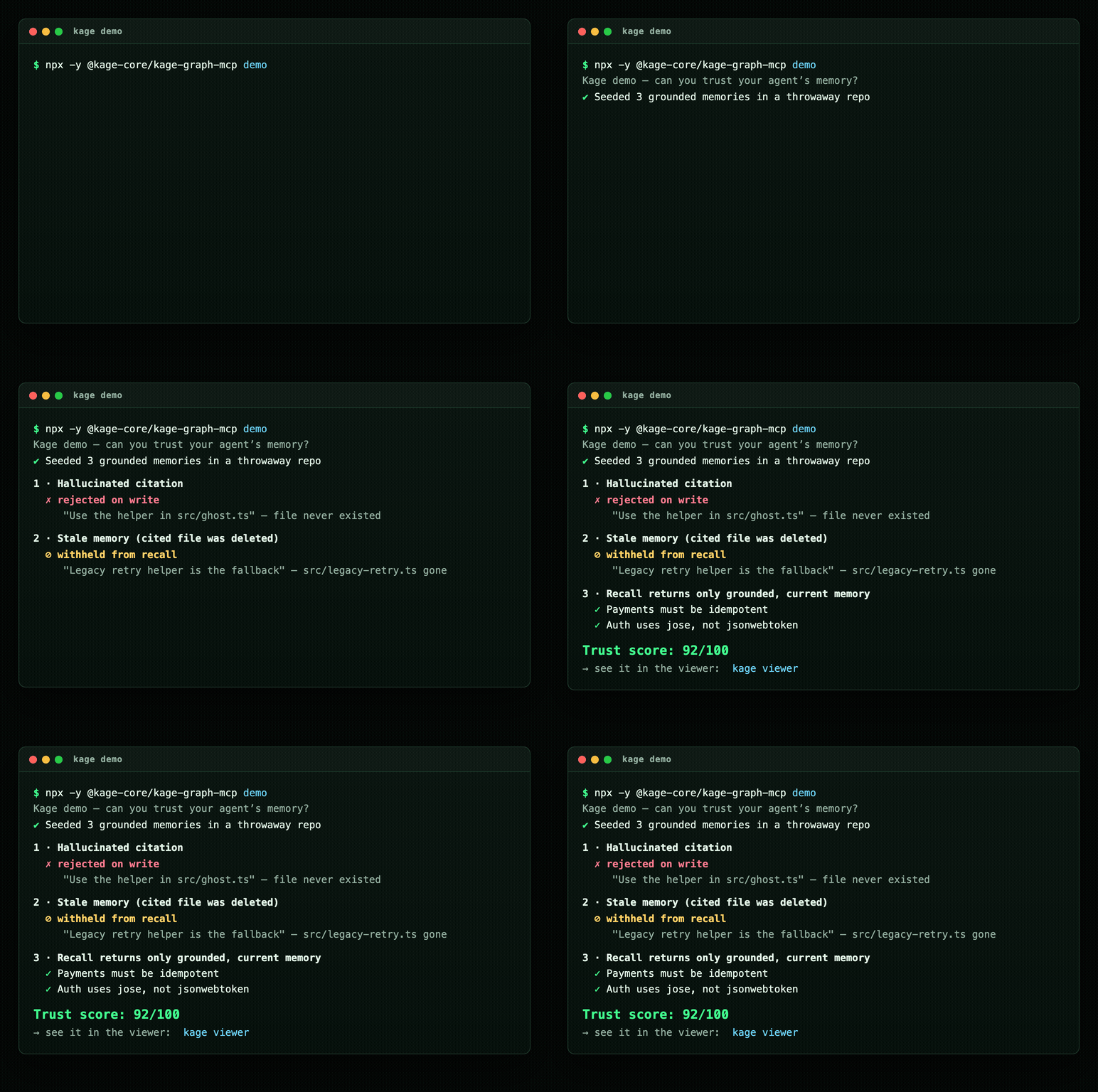
See what your own repo is hiding first: npx -y @kage-core/kage-graph-mcp scan --project .
Early users
Kage is days old in its current form — we'd rather show you a blank wall than fake quotes. These three spots belong to the first teams who run it.
"Your quote here — after we run the Truth Report on your repo, live."
— First design partner · book the demo
"Your quote here — after the first stale-catch saves your PR."
— Second design partner · book the demo
"Your quote here — after a week of receipts."
— Third design partner · book the demo
Used everywhere
kage install auto-detects and wires everything on your machine. Claude Code users can also /plugin marketplace add kage-core/Kage.
Claude Code Codex Cursor Windsurf Gemini CLI Cline Goose Roo Code Kilo Code OpenCode Aider Claude Desktop Copilot OpenClaw Hermes any MCP client
100/100trust benchmark — hallucination & staleness
0 depsno API key, no database, no daemon
348tests passing on every release
Git-nativememory reviewed in the same PR as code


Pricing
The open-source core is complete on its own — verification, receipts, sync over your own git remote. Local-first, private by default: secrets are scanned out and <private>…</private> is never stored.
$0 forever
Everything on this page: verified memory, Truth Report, receipts, auto-capture, repair, live viewer, 15 agents, kage sync over your own private git remote. No account, no API key.
$0 early access
Memory that follows you: your packets on every machine behind one private MCP link — verification stays client-side, so the cloud never sees your code.
Join the waitlist
Coming soon
Shared team memory with review gates — the same PR-reviewed trust model, hosted. Early design partners shape it.
Early access
The open-source core installs in 60 seconds. Kage Cloud — memory on every machine behind one private MCP link — is rolling out to the waitlist first.
Waitlist is one click on GitHub — 👍 or comment to join. Demos are 30 minutes, your repo, live. Or skip the line: install the open-source core now.
此内容由惯性聚合(RSS阅读器)自动聚合整理,仅供阅读参考。 原文来自 — 版权归原作者所有。