


A semantic query workbench for structured data.
Reckoner lets you query any dataset by meaning — not by column name, table structure, or JOIN logic. Drop in a CSV or connect a database. Ask questions in plain semantic terms. Get results in milliseconds with a full execution trace showing exactly how the answer was found.
Built on SNF (Semantic Normalized Form) and the Portolan planner.
See it running
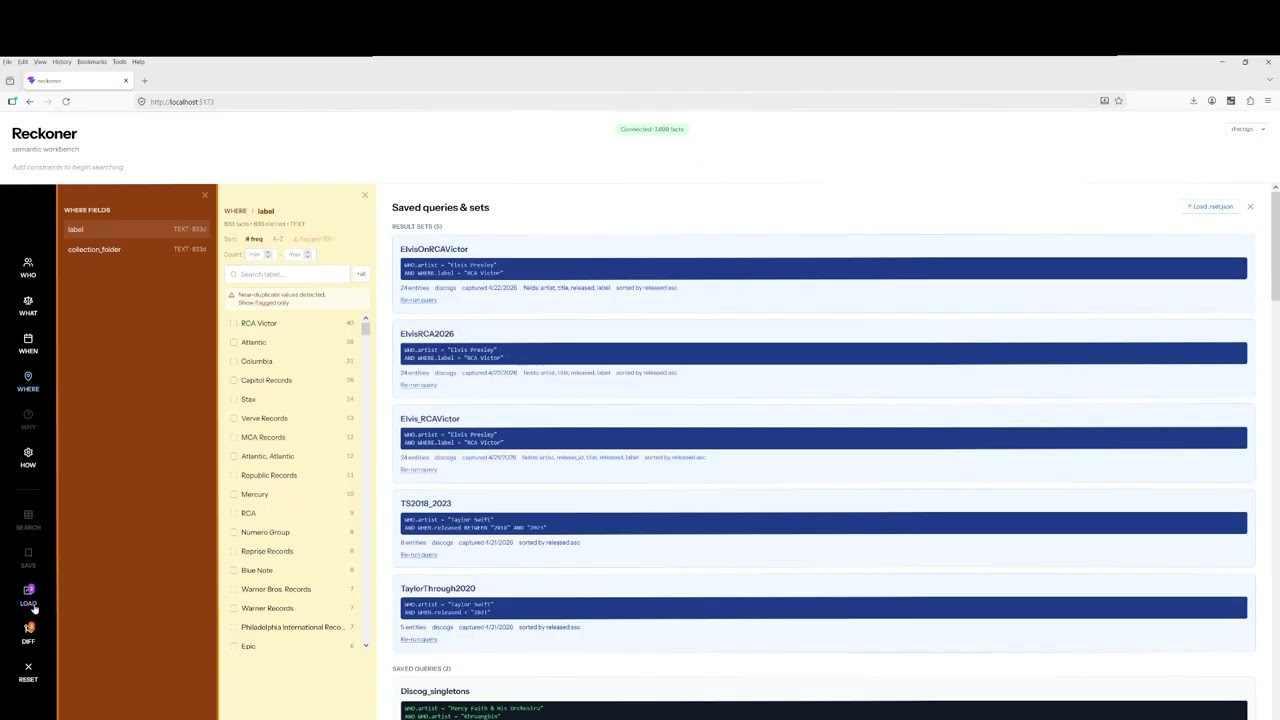
A record collection, a data quality catch, a diff between two named sets, and a substrate switch. 5 minutes. No setup required to watch.
What it looks like
You have a record collection. You want everything by Miles Davis released between 1955 and 1965 on Blue Note. In Reckoner:
WHO   artist     = "Miles Davis"
WHEN  released   BETWEEN "1955" AND "1965"
WHERE label      = "Blue Note"
Results appear in ~5ms. The trace shows:
PROBE 1.2ms   EXEC 3.8ms   TOTAL 5.0ms
WHO artist "Miles Davis"  →  anchor  52
WHEN released 1955–1965   →  14
WHERE label "Blue Note"   →  6
6 of 52 entities matched  88% skipped
The same workbench works on a law firm's matter database, a library catalog, a film archive, court opinions, or any structured dataset you can describe in terms of who, what, when, where, why, and how.
Requirements
- Python 3.10+
- Node.js 18+
- pip, npm
Optional (for live Postgres sources):
- PostgreSQL 14+
Quickstart — try the demo datasets in 5 minutes
This gets you running with the three demo substrates that ship in this repo. You can explore everything Reckoner does without loading your own data first.
1. Clone and install
git clone https://github.com/peirce-lang/reckoner
cd reckoner
pip install -r requirements.txt
npm install
2. Start the backend
python reckoner_api.py
You should see:
============================================================
  Reckoner API — Python backend
  Model Builder endpoints: /api/mb/*
============================================================
[registry] Loaded discogsv1: 833 entities ...
[registry] Loaded disney: 659 entities ...
[api] Model Builder endpoints loaded at /api/mb
3. Start the frontend
Open a second terminal:
cd reckoner
npm run dev
You should see:
VITE v5.x.x  ready

  Local:   http://localhost:5173/
4. Open Reckoner
http://localhost:5173
Your first query — do this exactly
1. In the top-right dropdown, select discogsv1
2. Click WHO in the left sidebar → click artist → type Miles Davis → click his name
3. Click WHEN → click released → set range 1955 to 1965
You should see a small set of results with a trace like:
PROBE 1.2ms   EXEC 3.8ms   TOTAL 5.0ms
WHO artist "Miles Davis"  →  anchor  52
WHEN released 1955–1965   →  6
6 of 52 entities matched  88% skipped
Now remove the WHEN constraint (click the × on the chip).
Watch what happens: the result set grows, the trace updates, the skipped % drops.
That's the core of what Reckoner does — each constraint permanently narrows the candidate set. Adding and removing constraints changes the shape of the answer in real time.
Bring your own data — Model Builder
(You do not need this to try Reckoner. Use the demo datasets above first.)
To load your own CSV, Excel file, or Postgres table, you'll also need snf-model-builder — the browser wizard that prepares data for Reckoner. It's a separate repo with the wizard frontend; the Python backend it talks to is already running inside reckoner_api.py (the same backend you started above).
Setup
Clone snf-model-builder next to your reckoner folder:
# from wherever you cloned reckoner — clone the wizard alongside it
cd ..
git clone https://github.com/peirce-lang/snf-model-builder
cd snf-model-builder
npm install
After this you should have two folders side by side:
your-projects/
├── reckoner/
└── snf-model-builder/
Start the wizard
With python reckoner_api.py already running (from the Quickstart above), open a third terminal:
cd snf-model-builder
npm run dev
You should see:
VITE v5.x.x  ready

  Local:   http://localhost:5174/
Open http://localhost:5174 — that's the Model Builder wizard.
Load your data — six steps
- Drop a CSV or Excel file (or connect directly to a Postgres table)
- Map your columns to semantic dimensions (WHO / WHAT / WHEN / WHERE / WHY / HOW)
- Review pre-ingest flags — variant candidates, null coverage, singletons
- Declare a nucleus — the column (or combination) that uniquely identifies each row
- Name your dataset and pick a target (DuckDB for local use)
- Compile → download the
.duckdbfile → drop it inreckoner/substrates/→ restartreckoner_api.py
Your data is queryable in under an hour. No schema authoring. No code required.
Demo datasets
The substrates/ folder ships with:
| Dataset | Entities | Source |
|---|---|---|
discogsv1 |
833 records | Discogs collection export |
disney |
659 films | Disney filmography |
shibuya |
103 items | Shibuya Publishing catalog |
To use the Discogs demo with your own collection:
- Export your Discogs collection as CSV (Discogs → Collection → Export)
- Open Model Builder at
http://localhost:5174 - Drop the CSV — columns are auto-mapped
- Compile and add to
substrates/
Connecting to Postgres
Reckoner connects to live Postgres substrates via .env:
cp .env.example .env
Edit .env:
PG_HOST=localhost
PG_PORT=5432
PG_DATABASE=your_database
PG_USER=your_user
PG_PASSWORD=your_password
Postgres substrates are built by running the SNF views script produced by Model Builder against your database. See snf-model-builder for the SQL path.
What Reckoner does
Boolean routing — every constraint is a posting list intersection. No full table scans. No query planner hints required.
Portolan planner — probes live cardinalities before executing. Anchors on the most selective constraint. The shrinking board: each constraint permanently reduces the candidate set. 98% skipped is normal.
Execution trace — every query shows probe time, execution time, step-by-step cardinality reduction, and the exact constraints that matched each result.
Admissibility checking — contradictory constraints are caught before execution. You see VALID / REWRITE / REJECT with a plain English explanation, not an empty result set.
Export — CSV, XLSX, JSON, Parquet. Row-level selection before export. Query provenance travels with the data.
Set operations — Diff (A − B), Union (A ∪ B), Intersect (A ∩ B), Join (A ⋈ B).
The six dimensions
| Dimension | Meaning | Examples |
|---|---|---|
| WHO | People, organizations, agents | artist, author, attorney, publisher |
| WHAT | Things, topics, identifiers | title, subject, ISBN, format |
| WHEN | Dates, times, periods | released, date_filed, year |
| WHERE | Places, locations, jurisdictions | label, office, city, country |
| WHY | Reasons, types, purposes | genre, matter_type, classification |
| HOW | Methods, formats, conditions | medium, condition, version |
These are not philosophical categories — they are operational coordinates. A record collection, a law firm's matters, a library catalog, and a film archive all have WHO and WHAT and WHEN. The dimensions are the common ground that makes any dataset queryable the same way.
Repository layout
After cloning, this repo looks like:
reckoner/
├── src/                     ← React frontend
│   ├── ReckonerSNF.jsx
│   ├── TrieValuePanel.jsx
│   ├── ResultCard.jsx
│   └── main.tsx
├── substrates/              ← drop .duckdb files here
├── reckoner_api.py          ← Python backend (FastAPI)
├── model_builder_api.py     ← Model Builder router (mounted into reckoner_api.py)
├── postgres_adapter.py      ← Postgres substrate adapter
├── duckdb_adapter.py        ← DuckDB substrate adapter
├── .env.example             ← copy to .env for Postgres
├── requirements.txt
├── package.json
└── vite.config.js
If you also clone snf-model-builder (for loading your own data), put it next to reckoner/ — both READMEs assume that layout:
your-projects/
├── reckoner/                ← this repo
└── snf-model-builder/       ← the wizard frontend (companion repo)
Third-party clients
The Model Builder API contract (/api/mb/ endpoints) is stable as of v1.0. Third-party clients — native apps, CLI tools, VS Code extensions — are welcome and encouraged. Clients that talk to the local API are not subject to AGPL. See snf-model-builder for the full API spec.
License
AGPL-3.0. See LICENSE.
Part of the peirce-lang ecosystem.