惯性聚合 高效追踪和阅读你感兴趣的博客、新闻、科技资讯
阅读原文 在惯性聚合中打开

推荐订阅源

爱范儿
爱范儿
Security Latest
Security Latest
NISL@THU
NISL@THU
OSCHINA 社区最新新闻
OSCHINA 社区最新新闻
C
Cybersecurity and Infrastructure Security Agency CISA
Cloudbric
Cloudbric
T
Threat Research - Cisco Blogs
大猫的无限游戏
大猫的无限游戏
C
CXSECURITY Database RSS Feed - CXSecurity.com
阮一峰的网络日志
阮一峰的网络日志
freeCodeCamp Programming Tutorials: Python, JavaScript, Git & More
雷峰网
雷峰网
C
Cisco Blogs
V
Vulnerabilities – Threatpost
S
Security Archives - TechRepublic
V
Visual Studio Blog
让小产品的独立变现更简单 - ezindie.com
cs.AI updates on arXiv.org
J
Java Code Geeks
D
Darknet – Hacking Tools, Hacker News & Cyber Security
Know Your Adversary
Know Your Adversary
博客园 - 叶小钗
腾讯CDC
钛媒体:引领未来商业与生活新知
钛媒体:引领未来商业与生活新知
P
Privacy International News Feed
P
Palo Alto Networks Blog
博客园_首页
V
V2EX
WordPress大学
WordPress大学
Schneier on Security
月光博客
月光博客
博客园 - 司徒正美
Google DeepMind News
TaoSecurity Blog
TaoSecurity Blog
博客园 - 聂微东
酷 壳 – CoolShell
酷 壳 – CoolShell
人人都是产品经理
人人都是产品经理
奇客Solidot–传递最新科技情报
奇客Solidot–传递最新科技情报
博客园 - 【当耐特】
The Cloudflare Blog
罗磊的独立博客
美团技术团队
N
News | PayPal Newsroom
K
KPMG report finds enterprise disconnect between AI and its ROI | CIO
Last Week in AI
Last Week in AI
K
Kaspersky official blog
Google Online Security Blog
S
SegmentFault 最新的问题
Application and Cybersecurity Blog
T
Tailwind CSS Blog

又见苍岚

COLMAP PatchMatch Stereo 算法详解 事件驱动的状态机框架:从理论到工程实践 Git 在国内网络环境下无法 Push 的排查与修复 —— 配置 Clash 代理 分段五次多项式插值原理详解 路径插值方法深度对比研究 Claude Code 使用指南 OpenClaw 记忆管理与技能创建指南 CBS(Conflict-Based Search)算法详解 A* 算法及其变种详解 OpenClaw 配置多 Agents Windows Powershell 无法加载文件,因为在此系统上禁止运行脚本问题的解决方案 MaxClaw 安装流程 大模型 AI 名词介绍 AList 网盘聚合工具简介 Protobuf 简介与测试 Claude Code 简介以及 GLM 4.7 模型接入 Github 歌词下载工具 163MusicLyrics Python __getattr__ 懒加载 Python TypedDict 机器人仿真平台 Gazebo 安装记录 机器人仿真平台 Gazebo 简介 多机器人路径规划问题(Multi-Agent Path Finding, MAPF)简介 Python exifread 读取修改过的 jpeg 信息错误问题修复 3D 坐标系变换的理解 3D 旋转矩阵基本概念 MongoDB Compass 介绍 Python 环境管理工具 uv Flutter 开发指南 Snipaste 安装下载与黑屏问题解决方案 全局路径规划算法记录 2025 Python 版本性能测试 Flutter Hello World Flutter 安装环境配置 Ubuntu VMware 硬盘扩容后 SMBus Host controller not enabled 报错问题解决 Python NetworkX 教程 Docker GPU 报错 - Failed to initialize NVML Unknown Error 解决方案 Python matplotlib 图表绘制 cuda-toolkit 安装替代 Cuda 与 Cudnn Jinja2 Python 利用 docxtpl 和 Jinja2 生成基于模板的 Word 文档 Docker 实现 CPU 核心隔离 LoFTR 基于 Transformer 的特征提取匹配算法 OmniGlue 特征匹配 SuperGlue 使用图神经网络学习特征匹配 Ubuntu 下将 xlsx 文件按照 sheet 转换为 图片 Python 使用 SQLAlchemy Python FastAPI 教程 openwrt 软路由配置安装 Nav2 地图文件(PGM/YAML)规范标准 3D OBJ 模型转换为 glb 瓦片格式 Python 源码 Redis 数据库介绍 Ubuntu 22.04 内核自动升级导致 MongoDB 7.0.12 错误记录 ubuntu 20.04 安装 ROS Noetic ubuntu 18.04 安装 ROS Melodic VMware Workstation Pro 个人免费版下载、安装、使用指南 Hybrid A-star 路径规划 Reeds-Shepp 曲线 Dubins 曲线 Linux kvm 虚拟机网络不通的问题解决方法 Ubuntu 自动内存清理 BiliBili 缓存视频转 mp4 Python 求解线性规划 3D Gaussian Splatting 官方源码实践记录 ImageMagick 教程 Ubuntu 22.04 安装 Colmap 对数几率 odds Ubuntu nmcli 网络管理工具使用指南 SuperPoint 自监督深度学习特征点提取 SyncTV Music Tag Web 在线音乐信息整理工具 ncm 格式转 mp3 MusicBrainz 音乐元数据百科数据库 Ubuntu 网络流量监控工具 私人云音乐平台 Navidrome 入门 手眼标定 四元数(Quaternions) OHTTPS 实现免费自动 https 证书申请、更新、部署 ubuntu 22.04 安装 CloudCompare 单机 KVM 虚拟机冷迁移 Ubuntu 22.04 使用 mdadm 实现软 raid 小鱼 一键安装 ROS-humble Fluid -46- 基于 Simpletex API 构建公式识别页面 公式识别 API 简介 -- Simpletex 使用 Python web 部署库 waitress 3D Gaussian Splatting for Real-Time Radiance Field Rendering Ubuntu Swap 简介与空间扩展 Ubuntu 24.04 安装 forticlient Clash Verge 使用 MongoDB 7.0.17 集群 Docker 构建源码 Error code - 2013. Lost connection to MySQL server during query 问题解决 Python 日志记录库 loguru 使用指北 Python 实现 Web 日志查看服务 MySQL LOAD DATA LOCAL INFILE 极速数据加载 Image size exceeds limit of 89478485 pixels 解决方案 Docker 使用 NVIDIA GPU 驱动错误解决 阿里云 docker 镜像仓库 Ubuntu中没有wired connected的解决方案 MinIO 简介 subconverter 代理订阅格式转换 修复 node –openssl-legacy-provider is not allowed in NODE_OPTIONS 错误
PyTorch 学习 -10- 利用模型块快速搭建复杂网络
Yiwei Zhang · 2023-07-23 · via 又见苍岚

本文最后更新于:2024年5月11日 下午

上一节中我们介绍了怎样定义PyTorch的模型,其中给出的示例都是用torch.nn中的层来完成的。这种定义方式易于理解,在实际场景下不一定利于使用。当模型的深度非常大时候,使用Sequential定义模型结构需要向其中添加几百行代码,使用起来不甚方便。

参考 深入浅出PyTorch ,系统补齐基础知识。

本节目录

  • 利用上一节学到的知识,将简单层构建成具有特定功能的模型块
  • 利用模型块构建复杂网络

对于大部分模型结构(比如ResNet、DenseNet等),我们仔细观察就会发现,虽然模型有很多层, 但是其中有很多重复出现的结构。考虑到每一层有其输入和输出,若干层串联成的”模块“也有其输入和输出,如果我们能将这些重复出现的层定义为一个”模块“,每次只需要向网络中添加对应的模块来构建模型,这样将会极大便利模型构建的过程。

本节我们将以U-Net为例,介绍如何构建模型块,以及如何利用模型块快速搭建复杂模型。

U-Net 简介

U-Net 是分割 (Segmentation) 模型的杰作,在以医学影像为代表的诸多领域有着广泛的应用。U-Net模型结构如下图所示,通过残差连接结构解决了模型学习中的退化问题,使得神经网络的深度能够不断扩展。
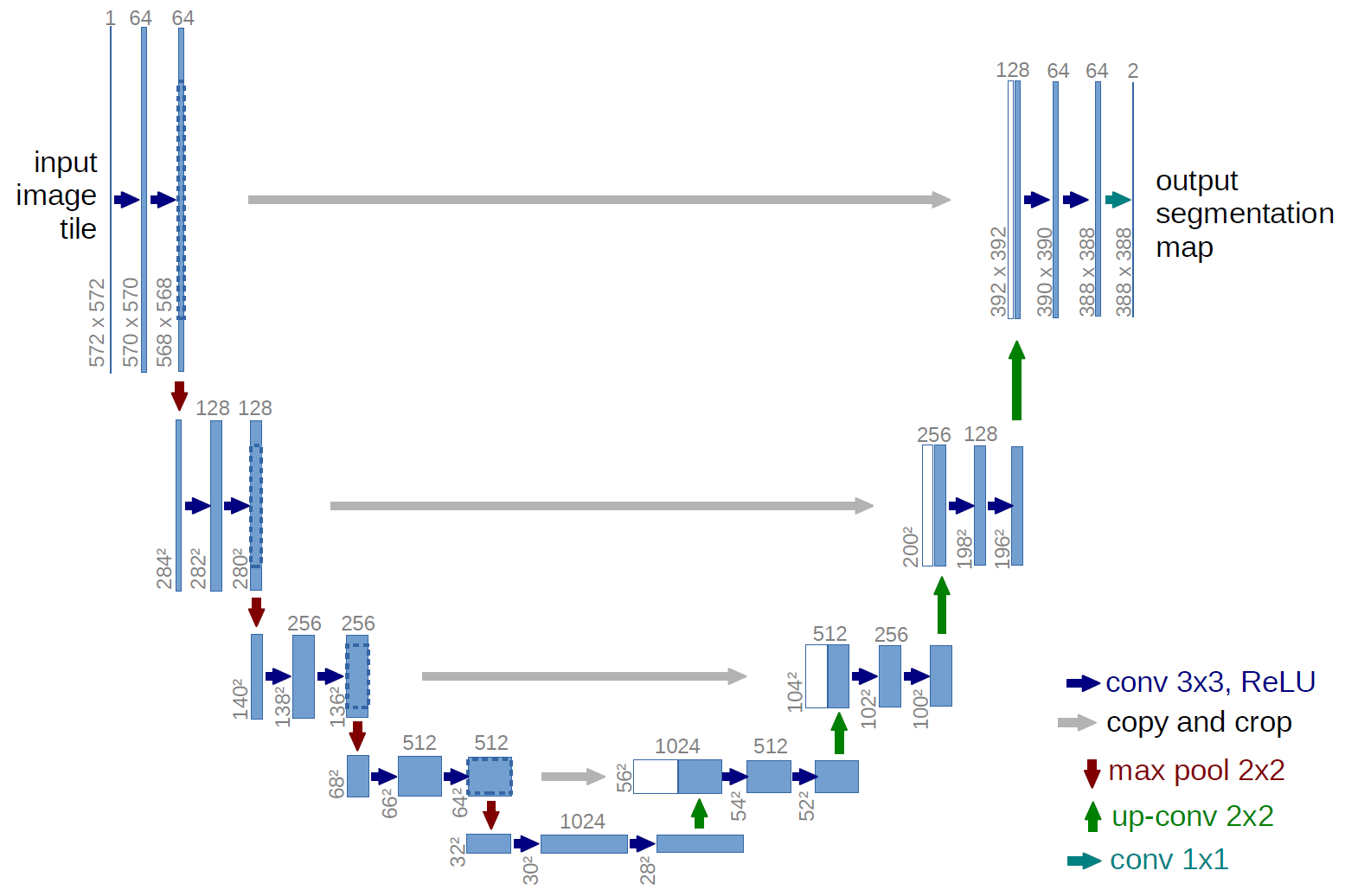
U-Net模型块分析

结合上图,不难发现U-Net模型具有非常好的对称性。模型从上到下分为若干层,每层由左侧和右侧两个模型块组成,每侧的模型块与其上下模型块之间有连接;同时位于同一层左右两侧的模型块之间也有连接,称为“Skip-connection”。此外还有输入和输出处理等其他组成部分。由于模型的形状非常像英文字母的“U”,因此被命名为“U-Net”。

组成U-Net的模型块主要有如下几个部分:

  • 每个子块内部的两次卷积(Double Convolution)
  • 左侧模型块之间的下采样连接,即最大池化(Max pooling)
  • 右侧模型块之间的上采样连接(Up sampling)
  • 输出层的处理

除模型块外,还有模型块之间的横向连接,输入和U-Net底部的连接等计算,这些单独的操作可以通过forward函数来实现。

下面我们用PyTorch先实现上述的模型块,然后再利用定义好的模型块构建U-Net模型。

U-Net模型块实现

在使用PyTorch实现U-Net模型时,我们不必把每一层按序排列显式写出,这样太麻烦且不宜读,一种比较好的方法是先定义好模型块,再定义模型块之间的连接顺序和计算方式。就好比装配零件一样,我们先装配好一些基础的部件,之后再用这些可以复用的部件得到整个装配体。

这里的基础部件对应上一节分析的四个模型块,根据功能我们将其命名为:DoubleConv, Down, Up, OutConv。下面给出U-Net中模型块的PyTorch 实现:

1
2
3
4
5
6
7
8
9
10
11
12
13
14
15
16
17
18
19
20
21
22
23
24
25
26
27
28
29
30
31
32
33
34
35
36
37
38
39
40
41
42
43
44
45
46
47
48
49
50
51
52
53
54
55
56
57
58
59
60
61
62
63
64
65
66
67
68
69
70
import torch
import torch.nn as nn
import torch.nn.functional as F
class DoubleConv(nn.Module):
"""(convolution => [BN] => ReLU) * 2"""

def __init__(self, in_channels, out_channels, mid_channels=None):
super().__init__()
if not mid_channels:
mid_channels = out_channels
self.double_conv = nn.Sequential(
nn.Conv2d(in_channels, mid_channels, kernel_size=3, padding=1, bias=False),
nn.BatchNorm2d(mid_channels),
nn.ReLU(inplace=True),
nn.Conv2d(mid_channels, out_channels, kernel_size=3, padding=1, bias=False),
nn.BatchNorm2d(out_channels),
nn.ReLU(inplace=True)
)

def forward(self, x):
return self.double_conv(x)

class Down(nn.Module):
"""Downscaling with maxpool then double conv"""

def __init__(self, in_channels, out_channels):
super().__init__()
self.maxpool_conv = nn.Sequential(
nn.MaxPool2d(2),
DoubleConv(in_channels, out_channels)
)

def forward(self, x):
return self.maxpool_conv(x)

class Up(nn.Module):
"""Upscaling then double conv"""

def __init__(self, in_channels, out_channels, bilinear=False):
super().__init__()

# if bilinear, use the normal convolutions to reduce the number of channels
if bilinear:
self.up = nn.Upsample(scale_factor=2, mode='bilinear', align_corners=True)
self.conv = DoubleConv(in_channels, out_channels, in_channels // 2)
else:
self.up = nn.ConvTranspose2d(in_channels, in_channels // 2, kernel_size=2, stride=2)
self.conv = DoubleConv(in_channels, out_channels)

def forward(self, x1, x2):
x1 = self.up(x1)
# input is CHW
diffY = x2.size()[2] - x1.size()[2]
diffX = x2.size()[3] - x1.size()[3]

x1 = F.pad(x1, [diffX // 2, diffX - diffX // 2,
diffY // 2, diffY - diffY // 2])
# if you have padding issues, see
# https://github.com/HaiyongJiang/U-Net-Pytorch-Unstructured-Buggy/commit/0e854509c2cea854e247a9c615f175f76fbb2e3a
# https://github.com/xiaopeng-liao/Pytorch-UNet/commit/8ebac70e633bac59fc22bb5195e513d5832fb3bd
x = torch.cat([x2, x1], dim=1)
return self.conv(x)

class OutConv(nn.Module):
def __init__(self, in_channels, out_channels):
super(OutConv, self).__init__()
self.conv = nn.Conv2d(in_channels, out_channels, kernel_size=1)

def forward(self, x):
return self.conv(x)

利用模型块组装U-Net

使用上面我们定义好的模型块,我们就可以非常方便地组装U-Net模型。可以看到,通过模型块的方式实现了代码复用,整个模型结构定义所需的代码总行数明显减少,代码可读性也得到了提升。

1
2
3
4
5
6
7
8
9
10
11
12
13
14
15
16
17
18
19
20
21
22
23
24
25
26
27
28
29
30
31
class UNet(nn.Module):
def __init__(self, n_channels, n_classes, bilinear=False):
super(UNet, self).__init__()
self.n_channels = n_channels
self.n_classes = n_classes
self.bilinear = bilinear

self.inc = DoubleConv(n_channels, 64)
self.down1 = Down(64, 128)
self.down2 = Down(128, 256)
self.down3 = Down(256, 512)
factor = 2 if bilinear else 1
self.down4 = Down(512, 1024 // factor)
self.up1 = Up(1024, 512 // factor, bilinear)
self.up2 = Up(512, 256 // factor, bilinear)
self.up3 = Up(256, 128 // factor, bilinear)
self.up4 = Up(128, 64, bilinear)
self.outc = OutConv(64, n_classes)

def forward(self, x):
x1 = self.inc(x)
x2 = self.down1(x1)
x3 = self.down2(x2)
x4 = self.down3(x3)
x5 = self.down4(x4)
x = self.up1(x5, x4)
x = self.up2(x, x3)
x = self.up3(x, x2)
x = self.up4(x, x1)
logits = self.outc(x)
return logits

参考资料

文章链接:
https://www.zywvvd.com/notes/study/deep-learning/pytorch/torch-learning/torch-learning-10/


“觉得不错的话,给点打赏吧 ୧(๑•̀⌄•́๑)૭”

微信二维码

微信支付

支付宝二维码

支付宝支付