


Yesterday at LGM2026, GIMP’s maintainer Jehan Pagès gave a talk about GIMP as a community project and made several interesting announcements.
This post is going to be quite a bit critical, so before I proceed, here is the obligatory disclaimer: I used to be a GIMP contributor, significantly decreased my participation in late 2021, and officially bowed out in late 2022.
I’m omitting a lot of things I found less interesting to discuss. You can watch the whole thing here and make your own judgments.
During the talk, Jehan mentioned that the project first considered creating some form of a non-profit in 1999 but never acted on that idea. Then Jehan himself nearly created a non-profit for GIMP in 2023, but instead went on to sign a fiscal sponsorship agreement with GNOME Foundation in June 2024.
Actually, scratch that. He did not exactly mention those last two bits of info: they were listed on the slide but weren’t discussed at all.
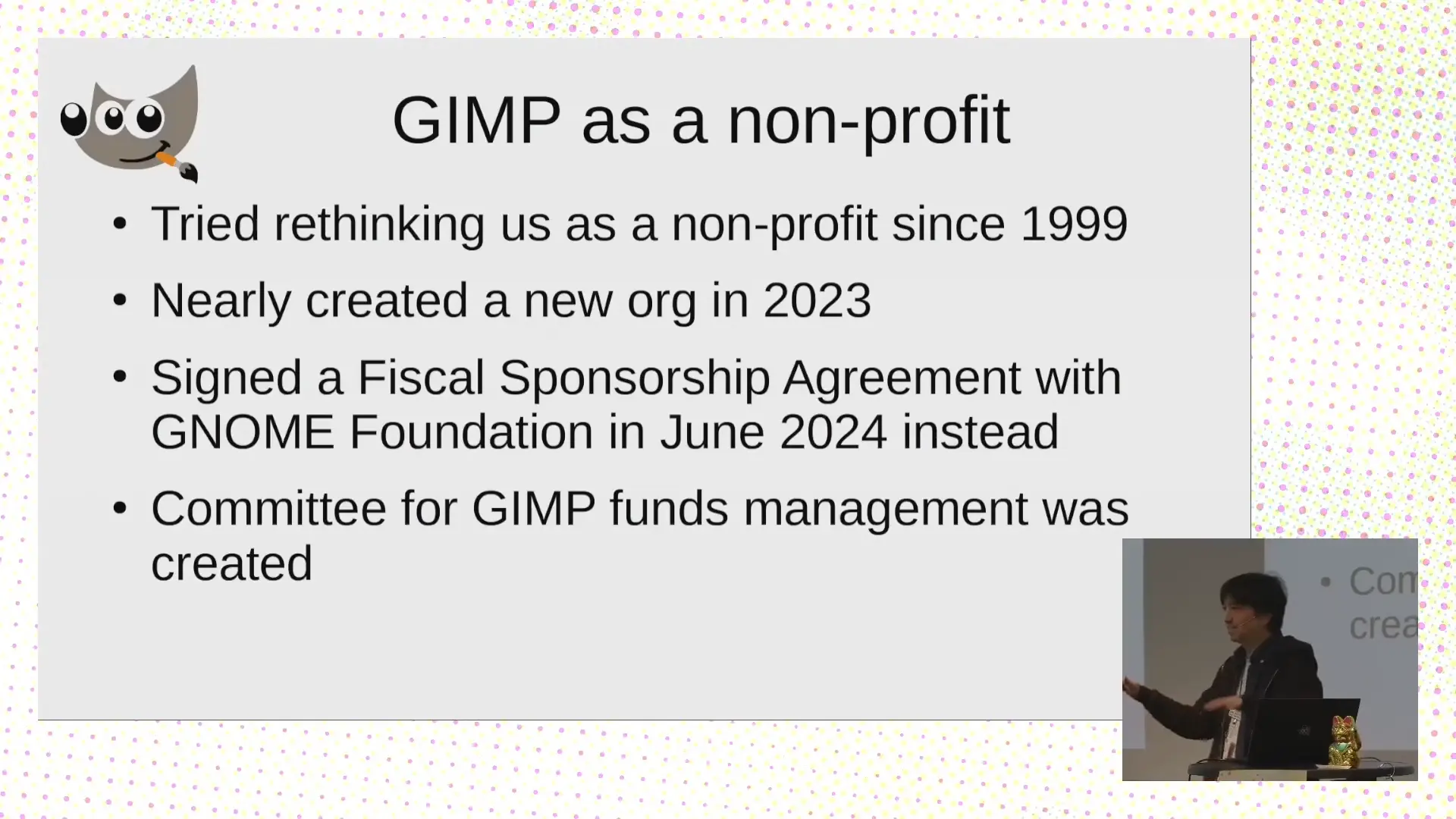
There’s no explanation why Jehan decided against creating the non-profit. Neither is there an explanation what the fiscal sponsorship agreement means.
I do know one thing the agreement involved — transferring all BTC to GNOME Foundation for GNOME Foundation to immediately sell it and put the fiat money on GIMP’s account (they’ve been managing GIMP’s money since dawn of times). But I know it from tracking the transactions and reading one contributor’s comments on Reddit, not from any sort of official announcement, because the only official announcement was very inspecific and hidden in release notes of v3.0RC1.
By my rough calculations from a year ago, there should be around 2 mil USD on that account after selling all BTC. So what have they been doing with that since early last year?
First off, in 2024, the team created a formal committee. It’s currently comprised of 9 people:
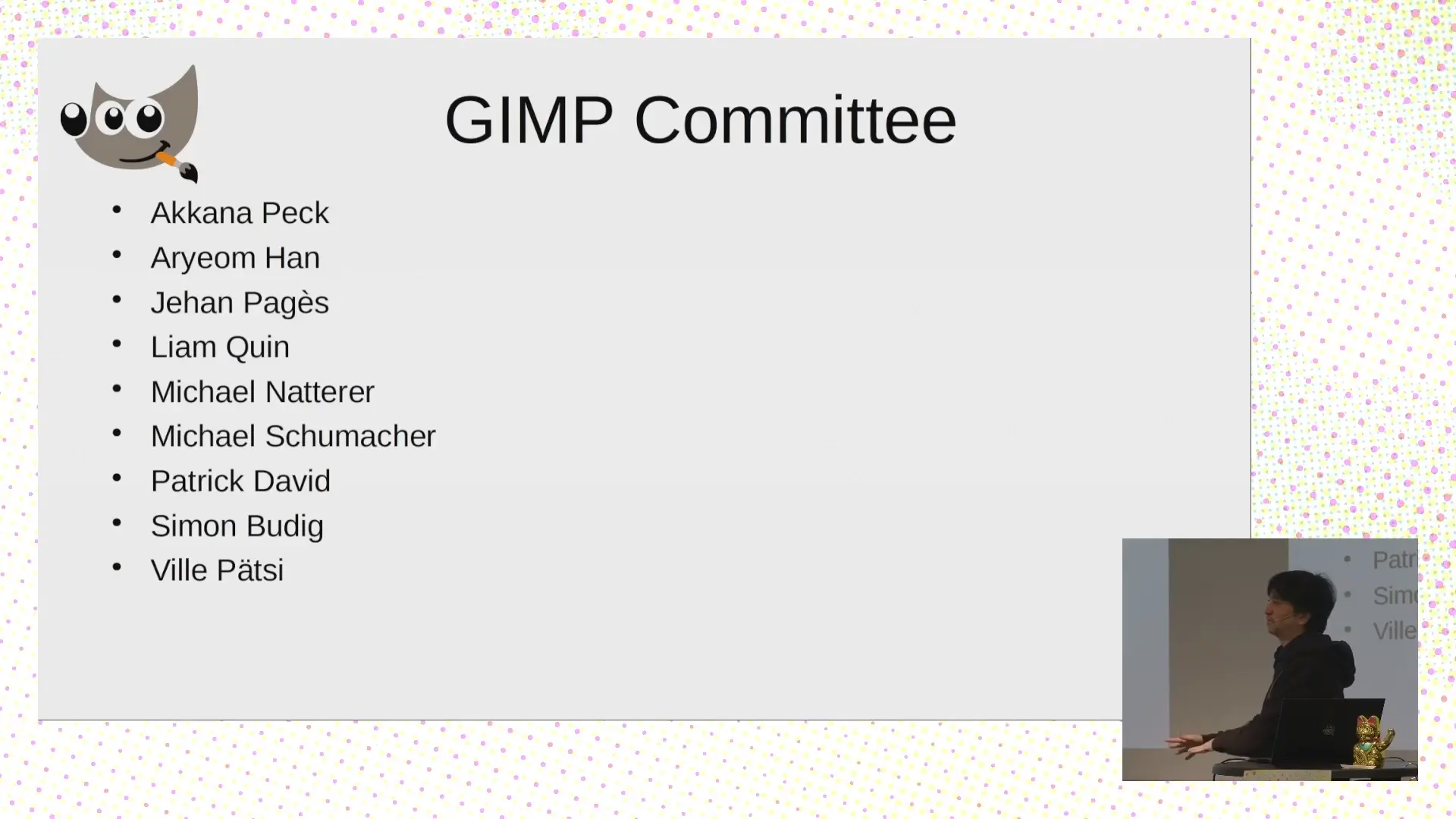
Let’s break it down.
So that should give you some idea who the committee members are. Personally, I think the committee’s composition is alright. But what do they do?
Jehan specifically said:
The GIMP committee is only for the funds. It was very important to me that it’s not about leading the software, it’s about managing the funds to support the software. We don’t decide what features go in, it’s not our role and it should not be.
I’ve seen projects like FreeCAD adopt this kind of role separation and still get a lot of heat from a vocal minority, so I can perfectly understand this sentiment. (Full disclosure: in case of FreeCAD, I’m very much biased.) So yes, this planned detachment from making software decisions makes sense to me personally and, hopefully, to you too.
The committee actually has a dedicated project on GNOME’s Gitlab server where they explain a few things. They even use the issue tracker for decision-making in the open.
The caveat is that while the committee has been around since approx. June 2024, it was never properly introduced. It got two minor mentions on the main website in release notes (v3.0RC2 and v3.2.2), and two mentions on developer portal (1, 2). Imagine a committee managing approx. $2,000,0000 of a FOSS project’s money and being nothing but a footnote on that very project’s website.
So, about the things they do…
One of the committee’s decisions was to try issuing grants. So far, there have been two test grants issued to Jehan himself and to Øyvind Kolås, the lead GEGL developer of 20+ years.
Jehan did not specify what the grants were issued for, how much any of them was, whether there was any formal proposal or agreement or any grant review and approval process whatsoever.
Incidentally, there is a description of the grant awarding procedure. I found it after asking someone who knew where to look. You now know about it too, likely after reading it here in an arcane blog post at the edge of interwebz.
Jehan also mentioned that they are waiting for something to be unblocked from the administrative side to continue with the second round of grants. The slide specifically says “Currently waiting to be allowed to continue”.
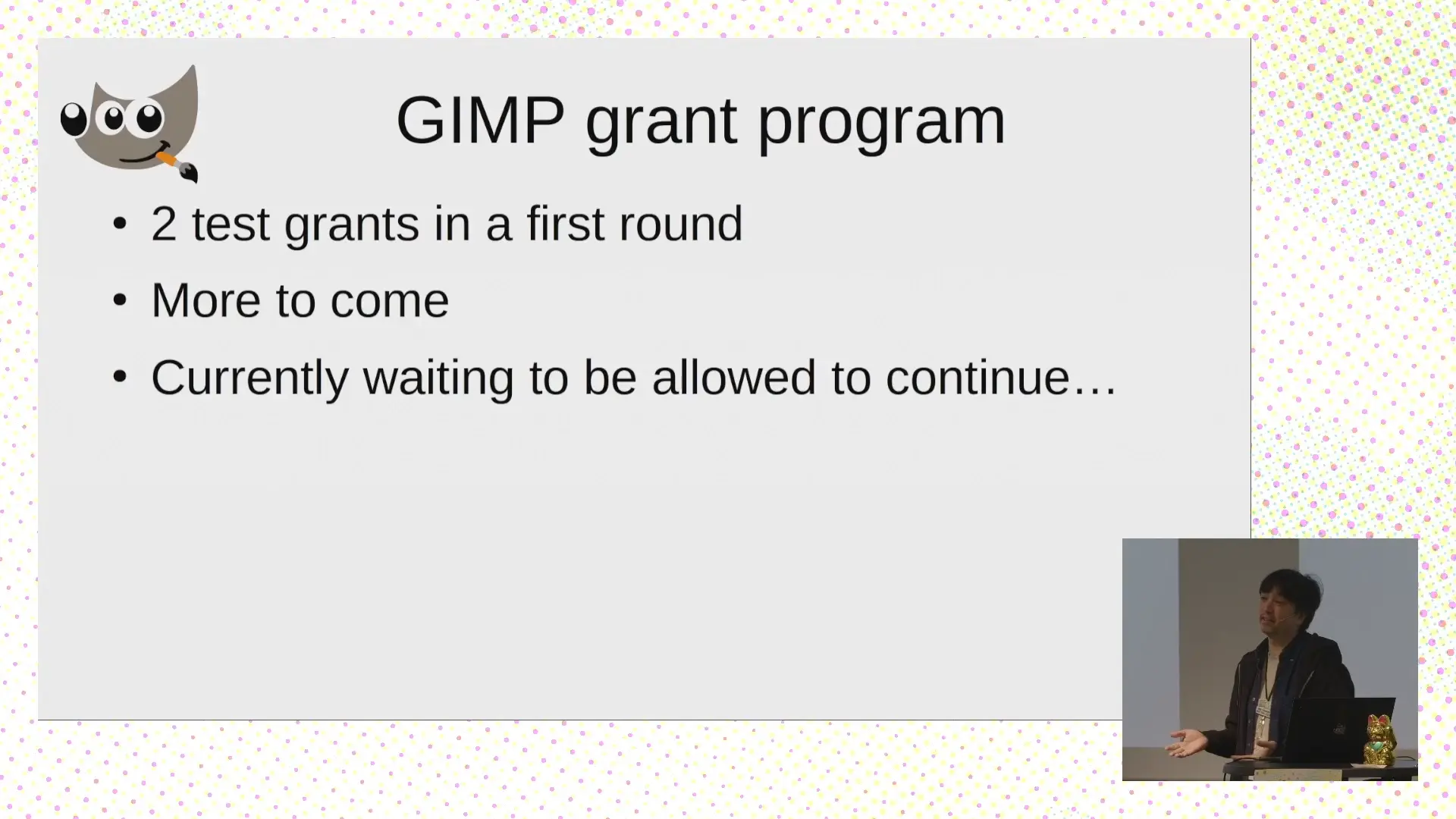
Taken literally, this could mean that the committee doesn’t have full control over the funds and depends on the GNOME Foundation to take action.
Again, there is no public information about the relationship between GIMP and GNOME Foundation. We are on the speculation territory here.
Jehan mentioned that the team has adopted a strict No-AI policy. This is a principle thing, and as you probably know from this study, FOSS projects are all over the spectrum on the use of AI.
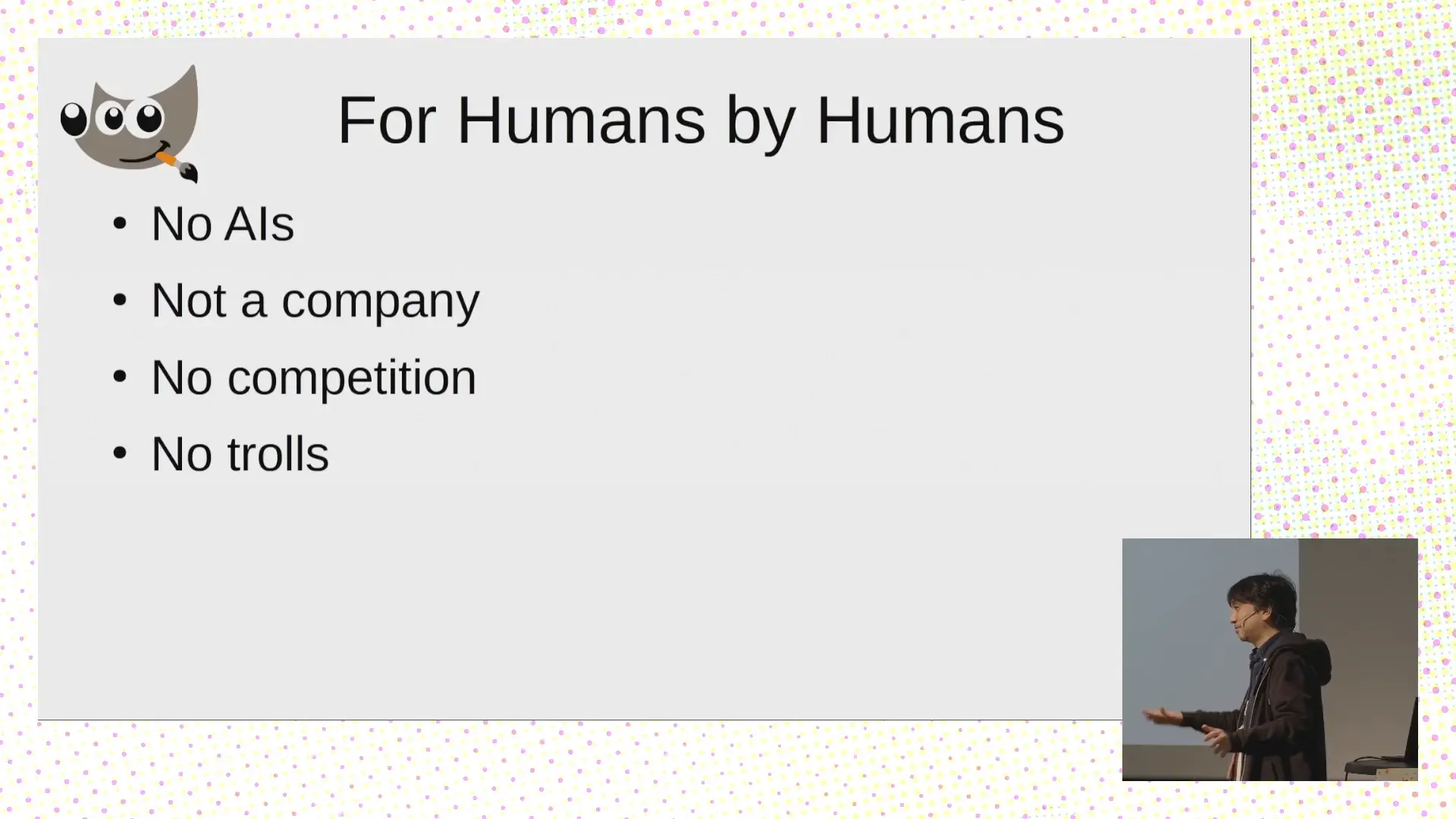
To the best of my knowledge, the formal part of this policy is only mentioned in a Gitlab template updated in March 2025 and on the Internship programs page at the developers portal.
During the talk, Jehan mentioned that the project’s participation has been very successful, and 9 out of 10 students from 2022-2025 program installments sticked with the project. He went on to attribute this success to the team looking at people more than at proposals.
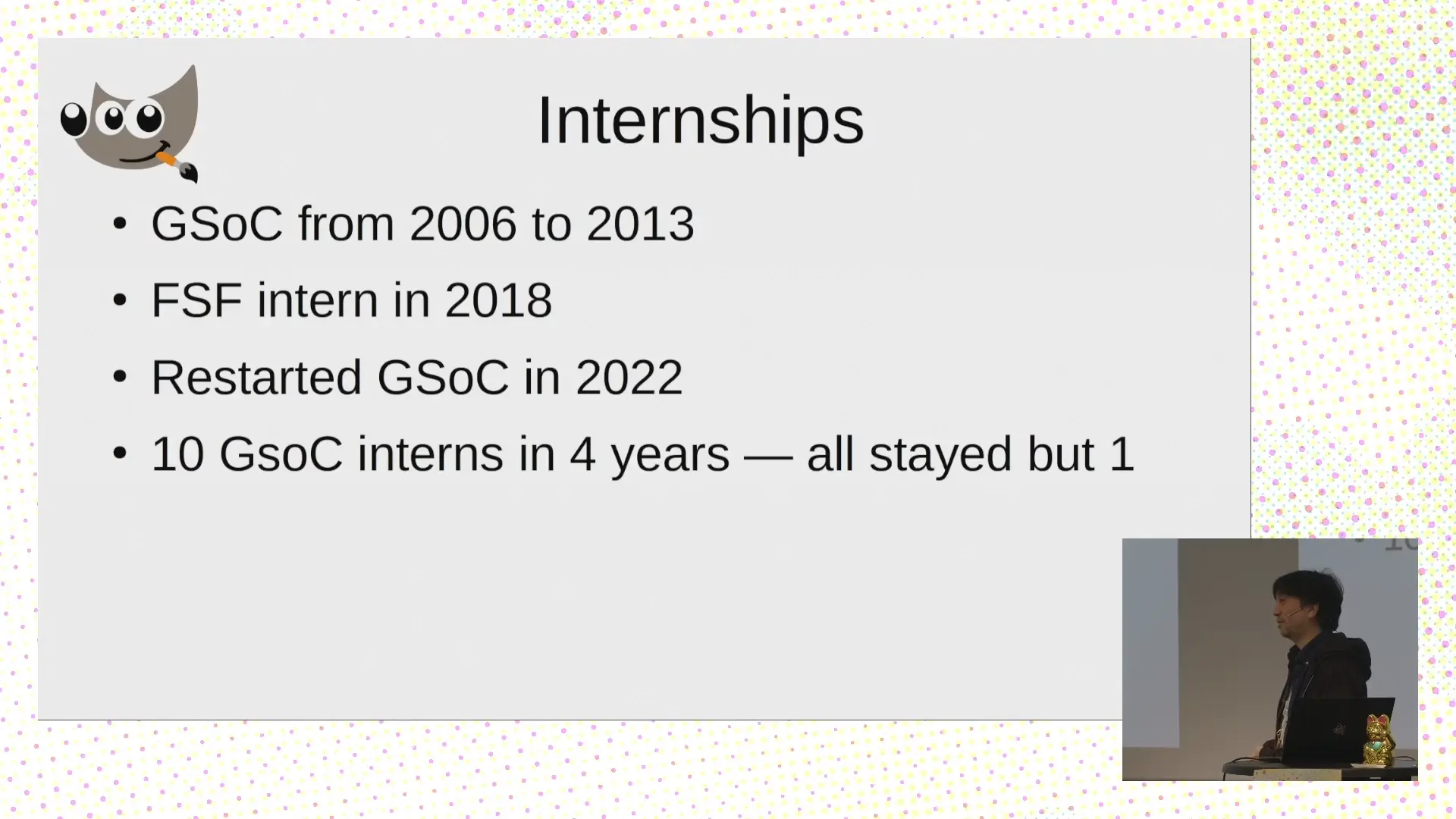
This is a mostly sensible approach, except his data is all wrong. Let me explain.
The project indeed had 10 slots from GSoC between 2022 and 2025. However they were filled by 8 different people: both CmykStudent and Idriss Fekir participated twice.
Here is a quick breakdown.
CmykStudent successfully completed both 2022 and 2023 projects and went on to become GSoC mentor in the organization in 2024 and is still a very active contributor. Most recently, he’s been working on the CMYK color mode and a shape drawing tool.
Idriss Fekir did two good GSoC projects dedicated to the text tool, his involvement extended somewhat after the 2024 project, but he hasn’t been active since October 2025. He had 8 commits to the project over the last 12 months.
Shubham did one decent project in 2023, layer autoexpansion support, and stopped at that.
Cheesequake worked on modernizing the GtkTreeView widget and continued contributing past his GSoC project until about 7 months ago.
Varun Samaga B L made 15 commits to GEGL as part of his GSoC project in 2024 and dropped out.
Shivam Shekhar Soy completed his part of working on the new extensions website last year and left the project after the program’s end.
Gabriele Barbero worked on the text tool and continues contributing. His latest merged commit from March this year fixed the text tool’s overlay positioning when the view is rotated.
Ondřej Míchal implemented GEGL filter explorer and keeps contributing. His most recent patches touch widgets, flatpak builds, and controllers UI in Preferences.
To sum it up, the statement that 9 out of 10 people sticked with the project is incorrect. There were 8 GSoC students between 2022 and 2025. 5 people continued contributing past their respective GSoC projects, 3 of them are currently active.
That is still a really good result, plus, as far as I can tell, all 10 GSoC projects in the past years have been successful. I have no idea why this exaggeration was needed when they had a perfectly solid case already.
So what have we learned from this LGM talk and this quick research?
I hope that while I’m very salty about this talk, you will appreciate that I’m also doing my best to stay objective.
Despite the unfortunate GSoC blunder during the talk and the continuous lack of transparency, the team is finally making the right organizational changes, if at a glacial pace. Let’s hope to see more in the coming months/years.
Patreon subscribers get early access to my posts. If you are feeling generous, you can also make a one-time donation on BuyMeACoffee.

此内容由惯性聚合(RSS阅读器)自动聚合整理,仅供阅读参考。 原文来自 — 版权归原作者所有。