







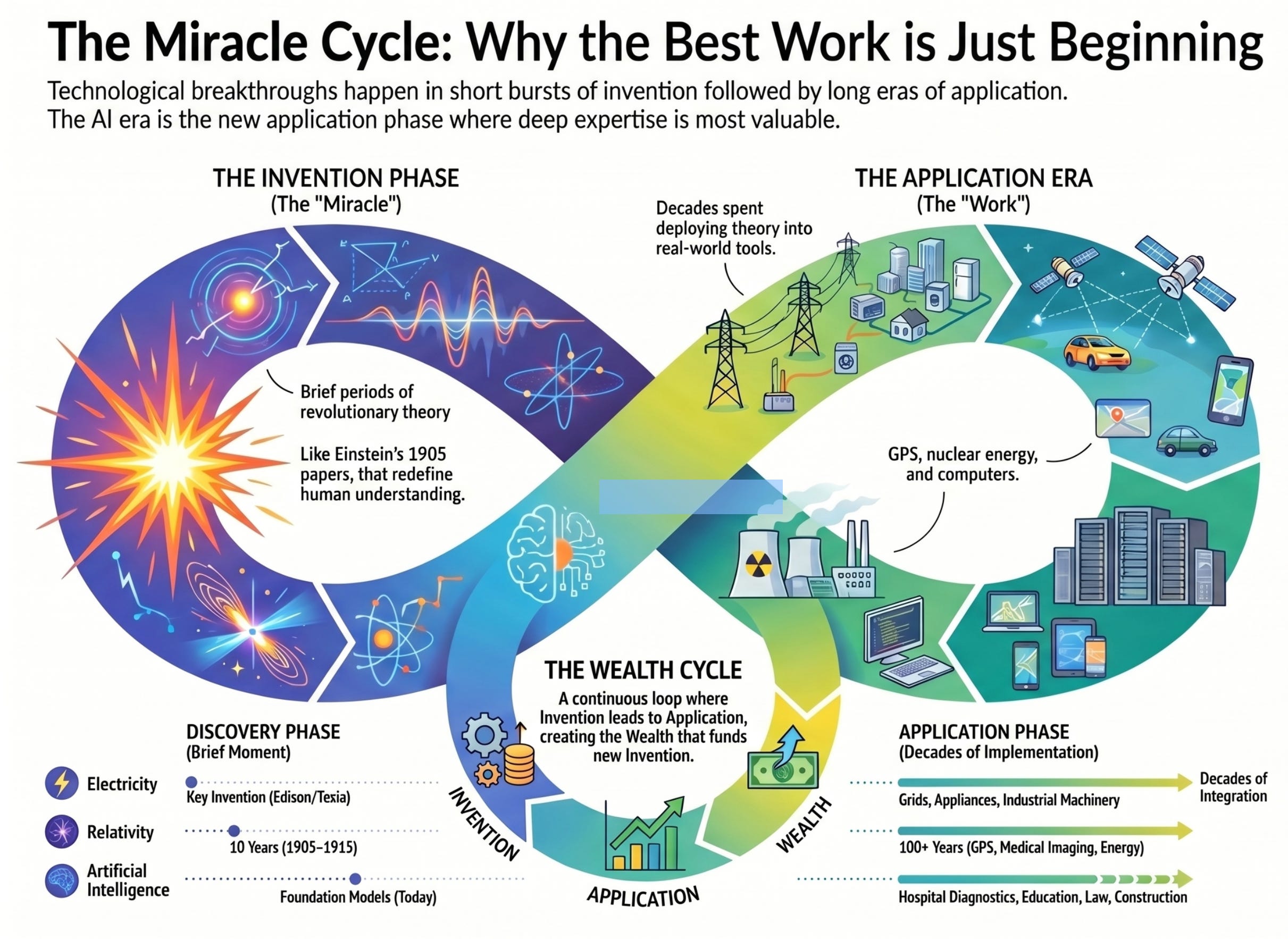
In 1905, a twenty-six-year-old patent clerk published four papers that broke physics wide open. Special relativity. The photoelectric effect. Brownian motion. E=mc². We call it the annus mirabilis… the miracle year.
That was 120 years ago. And I’ve always wondered: after those explosive early-twentieth-century discoveries, relativity, quantum mechanics, atomic theory, and what happened? It felt like a long silence.
Genius, National Geographic’s series on Einstein’s life, opens with young Einstein fighting with his father Hermann, who wants him to join the family engineering business. Albert refuses; he wants to understand the universe, not wire buildings.
The show ends with Einstein having the exact same argument, but now he’s the father. His son Hans Albert wants to be an engineer. Not a theorist. An engineer.
The irony is crushing. But Hans Albert wasn’t wrong, and neither was Hermann. By the time Hans Albert was choosing his career, the great theories had already been written. The world didn’t need more theory. It needed people who could apply it, who could take E=mc² and build nuclear energy, take quantum mechanics and build transistors and computers.
The miracle was over. The work had just begun.
Once that clicked for me, I started seeing it everywhere. History doesn’t move in a straight line of constant discovery. It moves in cycles:
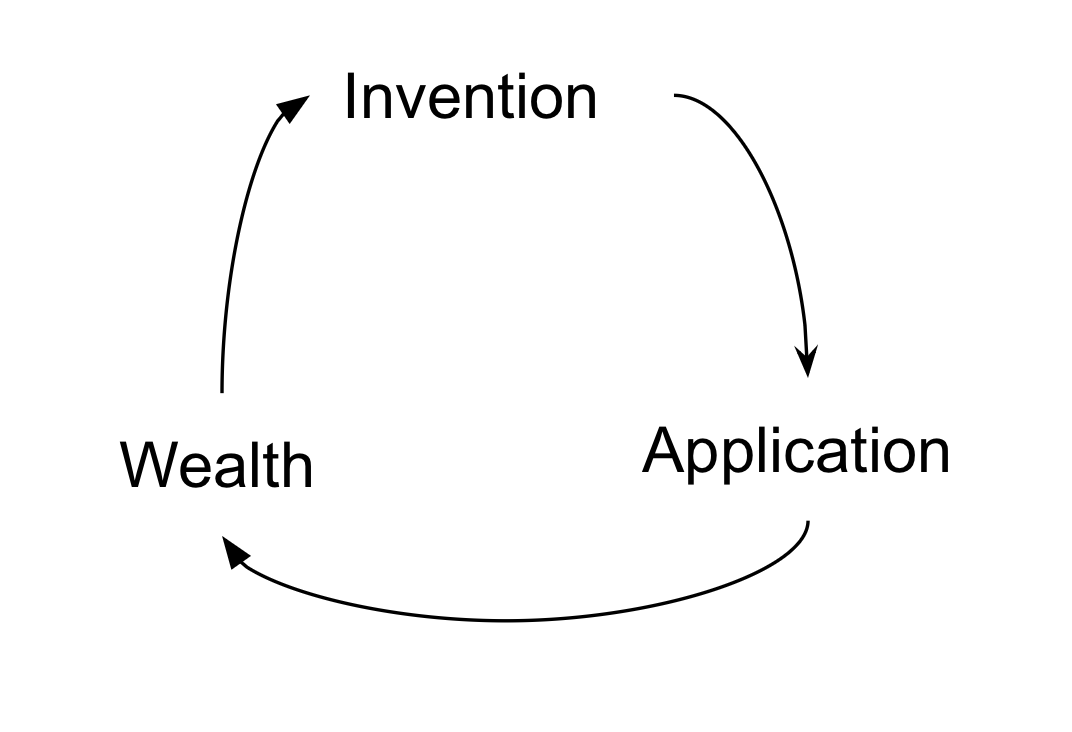
A handful of years of revolutionary breakthroughs, followed by decades, sometimes centuries, of people figuring out what to do with those breakthroughs.
Think about electricity. The core discoveries: electromagnetic induction, the lightbulb, and alternating current happened in a relatively compressed window. But the application of electricity? That took generations. Transformers, transmission lines, power grids, utility poles, wiring standards, household appliances, and industrial machinery. Entire industries were born not from inventing electricity, but from deploying it.
Or take the theory of relativity itself. The theory was published in 1905 and refined by 1915. But the applications? Nuclear energy. Nuclear weapons. GPS satellites (which literally correct for relativistic time dilation). Medical imaging. Particle accelerators. These came over the next century and continue today.
Ten years of miracles. A hundred years of making it real.
Here’s what I find most interesting about these application years: they always create a job shift that feels catastrophic in the moment but looks obvious in hindsight.
When electricity arrived, the people who made candles lost their livelihoods. That was real. That was painful. But the people who laid wires, who built transformers, who installed streetlights, who manufactured motors — they found entirely new kinds of work that didn’t exist a generation before.
The candle maker couldn’t have imagined the job of “electrical engineer” because the category didn’t exist yet. And that’s exactly the kind of displacement that makes people anxious — not because the new jobs won’t come, but because you can’t see them from where you’re standing.
I think we’re living through a new miracle period right now. AI and Generative AI — these are this century’s relativity and quantum mechanics. The foundational theory is being written as we speak. And just like in 1905, the window of pure invention will be short compared to what comes after.
What comes after is the application era. Someone will reshape how hospitals handle diagnostics. Someone else will reinvent how students learn. Others will find uses in agriculture, law, construction — in places we can’t foresee, just like the candle maker couldn’t have imagined fiber-optic cable.
Yes, some jobs will go away. Every cycle has its casualties. But I’m deeply optimistic — because the people who understand how to apply AI will be the wire layers and electrical engineers of our generation. The pattern holds across every major technological cycle in history: more people gain than lose.