
惯性聚合 高效追踪和阅读你感兴趣的博客、新闻、科技资讯
阅读原文 在惯性聚合中打开

推荐订阅源

aimingoo的专栏
aimingoo的专栏
V
V2EX
G
Google Developers Blog
F
Full Disclosure
Martin Fowler
Martin Fowler
宝玉的分享
宝玉的分享
H
Hacker News: Front Page
Exploit-DB.com RSS Feed
NISL@THU
NISL@THU
G
GRAHAM CLULEY
V
Vulnerabilities – Threatpost
Hacker News - Newest:
Hacker News - Newest: "LLM"
A
About on SuperTechFans
The Cloudflare Blog
C
Cisco Blogs
D
DataBreaches.Net
Threat Intelligence Blog | Flashpoint
Vercel News
Vercel News
P
Privacy International News Feed
Microsoft Security Blog
Help Net Security
Help Net Security
Recorded Future
Recorded Future
PCI Perspectives
PCI Perspectives
S
Schneier on Security
AI
AI
N
News | PayPal Newsroom
雷峰网
雷峰网
C
Cyber Attacks, Cyber Crime and Cyber Security
P
Proofpoint News Feed
The Last Watchdog
The Last Watchdog
L
LINUX DO - 最新话题
Hugging Face - Blog
Hugging Face - Blog
Apple Machine Learning Research
Schneier on Security
S
Securelist
云风的 BLOG
云风的 BLOG
Stack Overflow Blog
Stack Overflow Blog
博客园_首页
AWS News Blog
AWS News Blog
TaoSecurity Blog
TaoSecurity Blog
OSCHINA 社区最新新闻
OSCHINA 社区最新新闻
Recent Commits to openclaw:main
博客园 - 三生石上(FineUI控件)
C
CXSECURITY Database RSS Feed - CXSecurity.com
K
KPMG report finds enterprise disconnect between AI and its ROI | CIO
Cloudbric
Cloudbric
C
Cybersecurity and Infrastructure Security Agency CISA
Project Zero
Project Zero
C
Check Point Blog
S
Security Affairs

Hacker News - Newest: "AI"

AI can't read an investor deck AI as an attorney? Student uses ChatGPT, Gemini to sue UW over alleged racial discrimination Hacking MCP Servers in AI Systems – The Rug Pull: Tool Changes After Approval GitHub - MeepCastana/KubeezCut: Free Web based video editor GitHub - GenAI-Gurus/awesome-eu-ai-act: Curated tools, official sources, OSS, templates, and guides for EU AI Act compliance. Can AI judge journalism? A Thiel-backed startup says yes, even if it risks chilling whistleblowers Coming soon: 10 Things That Matter in AI Right Now DARPA built an AI to fact-check enemy weapons claims What explains heterogeneity in AI adoption? When AI Meets Muscle: Context-Aware Electrical Stimulation Promises a New Way to Guide Human Movements - Department of Computer Science AI Changed How We Build. It Did Not Change What Matters. Linux rules on using AI-generated code - Copilot is OK, but humans must take 'full responsibility for the… Meta spins up AI version of Mark Zuckerberg to engage with employees Code Mode: Let Your AI Write Programs, Not Just Call Tools | TanStack Blog GitHub - Delavalom/graft: Go framework for building AI agents. Type-safe tools, multi-provider (OpenAI, Anthropic, Gemini, Bedrock), zero vendor SDKs. India's TCS tops estimates, says new AI models did not dent services demand Gen Z's fading AI hype Strong feeling: we are in a folded AI reality GitHub - machinarii/total-recall-catalog: A reference catalog of latest knowledge retrieval, memory & RAG systems GitHub - mensfeld/code-on-incus: Give each AI agent its own isolated machine with root, Docker, and systemd. Active defense detects and stops threats automatically.. Quantization, LoRA, and the 8% Problem: Benchmarking Local LLMs for Production AI Iran war: We spoke to the man making Lego-style AI videos that experts say are powerful propaganda Powell, Bessent discussed Anthropic's Mythos AI cyber threat with major U.S. banks GitHub - immartian/bellamem: Persistent belief-graph memory for AI agents. Retrieves decisive context by importance — not recency, not RAG, not /compact. recursive-mode: The Repo-Native Operating System for AI Engineering After the attack on Sam Altman's home, will AI CEO's go on the offensive? The biggest advance in AI since the LLM Opus 4.6 vs GPT 5.4 One Prompt Unity World Generation Test “AI polls” are fake polls Client Challenge Can AI be a 'child of God'? Inside Anthropic's meeting with Christian leaders How to Switch AI Chatbots and Why You Might Want To GitHub - MattMessinger1/agentic_refund_guardrail: Safe refund policy layer for AI agents — Python + TypeScript. Same behavior, shared tests. Adam/papers/emergent_values_whitepaper.md at master · strangeadvancedmarketing/Adam Ask HN: How do you stop playing 20 questions with your AI coding tools How far can automation and AI support psychotherapy? - @theU GitHub - stagas/rtdiff: realtime git diff gui and AI-assisted commits A Mac Studio for Local AI — 6 Months Later A History of the Early Years of AI at the University of Edinburgh Why AI Coding Tools Still Feel Stuck on Localhost MSN AI Datacenters Are Becoming Strategic Targets twitter.com Penn Researchers Use AI to Surface Unreported GLP-1 Side Effects in Reddit Posts Show HN: MoodSense AI (ML and FastAPI and Gradio, Deployed on Hugging Face) Moodsense Ai - a Hugging Face Space by aman179102 AI models are terrible at betting on soccer—especially xAI Grok GitHub - xialeistudio/echoic GitHub - HimashaHerath/github-dev-wrapped: AI-powered weekly GitHub activity reports deployed to GitHub Pages GitHub - alejandrobalderas/claude-code-from-source: Architecture, patterns & internals of Anthropic's AI coding agent — reverse-engineered from source maps AI and Tech brief: Ireland ascendant GitHub - Titovilal/context0: Context0 - Never Surrender Training for a Marathon with an AI Coach: What Worked and What Didn't Cyber Pulse: Agentic Intel - Apps on Google Play I Built an AI PR Reviewer That Catches Bugs by Not Looking for Bugs Gen Z workers are so fearful AI will take their job they’re intentionally sabotaging their company’s AI rollout | Fortune How AI Is Reimagining the Game of Golf–For Both Players and Courses GitHub - nattergabriel/reseed: A CLI tool for managing and distributing agent skills across projects Is SVG the final frontier? My AI workflow evolved from prompts to a near-autonomous workflow MLSharp Help - 3DGS Viewer & Generator I put my cognitive field based AI's runtime on GitHub Is Numble the first AI-proof game? A3: Kubernetes for autonomous AI agent fleets | Emergent Principles Deepali Vyas ("The Elite Recruiter") GitHub - msmarkgu/RelayFreeLLM: A restful API designed to route user prompts to various AI model providers. Unionized ProPublica staff are on strike over AI, layoffs, and wages Unleashing the Advantage of Quantum AI We're heading for an AI-fueled 'dementia crisis,' brain scientist warns The AI-Assisted Breach of Mexico's Government Infrastructure [pdf] GitHub - stef41/lmscan: 🔍 Detect AI-generated text and fingerprint which LLM wrote it. Open-source GPTZero alternative. Zero dependencies, works offline. MSN GitHub - visionscaper/collabmem: Enabling long-term collaboration with Agentic AI - building up episodic and world model memory over time with in-context awareness We gave an AI a 3 year retail lease in SF and asked it to make a profit | Andon Labs AI Code is Hollowing Out Open Source, and Maintainers are Looking the Other Way What leaked "SteamGPT" files could mean for the PC gaming platform's use of AI AI is the boss at this retail store. What could go wrong? GitHub - Wuzu11517/agentic-proxy: Local proxy meant to help reduce With Drones, Geophysics and ArtificiaI Intelligence, Researchers Prepare to Do Battle Against Land Mines A Single Operator, Two AI Platforms, Nine Government Agencies: The Full Technical Report 在 Steam 上购买 FriedrichAI: Offline AI 立省 10% GitHub - inevolin/resume-cli: Hit Claude usage limits? Resume any AI coding session elsewhere. Switch tools at zero friction. GitHub - atripati/ark: AI Runtime Kernel — a context operating system for AI agents. Eliminates tool bloat, loads only what’s needed, and gives LLMs their reasoning space back. How to Build a Secure AI PR Reviewer with Claude, GitHub Actions, and JavaScript This Startup Wants You to Pay Up to Talk With AI Versions of Human Experts Intel Arc Pro B70 Brings 32GB VRAM to Local AI for $949 WordPress 7.0: The Good, the AI, and the Still Missing AI on the couch: Anthropic gives Claude 20 hours of psychiatry IatroBench: Pre-Registered Evidence of Iatrogenic Harm from AI Safety Measures AI Agents Know About Supabase. They Don't Always Use It Right. The history and future of AI at Google, with Sundar Pichai Inside an AI‑enabled device code phishing campaign How Meta Used AI to Map Tribal Knowledge in Large-Scale Data Pipelines AI for Systems: Using LLMs to Optimize Database Query Execution Forecasting the Economic Effects of AI Introducing Tinker: Play with AI, bring your ideas to life AI sheds light on an ancient gaming mystery People really hate AI but not as much as Iran—or Democrats | Fortune What is an AI Product Engineer? Phoebe Gates wants her $185 million AI startup to succeed with 'no ties to my privilege or my last name': 'I have a chip on my shoulder' | Fortune
On building an AI-native company
darkport · 2026-04-28 · via Hacker News - Newest: "AI"

I run CodeWall, a pre-seed AI security company. We recently published research on breaking into the AI platforms of McKinsey, Bain, and BCG — but this post isn't about the offensive side. It's about how we run an AI-native company day-to-day.

About six months ago I stopped thinking of AI as a tool I use and started thinking of it as infrastructure I build on.

This is what that looks like in practice.

The Thesis

I believe AI lets one person do the work of several. Not in the breathless "AI will replace everyone" way, but in a specific, structural way that most people are underestimating.

The real bottleneck now for a founder is context switching. On any given day I move between investor conversations, coding, infrastructure, customer onboarding, product decisions, hiring, compliance, legal, partnerships, speaking events — the list goes on. Each requires loading a different mental model, a different set of relationships, and a different set of outstanding commitments. The transitions are where the waste lives. You spend twenty minutes getting back up to speed on a thread you last touched three days ago. You forget to connect something you learned in one context to a decision you're making in another. You do shallow work across ten things instead of deep work on three.

The leverage doesn't come from any single task being faster. It comes from the overhead between tasks approaching zero. A founder who can move between six workstreams without losing context in the transitions operates at a fundamentally different level than one who spends half their day reloading mental state.

That's the theory. Let me show you what that looks like in practice.

Two weeks ago I was about to hire an EA and sign three SaaS contracts. I haven't done either.

1. The Investor Dataroom

A few weeks ago I needed somewhere to send investors. The deck, the financial model, customer references, client contracts, the cap table — the standard "please fund me" pre-seed package. The usual options are an absurdly expensive dataroom SaaS platform at a few hundred dollars a month for features I'd use a fraction of, or a Google Drive link that every other founder also sends.

Neither felt right. Pre-seed isn't the moment to spend on DocSend-grade tooling for something this simple at our stage. But a Drive link is also one of the first artefacts an investor sees, and a folder of PDFs says nothing about how we work. I wanted it to feel built, not bought.

So I put Claude to work. I gave it the spec — NDA flow, per-investor email verification via Magic Links, a personalised welcome badge for each investor (yes, really), gated document viewing, audit trail of who opened what, easy new-user onboarding and file uploading — pointed it at our stack, and let it build.

Even this demo was generated by an AI agent in two minutes — redactions and all.

The whole thing took a Claude agent under an hour, end to end. And I probably spent about another 30 minutes reviewing and tweaking everything. I'm pretty sure I would've spent more time looking at options, signing up, configuring everything, etc. Here, I told Claude what to build, it had access to all of our documents, and even deployed everything to our production server including creating new DNS records.

Is this overkill? Probably. A Drive link would have done the job, and at pre-seed nobody will fault you for that. But when something costs an hour rather than a week, overkill stops being the right frame — the threshold for "worth doing yourself" drops by an order of magnitude.

And look, this wouldn't work at a large Enterprise — that's the benefit of being a nimble startup. You need procurement-approved vendors, SOC 2 paperwork, a security review, an admin maintaining the thing who isn't the founder. At that scale you buy DocSend, and that's the right call.

When that overhead approaches zero, the build-vs-buy calculus shifts. Things that used to be obviously buy — because they weren't worth a developer-week — become obviously build. And what you build is yours: shaped to your brand, integrated with your stack, free to evolve when needs change.

2. The Company Brain

The most ambitious piece is what Tom Blomfield is calling a company brain in YC's latest RFS — the missing layer between scattered company knowledge and AI agents that can actually act on it. The same RFS frames the integration side of this as an AI Operating System for Companies: every channel queryable, the company itself becoming a closed-loop system. An AI Chief of Staff, if you will. And that's exactly what we've built at CodeWall.

It monitors every email arriving at the company, every Teams call I take, every Calendar invite, every LinkedIn message, every client Slack workspace — and processes all of them against a living knowledge base of everything else that's happening.

The knowledge layer is built on the approach Andrej Karpathy described in his LLM-maintained wiki. Every person gets a page, every company, every deal, every topic, every meeting. As I write this, that's 400+ people, 260+ companies, and 80+ topics — all cross-linked. The agent reads and writes these pages continuously, and knowledge compounds over time rather than decaying in a thread you'll never reopen.

When a new email arrives, the system already knows who the sender is, what company they're at, who introduced them, what the last conversation covered, and what's outstanding. If they're new, an agent spins up to do the legwork — LinkedIn profile, recent posts, X/Twitter, the company website, mutual connections, anything publicly relevant — and a person and company page exist by the time the email surfaces in my inbox, with the relevant context already pinned to the top. LinkedIn messages flow through the same enrichment — sender profiled, prior context linked, a draft reply waiting.

When a calendar invite lands, attendees are pre-researched, the agenda anticipated, and a prep brief is ready before I sit down. When a Teams call ends, the transcript flows through the same pipeline — attendees identified, action items extracted, wiki pages updated, follow-ups created.

When a message lands in a client Slack — a question in #support, a thumbs-up on a feature request, a casual mention of a competitor — it's tagged against the right account, linked to the relevant deal or topic, and surfaced if it needs my attention rather than getting lost in the noise.

Every interaction feeds the same picture, and the picture gets richer with every input. This is surfaced through a widget that sits right on my desktop, showing me what's important and what needs to get done — with the company brain in full context.

What This Looks Like In Practice

I like to show, not tell. So here are three examples:
  • An email came in from a partner at a Big 4 firm about a speaking engagement with several people in copy. The system processed the email and, as part of its research on each person, identified that one was part of the Cloud Security Alliance with a background in standards work. It cross-referenced that against an industry standards initiative I'd been building separately and instantly flagged the connection. Instead of "reply to this email", the follow-up action was: this person's standards background is directly relevant to your certification council, here's how to position the conversation, and here's the strategic value. That direct follow-up got him on the Founding Council. I would have missed that.
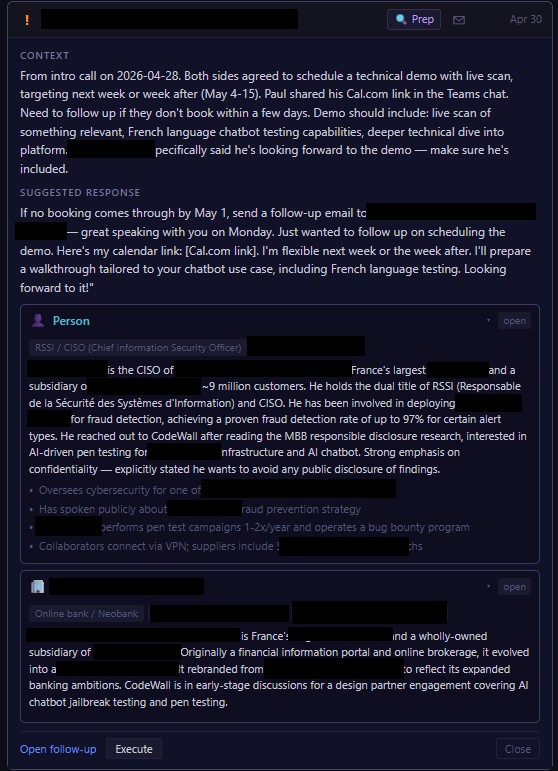
The primary interface of the system.
  • A CISO at a digital bank booked a cold-call after reading our research pieces. Minutes after the call ended, the system had processed the Teams transcript, built him and his bank wiki pages from public material, and pulled the demo scope he'd asked for (live scan, French-language chatbot testing). Todos created for what I'd committed to. A follow-up email drafted referencing specifics from the call — pre-staged to send if no booking lands by May 1. If he books, the note updates. If May 1 passes silently, the draft surfaces to the top of my list, already waiting.
  • A client kicked off procurement onboarding through their portal. Five tasks: business info, tax, payment, due diligence, cyber security policy. The system flagged the email as a buying signal and produced a single execute note with everything I'd need to paste — UK entity details, company number, banking block, and the right tax form for the situation (W-8BEN-E, not W-9, because we're a UK entity selling into the US). It flagged the trap too: don't sign W-9, that's for US persons only. What would have taken me over an hour took about five minutes.

(And countless other examples. Happy to share more if you drop me a line; [email protected])

The question I started with was "who should I hire?" The better question was "what does this job actually consist of and can an agent do it?"

Fewer Engineers != Not Less Product

A VC reviewing our pre-seed plan flagged the team composition as unusual: more GTM hires than engineers. At this stage, most companies are still hardening a v0.1 into a real product with founder-led sales — the GTM build-out comes later, at late seed or Series A. It's a fair pushback, and a sensible default for most teams.

The reason the default doesn't apply here is the same argument I've been making the whole way through. AI changes what each engineering headcount has to do. The dataroom you saw above, built in an afternoon. The chief-of-staff system that compounds context across every conversation, built in half-a-day. A new CodeWall platform feature a client asked for on a call, shipped to production under an hour. Each of these would have been an engineering project in a previous era; now they're features you ship between sales calls. The work that used to be split across three engineers genuinely fits into one person's day.

The work that doesn't compress the same way is the human-facing work. Sitting with a CISO and translating their threat model into an evaluation plan. Walking a procurement team through a SOC 2 attestation. Negotiating a design partner agreement. AI helps with the prep and the artifacts, but it doesn't replace the person in the room or on a video call at 10PM.

So the ratio inverts. Engineering gets smaller because each engineer covers more ground. GTM gets larger because customer-facing work scales with the size of the customer, not with the size of the engineering team behind it. A solutions engineer, a customer success lead, an account executive — these aren't roles AI subsumes. They're roles AI enables, by freeing up the engineering capacity that would otherwise have been the bottleneck.

Where This Ends Up

That's why the EA never got hired and the SaaS contracts never got signed. The same logic applies to every other role I thought I'd need next. One $200/month Claude Max subscription has quietly replaced what would otherwise be a CRM, a dataroom platform, a meeting-prep tool, a procurement automation platform, and the engineering hours to glue them all together.

That's what building an AI-native company looks like.