






With each electric streetlamp that replaced its gas-lit antecedent in America’s cities at the turn of the 20th century, urban freedom took a nimble leap forward. Poorly laid cobblestones became far less lethal. Street signs remained legible when you really needed them, like after you’d had a few too many at a saloon in a quarter of town you didn’t know well. A shopgirl could return home more safely from her job at 8 PM – or explore the city’s new wonders herself. Over time, a growing “night economy” created more entertainment options, evening classes at local colleges, a wide range of new jobs, and entirely novel patterns of living.
And that was just one aspect of electrification’s impact.
Spark-free motors in Minnesota grain elevators helped store-bought bread evolve from an occasional luxury into an affordable and time-saving staple for millions of Americans. Incandescent light bulbs in homes meant children could spend hours at night improving their reading skills without the adult supervision that kerosene lamps required. The X-ray machine turned electricity from a lighting tool into a new way to diagnose potential issues without cutting a patient open. Suddenly, the first steps of care were no longer more painful than the original complaint.
But before electrification did any of that?
It gave us slop.
Picture ordinary butter dishes, made from uranium glass, looking like alien artifacts in retail display windows as electric arc lights made them phosphoresce like neon. Picture the stage at Niblo’s Garden, a Broadway theater, where Thomas Edison himself helped equip hundreds of chorus girls and extras with electric lights for a show in 1883 that also featured a replica of the newly opened Brooklyn Bridge “with lighted boats running under it.” Picture a giant green pickle, 43-feet-wide, affixed to the side of New York City’s Cumberland Hotel and casting an unprecedented 12-kilowatt glow. According to Signs and Wonders, a 1998 history of the early electric signs known as “spectaculars,” the giant Heinz pickle created “an eerie visual throb of green and white that nightly invaded” the homes of people who lived blocks away.
Not everyone viewed this as progress.
In his 1878 essay, “A Plea For Gas Lamps,” the novelist Robert Louis Stevenson decried electric light as “unearthly” and “obnoxious,” a phenomenon that “should shine only on murders and public crime, or along the corridors of lunatic asylums, a horror to heighten horror.” (That Stevenson was cosmopolitan enough to shroud his anxieties in fainting-couch hyperbole hardly discounts those anxieties. Walter Benjamin himself read the essay as a prescient meditation on what we lose when technology surpasses “human” scale.) “The new illumination…” the writer G.K. Chesterton exclaimed in a 1927 essay, “has made people weary of the way of proclaiming great things, by perpetually using it to proclaim small things.”
But it wasn’t just literary elites decrying electricity and how it created what the cultural historian Wolfgang Schivelbusch would eventually describe in his 1995 book Disenchanted Night as “a nightmare of light from which there was no escape.” “Residents of [Madison Square] shuddered at the sight” of the electric Heinz pickle, a New York Times reporter recalled in 1936. “Old folk averted their eyes in shame as they passed the Square…”
But slop also gave electricity its first Eureka moment – that flash of illumination when people realized that these new carbon-filament bulbs weren’t just a steadier and less sooty form of artificial light. What slop made clear was that electricity was an entirely new way of powering human expression and inhabiting the world.
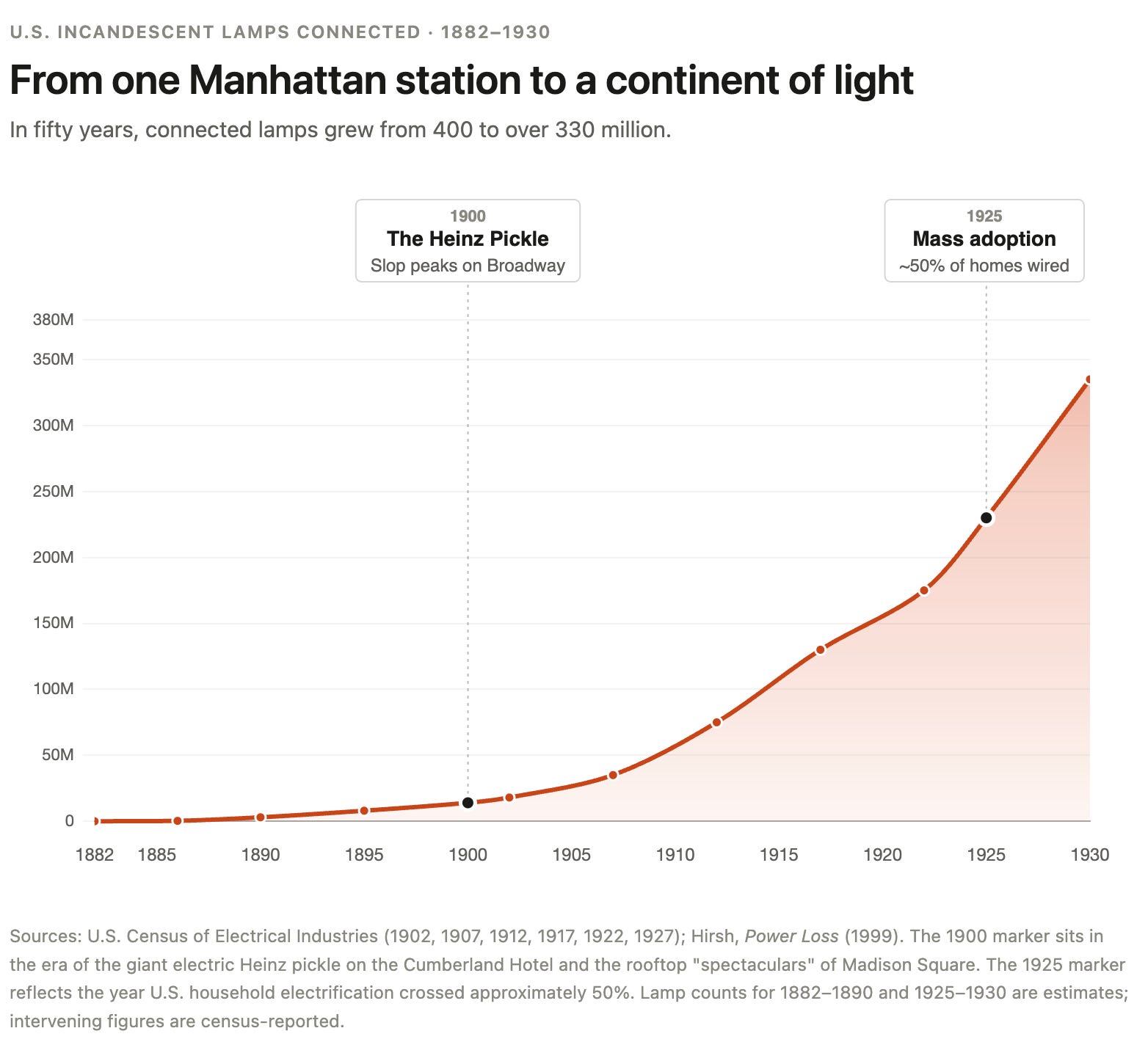
This became even more self-evident as the slop grew more ambitious. By the early 20th century, urban rooftops erupted with state-of-the-art brain rot like “Leaders of the World,” a 2,000-square-foot sign on top of New York City’s Hotel Normandie. Depicting a Roman chariot race, it used nearly 20,000 light bulbs controlled by high-speed mechanical switches to stage a 30-second loop of stampeding horses and spinning wheels that was so mesmerizing it compelled some onlookers to view it for hours on end.
Attractions like these gave the Edison General Electric Company and other pioneers of the spark something far more valuable than approval from the likes of Robert Louis Stevenson: Early Adopters.
This was crucial, because like most new technologies, electricity was not an easy sell. Sure, it was novel and even downright magical. But it was also unproven, volatile, and complicated. All of which made its best prospects on paper its least likely converts.
Gilded Age steel mills and textile factories had massive energy demands. And the vast corporate resources to pay for power in bulk. But for enterprises of such unprecedented scale, the prospect of electrification also created a risk signal as bright as a 43-foot electric pickle. Because factories in that era were built around a single steam engine and the dense networks of overhead iron shafts and spinning leather belts that fanned out from them, retooling for electrification was far more complex than just flipping a switch. Instead, it necessitated massive investments for unclear rewards. The inefficiencies and dangers of steam power, in contrast, were the devil these enterprises already knew.
But where factory owners saw risk, others saw a dazzling competitive advantage. In 1886, Boston’s Bijou Theatre was the first customer of the Edison Electric Illuminating Company of Boston. Because early power stations were notoriously inefficient at running under partial loads–burning the same amount of coal whether one bulb was on or a thousand–customers like the Bijou that consumed massive and predictable amounts of power at once were crucial to the industry’s development. A single theater with hundreds of lamps drew as much current as dozens of homes, and they drew it at the exact time the grid needed a steady “load” to remain stable.
In this way, electric slop played a key role in funding and scaling the wires, underground cables, and massive dynamos that would eventually service both factories and individual homes.
IN SLOP WE TRUST
As revolutionary as electrification was, it wasn’t as if Thomas Edison had invented centralized energy supply, metered usage, and monthly utility bills along with the incandescent bulb. All of that already existed, in the form of the vertically integrated leviathan known as the gas industry.
By the 1880s, the industry’s leaders had established local monopolies in most large American cities. Each had its own manufacturing facilities for converting coal into gas and storing it in quantity. Each had laid thousands of miles of cast-iron pipes beneath the streets for pressurized delivery to businesses and homes. They all boasted massive service crews, lucrative municipal street-lighting contracts, and lobbyists devoted to assuring public officials that flickering gas-light was the key to a bright future.
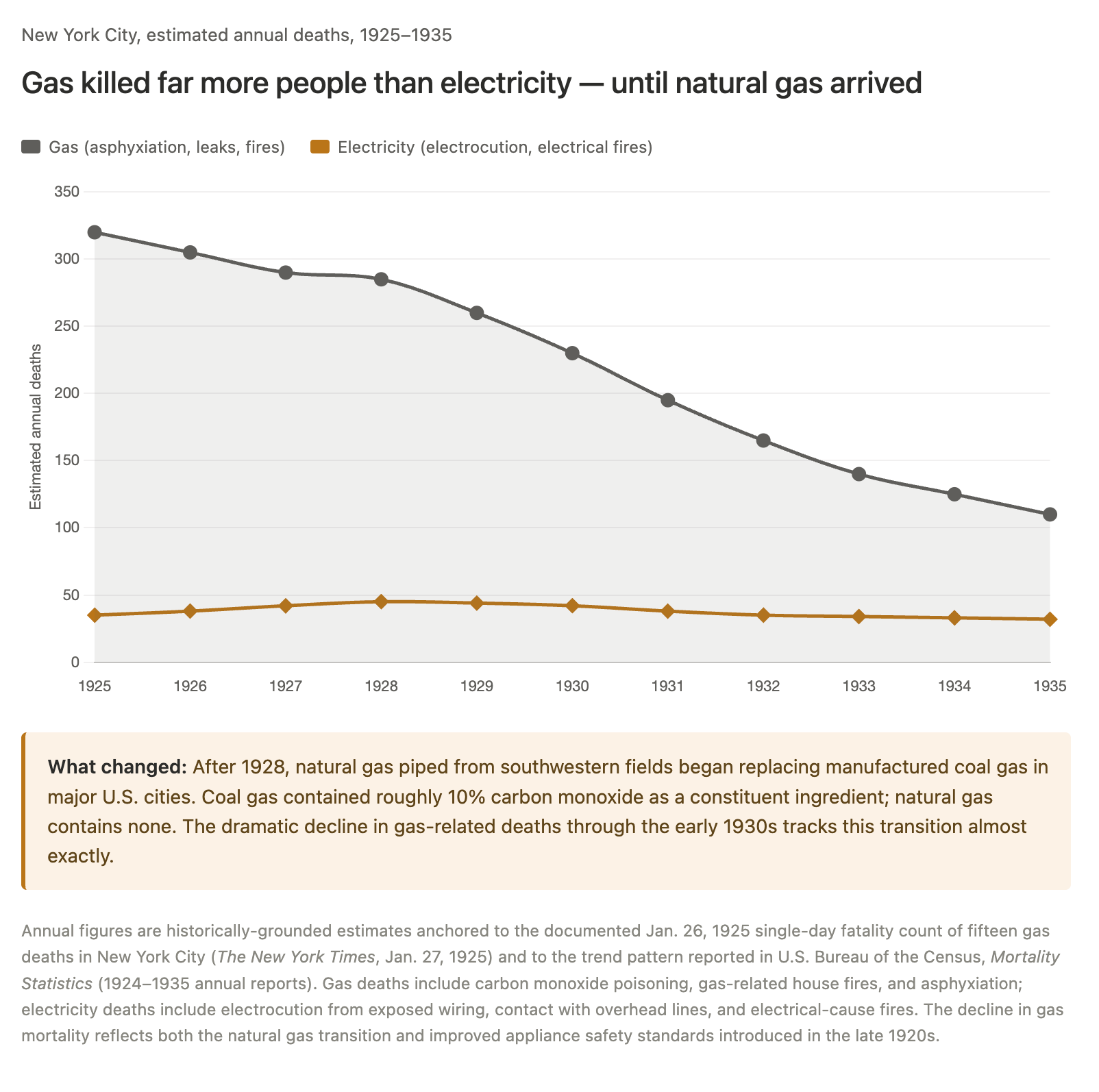
In addition to wilting houseplants and tarnishing the family silver, gas lighting also regularly caused house fires and even death. In that era, the gas being piped into homes and businesses still contained carbon monoxide as a constituent ingredient, so any crack in a pipe, valve, or fixture could potentially lead to tragedy. As late as 1925, when electricity had been in common use for a generation, there were still days when gas might claim fifteen lives in a single day in New York City alone.
Electricity brought its own dangers too, especially initially, when electricity providers were still iterating on and standardizing equipment and improving safety protocols. In the 1880s, the urban sky was filled with uninsulated, high-voltage wires strung haphazardly across rotting wooden poles. During winter storms, these wires frequently snapped, turning city sidewalks into electrified minefields. Fuses were primitive, and leakage from poorly grounded wires could cause the very walls of a home to hum or spark.
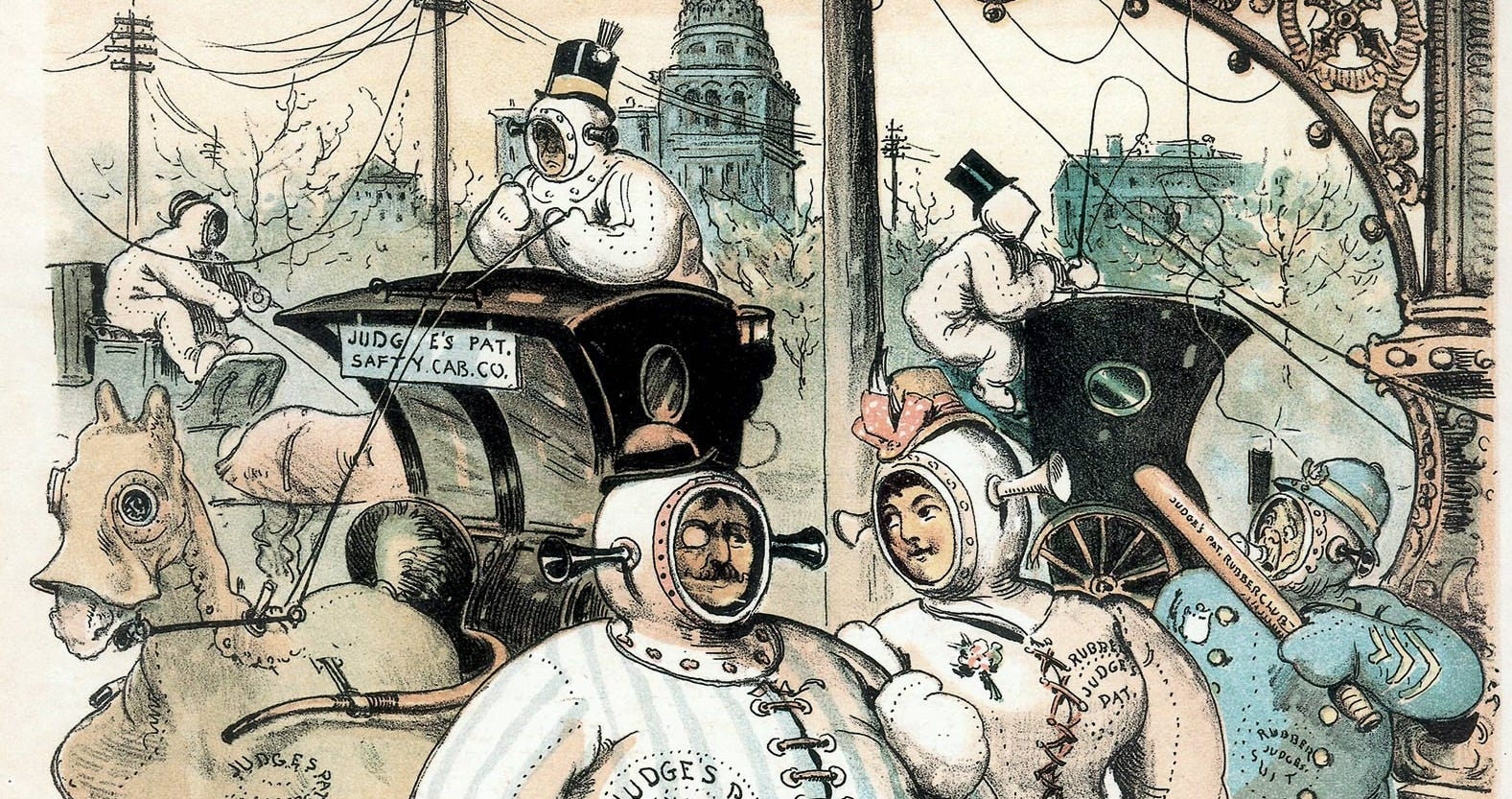
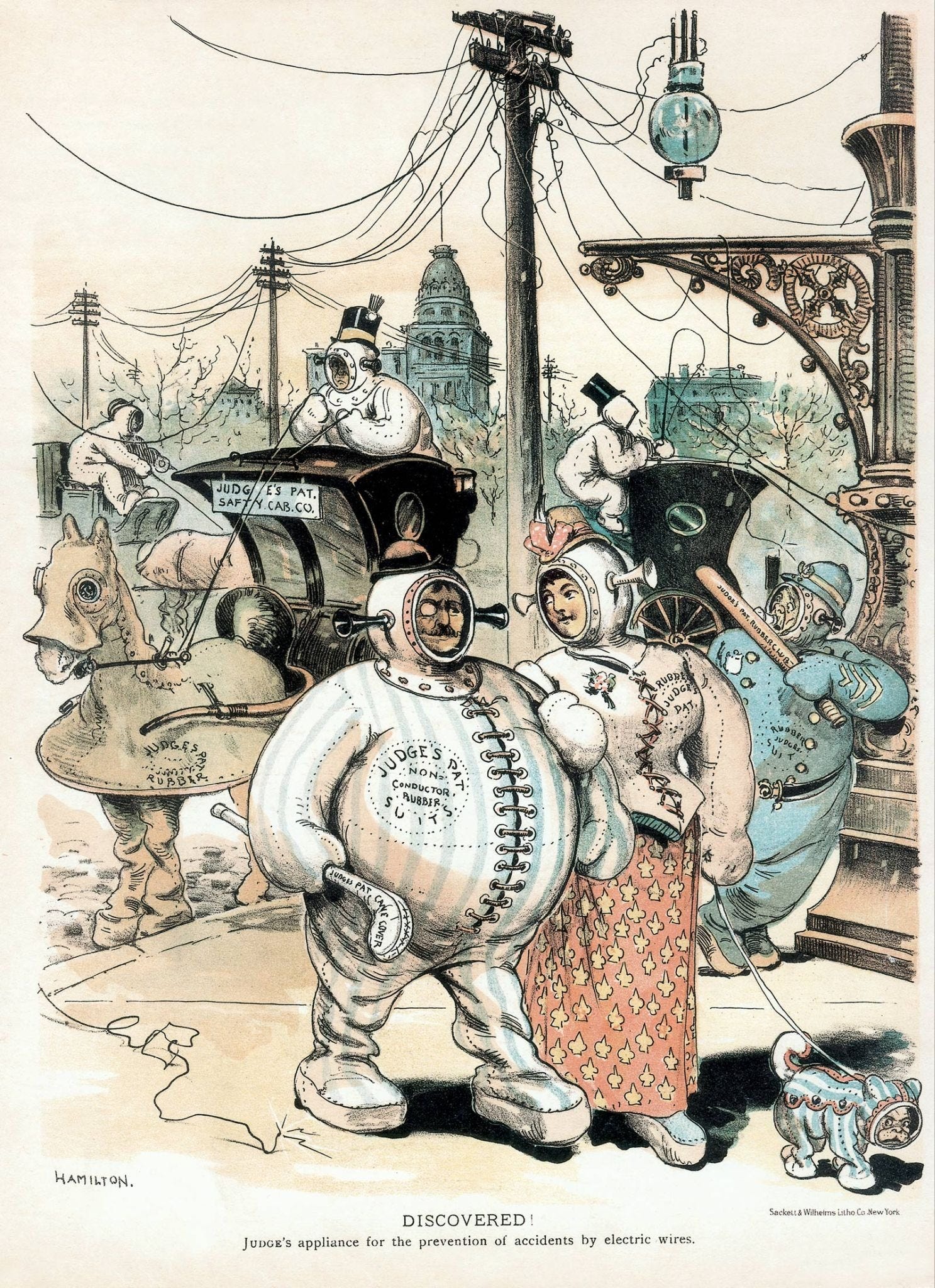
In December 1889, a cartoon in Judge, a satirical weekly, showed urban residents wearing “non-conductor” rubber suits to avoid accidents caused by the electric power lines that were beginning to crowd the streets overhead. Two months earlier, Judge’s cover had depicted an accident that had occurred in Manhattan in March 1889 when, as a Substack called The Forgotten Files recounts, “a Western Union lineman named John Feeks was electrocuted while trying to repair a broken telegraph wire.”
Even Thomas Edison himself weaponized the fears born of these early realities. In a bid to protect his direct-current empire from the more efficient alternating current (AC) championed by Nikola Tesla and George Westinghouse, he launched one of history’s most macabre PR campaigns. Under the pretext of objective safety research, Edison’s team subjected stray animals to both forms of electricity. By carefully calibrating the tests to show that low-voltage AC could kill a dog while DC merely singed it, Edison hoped to brand his rival’s technology as uniquely lethal—even lobbying newspapers to adopt the verb “to Westinghouse” as a synonym for “to electrocute.”
There was the perceived waste of it all. Critics looked at Edison’s massive Pearl Street Station—the “server farm” of its day—and saw both a substantial drain on natural resources and a quality-of-life nuisance, whose “Jumbo” dynamos reportedly vibrated with enough force to rattle the windows of neighboring buildings. Why burn tons of coal just to power a few blocks of Wall Street and a handful of playhouses, when existing (if occasionally explosive) gas networks already provided seemingly everything electricity could provide?
In the short term, at least, slop stood as the electric light industry’s most effective rebuttal. By placing the miracle of the electron inside highly visible advertising signs and other prominent public displays, electrification’s champions made their product spectacular, then familiar, then trustworthy. Night after night, as such installations cycled through loops of motion and light, the “death at every street corner” apocalypse depicted by Judge and other news media outlets from that era.
Instead, each new display seemed to prompt another: Shimmering department store wonderlands. Ocean-front amusement parks where endless strings of lights turned a night on the town to a day at the beach. Spectacular billboards whose bulbs burned even brighter than the stars in the sky, imbuing the products and services they advertised with celestial grandeur.
By 1891, there were over 1,100 central stations in the U.S., the most prominent of which were located in entertainment districts or high-end commercial hubs.
This early infrastructure set the stage for a transformation so dramatic it would change the very boundaries of human possibility. In a matter of decades, what started out mostly as a conduit for slop turned into civilization’s most important platform, re-wiring daytime and nighttime, seasons, distance, global communications, and our very definitions for progress, the good life, and modernity.
Today, critiques targeting AI and the physical infrastructure that makes it possible echo those that were once made about electrification. Data centers, in particular, have emerged as a lightning rod for current concerns around the economic, environmental, and cultural impacts of AI. In February, Time magazine cited research from a group called Data Center Watch that concluded that activists in Virginia, Indiana, and Arizona “stalled $98 billion in data-center projects in the second quarter of 2025 alone.”

That local communities possess an absolute right to explicitly approve each new instance of infrastructure that stands to shape their lives is generally not legally true. But it is a widely held instinct in democratic societies, and as such, it’s morally, politically, and operationally strategic for developers to heed it. After all, big infrastructure projects do materially impact civic identity, shared natural resources, economic opportunities, physical landscapes, and overall quality of life. If AI developers and data center operators expect to occupy a mutually productive place in the local landscape, it’s crucial that we move beyond the logic of “inevitable progress” and provide more than just boilerplate promises. Fair-market offers and a commitment to long-term coinvestment should be the table stakes here.
Even then, many communities are likely to reject such opportunities. For any community contemplating this decision, however, the power to say “Yes” is just as important as its right to say “No.”
There are obviously legitimate reasons for either decision, and in a future essay, I’ll make the case for why communities should choose data centers. For now, I’ll just reinforce the idea that slop obviously plays a key role in AI’s evolution too. We were promised AI cures for cancer. Novel insights that crack the code for limitless cold fusion. Instead what we’re getting, critics insist, is the 21st century version of the Heinz Pickle. Carcinomas persist, but at least we’ve got fake security-cam footage of cats playing late-night violin concertos on people’s front porches.
But this view mistakes the “pickle” for the “grid.” Just like the early 20th century’s central stations, today’s data centers exist as the foundational infrastructure that will ultimately make general-purpose intelligence as abundant and accessible as electricity became. Some of today’s high-performance GPUs, advanced cooling systems, and zero-latency fiber optics might be enabling little more than slop now, but if history’s any indication, that’s a sign of imminent success, not concern.
The faster we get to Peak Pickle, the more likely it becomes that we will see the 21st-century equivalents of the X-ray machine and affordable bread. In this era, that looks like personalized tutors for every child, carbon-capture systems optimized by real-time physics models, and drug discovery that moves at the speed of software. To slow-walk the build-out of data centers because we find their current output little more than “slop” is as short-sighted as it would have been to ban electricity in 1900.
In the end, it’s exceedingly hard to ration and constrain your way to a revolution. Massive transformation typically requires widespread attainable access to some new resource. Because this is true, our current moment is no doubt messy, sometimes wasteful, and frequently absurd. We are immersed in silicon pickles.
But if we want a future where AI solves the intractable problems of biology and physics, we should view slop not as a diversion or failure, but rather as a sign of progress. In the early days of electrification, the road to the hospital ran through the theater. Today we are witnessing the spectacular and ultimately substantive sequel to that story.