





I've been working in software automation for a long time, and I've had a front-row seat to how rapidly AI is changing software development. In less than a year, our teams have gone from generating almost no code with AI to having AI produce all first drafts.
Now, I've always loved programming ever since I got my first computer in the 80s. It's been one of the most satisfying pursuits, and it's one that I recommend to ambitious kids. I recommend software as a starting career because of the speed of innovation, the access to networks and capital, and the impact you would have on the world.
This is, of course, still true today, but things are changing. The news is filled with AI-driven layoffs; some are accurate, and some are AI-washing of executives' sins. I've written before that AI should not be a tool for shrinking companies. The best founders see AI as a way to raise their ambitions and build more value for the world, not less.
So, as AI changes our world, what should our children focus on in the future? What should they study? Is programming, as it is today, still a viable option? I've been grappling with this for the better part of the year, and I think I have a semi-decent answer: a good place to be is in the basic sciences and entrepreneurship. Let me explain why this is going to be an incredible place in the coming years.
AI will continue to get better and come up with "first draft" scientific breakthroughs. It might figure out the scientific foundation for building a food replicator, or a room-temperature superconductor, or lossless wireless energy transfer, or personalized vaccines, etc. These draft discoveries will need people to put them through all the motions that make it safe, reproducible, useful, and accessible at scale, from a draft prototype to a final product.
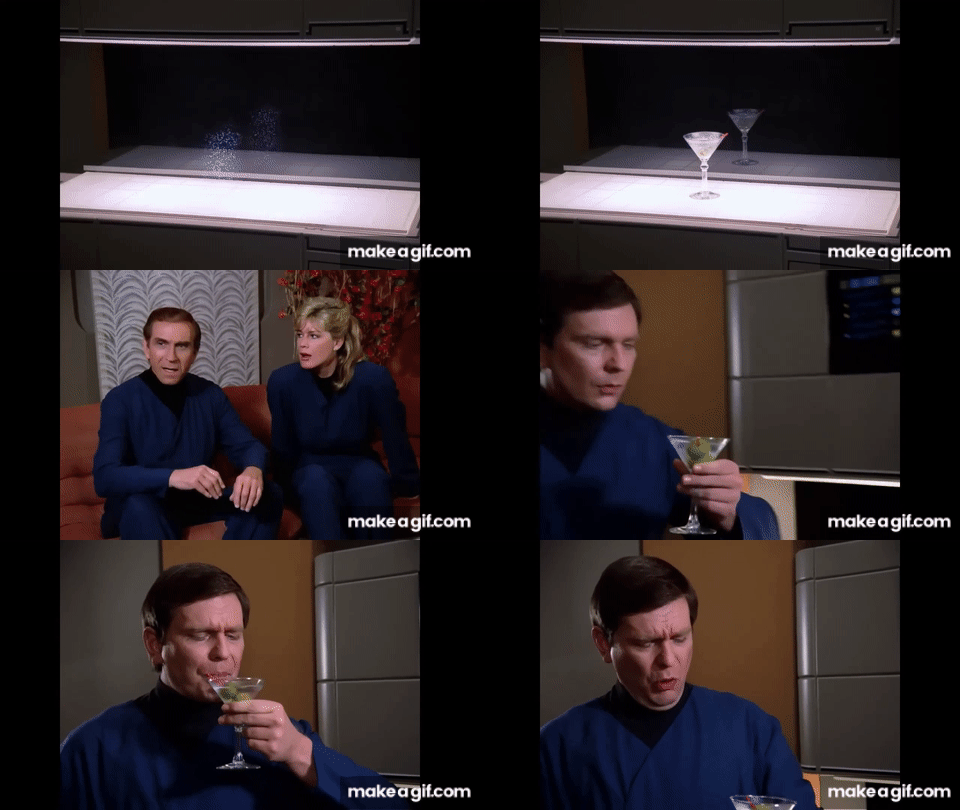
If it's a physics-related discovery, then the best people to work on that are physicists. Just like the best people to work on AI-generated code are programmers who can build the harness around it and understand the edge cases and problems we see today.
So, when AI tells you the basics of how a food replicator might work, someone will need to confirm the science, figure out which parts don't work, confirm the outputs, iterate over the replicator, run real-world experiments, generate multiple versions of the replicator, work on cost economics, and so on. I don't think a single mega frontier-lab will be able to handle all the discoveries that might come out of AI, nor do I think they'll be able to capitalize on them.
Along with basic science, you need to solve distribution and market access: regulation, manufacturing, go-to-market, trust, and economics. In theory, you could have both skills in one person, but it doesn't need to be. Sam Altman is not an AI expert, but he is leading a frontier lab, and Elon is both an entrepreneur and an expert in space tech.
Of course, entrepreneurship isn't really a "teachable" skill in the classroom sense; it's an outcome of taking responsibility, making bets, and learning by doing. This is also why I don't think frontier labs will be the only place breakthroughs turn into reality. If AI increases the number of first-draft prototypes, we'll need many small teams to translate them into real products. Those teams will be deeply software and systems-heavy, even when the breakthrough starts in basic science. This includes legal, support, logistics, procurement, and every other modern-day business function. We'll see an explosion of these teams.
When framed this way, I think it's actually quite exciting to think about what our children might be working on in the future: lower-cost food, long-shelf-life food, better and cheaper medicines, better and cheaper ways to recycle water, better and cheaper electricity…
tl;dr: the leverage will shift toward people who can validate scientific discoveries and people who can ship them into the world.
此内容由惯性聚合(RSS阅读器)自动聚合整理,仅供阅读参考。 原文来自 — 版权归原作者所有。