






Good morning from North Carolina! This is a long one, and it’s an attempt to compile much of the research around AI and the labor market that’s come out over the past several months. It explores what jobs are in the age of AI, how firms are thinking about AI, what wealth looks like, the permanent underclass problem, and a few ways to think about your future in the age of AI.
Audio version:
Audio playback is not supported on your browser. Please upgrade.
Many college commencement speakers are getting booed off stage for delighting in the productivity of AI in front of the audience it threatens to displace, cheering for all the money it will make them as CEOs, largely at the expense of the students who are supposed to be celebrating their achievement of finishing school.
Eric Schmidt, former CEO of Google, gave a commencement speech at the University of Arizona, and told students that AI was going to touch every profession and the question to answer wasn’t if AI would shape the world but whether they would shape AI (rhetorically similar but substantially different to JFK’s “ask not what your country can do for you, but what you can do for your country”). He was booed1. Real estate owner Gloria Caulfield told graduates that AI was the next industrial revolution, and was booed. Scott Borchetta, a record-label CEO, during his booing, told graduates that “you can hear me now or you can pay me later.”
The asymmetry is really the thing that is being booed here. These students have been training their entire lives for a credentialing system that is now actively being dismantled in the name of efficiency and profit. They are booing the people on stage who have benefited from the rules of a previous game, and are now lecturing them about embracing the rules of a new one. These students aren’t anti-technology, in the same way that the luddites weren’t anti-technology. They are anti-technology-without-solution and anti-future-without-hope. Of course they are booing.
I did an event at LinkedIn headquarters a few weeks ago on “Careers in the Age of AI.” It was an in-person room of about 25 recent college graduates with a livestream with people of all ages. The whole point was to talk about jobs and AI and the changing world we are all trying to figure out.
Naturally, the question that kept coming up was: what do I do right now?
And what does anyone do right now?
What does it mean to train your whole life for something, only to have a person of power call you a “lower-value human?”
How should someone think about (multiple) AI CEOs saying white-collar work will be “fully automated by an AI within the next 12 to 18 months?” but now walking back those statements?
What does a career mean anymore, and how should people think about the future they worked so hard to arrive at?
The question underneath all of that is timing. When is the life that people have been told to train for supposed to start?
According to a recent Economist/YouGov poll, over half of Americans aged 18-29 are pessimistic about AI, and over 60% are very worried or somewhat worried about AI replacing jobs. The feelings are only deteriorating more over time, with anger and anxiety becoming the dominant emotions over excitement and hope.
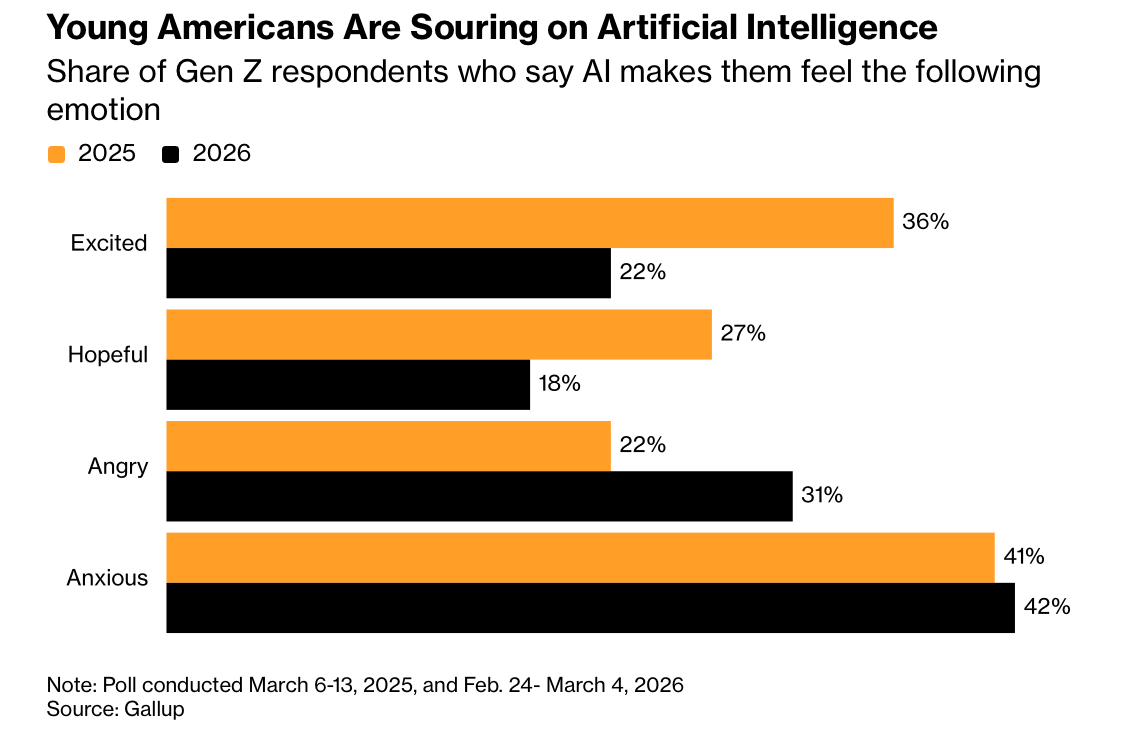
It’s hard to know what to do because we largely don’t know what’s happening yet. The data around AI and the labor market is mixed, and the people telling you that they know are mostly selling you something (usually, an AI product, like the CEOs who gallop to Twitter to delight in how efficient their AI company is in using AI so they can fire everyone).
To level set on my direct experience with jobs and job applications - I grew up in Kentucky and went to Western Kentucky University. I didn’t even know you could major in economics until I got to college, because I had never met anyone who worked in that specific field. Once I took my first economics class, I was completely hooked. I started dreaming about jobs, new cities, financial stability, and a world where I could do what I loved every day.
I started a blog, Scanlon on Stocks (oh yeah), primarily to meet more people (and met Nick Maggiulli and the Ritholtz team, to whom I owe a lot). I sacrificed much of my college time for the sake of work (something that I would do differently now, it’s okay to have a little fun) I had a 4.0 GPA, three majors, club president and founder, D1 athlete–anything you could do on campus, I was doing it, primarily to try and get a job. When it came time to graduate in 2019, I applied to over 150 jobs. I got callbacks for about 5 or 6 of them.
I had three good options. One of the options mostly existed because a recruiter from the company gave me a chance. He had noticed the blog and the initiative and gave me the chance to try, which was all I really needed. And I got the job.
In 2019, a human being read my resume.
In 2026, that doesn’t always happen. Humans have more or less exited the job process. The hiring funnel has been almost entirely intermediated by AI on both sides. As Derek Thompson wrote about last year, it’s a “plexiglass wall” with both applicants and companies throwing technology at the process, neither side really seeing each other. Much has changed since I applied, including how we think about jobs.
But the story that most people tell about how the economy works is not even from 2019, it’s from many, many years ago, the glowing boom of the Post-World War II economy. Work hard, get a degree with enormous government support, buy a house with enormous government support, raise a family, get an awesome pension. Sometime in the 1970s and 1980s something went wrong–globalization, automation, high interest rates, the death of pensions, housing as a speculative asset–and we entered a long stagnation.
In recent years, entry-level hiring has been depressed. Unemployment for college graduates aged 22-27 is 5.6%, up sharply from 3.6% before the pandemic. Guy Berger notes in a WSJ interview that today’s college graduates have usually done better in the face of a weakening job market than they are doing now.
Part of it is this AI confusion/problem/opportunity—an April 2026 paper finds that when/if AI absorbs the work juniors used to do, firms cut junior hiring, which weakens the pipeline that creates future seniors. The result is “lost cohorts” of juniors who don’t get the training they need.
Part of it is other problems, including pandemic overhang. A study of 243 million hires across four countries finds that when you separate the effect of AI from the effect of remote work, remote work turns up as the likeliest culprit of a recent collapse in entry-level hiring. When teams went remote, the cost of supervising and training a junior went up, so firms stopped hiring them.
Both papers point to firms kind of giving up their juniors. That’s a core rung on the economic ladder that young people are missing out on. The booing is rational.
So the entire AI conversation has been organized around one question: will AI replace your job, yes or no, and as we can see in the results from these papers, it’s really not clear what is happening. That’s why a framework for thinking about jobs is so important.
Alex Imas has written many excellent pieces on AI and labor market displacement. He begins a piece from earlier this year discussing a widely cited 2023 paper on AI exposure, which found that around 80% of workers in the US could have at least 10% of their tasks affected by large language models. Many people interpret this as “80% of jobs are at risk,” and Imas points out that the reading is wrong—that the 80% exposure measures whether AI can do some of the tasks in a job, not whether or not the job entirely disappears.
Imas says the dimensionality of a job really matters, the number of distinct tasks it involves. A job with two tasks, one of which AI can do no problem, is a high-risk job. If a firm can automate half the job, mechanically it’s hard to justify keeping the worker.
A job with seven tasks, one of which AI can do well, is a job that probably gets more productive (if the firm is smart) because the worker has more time to do the other six tasks that can’t be automated. Imas says that the resulting productivity gains, the focus effect, can raise wages instead of eliminating the role.
He compares a long-haul truck driver to a consultant. A truck driver could be automated, because it’s theoretically one task, of going from A to B. However, a management consultant, a job that has a bundle of tasks including being a scapegoat for companies, can have some of their work automated, but the political work and client communication and presentation of results cannot be.2
Thinking of a job as a bundle of tasks, the dimensionality, is a very useful rule of thumb because it gives you a good sense of how at-risk a chosen job might be. Luis Garicano builds on Imas’s framework, offering the supply side version, and points out that firms buy bundles, not tasks, so they pay for a human so a human can do a bunch of interconnected, context-dependent tasks, because jobs are complex.
Ernie Tedeschi at Stripe Economics uses travel agents as an example of “the economic value of human expertise” as Imas calls it. In 2000, the job was exposed to automation–booking, fare aggregation, ticketing—all of it could be automated and no one was safe. Travel agent headcount fell by more than 60% from the dotcom peak. But some survived.
They survived by moving up market. Travel agents now earn close to 99% of the private-sector average wage, up from 87% in 2000. Those that survived leaned on judgement and accountability and relationships and the ability to swoop in and fix something quickly when things go wrong at 2am. Those seem to be the pillars of strength in the AI age: being able to evaluate, having some element of taste, holding accountability, building out networks, and the capacity to deliver a human touch in an increasingly automated world.
I was in line at the rental car center a few days ago. I tried to check-in online but the app kept logging me out. So I had to wait in a 20-person line that took about one hour to get through to have a human fix whatever was going wrong. The meta-work of that: finding a car, finding my profile, the payment, can all be automated. But the ability to step in when the technology doesn’t work is still something only a human can do.3
We don’t quite understand how human most jobs are. It drifts into Rory Sutherland’s Doorman Fallacy. The job of a doorman is just opening doors, right? Well, no - it’s welcoming and helping and security and a place to ask questions. A job is usually a whole lot more than it seems.
Firms are also craving some humanness. Gillian Tett at the Financial Times wrote that firms are focusing on “critical thinking” skills and are looking towards hiring students that majored in the humanities rather than STEM. Much of this is due to “shallowness” of the ideas of STEM students.
So the big question now — for financiers, regulators and educators alike — is how to create skilled AI natives who can also use the critical thinking needed to spot both the opportunities and (very real) risks in AI. Those companies which find them will be the real winners. All eyes, then, will be on the 2026 intern pool.
People optimized too much for one side of intelligence, ignoring the curation of their creative skills. Creativity is enormously valuable in the age of AI.
My take on it is that AI is sort of like freeze-dried camp food. It does a good enough job, is filling enough, but it isn’t something you want to eat everyday (trust me, I tried). People crave ineffcient, home-cooked meals for a reason, and it’s because it’s a nice thing, not that it provides a certain exact number of calories and fat and protein.
It does require some context (some bakers know that breakfast skillets are better with some avocado slices or some butter). It also leans on accountability (a chef is responsible for what they cook!) and taste (in both flavor and meal design).
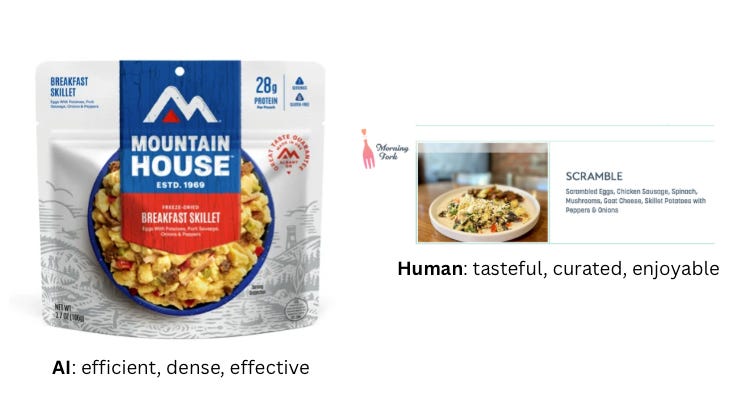
You need camp food some days. It’s good that camp food exists. Camp food is efficient and helpful. But, we still need real food too.
The technology is very expensive. Much of our assumptions on AI displacement seems to be based on the idea that it is cheaper than labor. It might be soon (Nvidia wrote in February that Nvidia’s new chip allowed the leading inference providers to reduce token (think of these as arcade coins that the AI models eat in order to work) costs by 10x), but right now, that assumption is just not true.
Agentic workflow, which consists of the multi-step work building toward context and revisions and judgement, the human-y AI, is more compute intensive than a chatbot. Upcoming frontier models could be even more expensive. Lots of arcade tokens.
In April, Uber’s CTO said that he had to go “back to the drawing board because the budget I thought I would need is blown away already.” Azeem Azhar and Hannah Petrovic cover this in a recent piece, writing that over 70% of companies exceeded their AI budgets in 2025. This stuff is not cheap!
Some of the enormous spend is good. Brian Albrecht published a long piece a few weeks ago called “You Are Not a Horse” that walks through the AI-displaces-everyone story by tracing the dollars. If AI makes some tasks cheaper, the money saved through efficiency doesn’t vanish, but rather gets spent somewhere else, which creates demand somewhere else, which keeps humans employed somewhere else.
For the horse outcome to happen (where horses are no longer our tractors and instead are living a relaxing life in the fields) every dollar of spending would have to land on activities with no human labor inside them, anywhere in the supply chain. People save money on goods because of the efficiency of AI, so they start spending money on services. The dollar has to go somewhere, and that somewhere can support employment somewhere else in the economy.
But some of the spend is bad. Companies have fired people in the name of AI efficiency, but in many cases, it hasn’t really made anything more efficient. Uber’s COO recently came out and said that “tokenmaxxing” was making it “harder to justify AI costs within the company” because more tokens spent by engineers wasn’t leading to a measurable increase in “useful consumer features.”
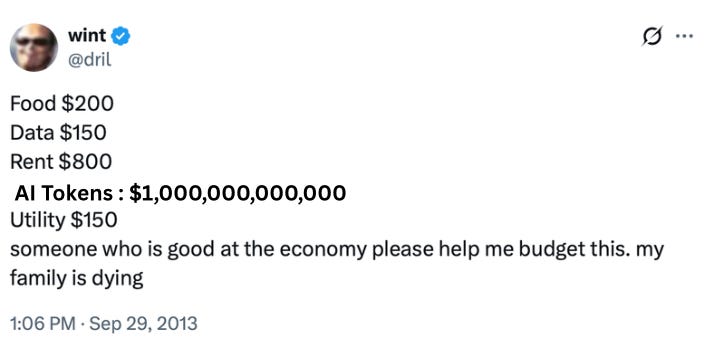
Part of this is a measurement problem (we likely don’t totally understand how to implement AI outside of “people-shaped workloads”) and part of it is AI compute is increasingly constrained and therefore increasingly expensive. More data centers or whatever might make all of this cheaper and more effective. But jobs that are expensive to automate at the moment might be safe for a while.
But for now, when you put these pieces together: the dimensionality + the bundle strength + the compute economics = a framework that is pretty useful.
Jobs that are at risk are (1) low dimensional with weak bundle strength with tasks that are already cheap to run on AI, like customer service (although, as someone that has been trying to stop my insurance from double charging me for the past several months, I would very much like a human involved) and back-office document processing and entry-level analyst work.
So if you have a high dimensional job with a lot of tasks that take a lot of compute; a job threaded with judgement and accountability and creativity, that might even benefit from AI spend, you’re probably relatively safe. Imas says that the “relational sector”, which is “human-intensive, provenance-rich, sometimes artisanal part of the economy where the human aspect is part of the value of the good or service” will become increasingly important.
But that requires firms to think about jobs in a way that is more than a cost metric, which they don’t tend to do. Axios recently reported that companies are firing employees to cover their AI bills. People are getting laid off who might have a high dimensional job because the firm could be unaware of how challenging it will be to AI that specific job. Starbucks is retiring AI inventory tooling because it kept hallucinating.
We are likely in a rough transition period of fires and rehires as we adjust to that.
Well:
Some firms are using AI. Rob Copeland reported in April that six of the largest US banks posted $47 billion in profits in Q1 2026 while shedding 15,000 jobs, and the CEOs are now openly like “AI let us do that :)” on earnings calls. In 2025, Brian Moynihan at Bank of America said that AI was “not a threat” to his 210,000 employees. In 2026, he announced that the bank had shed 1,000 jobs through “eliminating work and applying technology”. JP Morgan’s Kevon Brunner says that AI has shifted from “hype to real execution.”
Some firms are using humans to train the AI to eventually fire themselves. Meta laid off 8,000 employees in an AI-push, assigning 7,000 workers to “AI-initiative focused teams”. The SF Standard did an interview with an anonymous Meta employee (who ended up being one of those laid off) about the morale at the company. Much of the interview was focused on the sense of detachment from humanity, with the employee stating that Meta is “not at all empathetic enough or human enough in how they are leading humans through [the AI] era.”
Some firms are designing their own AI. Kirkland & Ellis, the world’s highest-grossing law firm, announced in May that it’s spending $500 million to build its own AI platform designed using information from 250 of its lawyers about how they do their jobs, instead of using a product like Harvey. The chair, Jon Ballis, told the FT the idea is to “take the collective intelligence of our institution and be able to deploy that throughout our firm.” The senior generation pouring its knowledge into a system that will eventually do the work that juniors used to do to learn the job.
Some firms are having mixed results. Gillian Tett at the Financial Times wrote about a Judge Business School survey of over 600 finance and AI companies that found that about 80% of private sector finance groups are using AI, but only 40% reported any profit boost from it. 60% of respondents actually expect AI to increase hiring or reskilling at their firm.
Many firms are not using it at all. Only 1 in 5 firms across the board are actually using AI, as Guy Berger notes in his piece on AI adoption. That’s with a pretty strong growth rate—Federal Reserve’s Jeffrey Allen does a great breakdown of the three public surveys we use to gauge AI adoption, noting that the adoption rate grew 70% from late 2024 to late 2025—but it’s still pretty low, considering how much money the companies are spending and for all the fuss it makes.
Ernie Tedeschi ends his piece on travel agent employment by highlighting a framework around job displacement:
On the one hand, AI disruptions to the labor market may be delayed and not salient until (perhaps even amplified by) the next recession. On the other hand, the most negative effects may be limited to specific occupations rather than broad-based, and as prices and wages adjust, those occupations may even look more favorable over time
He points out that (1) we might not see any real AI impact until we see a recession and (2) specific jobs might be impacted rather than the labor market and (3) those specific jobs might be fine in the long run.
David Solomon, the CEO of Goldman Sachs, wrote a New York Times op-ed last week titled “The A.I. Job Apocalypse Is Overblown.” His argument is the standard optimistic one: the economy has absorbed technological transitions before (electrification, the digital revolution), job growth has outpaced population growth since the 1960s, and even if AI automates 25% of work hours, people will find more productive things to do. All will be well, in the long run.
The aggregate case is fine, sure, but that’s not what's actually breaking people.
In April, Goldman Sachs economists published a paper telling a different story. They examined four decades of individual-level data on workers displaced by technology, and the findings line up with Tedeschi’s concern.
Workers displaced from technology-disrupted occupations take about a month longer to find a new job and suffer real earnings losses of more than 3% on reemployment.
Ten years out, their earnings are still nearly 10 percentage points behind workers who were never displaced, and 5 points behind workers who were displaced from more stable occupations, known as “scarring” effects.
Tech-displaced workers experience delayed homeownership and delayed household formation, with the effects amplifying significantly in recessions. To be clear, this type of displacement has always worked like this. The costs land on individuals for a very long time. The economy will adjust in the long-run, but the adjustment period can still suck. Jasmine Sun summarizes it well with a quote from Carl Benedikt Frey:
Most economists will acknowledge that technological progress can cause some adjustment problems in the short run. What is rarely noted is that the short run can be a lifetime.
The economy can absorb AI the way it absorbed previous technologies, slowly, unevenly and with new sectors appearing at the same time that the rungs of the economic ladder are getting squeezed. But jobs are only one part of the AI conversation. Wealth creation is another important part.
Wealth is mainly a combination of labor income and investment income and real estate. True wealth comes owning shares of companies, and the US stock market is meant to be that wealth-creation opportunity. Companies go public because that’s the promise we made people—don’t worry, tying your retirement to the stock market is going to go really great because all of the biggest companies go public and you, the general public, can participate in the upside. And retire. But companies don’t go public anymore.
Deedy Das wrote a post about Silicon Valley where he estimates that about 10,000 people, those working at Anthropic and OpenAI and Nvidia and Meta have all hit retirement-level wealth, more than $20 million dollars within the past five years. Everyone outside of that circle is frothing at the mouth to try and get in, but the door has closed—the companies are pushing back against people selling secondaries, meaning that the most enormous wealth engine in history is increasingly confined to just a few people. OpenAI and Anthropic4 are both sniffing around IPOs, but both are near $1T private market valuations, which could leave little room for more upside.
As Joachim Klement wrote “the IPO of these AI companies is probably nothing more than a major transfer of investment risk from the current owners to retail investors, pension funds and others who are willing to buy the hype.”
SpaceX just filed to go public after 24 years—they are unprofitable on $18.7 billion of revenue, losing almost $5 billion last year, and are about to IPO at a $1.5 trillion valuation, with Musk holding 85% of the voting power. This is a company that we are asking people to build their retirement on!
If you don’t own equity here (or more importantly, work at one of those companies and have access to shares regular people can only dream about) your participation in the AI boom is entirely through the lens of: is this thing going to destroy my life?
Much of the age of AI is like this, the privatized gains and socialized losses. It’s a contributor to the discourse around the “permanent underclass.” Jasmine Sun wrote about this concept in the New York Times a few weeks ago, the idea that if you don’t get wealthy now, you will never, ever be successful. I spoke to a room of Stanford undergraduates a few weeks ago and that term was floated a few times.
People are living in fear of the economy.
The vibecession, the marked disconnect between economic data and consumer sentiment, is back in the discourse again, with terrific new research from Jared Bernstein and Daniel Posthumus pointing to enormous price level variability as a driver of negative sentiment and Annie Lowrey at the Atlantic advocating for erasing the term entirely and replacing it with the term “permacession.”
I read the 600+ comments on her piece — all of them, plus many on r/Economics. Most relitigated what she’d already granted and what many people grant when the vibecession comes around: that housing and healthcare and groceries are brutal. But the ones who actually engaged her question — why the vibecession exists — kept talking about the concept of economic security, which appears to be defined as a:
Bounded downside: an illness or layoff can’t erase everything you’ve built
Predictable floor: you can count on and plan around where you are
Reward for work: A perceived link between effort and outcome still holding
Anticipated progress: And a believable path to the next thing: the job, the house, the kid.
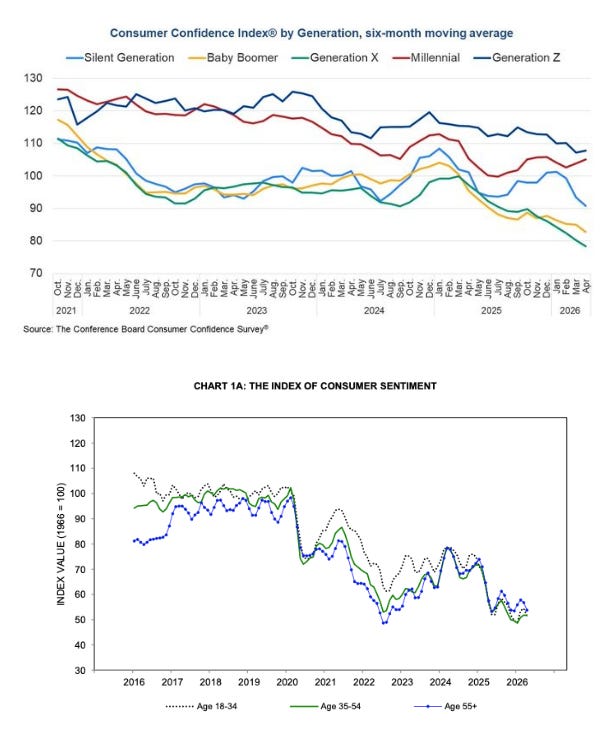
The vibecession is complicated, but there seems to have been a structural break in sentiment in 2022, I think largely driven by structural gaps in how people feel connected to their economic reality. Economic data captures a moment, but I think sentiment is capturing people’s concern about their economic future. People can’t save, so of course, they aren’t going to think to positively about the future they can’t save for.

Heather Long@byHeatherLong
This is stunning. Personal savings rate April 2025: 5.5% Personal savings rate April 2026: 2.6% That's a sharp plunge. It underscores how squeezed Americans are right now with higher prices and incomes not keeping up. Maybe you can explain some of this away by Baby Boomers

1:05 PM · May 28, 2026 · 168K Views
70 Replies · 664 Reposts · 1.47K Likes
Below are the charts for consumer confidence and consumer sentiment, both nosing downwards, with the University of Michigan Consumer Sentiment Survey5 showing a marked decline among all generations (most notably, for Gen X, the increasingly squeezed ‘sandwich generation’).
When none of those four conditions of economic security hold, the casino looks rational. Of course it does. Prediction markets did roughly $25 billion in volume in April alone. A recent Wall Street Journal article found that 70% of Polymarket bettors have lost more money than they made. The system is designed to extract from people who need a fast win and to compound for people who can afford technology to get ahead.
There are also people who are opting out of the system because they have economic security. While middle-class kids are being told to embrace AI to keep up, wealthy families (including many who make the AI products) are pulling their kids out of algorithmic credentialing entirely. No-screens private schools are growing, with handwritten essays, oral examinations, in-person seminars, human access: you can pay your way out of technology.
The elite version of education is becoming analog. Everyone else is stuck talking to ChatGPT. The thing that is good for you is something that you have to be wealthy enough to access. AI (probably?) isn’t going to destroy your life, but it’s accelerating the closure of doors that were already closing, and the panic about that is rational.
I do think we are facing a duration problem, which ties into the economic security/vibecession issue. Things are just taking longer than they used to. Career formation takes longer because retirement is pushed farther out, which is great because people are living longer but creates career ladder issues.
Skill compounding takes longer. Family formation, home ownership, financial stability, career stability–it’s all getting pushed out by about 5ish years. The thing that used to happen between 18 and 25 is now happening between 25 and 30.
The news cycle and the social media cycle and the AI hype cycle and the casino cycle have all gotten faster, and the timescale of building a durable adult life has gotten slower, and the gap between those two things is enough to drown in.
25 is the new 18, you might say. Figuring out who you are, what you’re good at, how the world works is now happening later. Partly because of the pandemic knocking a few developmental years off (I lost a good chunk of my early twenties to COVID and now am 28 years old and just now figuring out how to be a person in the modern universe). It’s a different clock than what the world expects from young people.
So the failures that we often state as problems–the delayed home buying (which is also part of high mortgage rates and high home prices) and the marriage data and the wage data and all of the other data–those are functions of people just taking a long time. It’s a longer development timescale colliding with a faster extraction timescale.
That’s why the cheating and casino economy is so enticing. Everything takes so long. The despair and the doom and the booing and the financial nihilism are all rational responses to being told you are behind on a schedule that quite literally cannot apply to you.
Tyler Cowen published some notes on jobs advice in the age of AI. His first principle is to look for “messy jobs,” the ones hard to describe, that change by the day, with many discrete tasks, as well as work in biomedical, work in energy, run experiments, gather data. Go where the capex is going. I think it’s terrific advice, and wanted to compile other things I’ve heard over the past several months.
Pick the manager, not the company: The training pipelines that used to build up junior employees have been more or less gutted across most white-collar industries. The single biggest variable in whether your first job teaches you anything is the person who manages you, so as you go through interviews, try to get a sense of what that relationship might be like.
The search is the job: One warm introduction is worth fifty cold applications. If you don’t have a network, the work of building one is the work.
Lean into creativity: Gillian Tett’s piece makes this really clear. Firms want good thinkers, and they are prioritizing creativity. They want people who are unique and who can look at hard problems and come up with novel solutions. Original thinking is an asset in the age of AI. The goal isn’t to compete with the AI, but to be the person who knows what to do when it all stops working.
Build something: Networks come from building a living portfolio online. It’s very unfortunate that Twitter has devolved into what it is now, but the smartest people in the world still flock to the site. Building a voice, interacting with people on social media, and developing evidence that you can think in public is enormously valuable. Ernie Tedeschi wrote a terrific piece about the surge of new US business applications, specifically the rise of AI solopreneurs who are using the technology to run companies or side businesses.
Be AI native, not AI proof: What jobs get more leverage from AI? Sarah Eckhardt and Nathan Goldschlag at the Economic Innovation Group have been tracking this and found that students are flocking toward AI-exposed degrees, not away. Part of this is momentum–the jobs that pay the most tend to the the most AI-exposed, like finance and engineering. This is the importance of learning about the tooling behind AI. We can boo AI, and we should for the way people talk about it, but there is still opportunity. Being able to help a non-tech company automate some tasks is likely one of the fastest growing jobs out there.
The Pope was the first world leader to really go toe-to-toe with AI. It was a relief (especially as a Catholic, it was cool) to see someone say something substantial and thoughtful. The Pope acknowledged that AI is indeed helpful, but it’s not morally neutral. It needs guidance.
We otherwise don't know what AI is to us, evidenced by Paul Graham, one of the people who pushes the private market around AI forward, working it out in real time on Twitter:
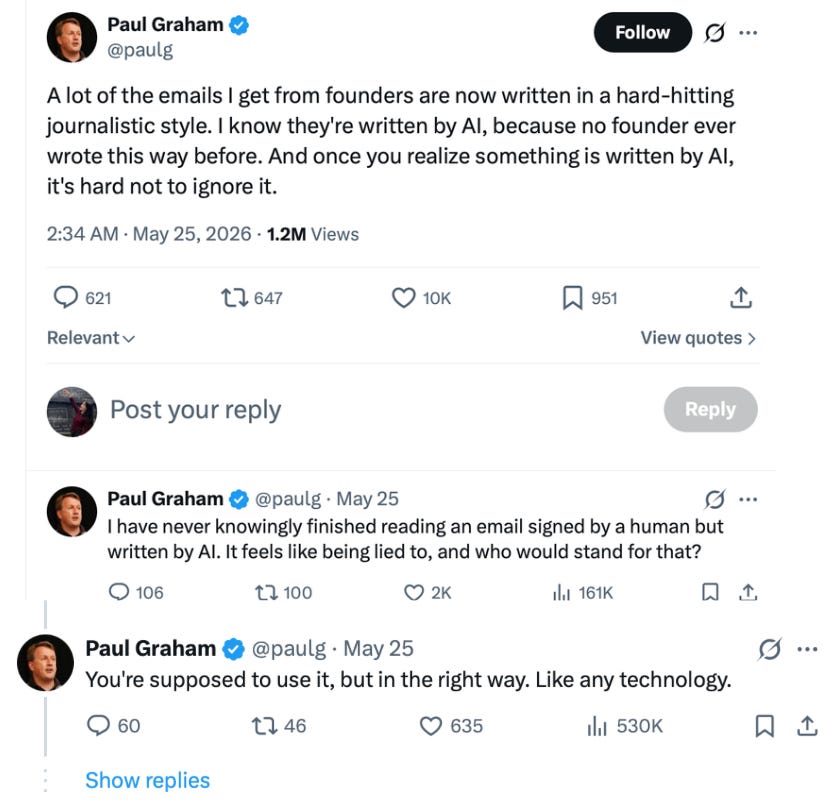
There is a “right” way to use the product, but no one has made that clear, at any level, other than Pope Leo. The discourse around AI is growing increasingly negative, and a technology that could have been used as a force for good, was marketed as a job killer.
The despair and the doom and the booing and the financial nihilism are all rational responses to being told that you are behind on a schedule that doesn’t really apply anymore. The rules are changing. Bounded downside, a predictable floor, reward for work, and a believeable path to the next thing are the conditions under which a future feels possible. For a lot of people, none of that holds.
Thanks for reading!
此内容由惯性聚合(RSS阅读器)自动聚合整理,仅供阅读参考。 原文来自 — 版权归原作者所有。