



POD! On YIMBY Pod this week, Martin and I look at Zack Polanski’s claims about the price of food, and I make myself popular by defending, er, the Big Supermarket. Then we speak to the excellent Thomas Ableman about how the Swiss would have built HS2 completely differently. Listen here, or wherever you get your pods!
Building stuff in Britain is a nightmare.
The arguments are well rehearsed by now. Our planning system is wildly bureaucratic with applications sometimes running to thousands of pages, and even the most thoughtful developments can be killed at the behest of a handful of grumpy councillors.
The government’s Planning and Infrastructure Act, which received Royal Assent at the end of last year, was definitely a leap in the right direction, and I do not want to play down its significance. It’s an important law, which reformed environmental mitigation, established a legal basis for creating local development corporations, and it shifted many smaller-scale planning applications from committee meetings to council planning officers’ discretion.
But fundamentally, these are upgrades to the existing system, and we haven’t moved to something bolder, like a system based on zoning, where buildings are effectively approved by default, as long as they meet a given zone’s criteria.
This means that if you want to build something in Britain, even something simple like a loft extension or a garden office, it still requires you to submit a tonne of paperwork to the council, and then to wait for a decision before you can get started.
This is very irritating, as it can involve long, uncertain waits. Officially, the statutory target is an eight-week turnaround time for decisions on small/minor household applications, but in practice it can take longer as councils only have a fixed number of planning officers available to scrutinise and approve the roughly 350,000 applications made every year.
And the impact of this sluggishness shouldn’t be underestimated. It’s essentially a tax on building, and a self-inflicted hit on the economy. Less gets built, productivity falls, and it ties up money earmarked for investment and financing.
However, all of this could be about to change, at least a little bit. Today the government has announced a pair of new projects to help planning officers make decisions faster. One is being built in-house by the Ministry of Housing, Communities and Local Government (MHCLG) and the Department of Science, Innovation and Technology (DSIT),1 and the other is an £8.2m collaboration with Google and Faculty AI.
And as luck would have it, I’ve got some behind-the-scenes details on how the two systems are going to work.
The fundamental bottleneck on planning application processing is the time available to council planning officers. According to MHCLG, the average council planning department has around 40 people,2 which might sound like a lot – but they have a lot to do, and a lot of their work is tedious grunt-work.
For example, many existing historic planning documents are not yet digitised, and are still stored on paper in filing cabinets. Which is bad if you’re a planning officer and need to consult the archives. So before you can even begin to consider an application, you need to digitise the existing documents.
Annoyingly, this is a process that could conceivably take hours, as the planning officer would have to scan the paper map and associated documents, and spend time manually transcribing information, and carefully drawing out a detailed digital map with a mouse.
But this is where the first tool, dubbed ‘Extract’ comes in.
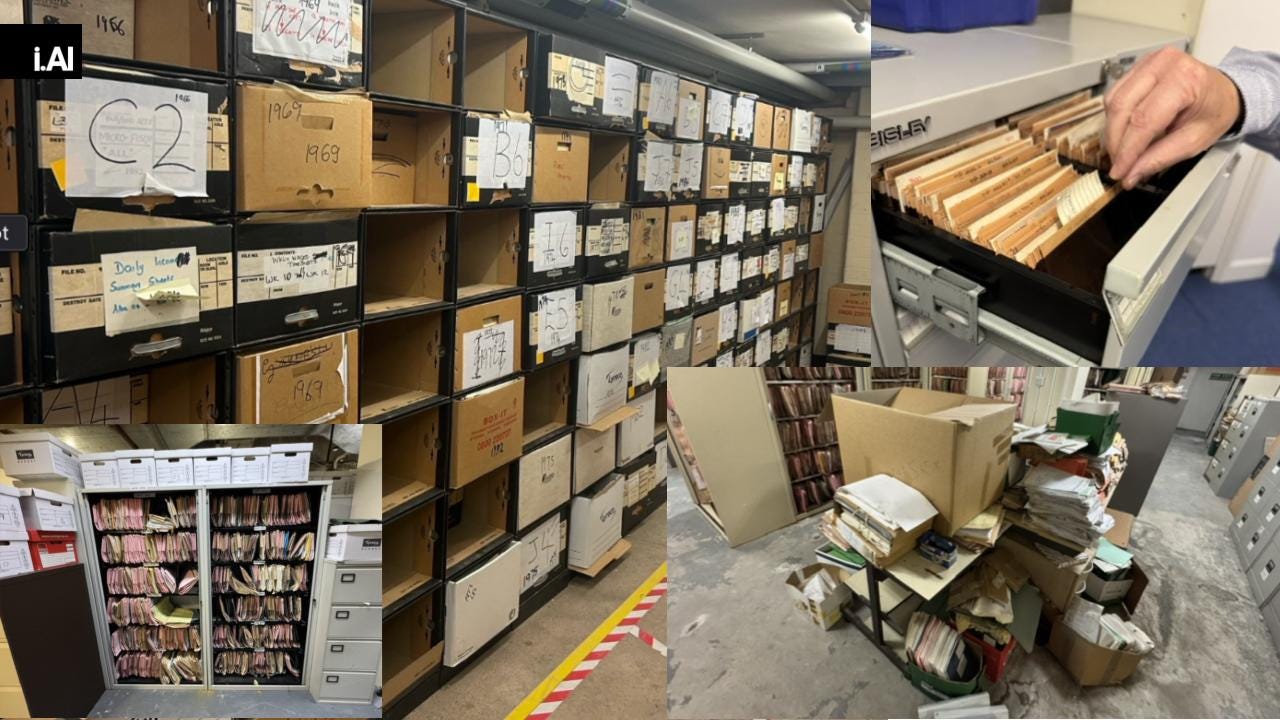
Extract was built in-house by a team at MHCLG. It’s designed to automate the entire digitisation process, and turn paper documents and hand-drawn maps into digital objects that work with modern mapping and planning tools.
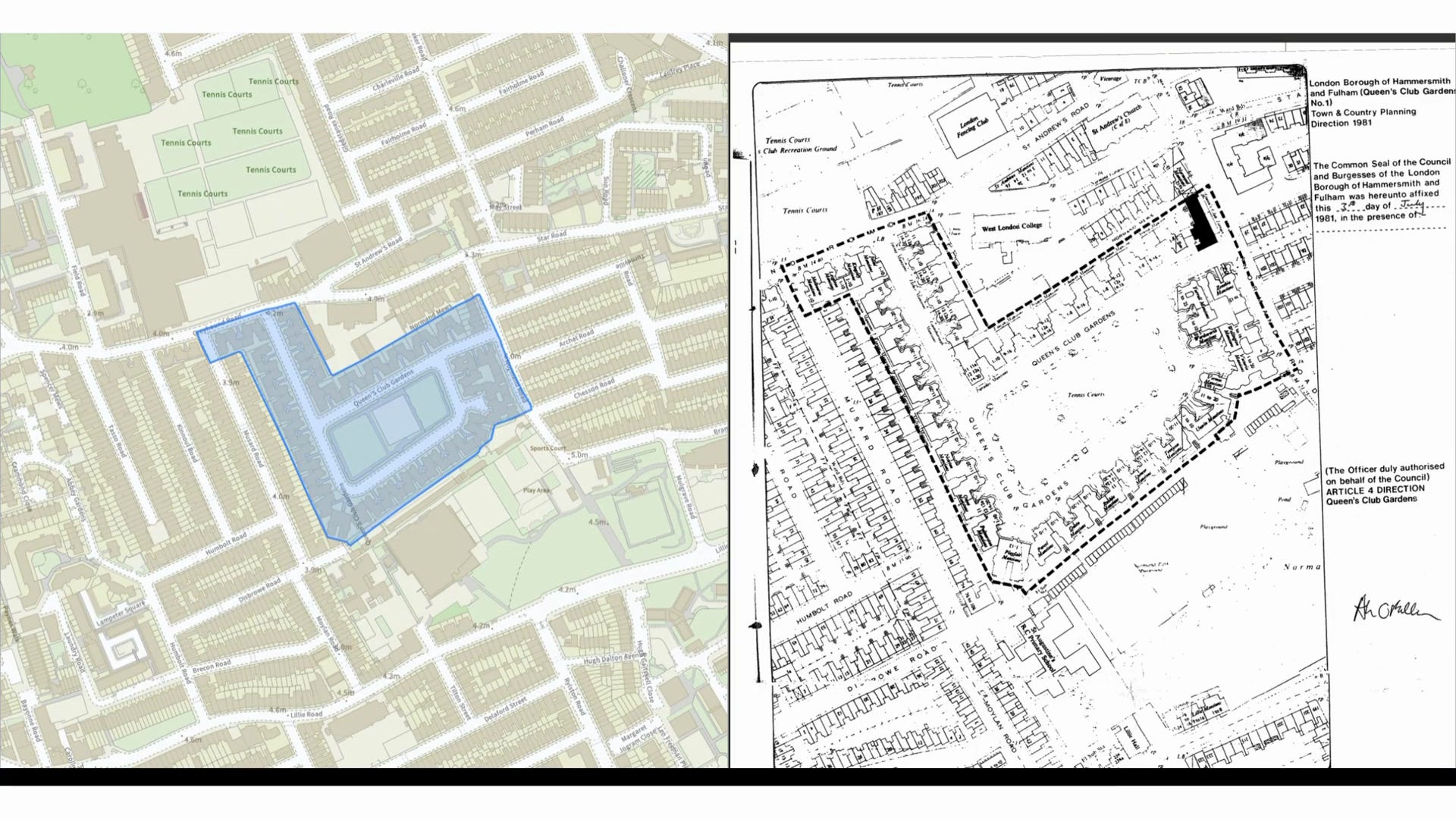
For example, above is a scan of the plans for Queen’s Club Gardens, in London. In 1981, it received an ‘Article 4’ designation, which limits what can be modified on the buildings3 – a restriction that is relevant if a planning officer has to make a decision on an application in the area. Once it was fed into Extract, it was transformed into a modern digital shape file in just a couple of minutes.
And the way it does this is incredibly clever, as to do it reliably, there’s a multi-step pipeline, that involves multiple AI models working to turn a flat drawing into something useful.
So first, the PDF scan is run through Google’s Gemini model to extract textual information, such as dates and other details about the area. In principle, this might sound straightforward, as Optical Character Recognition (OCR) has existed for a long time – but the reality is many planning documents are messy. Some are handwritten, and many of those that are typed often have hand-written notes scribbled around the edges, or lines crossed out with a pen.
But whereas this would have tripped up older software, it isn’t much of a problem for a modern Large Language Model.
Anyway, after the text, maps are also identified by the AI. They’re then chopped out of the PDF, and fed into Meta’s Segment Anything, a specialist AI model that can take an image and identify different objects within. This is how the system extracts the shapes on the map – like the shape of the perimeter of the Article 4 area above, or the houses on the map below.

But what use is a shape if a system can’t plot it on a map? That’s why next Gemini is used to look at the paper maps and extract things like the names of streets and other geographic features. These are then fed into the Google Maps and Ordnance Survey APIs, to pin-point exactly where the map is supposed to be.
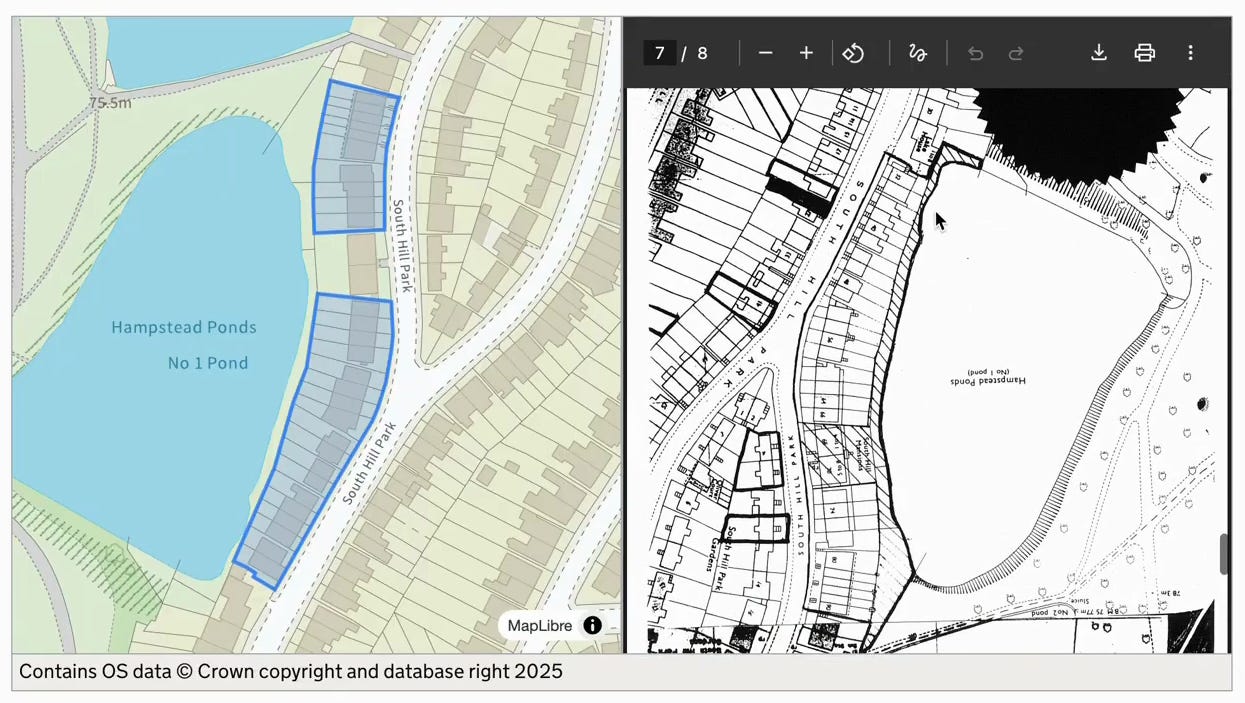
And even at this point, Extract’s job is not quite done. Because the shape file then needs to be placed on the digital map accurately. So here Extract uses another specialist AI model called MatchAnything, which has been trained to identify common points in, well, anything.
Apparently it’s capable of, for example, identifying common points in photos of the same object from different angles, and more relevantly here, it can figure out the common points on two maps of the same place where one map is digital, and the other is hand-drawn and upside-down, as in the above example from Hampstead.4
And once you have these points, it becomes pretty straightforward to work out the longitude and latitude of each of the different points on the extracted shapes. Which means Extract can even super-impose the original scan on top of the digital map, skewing the image so that it matches the digital version.
And if it doesn’t perfectly match at the end, the planning officer can go in and edit the generated shapes manually, to ensure that it is accurate.
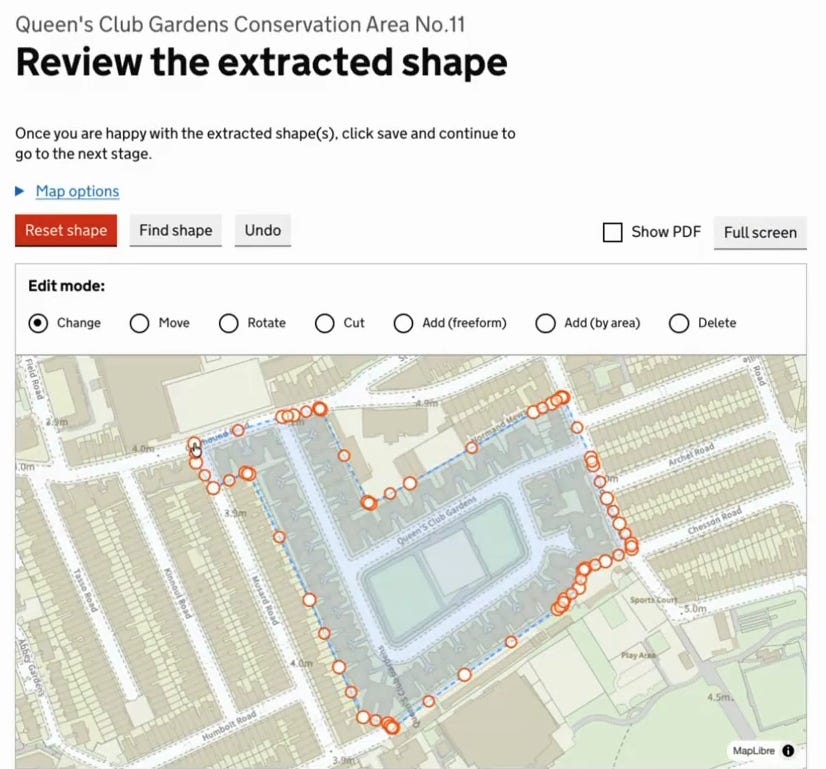
This is all to say that there is a lot going on under the surface. But what’s amazing is that apparently the average processing time to turn a scan into a usable digital object is… is 1 minute, 42 seconds, turning a process that would have taken literally hours into something that is almost instantaneous.5
So assuming Extract works as described, that’s going to be an enormous productivity boost in its own right. But this is only the start of the battle – as once all the relevant documents have been assembled, planning officers need to go through them – which is time consuming in its own right.
When a planning application is made, developers have to submit dozens, or even hundreds of pages outlining their plans, depending on the complexity. They have to explain what they want to build, and how it complies with whatever regulations apply to the local area.
Then there are often submissions from other stakeholders, such as statutory consultees like Natural England, or contributions from other residents who want to support or (more likely) oppose construction.
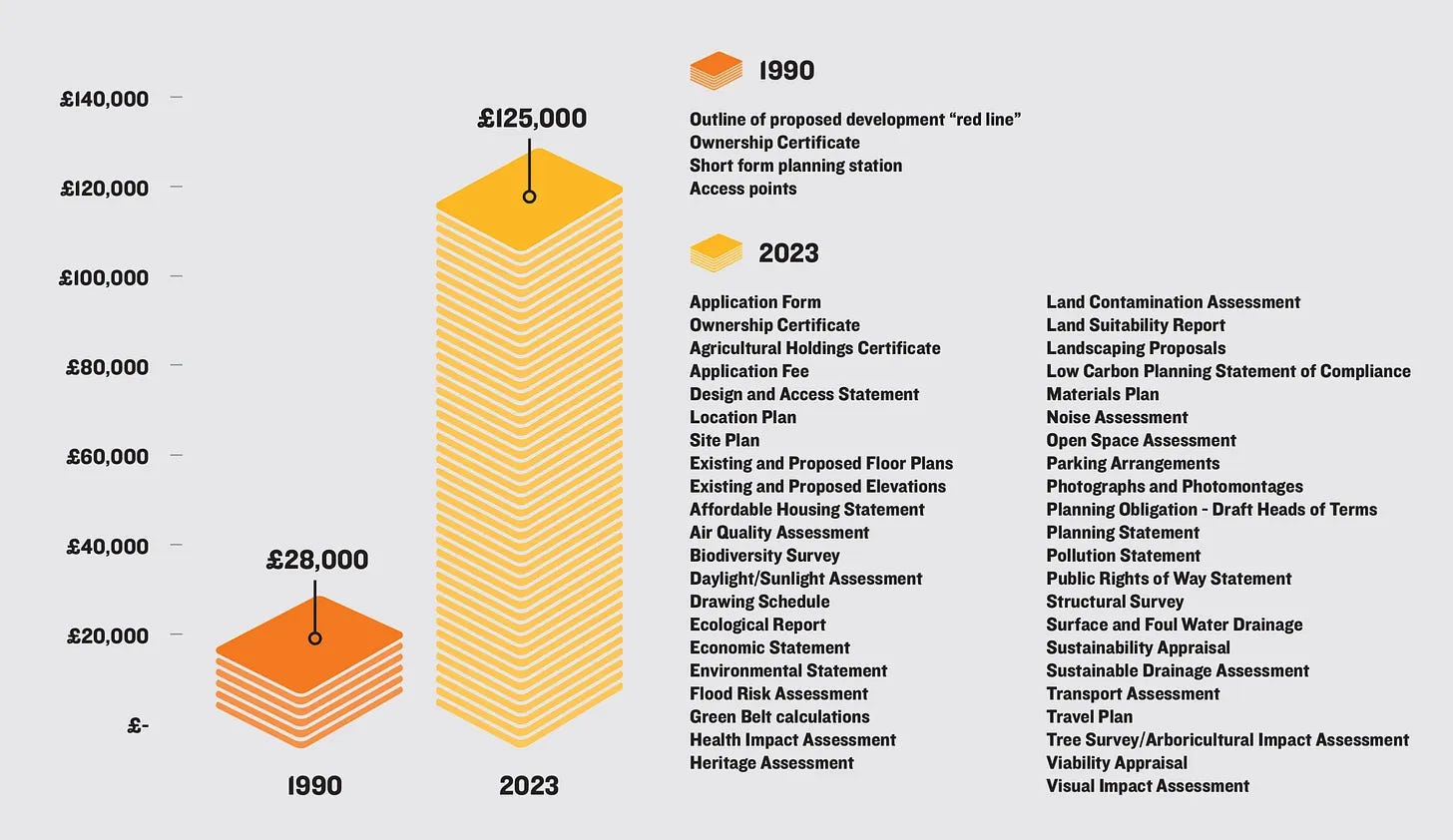
These documents all land on the virtual desk of a planning officer, whose job it is to sift through and compare what the application says with what is contained in the planning system’s many rulebooks, which stretch to thousands of pages.
For example, planning decisions may have to take into account the National Planning Policy Framework, the council’s own Local Plan, or specific local rules around conservation areas that limit how buildings are allowed to look and feel, like the Article 4 area around Queen’s Club Gardens.
So, in effect, in order to make a judgement, the planning officer has to conduct a miniature literature review, comparing guidelines against proposals to work out if the development passes the extremely complicated test or not.
This, though, is where the second AI opportunity lies. This is at a much earlier stage than Extract, but Google and Faculty are currently working with the government to prototype a system dubbed Augmented Planning Decisions – or APD.
The idea here is to take what Large Language Models (in this case, Gemini 3 Pro) are already very good at – comparative text analysis – but apply this skill in a more structured and rigorous way to planning documents. So the plan is that APD will take the hundreds of pages in a planning application, and compare them against the thousands of pages of guidance that they need to be judged against, and present a summary containing everything the planning officer needs to know to make a final decision.
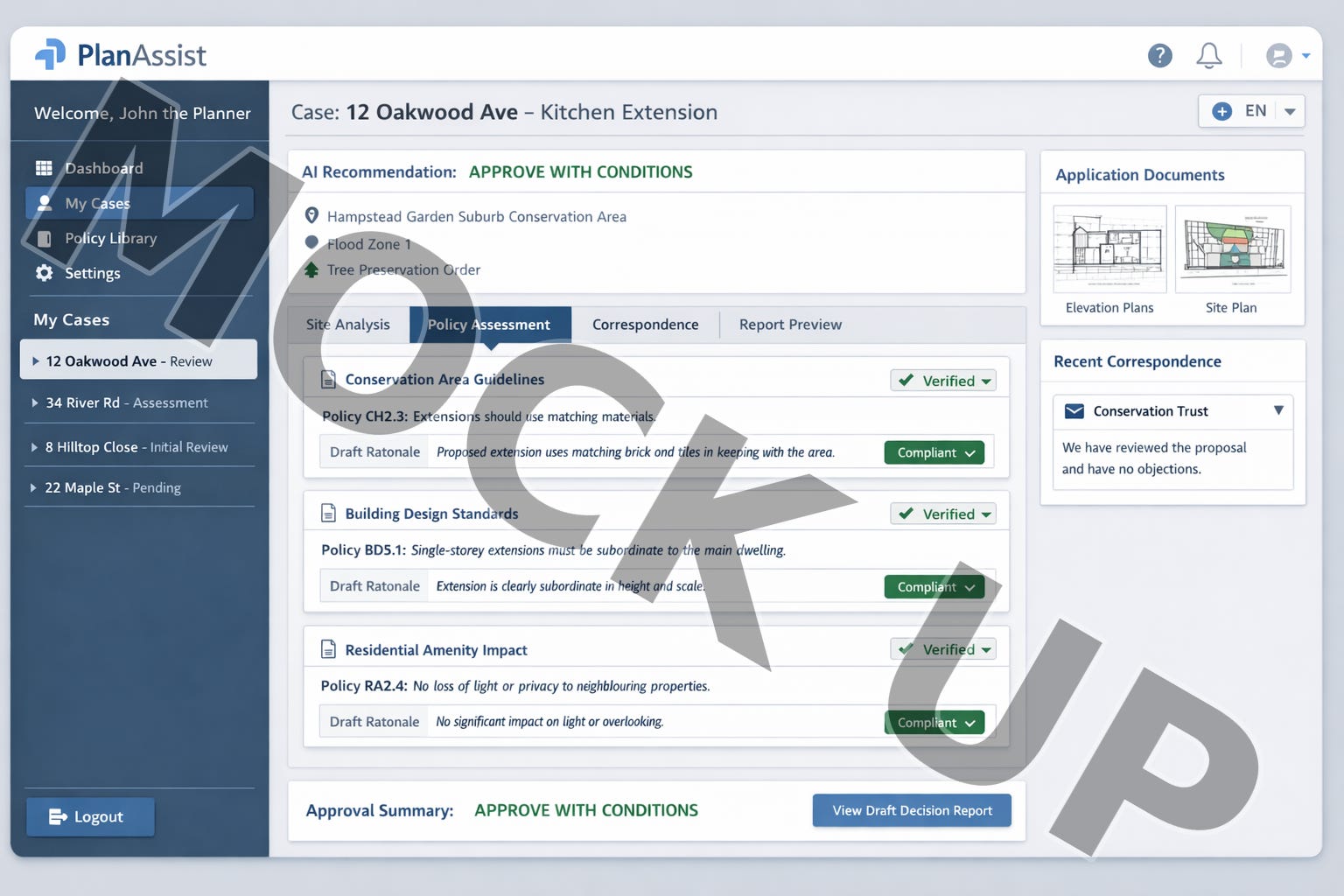
I’ve attempted to mock up something above that looks a bit like it. APD is basically a smart case management system. They can click into any application to see the AI’s reasoning, separated into all of the different criteria that need to be satisfied, each with a deep link to the specific guidance or legislation that justifies whatever conclusion has been drawn.
So all the officer then has to do is review the choices made, and decide whether or not they accept the AI’s recommendations. And even if they disagree with the AI conclusion, and change the decision before signing off on it, the system still saves a tonne of time compared to scrolling through thousands of pages of guidance manually.
At this point, depending on your level of AI-enthusiasm, you’re either pretty excited, or pretty sceptical.
I am very much in the excited camp.
Because what’s smart about the way both Extract and APD have been designed is that they are not just like if you or I were to slap a planning PDF into ChatGPT (or, I guess, Gemini) and say, “So what do you think of this then?”.
Aside from the fact that Gemini 3 Pro is a sophisticated reasoning model, and thus a cut above the experience most users have of AI models,6 both systems have been carefully designed to break tasks down into multi-step processes, to ensure greater accuracy, and avoid hallucinations.
This is especially the case, as I understand it, for APD, which functions using teams of AI ‘agents’, each given a single discrete task to complete.
For example, an individual agent could be tasked with determining a single basic fact about the proposal like identifying the type of dwelling, to determine whether the application is for a bungalow or a semi-detached house, and so on.
In fact, I understand this can get really granular, with agents spun up by the system to figure out really specific details, such as individual measurements for one wall in one room, or to dig one specific piece of guidance out of a larger document.
And I’ve even heard talk of how Faculty plans to build in “judge” agents, where one AI will critique the work of others, to sense-check it before showing it to a planning officer. And other agents will carefully consider where explicit human judgement is required, such as when planning guidance demands that developments be kept ‘in keeping with the local character’, or whatever NIMBY nonsense councillors demand.
So that, in a nutshell, is how the government is planning to use AI to speed up the planning system. To me, it seems like a striking example of how AI can actually be operationalised to boost productivity.
The planning system might still be too weighed down by red tape and too vulnerable to NIMBY locals wielding vetoes, but if decisions can be made faster, the whole system will work a lot more effectively – and hopefully get Britain building faster.
And the good news is that the rollout has already started. Extract is now available to all councils in England, having already been tested in 32 local authorities around the country. APD has already been tested in three areas – Barnet, Camden and Dorset, and the plan is apparently to scale up to ten additional councils later this year, before going nationwide next year – assuming the tests are successful, of course.
Though having said all this, I know what you’re thinking. Planning officers have much more complicated jobs than this, right? They don’t just sit at computers, evaluating loft conversions and conservatories.
In any given week, a planning officer might have to meet with councillors, negotiate with applicants on the phone or on site, or perhaps even don their windbreaker and stab vest, and go out on an enforcement mission.7
Similarly, it’s true that rolling out both Extract and APD will be a bureaucratic challenge in its own right. Similar to Digital Traffic Orders, though the core platforms have been commissioned by the government in Westminster, they will need to be taken up by local authorities on a council-by-council basis.8
But if the AI works as intended, councils try the tools out, and the paperwork side of the job is sped up, this could be transformative. It will give overstretched planning officers more time to do the other parts of their jobs – which will reduce the time from an application going in to spades hitting the ground. And that’s not even to mention how much less annoying it will be to be on the other side of the planning process, as your application won’t be left in limbo for quite so long.
Perhaps though, there is another, even bigger prize if these tools are a success.
Because think about it, if AI can speed up planning, why can’t it speed up other stodgy bits of the public sector too? Planning is far from the only place in government with casework, where an official has to compare an application against a rulebook, and make a judgement.
In fact, there are countless examples to point to. Local authorities have to assess social care and special education needs, Job Centres determine what benefits people receive, the Home Office evaluates visa applications, and the DVLA has to assess whether people are medically fit enough to continue driving.
There’s no reason that similar systems to Extract and APD couldn’t be built in those cases to digitise paperwork and to assist the humans making the decisions. And ‘assist’ is the key word there. It’s important that in all of these examples, that a human also stays in the loop, and that we don’t end up with a government where ‘computer says no’ can have devastating consequences.
But I think that used carefully, like Extract and APD, AI could be transformative for casework.
And hell, planning seems like a particularly great place to demonstrate how AI-assisted casework can work, as though planning is important, the stakes of whether Rupert and Felicity get their kitchen extension are slightly lower than whether someone receives their benefits.9
So I hope that both of these tools are a success. If they work, they could not just help us build, but they could provide a template for the rest of government too.
If you enjoy ultra-nerdy deep dives into politics, policy, tech, transport, and media, then you will like my newsletter. Sign up (for free!) to get more like this direct to your inbox.