
惯性聚合 高效追踪和阅读你感兴趣的博客、新闻、科技资讯
阅读原文 在惯性聚合中打开

推荐订阅源

B
Blog
C
Cybersecurity and Infrastructure Security Agency CISA
Microsoft Security Blog
B
Blog RSS Feed
云风的 BLOG
云风的 BLOG
G
Google Developers Blog
Recent Announcements
A
About on SuperTechFans
cs.AI updates on arXiv.org
Google Online Security Blog
Google DeepMind News
S
Schneier on Security
S
Secure Thoughts
T
The Exploit Database - CXSecurity.com
Martin Fowler
Martin Fowler
P
Proofpoint News Feed
Security Latest
Security Latest
Jina AI
Jina AI
D
Darknet – Hacking Tools, Hacker News & Cyber Security
Recorded Future
Recorded Future
T
Tor Project blog
有赞技术团队
有赞技术团队
H
Hackread – Cybersecurity News, Data Breaches, AI and More
N
News | PayPal Newsroom
博客园 - 三生石上(FineUI控件)
MyScale Blog
MyScale Blog
cs.CV updates on arXiv.org
Last Week in AI
Last Week in AI
F
Full Disclosure
Hacker News: Ask HN
Hacker News: Ask HN
Forbes - Security
Forbes - Security
D
DataBreaches.Net
人人都是产品经理
人人都是产品经理
NISL@THU
NISL@THU
C
Cisco Blogs
Recent Commits to openclaw:main
Google DeepMind News
Project Zero
Project Zero
IT之家
IT之家
T
Threatpost
Cyberwarzone
Cyberwarzone
O
OpenAI News
cs.CL updates on arXiv.org
J
Java Code Geeks
P
Proofpoint News Feed
The Last Watchdog
The Last Watchdog
月光博客
月光博客
Latest news
Latest news
MongoDB | Blog
MongoDB | Blog
Apple Machine Learning Research

Hacker News - Newest: "AI"

AI can't read an investor deck AI as an attorney? Student uses ChatGPT, Gemini to sue UW over alleged racial discrimination Hacking MCP Servers in AI Systems – The Rug Pull: Tool Changes After Approval GitHub - MeepCastana/KubeezCut: Free Web based video editor GitHub - GenAI-Gurus/awesome-eu-ai-act: Curated tools, official sources, OSS, templates, and guides for EU AI Act compliance. Can AI judge journalism? A Thiel-backed startup says yes, even if it risks chilling whistleblowers Coming soon: 10 Things That Matter in AI Right Now DARPA built an AI to fact-check enemy weapons claims What explains heterogeneity in AI adoption? When AI Meets Muscle: Context-Aware Electrical Stimulation Promises a New Way to Guide Human Movements - Department of Computer Science AI Changed How We Build. It Did Not Change What Matters. Linux rules on using AI-generated code - Copilot is OK, but humans must take 'full responsibility for the… Meta spins up AI version of Mark Zuckerberg to engage with employees Code Mode: Let Your AI Write Programs, Not Just Call Tools | TanStack Blog GitHub - Delavalom/graft: Go framework for building AI agents. Type-safe tools, multi-provider (OpenAI, Anthropic, Gemini, Bedrock), zero vendor SDKs. India's TCS tops estimates, says new AI models did not dent services demand Gen Z's fading AI hype Strong feeling: we are in a folded AI reality GitHub - machinarii/total-recall-catalog: A reference catalog of latest knowledge retrieval, memory & RAG systems GitHub - mensfeld/code-on-incus: Give each AI agent its own isolated machine with root, Docker, and systemd. Active defense detects and stops threats automatically.. Quantization, LoRA, and the 8% Problem: Benchmarking Local LLMs for Production AI Iran war: We spoke to the man making Lego-style AI videos that experts say are powerful propaganda Powell, Bessent discussed Anthropic's Mythos AI cyber threat with major U.S. banks GitHub - immartian/bellamem: Persistent belief-graph memory for AI agents. Retrieves decisive context by importance — not recency, not RAG, not /compact. recursive-mode: The Repo-Native Operating System for AI Engineering After the attack on Sam Altman's home, will AI CEO's go on the offensive? The biggest advance in AI since the LLM Opus 4.6 vs GPT 5.4 One Prompt Unity World Generation Test “AI polls” are fake polls Client Challenge Can AI be a 'child of God'? Inside Anthropic's meeting with Christian leaders How to Switch AI Chatbots and Why You Might Want To GitHub - MattMessinger1/agentic_refund_guardrail: Safe refund policy layer for AI agents — Python + TypeScript. Same behavior, shared tests. Adam/papers/emergent_values_whitepaper.md at master · strangeadvancedmarketing/Adam Ask HN: How do you stop playing 20 questions with your AI coding tools How far can automation and AI support psychotherapy? - @theU GitHub - stagas/rtdiff: realtime git diff gui and AI-assisted commits A Mac Studio for Local AI — 6 Months Later A History of the Early Years of AI at the University of Edinburgh Why AI Coding Tools Still Feel Stuck on Localhost MSN AI Datacenters Are Becoming Strategic Targets twitter.com Penn Researchers Use AI to Surface Unreported GLP-1 Side Effects in Reddit Posts Show HN: MoodSense AI (ML and FastAPI and Gradio, Deployed on Hugging Face) Moodsense Ai - a Hugging Face Space by aman179102 AI models are terrible at betting on soccer—especially xAI Grok GitHub - xialeistudio/echoic GitHub - HimashaHerath/github-dev-wrapped: AI-powered weekly GitHub activity reports deployed to GitHub Pages GitHub - alejandrobalderas/claude-code-from-source: Architecture, patterns & internals of Anthropic's AI coding agent — reverse-engineered from source maps AI and Tech brief: Ireland ascendant GitHub - Titovilal/context0: Context0 - Never Surrender Training for a Marathon with an AI Coach: What Worked and What Didn't Cyber Pulse: Agentic Intel - Apps on Google Play I Built an AI PR Reviewer That Catches Bugs by Not Looking for Bugs Gen Z workers are so fearful AI will take their job they’re intentionally sabotaging their company’s AI rollout | Fortune How AI Is Reimagining the Game of Golf–For Both Players and Courses GitHub - nattergabriel/reseed: A CLI tool for managing and distributing agent skills across projects Is SVG the final frontier? My AI workflow evolved from prompts to a near-autonomous workflow MLSharp Help - 3DGS Viewer & Generator I put my cognitive field based AI's runtime on GitHub Is Numble the first AI-proof game? A3: Kubernetes for autonomous AI agent fleets | Emergent Principles Deepali Vyas ("The Elite Recruiter") GitHub - msmarkgu/RelayFreeLLM: A restful API designed to route user prompts to various AI model providers. Unionized ProPublica staff are on strike over AI, layoffs, and wages Unleashing the Advantage of Quantum AI We're heading for an AI-fueled 'dementia crisis,' brain scientist warns The AI-Assisted Breach of Mexico's Government Infrastructure [pdf] GitHub - stef41/lmscan: 🔍 Detect AI-generated text and fingerprint which LLM wrote it. Open-source GPTZero alternative. Zero dependencies, works offline. MSN GitHub - visionscaper/collabmem: Enabling long-term collaboration with Agentic AI - building up episodic and world model memory over time with in-context awareness We gave an AI a 3 year retail lease in SF and asked it to make a profit | Andon Labs AI Code is Hollowing Out Open Source, and Maintainers are Looking the Other Way What leaked "SteamGPT" files could mean for the PC gaming platform's use of AI AI is the boss at this retail store. What could go wrong? GitHub - Wuzu11517/agentic-proxy: Local proxy meant to help reduce With Drones, Geophysics and ArtificiaI Intelligence, Researchers Prepare to Do Battle Against Land Mines A Single Operator, Two AI Platforms, Nine Government Agencies: The Full Technical Report 在 Steam 上购买 FriedrichAI: Offline AI 立省 10% GitHub - inevolin/resume-cli: Hit Claude usage limits? Resume any AI coding session elsewhere. Switch tools at zero friction. GitHub - atripati/ark: AI Runtime Kernel — a context operating system for AI agents. Eliminates tool bloat, loads only what’s needed, and gives LLMs their reasoning space back. How to Build a Secure AI PR Reviewer with Claude, GitHub Actions, and JavaScript This Startup Wants You to Pay Up to Talk With AI Versions of Human Experts Intel Arc Pro B70 Brings 32GB VRAM to Local AI for $949 WordPress 7.0: The Good, the AI, and the Still Missing AI on the couch: Anthropic gives Claude 20 hours of psychiatry IatroBench: Pre-Registered Evidence of Iatrogenic Harm from AI Safety Measures AI Agents Know About Supabase. They Don't Always Use It Right. The history and future of AI at Google, with Sundar Pichai Inside an AI‑enabled device code phishing campaign How Meta Used AI to Map Tribal Knowledge in Large-Scale Data Pipelines AI for Systems: Using LLMs to Optimize Database Query Execution Forecasting the Economic Effects of AI Introducing Tinker: Play with AI, bring your ideas to life AI sheds light on an ancient gaming mystery People really hate AI but not as much as Iran—or Democrats | Fortune What is an AI Product Engineer? Phoebe Gates wants her $185 million AI startup to succeed with 'no ties to my privilege or my last name': 'I have a chip on my shoulder' | Fortune
Is AI-written code buggier than human code? We measured it
Raghav Chamadiya · 2026-06-18 · via Hacker News - Newest: "AI"

Ask ten engineers whether AI-written code is buggier than the code they write by hand and you'll get ten confident answers, roughly half in each direction, and zero of them backed by a number. It's one of those questions where everyone has a prior and nobody has the data. The takes are loud, the measurements are scarce, and the few measurements that exist tend to be a survey of how people feel about AI code rather than what the code actually does once it's merged.

So we measured it the way the defect-prediction field measures everything else: by going back through the git history of real projects and blaming every bug fix to the commit that introduced the bug. We did this across 28 public repositories and 112,382 commits spanning the first year of coding agents merging real pull requests, and then we asked a simple question of the data. When an agent wrote the commit, was it more likely to be the one that planted a bug than a human commit in the same codebase?

The short version: no. If anything, the opposite. And the agent-written lines that did land stuck around longer than the human-written ones. The longer version, with the caveats that make me actually believe it, is the rest of this post.

The first problem with this question is that "AI wrote it" isn't one thing. A senior engineer driving Claude Code through a careful refactor and an unattended bot opening PRs on a schedule are both "AI code," and lumping them together would hide whatever signal exists. So before measuring anything we built a per-commit provenance detector that reads eight different signals: bot account identities, service email addresses, commit-message footers, co-author trailers, and merged-PR evidence like agent branch prefixes and PR-body markers. We then blind-validated it, handing 124 commits to six independent reviewers, and it came back at 96.2% precision, with six of the eight detection channels perfect. The one real failure mode, a human pushing a follow-up commit inside an agent's PR, gets its confidence downgraded so we can filter it.

With provenance in hand we split agent commits into three tiers and, importantly, never pooled them:

  • T1, bot agents. Near-autonomous, no human in the immediate loop. Think Devin, the Copilot coding agent, Cursor's cloud agents.
  • T2, human-driven agents. Claude Code, Codex, and friends, where a developer is steering and reviewing as they go. This is the overwhelming majority of agent commits in the wild.
  • T3, AI-assisted. A co-author trailer and not much else, the lightest touch.

That tiering turns out to matter, because the tiers behave differently, and any honest version of this story has to keep them apart.

The standard tool here is SZZ, named after Śliwerski, Zimmermann and Zeller. The idea is mechanical: find the commits that fix bugs, then git blame the lines they changed to find the commit that last touched those lines, and call that earlier commit the one that introduced the bug. Do this across a whole repo and you get a labeled dataset of bug-inducing and not-bug-inducing commits.

We ran SZZ within each repository, comparing agent commits to human commits in the same codebase, which controls for the obvious confound that some projects are just buggier than others. Then we fit a logistic model with the lines added, lines deleted, and files touched as controls, plus a repo fixed effect, so that every result reads as "bug risk beyond what the size of the change already explains." That size control is not optional. The single strongest predictor of whether a commit introduces a bug is how big the commit is, and if you skip the control you mostly end up measuring whether agents write bigger or smaller diffs than humans.

There's one more piece of discipline that ended up being the difference between a believable result and a flattering one. Naive SZZ has a built-in bias in favor of agents here. It excludes fix commits from being counted as bug-inducers, and agents do a disproportionate amount of fixing, so the naive method quietly shields them. To catch that, we ran a stricter variant (B-SZZ) as a mandatory sensitivity check on every single result. If a finding only shows up under the friendly variant and evaporates under the strict one, it isn't real. I'll tell you below exactly where that line falls.

Here is the core result, the adjusted odds of a commit introducing a bug, by authorship tier, relative to human commits in the same repo. Below 1.0 means fewer bugs than the human baseline.
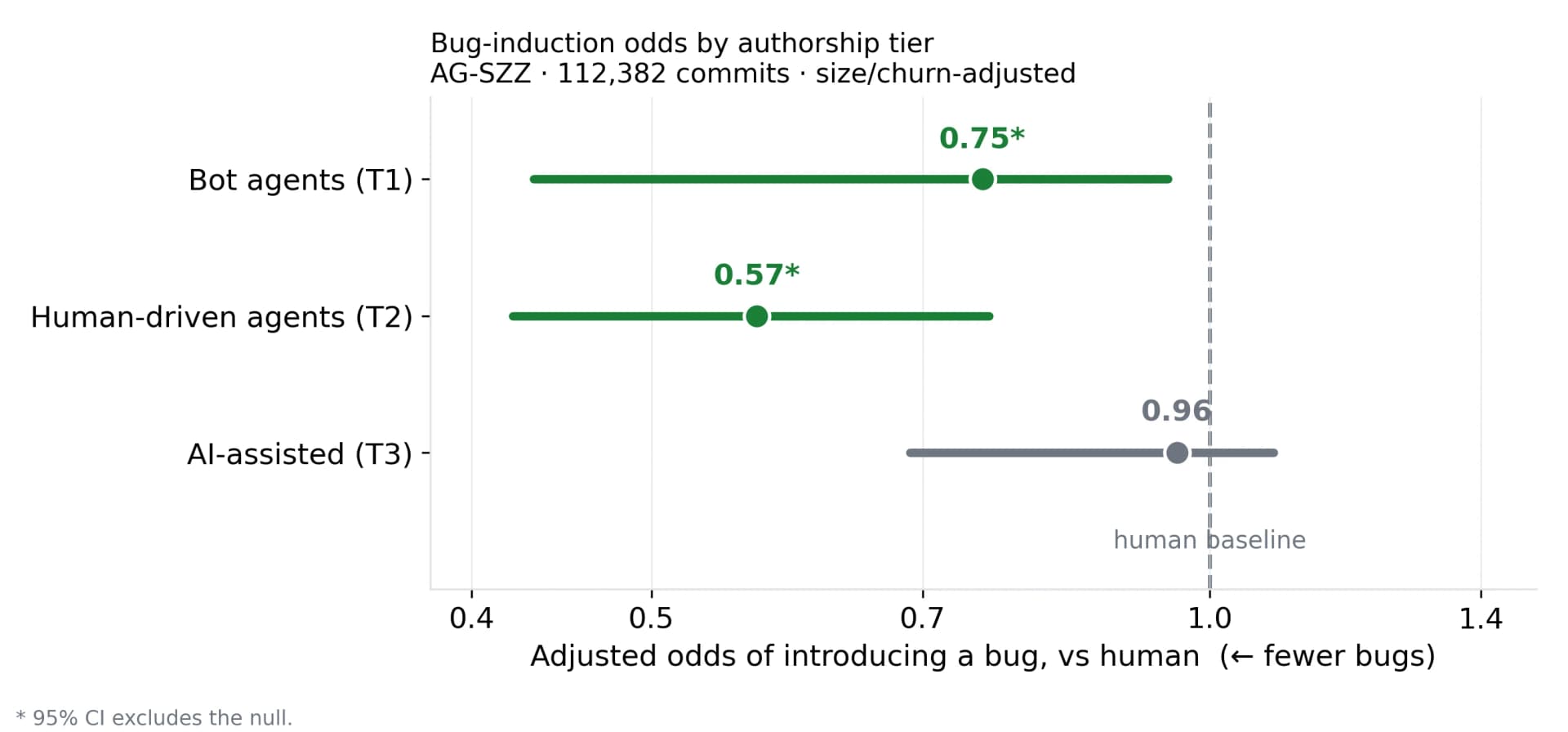
Adjusted odds of introducing a bug by authorship tier, controlled for change size and churnAdjusted odds of introducing a bug by authorship tier, controlled for change size and churn

Every tier lands at or below the human line. Human-driven agents (T2) come in at an odds ratio of 0.57, with a 95% confidence interval of 0.42 to 0.76, so the whole interval sits below 1.0. Bot agents (T1) are at 0.75 [0.43, 0.95]. The lightest-touch assisted tier (T3) is at 0.96 [0.69, 1.08], which is just indistinguishable from human, exactly what you'd expect from commits that are mostly human-authored anyway.

Now the honesty pass. Under the strict B-SZZ variant, the T2 effect attenuates toward the null: it moves to 0.79 with an interval of [0.68, 1.01] that just barely touches 1.0. So I would not stand behind the strong claim that agents are "43% less bug-prone." What I will stand behind, because it holds across every variant and every tier we tested, is the weaker and more durable claim: there is no evidence that agent commits introduce more bugs than human commits in the same repo, and the point estimates are consistently protective, never worse. The thing the loud half of the internet is sure about, that AI is shipping a wave of extra bugs, is not visible in the blame graph.

Bug induction is one lens. Another is durability: when an agent writes a line of code, does it survive in the codebase, or does it get ripped out and rewritten a month later? "Agent code all gets thrown away anyway" is a common deflection even from people who accept the bug numbers, so we measured that too.

We sampled files across the repos, took the lines added six or more months before the current HEAD, and computed what fraction were still present, paired within each repo so we're comparing agent and human lines from the same project and the same era.

Line survival to HEAD, human versus human-driven agent, paired within repoLine survival to HEAD, human versus human-driven agent, paired within repo

In every repo with enough human-driven-agent volume to measure, the agent lines survived at a higher rate than the human lines, by 17.9 percentage points in aggregate, with a confidence interval well clear of zero. The slopes all tilt the same way. The one exception anywhere in the study was a single bot-agent (T1) deployment in one repo that re-fixes its own files about three times as often as the others, and unsurprisingly its lines churn out faster. Deployment pattern, again, beats the agent's brand name.

A result this counter to the vibe deserves a mechanism, and I think there are three honest ones.

The first is selection by review. These are merged commits, which means they already cleared whatever review bar the project enforces. It is entirely plausible that agent PRs get scrutinized harder than a trusted human teammate's, and that some of the protective effect is really measuring reviewer stringency rather than the model's raw output. I'll come back to this, because it's the caveat I take most seriously.

The second is that agents are disproportionately the maintenance crew. When we characterized what agent commits actually do, they skew heavily toward fixes rather than net-new features. Fix-shaped commits, small, localized, touching code that already exists and works, are simply lower-risk than greenfield feature commits, and a lot of agent volume is exactly that shape.

The third is the boring one that's probably underrated: a lot of human commits are also not very good. The human baseline is not a senior engineer at their best; it's the realistic mix of rushed Fridays, unfamiliar subsystems, and "just ship it" that any real repo contains. An agent that is merely consistent can clear that bar.

I want these louder than the headline, because a study like this is only as trustworthy as the things it refuses to claim.

  • These are reviewed, merged commits. The result says nothing about unreviewed agent output dumped straight to a branch, and some of the protective effect is likely review stringency, not the model.
  • We can only see detected agent code. A developer who pastes an agent's output and commits it under their own name with no marker is invisible to us and counts as "human." Every agent number here is therefore a floor, not a ceiling.
  • Agent-heavy repos are young. The agent era is about twelve months deep. That's why every comparison is within-repo or against matched controls, never a raw pooled rate, and why we owe a re-run in six months when the windows double.
  • The corpus is not a random sample. It skews toward projects that keep attribution and toward AI-adjacent tooling. We deliberately oversampled boring non-AI projects (a 17-year-old Java framework, a CMS, observability and chat platforms) as counterweight, but we're not claiming population-wide rates.
  • SZZ is SZZ. Blame-based induction inherits the method's known limits with tangled commits and large refactors, which we guard against but cannot fully eliminate. That's the whole reason the strict B-SZZ variant rides along with every number.

One thing fell out of this work that's worth its own mention, because it bit us before we understood it. In repos where agents write most of the commits, the cheap way everyone labels bugs, keyword and file-level "this file was touched by a fix" heuristics, falls apart. The fix firehose is so constant that in the most extreme repo, 86% of files counted as "buggy," which drags any predictor's accuracy down toward a coin flip. For a while that looked like "agent repos break defect prediction."

It isn't, quite. What breaks is the labeling shortcut, not the underlying structure. When we moved to commit-level SZZ labels and de-spammed the obvious self-fix churn, prediction came right back; the usual signals (prior fixes, churn, ownership) work fine on agent code. It's a measurement problem masquerading as a modeling problem, which is a distinction we care about a lot, since the whole Repowise code-health score is built on getting that kind of labeling right. If you want the deeper version of how we keep these history-based signals honest, the companion posts on why process metrics beat structural metrics and whether our health score actually predicts bugs both go into the leakage traps in detail.

If you came for a verdict: the fear that AI agents are flooding codebases with bugs is not supported by the blame history of 28 real projects. Across 112,382 commits, agent commits were no more likely to introduce a defect than human commits in the same repo, the point estimates leaned protective, and agent-written lines outlived human ones. The effect is real but modest, and it lives almost entirely in the human-driven tier, the one where a person is still reviewing the diff. That last part is not a footnote. The story the data tells isn't "the robots are better," it's "a competent human plus an agent, with the human still reading the code, produces commits that hold up at least as well as that human working alone." Which, honestly, is the workflow most of us are already in.

The full report, the per-repo numbers, the strict-variant sensitivity tables, and every analysis script (so you can re-run it on your own corpus) are open in the Repowise benchmark repo. And if you want to see the same history-based health signals computed live on a real codebase, the public repo explorer runs the whole pipeline end to end. We'll be re-running this study in six months, when the agent era is eighteen months deep instead of twelve, and I'm genuinely curious whether the protective gap widens, holds, or closes. Either way, we'll show the numbers.