







Last week, Google held its annual I/O event where it presented updates to its models, new search features, Gemini updates, its own OpenClaw competitor, and much more. Like Google itself, the event seemed all over the place. Dithering aptly described this I/O as Google shipping its own org chart - AI in everything with some confusing naming to go with it.
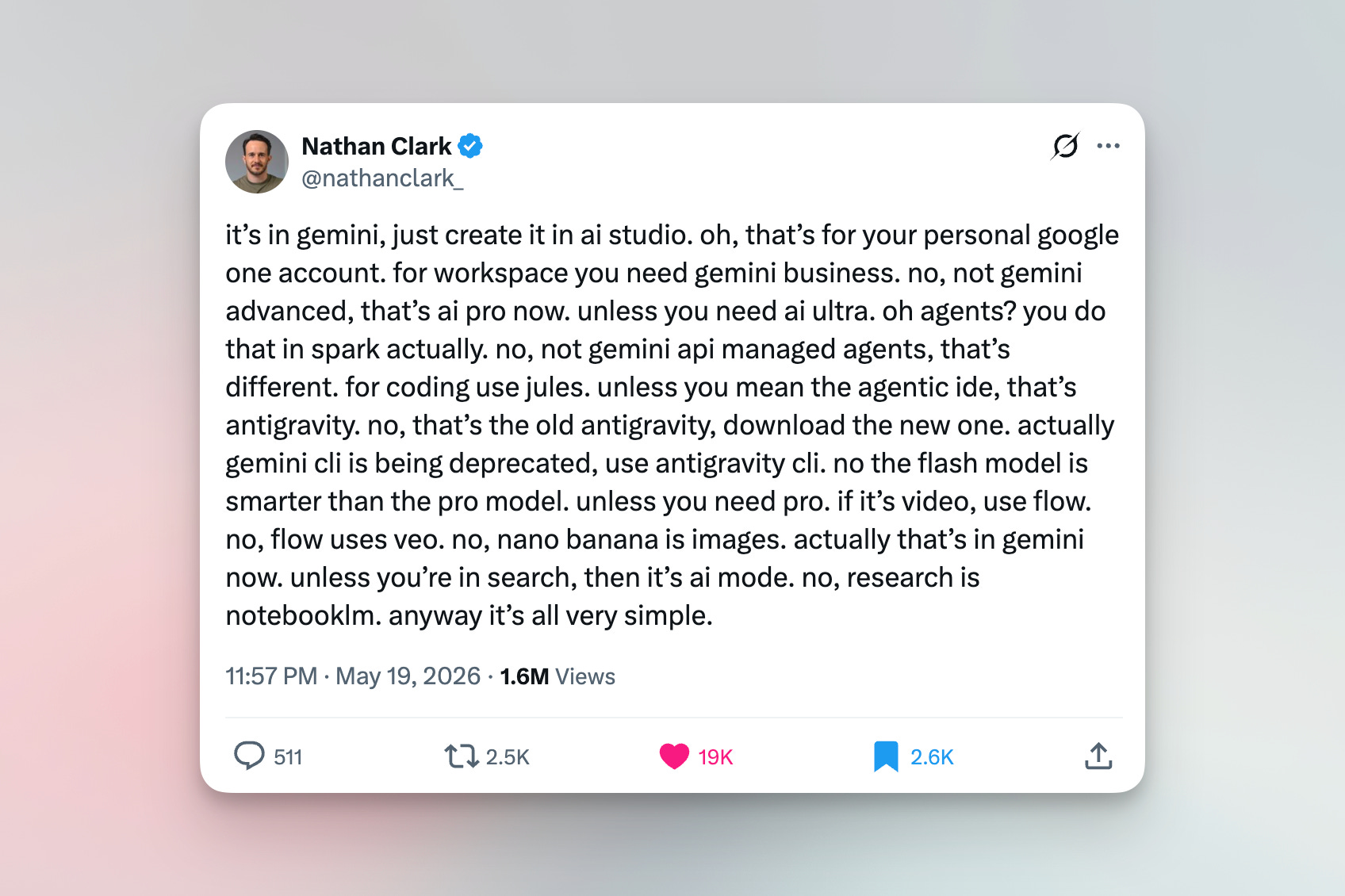
Amid the sea of announcements (100+ of them), it was easy to miss one that carries some significance:
We’re introducing Gemini Omni, where Gemini’s ability to reason meets the ability to create. Omni is our new model that can create anything from any input — starting with video. With Omni, you can combine images, audio, video and text as input and generate high-quality videos grounded in Gemini’s real-world knowledge. You can also easily edit your videos through conversation.
The significant part here is “Omni”. Up until now, we’ve gotten used to using different models for different modalities - GPT 5.5 & Opus 4.7 for text & coding, Nano Banana & GPT Image 2.0 for images, Veo 3.1 & Seedance 2.0 for video, Quiver for SVGs, and so on. And while specialized models are here to stay, we’re likely going to see more frontier models converging towards this anything-in-anything-out architecture (although this specific model seems to only output video for now).
Why is that significant? Well, most of the internet has been built around text and so are the LLMs that are built on top of all that data. They’re quite literally text-based representations of the world. Text is their raw material, their language, their expected input, and their eventual output. Google’s new Omni model is giving us a hint at what’s next - models that can reason across multiple modalities. For anyone building consumer-facing products with AI, the way you think about your own raw materials should evolve accordingly. If you want to create beautiful products & media that appeal to every one of our senses, text as raw material is no longer enough.
If you have ever tried to build a simple web page (or any HTML artifact) with AI without a ton of guidance, it always ends up looking kind of the same. Some are starting to call it AI “tells” or “smells” - an italicized word in a headline, too much beige, excessive purple gradients, and generally too much of everything. If you’re building with AI daily, you can almost instantly tell if some landing page is average AI slop. Now, you can absolutely create visually tasteful designs with AI, and many do. But 99% of people don’t bother to steer it out of the slop valley:
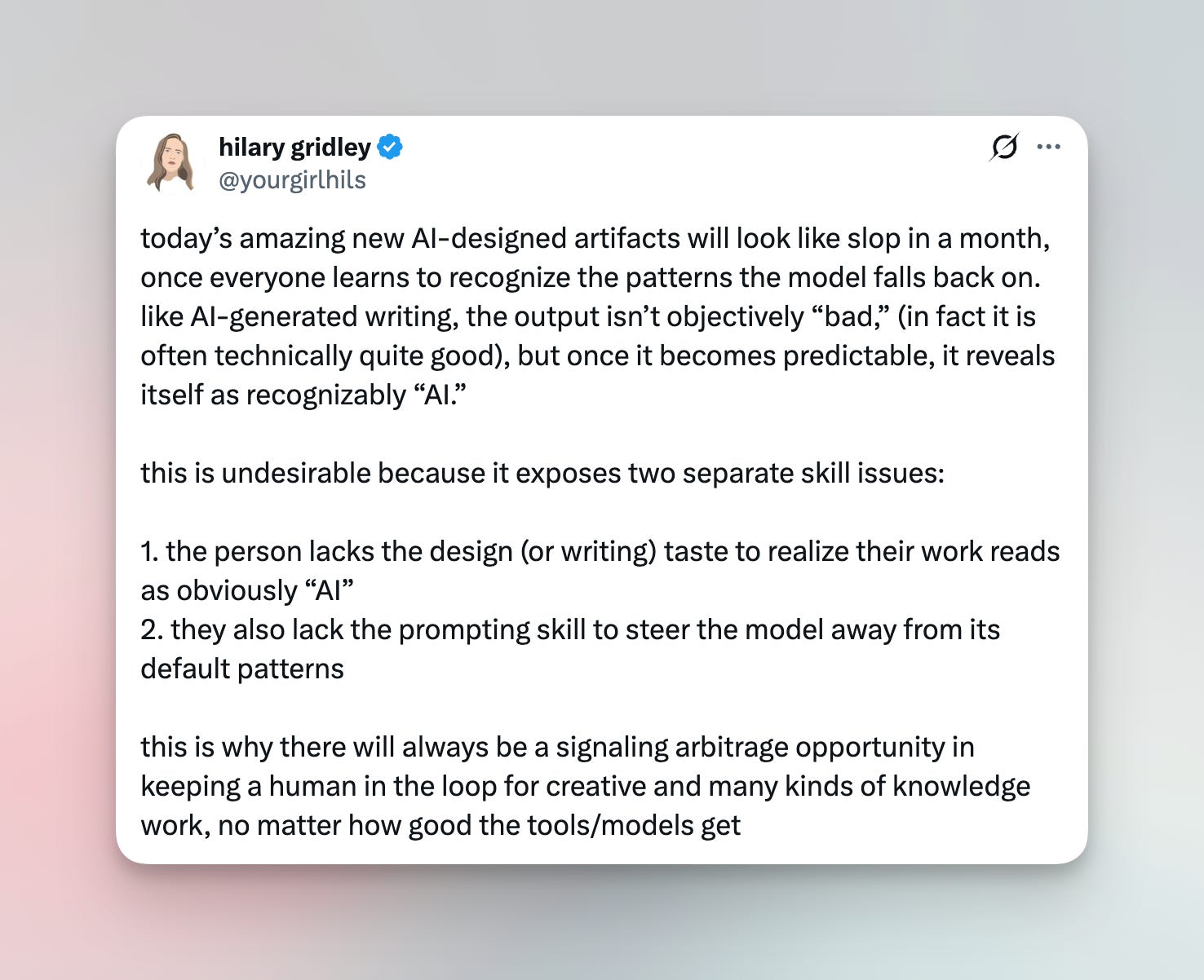
I keep coming back to this tweet because it’s extremely prescient. Without opinionated guidance, every model, however amazing, will regress towards the same patterns that we will recognize as slop. And as the tweet points out, to provide such opinionated guidance you need (a) taste and (b) knowing how to prompt. I agree, but I would slightly change this to (a) taste and (b) the skill of codifying your taste - i.e. conveying your taste in a way that the model can imitate. This to me is key to creating tasteful things with AI. And the answer to improving both of those is more digital hoarding. Let me explain.
(First, let me get something out of the way - output isn’t design. What I’m about to talk about is purely about building visual identity for your products. This is a small and often downstream aspect of the design process in which you’ve spent most of your time understanding the shape of the problem. We’re only talking about this small slice of the process.)
For any designer working on a brand new product, mood-boarding is a core part of the process. Mood-boarding is the process of collecting visual references - images, colors, textures, typography, objects, etc. - to define the desired feeling, direction, and aesthetic of a project. The mood board is then a key input into the next set of artifacts that make the visual identity more concrete - prototypes, decks, design systems, and brand guidelines. The crucial insight here is that this process has never started with a text file (MOODBOARD.md?). Because even for humans, text is not a sufficient medium on its own to convey every dimension of what you’re trying to create.
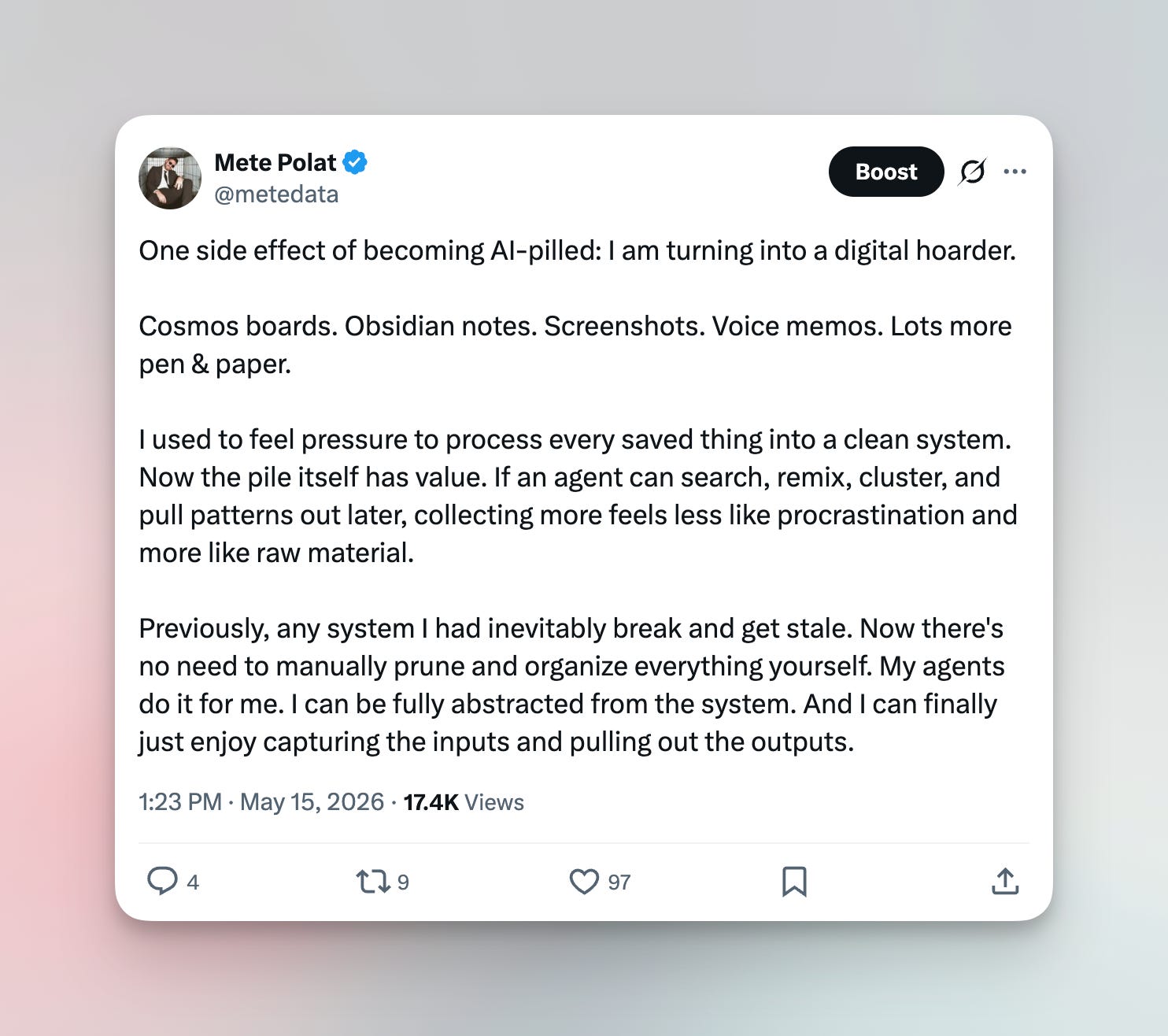
Yet, almost all of the AI-driven product development today is rooted solely in text artifacts - DESIGN.md, PLAN.md, SOUL.md, AGENTS.md, SKILL.md... You get it. And while you can now use AI to help you define a product’s visual identity, you will have a hard time moving past generic slop if your thinking is grounded entirely in text. To create unique, tasteful, and consistent outputs, you need to first turn to visual inputs. And to do that, you need to start hoarding inspiration from everywhere you can find it.
Mood-boarding is often done on a per-project basis but it’s generally a good idea to make it an ongoing practice, because it helps you build taste. Start clipping anything you find visually appealing into something like Cosmos, Raindrop.io, myMind, Are.na, or literally just a folder on your computer (check out tinyUI for a fun example of this). And anytime you do, try to understand what you like about it - is it the colors? The layout? The typography? The motion? If it’s the motion, why do you like it? Apply the five whys to better understand why something feels the way it does. Having a hard time verbalizing it? Drop one or more artifacts into Claude or ChatGPT and ask them why they’re appealing. Over time, you will start noticing patterns, building a richer vocabulary, and developing a keener sense for what makes something visually appealing.
(And, by the way, all this generally applies to other design dimensions such as sonic branding or video - I’m just anchoring on the visual aspect as it’s most tangible on the web today.)
More importantly, as AI becomes more “omni”, this growing pile of references gets increasingly more valuable as it (a) encapsulates your taste and (b) serves as raw material for AI as you begin morphing your products. Imagine your taste as a very blurry image - as you collect more artifacts that align with your taste, you slowly increase the fidelity of this “taste image” for AI. And as you jump into new projects, instead of asking Claude to “make it more modern”, you will have a rich library of references to draw from. You can now steer the output away from slop and towards taste.
Once you have a library of taste-aligned references (visual, cinematographic, sonic, etc.), the question then turns to codifying it back into the language that current models actually understand - text. Today’s frontier models are already incredibly good at visual analysis, so even feeding them a few visual references goes a long way. From here, you can scale this visual analysis process to output grounding system artifacts like TASTE.md and DESIGN.md. Here’s a concrete example (and tool you can use) to illustrate how this can work today:

Jaytel@Jaytel
What started as building a personal taste.md skill for myself, turned into building a pipeline to create any taste as a skill. The most important piece is references. This is where you should spend time. If the references suck, so does the skill. I find that references cropped
10:14 PM · May 23, 2026 · 52.1K Views
37 Replies · 35 Reposts · 856 Likes
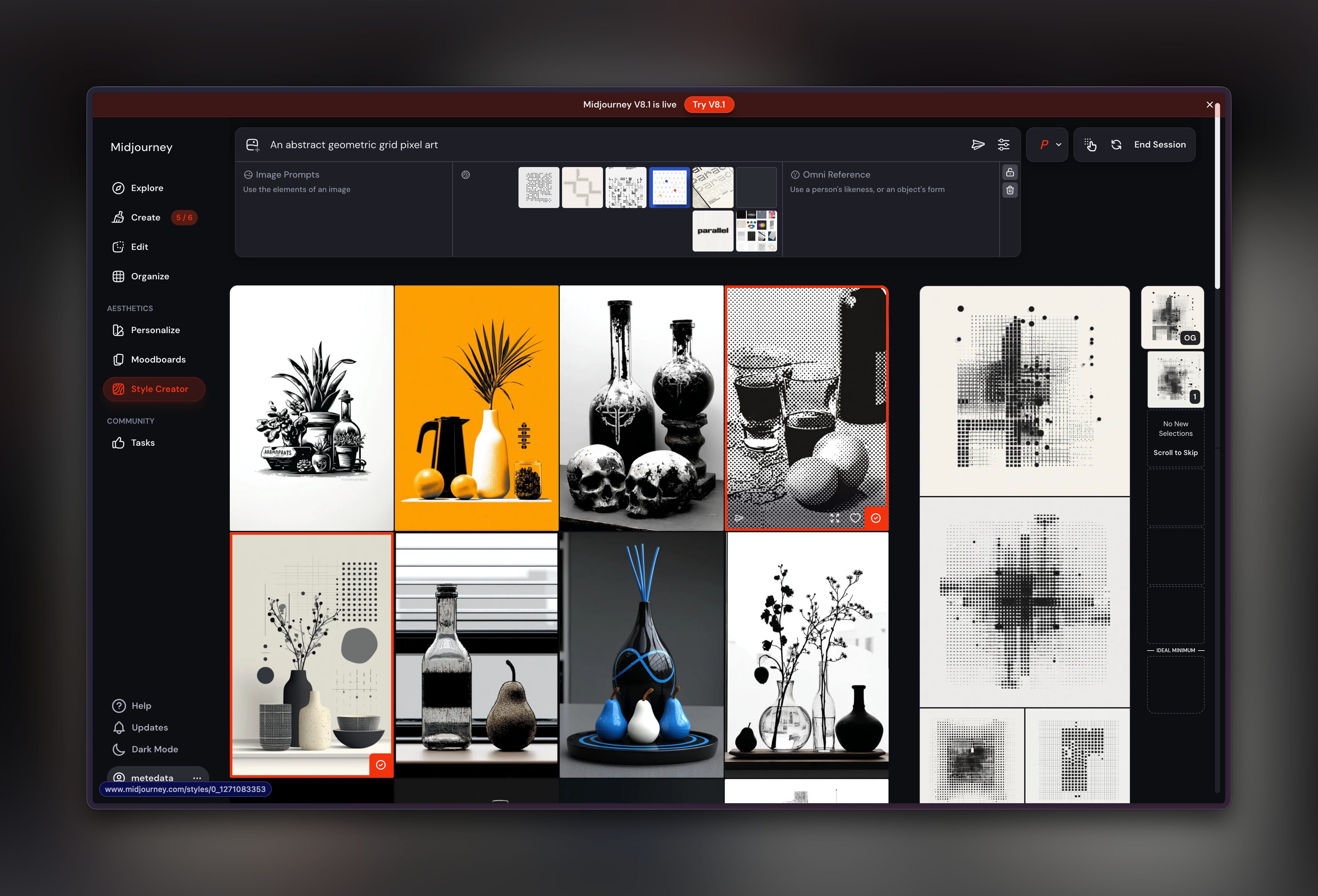
Beyond code, having visual references is also a more effective way to guide image models. I attended a great talk by @jameygannon (an amazing AI-pilled brand designer) that demonstrated this principle in practice - giving an image model one reference of what you’re looking for is way more effective than writing a 1000-word ultra-detailed prompt describing every detail. If you use Midjourney (you should), their “Style Creator” feature creates a detailed style profile by getting you to select a ton of images that align with what you’re looking for. And node-based tools like flora.ai are a pure embodiment of this type of visual input-output workflow.
This codification of visual artifacts into textual taste and then into code is inherently lossy - it will rarely capture the full essence of the visual inputs. As the new AI models become more “omni”, the need to translate everything into text will fall away. With this, the codification of taste will be internalized by the model, letting you focus even deeper on judgement, curation, and creation. But the hard part of building a comprehensive “taste library” will remain. So just like the models, it’s time to become more “omni” yourself - start building your digital taste library, understanding it yourself, and codifying it for today’s models. Besides developing your taste and building better products, you will drastically increase the potential value of the future models for your own workflow.
If you’re new here (welcome!), in addition to the main thought above I provide 3 curated resources / ideas / tools from the web related to AI & Design from the past week.

Ben Blumenrose@benblumenrose
Our 2026 Design in AI Report is now live! This report is the culmination of thousands of people hours and many late nights to create what we believe is the most comprehensive, well-researched report capturing and synthesizing the state of Design + AI today. While we used AI in
2:41 PM · May 20, 2026 · 224K Views
60 Replies · 174 Reposts · 1.46K Likes
Full disclosure - I have not read this yet, but enough people I respect praised this for its depth and nuance it captures. So I’m diving in the first chance I get.
2. Roughdraft

Nathan Baschez@nbaschez
4:42 PM · May 20, 2026 · 297K Views
142 Replies · 80 Reposts · 1.02K Likes
Really cool new product for better agent <> human collaboration. Effectively adding agent-driven commenting and suggested changes to a markdown doc. Check it out.
3. Learnings on running coding agents in large-scale projects

Simon Last@simonlast
1/ Some things I've learned recently running coding agents on large-scale projects. Most of this contradicts advice from 6 months ago!
12:13 AM · May 23, 2026 · 561K Views
93 Replies · 212 Reposts · 3.07K Likes
Great thread with some non-conventional (or soon-to-be-conventional) advice for running coding agents effectively. I learned some new things, but also interestingly were already doing some of these myself (like adversarial reviews). Check it out.
Last week I wrote about my Hermes & Obsidian setup and it ended up being my biggest article so far. Check it out if you haven’t yet. And if you’re interested in more of my use cases, I routinely share them on Threads.
I wanted to leverage my Mac Mini for more than just Hermes, so I finally set up a proper Plex media server on it (with Hermes managing it, organizing it, adding new stuff, etc). Even bought Plex’s lifetime subscription (which is going up in price in a few months). Feels weirdly liberating streaming your own media files from your own server.
I want to ask you for a favor - if you’ve been enjoying the newsletter, please consider sharing it with your team / colleagues / friends. It really helps, especially in these early stages as I’m posting into the social media void and looking for like-minded people. To those who already shared - thank you, it means a lot. See you next week.