





May 21, 2026
They’ve amassed more than $322 million in 2026—with much more to come.
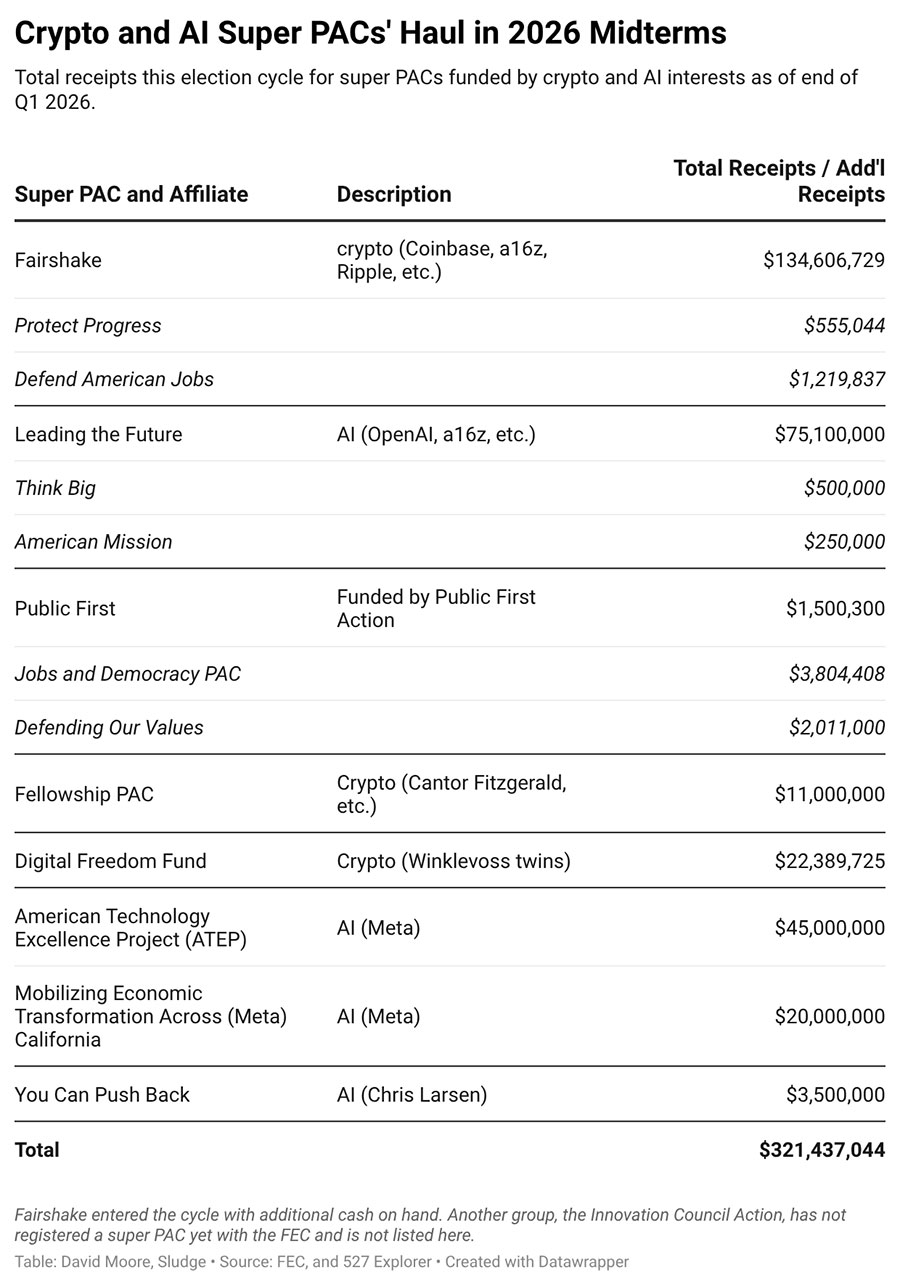
Super PACs funded by the cryptocurrency and artificial intelligence industries have amassed more than $321 million in the 2026 cycle, according to a review of Federal Election Commission filings, as they spend millions to knock out candidates they deem unsupportive of industry-favored regulation.
The proliferation of these industry-funded super PACs, rivaling the size of the giant spending groups controlled by the Democratic and Republican parties, is making its mark on 2026 elections. In the last midterms, the four top spending outside groups were the super PACs tied to House and Senate leaders, crowned by the Senate Leadership Fund (SLF) backing Republican candidates. This year, they face competition from crypto and AI industry war chests willing to target both parties.
Lawmakers are weighing foundational regulatory questions on crypto and AI. Both industries are pushing “light-touch” legislative frameworks, and the money ensures that their preferences are unmissable by congressional leaders trying to protect their members. The crypto industry’s pressure campaign is up for a test: On May 14, the Senate Banking Committee advanced the Clarity Act, the industry’s top legislative priority, after months of negotiation, setting it up for a full Senate vote.
The over $321 million raised this cycle spans 14 federal and state super PACs bankrolled by AI and crypto companies, but even that sum doesn’t capture all the pledged money from the AI industry. A new Republican-focused nonprofit aligned with the Trump White House’s deregulatory AI agenda, Innovation Council Action, has pledged to spend $100 million in midterm contests, likely forming another super PAC. Tens of millions more dollars are sluicing into new “dark money” AI advocacy groups like the Anthropic-funded nonprofit Public First Action.
“The campaign finance landscape, and the lack of any real limits, has opened up this opportunity for industries that have a very clear agenda,” said Daniel Weiner, director of the Brennan Center’s Elections and Government Program. “And we see AI, crypto, and some of these Big Tech companies really leaning into that.”
Crypto’s Money Cannon Reloads
In the 2024 cycle, the crypto firm–funded Fairshake super PAC network set a record for independent expenditures by an industry-funded group, shelling out more than $133 million to target lawmakers it saw as not on board with its policy agenda and promote its favored candidates. Fairshake funneled funds to party-specific super PACs for ads that made zero mention of crypto. An allied nonprofit advocacy group launched by Coinbase, Stand With Crypto, handed out scorecards to the industry’s cheerleaders and critics.
Fairshake and its two super PAC affiliates ended the first quarter with $170.4 million in cash on hand—an amount on par with the SLF’s $166.4 million. Its top donors remain Coinbase, Ripple Labs, and VC firm Andreessen Horowitz (a16z), which together have poured hundreds of millions of dollars into the group.
Already this cycle, Fairshake and a couple of newer pro-crypto super PACs have made nearly $51 million in independent expenditures. One joiner is the Digital Freedom Fund, launched last year by the crypto billionaire Winklevoss twins, who have given the group around $21 million in Bitcoin (not yet liquidated—its cash on hand is under a million). Another new pro-crypto spender is the Republican-focused Fellowship PAC, funded largely with $10 million from Cantor Fitzgerald, the Wall Street firm now run by Commerce Secretary Howard Lutnick’s sons that holds multibillion-dollar positions in crypto. The new PAC, which praised President Trump’s crypto moves, touted $100 million in pledges at its September announcement and held around $8 million cash on hand as of the end of March.
The spending arrives as crypto’s flagship market-structure bill, the Clarity Act, advanced by a vote of 15–9 out of the GOP-led Senate Banking Committee after battles with the bank lobby over stablecoin yields and objections from Democratic lawmakers over the Trump family’s crypto ventures. The bill would put most digital tokens under the lighter-touch Commodity Futures Trading Commission, versus the more robust Securities and Exchange Commission, and the crypto industry is racing to get it through the Senate before midterm-season gridlock sets in. Senator Bernie Moreno (R-OH), whose 2024 victory over Sherrod Brown was bankrolled by $40.1 million in Fairshake spending, told the DC Blockchain Summit that the end of May is a de facto deadline for the bill’s passage.
AI Adopts the Playbook
The AI industry faces similarly weighty questions in Congress, especially whether lawmakers will pass federal preemption of state regulations, as is being pushed by firms like OpenAI and Big Tech giants like Meta. Since 2025, states have seen a surge in measures seeking to set out AI safety precautions in areas ranging from deepfake videos to chatbot disclosures to consumer protections.
Following the crypto industry’s model, the AI super PAC Leading the Future launched in January with $125 million in announced funding. The group is calling for a national AI framework aligned with the Trump administration’s December executive order, a federal approach that would preempt the AI laws that 38 states enacted in 2025, along with new safety measures advancing this year. Of its announced haul, the group had around $70 million in cash on hand as of the end of the first quarter, including $25 million from OpenAI president Greg Brockman and his spouse, and the same amount from a16z. Donations also came from Palantir cofounder Joe Lonsdale and Silicon Valley investor Ron Conway. Like Fairshake, the group splits funds between two party-focused super PACs and is rolling out a candidate scorecard—it even shares staff with Fairshake.
Popular
“swipe left below to view more authors”Swipe →
Other AI-funded vehicles cut across the industry’s policy goals. Anthropic seeded a new nonprofit, Public First Action, with $20 million announced in February. The nonprofit, which says it “strongly supports” state efforts on AI safety rules and opposes federal preemption, birthed three super PACs—though Anthropic later said its donations weren’t intended for federal election spending, leaving the original source of the super PACs’ spending money in the dark. In the Democratic primary in New York’s 12th Congressional District, its affiliate Jobs and Democracy PAC has spent $2.3 million supporting state Assemblyman Alex Bores, author of the state AI safety bill the RAISE Act. Bores has been hit with nearly $3.3 million in attack ads by Leading the Future’s affiliate Think Big (making virtually no mention of AI regulation). A new super PAC, You Can Push Back, funded by Ripple cofounder and tech billionaire Chris Larsen, announced plans to quickly spend $3.5 million backing Bores’s primary bid.
Meta announced two state-focused spending groups last fall, a super PAC named Mobilizing Economic Transformation Across (Meta) California and a 527 nonprofit named the American Technology Excellence Project, pledging $65 million to promote aligned state candidates.
Also, on the Republican side, the nonprofit Innovation Council Action debuted in March with pledges to spend more than $100 million, led by former Trump campaign official Taylor Budowich and aligned with Trump AI and crypto adviser David Sacks.
Looming over them all is the super PAC with the most cash on hand: MAGA Inc., the spending arm of the term-limited President Trump, sitting on $347.8 million as of March 31 and teasing plans to spend for GOP allies in the midterms.
“It’s not just that this super PAC can raise unlimited amounts of money, but it is very consciously President Trump’s super PAC—this idea that they are separate is purely a legal fiction,” said Weiner. “And that’s what allows it to become such a vector for corruption and what amounts to gaining access and influence.”
Some of its donors include Crypto.com’s parent company, OpenAI’s Brockman, the Gemini crypto exchange, the Winklevoss twins, xAI’s Elon Musk, and a16z founders Marc Andreessen and Ben Horowitz, all of whom have combined for tens of millions given. Whether the GOP-controlled Congress gets crypto’s flagship CLARITY Act to a Senate vote this year, and whether lawmakers in the next Congress are willing to consider substantive AI safety legislation, could hinge on the nine-figure sums about to be dumped on voters in House and Senate races.
Your support makes stories like this possible
From illegal war on Iran to an inhumane fuel blockade of Cuba, from AI weapons to crypto corruption, this is a time of staggering chaos, cruelty, and violence.
Unlike other publications that parrot the views of authoritarians, billionaires, and corporations, The Nation publishes stories that hold the powerful to account and center the communities too often denied a voice in the national media—stories like the one you’ve just read.
Each day, our journalism cuts through lies and distortions, contextualizes the developments reshaping politics around the globe, and advances progressive ideas that oxygenate our movements and instigate change in the halls of power.
This independent journalism is only possible with the support of our readers. If you want to see more urgent coverage like this, please donate to The Nation today.
David Moore
David Moore is a cofounder of Sludge, an independent newsroom focused on money in politics. He is based in Brooklyn.