





A first person walkthrough of what’s on my dock in April 2026. The tools, the workflows they form, and an honest cross-platform picture for the Windows and Linux folks.
Every “AI productivity stack” post reads the same. A tool grid. No glue.
Here’s mine, organized by the workflows they live inside, not the categories they belong to. Plus the honest answer for Windows and Linux people, because half of you aren’t on macOS.
(Reading on mobile? Skip to the matrix at the bottom. That’s the useful part.)
What Is an AI Productivity Stack?
An AI productivity stack is the collection of AI tools, workflows, and integrations that help knowledge workers, developers, and teams capture information, make decisions, build software, manage knowledge, and automate repetitive work. The most effective AI productivity stacks are organized around workflows rather than individual tools
Why most “my stack” posts miss
Tool lists are the fast food of LinkedIn. Filling, forgettable by lunch, calories from the wrong places.
A tool on its own doesn’t really do anything. A tool inside a ritual does. So, this post is organized around the five loops I actually run, and the tools fall out of the ritual naturally.
One caveat before we dive in. I work on a Mac. Most of my stack is cross-platform. Some of it isn’t. I’ve added platform notes next to each tool, and there’s a proper Mac/Windows/Linux matrix at the end.
Loop 1, capture
The goal here is simple. Lower the cost of getting a thought, a meeting, or a decision out of my head and onto a searchable surface.
Wispr Flow for voice dictation. It runs on Mac, Windows, iOS, and Android. I use it in every text field on the OS, not just documents. Typing feels archaic now. If you’re on Linux, Whisper via Whishper or WhisperX gets you close, though it’s rougher around the edges.

Fathom for meetings. Free unlimited recording, supports Zoom, Meet, and Teams. In April 2026 they shipped a botless mode, which finally kills the “there’s a third participant on this call” awkwardness. I moved off ChatGPT Record for recurring meetings because running two sources of truth was costing me more time than it saved.
ChatGPT Desktop stays in the mix for one-off recordings when I’m the only one in the room. Workshops, whiteboard sessions, a long walk where I want the thinking transcribed.
Rule of thumb: capture has to be frictionless. If it takes more than one shortcut, the friction compounds across a day, and I stop capturing.
Loop 2, think
The goal is turning raw capture into decisions, not just more notes.
Claude Desktop is my main chat surface. Mac and Windows, not Linux. The reason I stay here is Claude Cowork, the desktop control mode that can operate native Mac and Windows apps, not just the web. Last mile automation is where most knowledge work actually happens, and web agents can’t see your Finder.
ChatGPT still wins in a few niches. Voice mode on a walk, image edits, the occasional sanity check on what Claude just told me.
Perplexity when the question needs sources more than reasoning. I think of it as: Claude for “help me think”, Perplexity for “tell me what’s out there”.
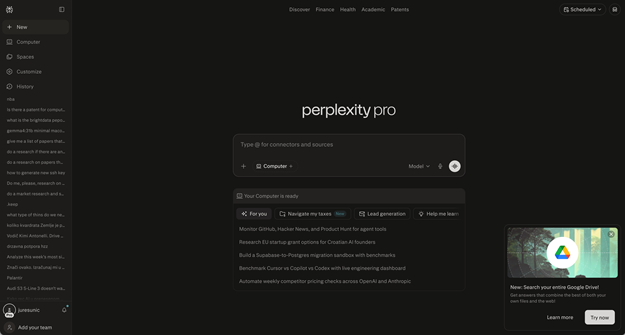
I dropped Notion AI. Running Claude against my Notion via MCP is cheaper and better. That isn’t a hot take in mid 2026. It’s just the math.
Loop 3, build
This is the part of the stack that gets argued about most on LinkedIn, so I’ll be precise.
Cursor for flow. The autocomplete is still best in class, and when I’m in a tight edit loop it’s faster than talking to an agent.
Claude Code for depth. Anything touching more than a few files, a migration, a refactor I can describe in English. It runs in the terminal (Mac, Windows, Linux) and is more token efficient than you’d expect. This is where Warp earns its seat.
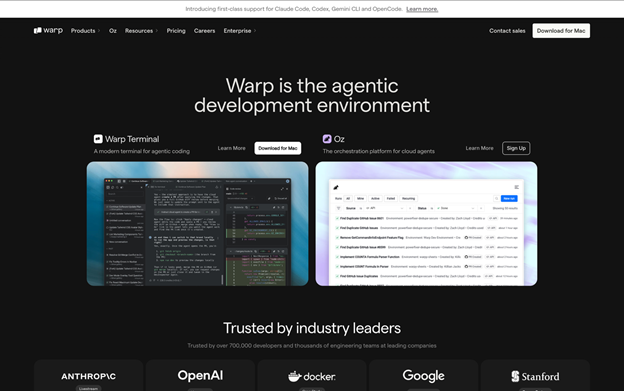
Warp as the terminal. GPU rendered, block based, and the cloud agent orchestration (Oz) means I can hand off long running jobs without a local shell staying open. Mac and Linux today, Windows in alpha.
Codex for code review. I develop with Claude Code, then run a second pass through OpenAI’s Codex app. Having a different model review the code catches things a same model review won’t. I tried CodeRabbit and Cursor BugBot for a while, both are solid products, but the two model loop (Claude writes, GPT reviews) is the one I actually kept running. Cross-platform.
Docker Desktop for local containers and, newly interesting, microVM sandboxes to run agents in isolation. Cross-platform.
DBeaver for databases. Open source universal SQL client, added MCP support this year. Cross-platform, free, zero regrets.
Ollama for local models. I’m not running production workloads on it, but for iteration, running cheap loops before paying for a frontier call, it’s essential. Cross-platform, open source, 52M downloads in Q1 2026 alone.

A contrarian note. Cursor’s pricing got hostile in 2025 (the credit reset was painful for anyone deep in a long session). Claude Code plus Warp is cheaper for most teams now. I still keep Cursor for the autocomplete and because IDE switching costs are real.
Loop 4, know
Make the sum of what I’ve read, written, and decided retrievable in seconds.
Obsidian is my personal RAG. Local markdown, cross-platform, plugin ecosystem that ages well. With Claude connected via MCP, it queries my vault directly. This isn’t a chat interface over my notes. It’s an agent that reads them when it needs context.
Notion is the team’s surface. Docs, wikis, project databases. The split is deliberate: Obsidian for what I’m thinking, Notion for what the team needs to know.
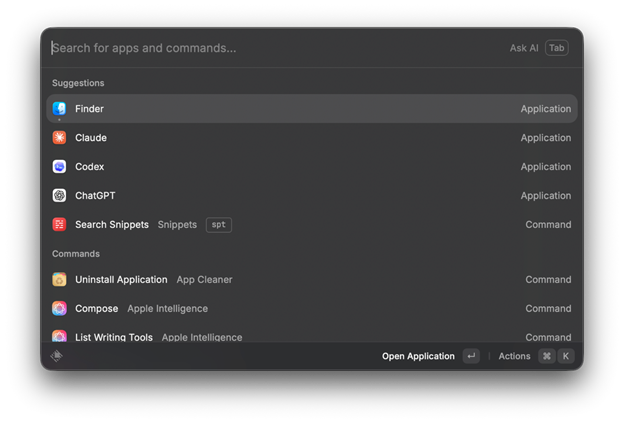
Raycast ties both to the OS. I use it for snippets (prompt templates I reach for weekly), clipboard history, and as a universal launcher. Mac native, Windows in beta. If you’re on Linux, Ulauncher is the closest philosophical cousin.
Loop 5, operate (the daily OS)
The day itself runs on rails, not on willpower.
Raycast opens everything from one keystroke.
LookAway forces breaks. 20 20 20 rule for the eyes, posture reminders, Pomodoro style sessions. Mac only, unfortunately. On Windows I’d look at Stretchly, which is open source and cross-platform. Founders who scoff at break timers burn out fastest. I’ve watched it happen more than once.

Setapp covers the long tail of Mac utilities. CleanShot X for screenshots, LookAway itself, Dato for a better menu bar clock, a dozen more. $12.99/mo for 250+ native apps is a bargain if you live on a Mac.
Docker keeps local dev reproducible across the team.
What I’d add if I were starting today
If I rebuilt the stack from scratch in April 2026, three things I don’t yet have would go in first.
A calendar AI, like Reclaim or Motion. Founders waste enormous hours on scheduling, and this category has the cheapest ROI by a mile.
A meeting to action pipeline. Fathom feeds Notion database, which triggers a Reclaim follow up, which ends as a Linear or Asana task. Glue it with n8n. I’ve built bits of this. It isn’t end to end yet.
An AI native browser, Dia or Comet. Most people underestimate how much of their work lives in a browser. A browser that reads across tabs is the clearest upgrade in the category since Arc.
The cross-platform picture (the part Windows and Linux people actually care about)
I hate when Mac stack posts hand wave this. So here’s the honest table.
macOS only or macOS first: Raycast (Windows beta exists), LookAway, Setapp (the bundle), CleanShot X, Screen Studio, Superwhisper (if you go local dictation).
Cross-platform and happy about it: Wispr Flow, Claude Code, Codex, Cursor, Zed, Obsidian, Logseq, Heptabase, Ollama, LM Studio, Jan, Continue.dev, Aider, Docker, DBeaver, CodeRabbit, Notion, ChatGPT, Claude Desktop, Warp (Linux is good, Windows is alpha).
Windows first, worth knowing: PowerToys (native quasi Raycast), Microsoft Copilot deeply integrated into Office. Underrated for operator workflows.
Linux first: Espanso for text expansion, Ulauncher as the launcher. Aider plus Continue.dev plus Ollama will get you 80% of the Claude and Cursor experience if you stay local first.
Three patterns worth stealing
Instead of a generic “top 10” to wrap, here are the three patterns that reshape how my day actually goes.
Voice to knowledge loop. Wispr Flow, Fathom, Obsidian, Claude via MCP. Capture is voice, retrieval is agentic, and I never “take notes” in the traditional sense anymore.
Multi runtime dev. Ollama locally for cheap iteration, Claude Code for depth, Cursor for flow. “Local vs cloud” is the wrong frame. It’s multi runtime, and each loop picks the right one.
Desktop control as the last mile. Claude Cowork does what web agents can’t. It opens my Finder, drives my Mail, fills forms in native apps. Roughly a third of knowledge work lives in native apps, and automating that is the real unlock.
One thing I’m watching
MCP adoption. Ten thousand public servers, Anthropic’s donation to the Linux Foundation in December 2025, 80% of Fortune 500 deploying agents. Teams whose stack isn’t MCP connected by the end of 2026 will be paying consolidation costs they don’t yet understand. This is the npm of AI agents. You don’t want to show up late.
What is an AI productivity stack?
An AI productivity stack is a collection of AI tools, workflows and integrations that help individuals and teams capture information, make decisions, build software, manage knowledge and automate repetitive work. The best stacks are designed around workflows rather than individual tools.
What are the best AI productivity tools in 2026?
Popular AI productivity tools include Claude Code, Cursor, ChatGPT, Claude Desktop, Perplexity, Obsidian, Notion, Ollama, Docker, Warp and Raycast. The best choice depends on the workflow you are optimizing.
How do developers use AI in their daily workflow?
Developers use AI for coding assistance, code reviews, research, documentation, meeting transcription, knowledge retrieval and workflow automation. Many combine local AI models with cloud-based models to balance cost, speed and capability.
What is the difference between Claude Code and Cursor?
Cursor excels at autocomplete and fast editing workflows inside the IDE, while Claude Code is often preferred for larger tasks such as migrations, refactoring and multi-file changes executed through the terminal.
What is MCP and why is it important?
Model Context Protocol (MCP) is a standard that allows AI models to connect with external tools, databases and applications. It enables AI agents to access context and perform actions across systems, making workflows significantly more powerful.
Can an AI productivity stack work on Windows and Linux?
Yes. Many leading tools such as Claude Code, Cursor, Docker, Ollama, Obsidian, Notion and DBeaver are cross-platform. Windows users can also leverage PowerToys, while Linux users often use Ulauncher, Espanso and local AI tools.
What is the best AI stack for software engineers?
A common setup includes Claude Code or Cursor for development, ChatGPT or Claude for reasoning, Obsidian for knowledge management, Docker for reproducible environments and Ollama for local model execution.
Why are AI workflows more important than AI tools?
Individual tools create limited value on their own. Productivity gains come from connecting tools into repeatable workflows that capture information, support decision-making, automate tasks and make knowledge easily retrievable.
How does Obsidian fit into an AI productivity stack?
Obsidian serves as a personal knowledge base where notes, decisions and documentation are stored in local markdown files. When connected through MCP, AI systems can retrieve and use this information as context.
What is the future of AI productivity stacks?
The future is increasingly agentic. AI systems will connect through standards such as MCP, access multiple tools, operate across applications and automate larger portions of knowledge work while remaining grounded in trusted sources of information.