









Hi, I’m KunYuan.
I’m an AI Builder & Researcher in Singapore, working to build trustworthy AI and exploring AI risk, AI safety, AI governance, AI alignment, ontology, philosophy, and human existential risk in the age of AGI.
I’m also the founder and chief researcher of TRANTOR LABS. Over the past few years, I have been working on long-term AI systems, AI companions, advanced AI action, structural safety evidence, and the deeper questions that arise when AI enters human knowledge, organizations, institutions, and processes of judgment.
But on Substack, I am still a very new writer. I arrived here less than a week ago. Right now, this newsletter has only 27 subscribers. In terms of the platform, I am still very small, still slowly learning the rhythm of this place, and still learning how people here write, read, respond, and discover one another.
Precisely because I have just arrived, my first impression of Substack is still very fresh. In less than a week, I have already come to like Substack very much. I like that there are still many people here who truly believe in writing. Not just content, not just traffic, not just quick reactions, but the belief that an article can unfold slowly, that a person’s thinking can be seen through long-term writing, and that a relationship between writer and reader can be built in a way that is not entirely determined by algorithms.
On many platforms, content increasingly feels like something pushed, consumed, and forgotten. But on Substack, I feel that a slower and more real atmosphere still remains. People subscribe to a specific person. They wait for a letter. They read a long essay. They respond seriously in the comments. They stay because of some real judgment, voice, or experience.
This moves me.
And precisely because I like this place, I quickly noticed one especially sensitive question on Substack: AI writing.
If Substack were only a content factory, perhaps people would not care so much about whether AI had participated in writing. But Substack is not that. Many people here care about the writer as a person. They care about the experience, judgment, and voice behind the words. Readers do not come here only to obtain information. They come here to read how a real person sees the world.
So when AI begins to enter writing, many uneasinesses begin to appear.
I have seen some people become very wary of AI writing. They worry that once an article uses AI, it is no longer real writing; that once a writer lets AI help organize, polish, or expand a piece, the writer’s voice is no longer pure; that once a piece of writing has passed through a model, the human being behind it becomes suspicious.
I have also seen another, more subtle psychological state. Many people are already using AI to assist their writing, but they are reluctant to say so publicly. Not because they have necessarily done anything wrong, but because they feel an invisible pressure: once they admit that AI was involved, they first have to explain themselves, justify themselves, and prove that they are not being lazy, not deceiving readers, and not mass-producing content.
This feeling is subtle, but I understand it. A person may have their own ideas, their own experience, and their own judgment. They may simply use AI to help organize structure, translate language, test titles, compress expression, or find gaps. But in certain discussion environments, as soon as they say “I used AI,” the article seems to be discounted. It seems no longer fully theirs. The writer also seems to become somewhat lesser.
In my view, this is not a small issue. It touches the sovereignty of writing. For a writer, an article is not merely an output. It is also connected to identity and sovereignty. When we write, we are not merely arranging information. We are also saying: this is the problem I saw, this is the judgment I formed, and this is the expression I am willing to take responsibility for.
So when AI enters writing, a deeper question appears: does an article written with AI still belong to me?
I believe this is a question many writers have thought about. We become confused: if I use AI to help me write an article, is that right or wrong? I do not think this question can be answered with a simple right or wrong.
At the same time, discussing whether AI was used in writing is also very meaningful. In academic writing, journalism, law, public decision-making, commercial copy, and personal expression, we do need to discuss transparency, responsibility, and credibility. Readers have the right to know what they are reading, and writers have a responsibility to be honest about their writing process.
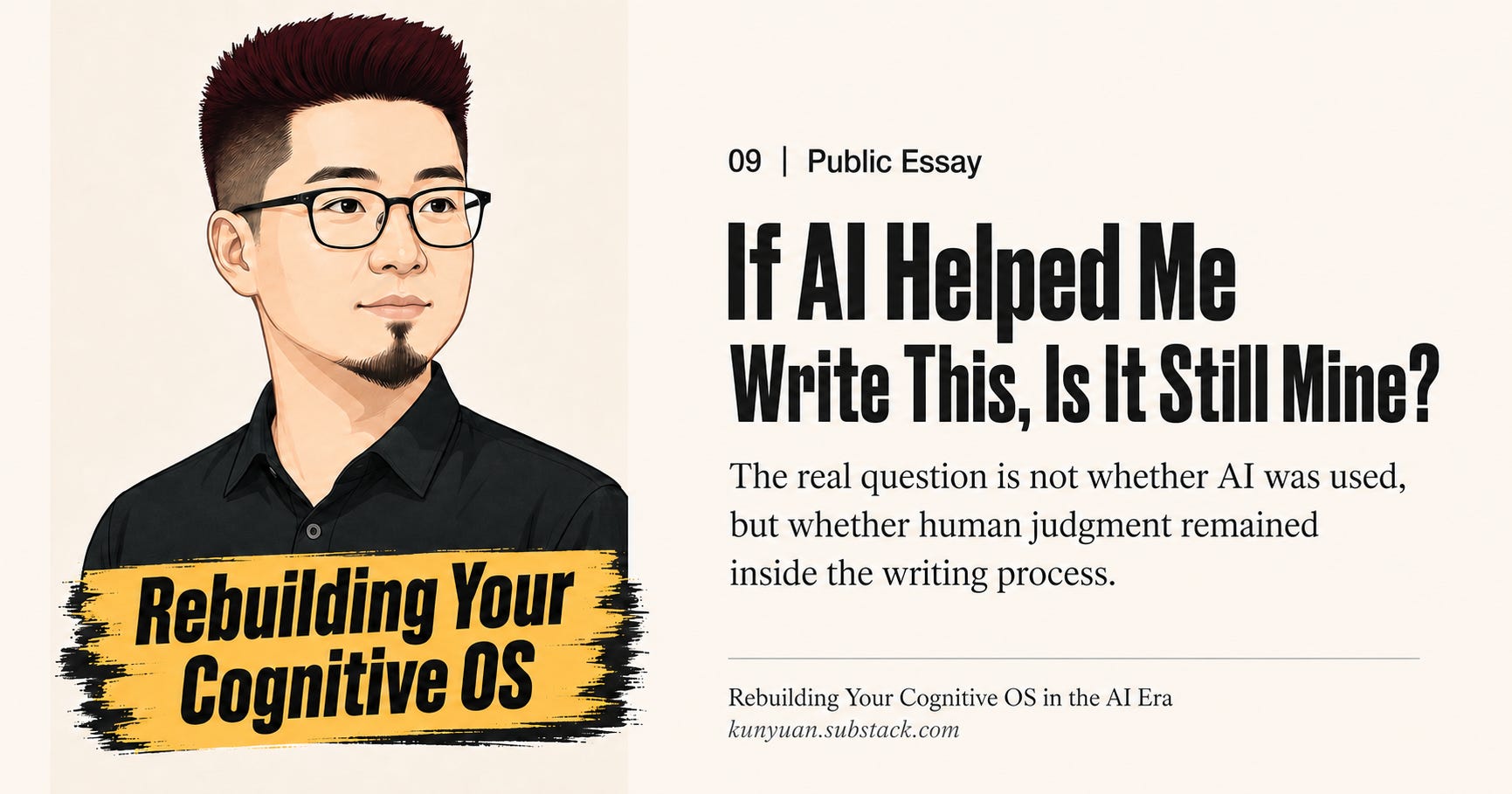
But when we only ask, “Was this written by AI?”, we can easily obscure the more important question. In my view, the deeper question may be: was this formed inside human judgment? The key is not only whether AI participated in writing the article, but whether the human being was still present in the writing process. This is what I have been emphasizing: whether human judgment is still inside the process.
In my view, whether AI participated and whether human judgment remained inside the process are two very different questions. “Was this written with AI?” asks about the source of the text. “Was this formed inside human judgment?” asks whether the writer as a person was still present.
AI participating in the generation of text does not necessarily mean AI generated the judgment. In my view, a person can use AI while still maintaining clear judgment. In the writing process, the human can raise the question, set the direction, choose the material, examine the reasons, reject errors, restructure the argument, and take responsibility for the final expression. In such a case, AI is a tool, a mirror, an external device for assisted thinking. It participates in the generation of text, but it does not replace human judgment.
By contrast, a person may also only symbolically review AI’s output. They do not truly define the question, understand the argument, check the evidence, reorganize the reasoning, or form their own responsibility for the final expression. They simply look it over, feel that it is “good enough,” and click publish. In that case, even if the human appears at the final step, they may not have truly participated in the judgment.
So, in my view, the key question is not whether the text was generated with AI participation. The more important question is: was it generated inside human judgment? Were the human being’s own intention and judgment still inside the process?
I increasingly feel that we should move the debate about AI writing away from “using AI or not using AI” and toward a more accurate position: AI-assisted writing is not the problem. Judgment-outsourced writing is.
AI-assisted writing is not the problem. Judgment outsourcing and cognitive outsourcing are the problem.
Whether an article still belongs to me does not depend on whether every word was typed by my own hands. It depends on whether the article carries my intention, experience, judgment, selection, and responsibility. When the question comes from me, the direction comes from me, the material has been checked by me, the structure has been reconstructed by me, and the final language is something I take responsibility for, then even if AI participated in certain parts of the process, the article can still belong to me. It still carries my intention and spirit.
But when AI sets the question for me, forms the argument for me, organizes the reasons for me, decides the tone for me, and generates the conclusion for me, while I merely look it over, change a few words, feel that it is good enough, and publish it under my own name, then the problem is no longer simply that “AI was used.” The deeper problem is that my relationship with the article has become thin. My judgment and cognition have been outsourced.
The account is still mine. The author name is still mine. The publish button is also clicked by me. But although I am still formally present, that does not mean my judgment is still present.
This is also the distinction I have been trying to make: human-in-the-loop is not the same as judgment-in-the-loop. A human being in the loop is not the same as judgment in the loop. In the context of writing, we can also say: the author’s name on an article does not mean the author’s judgment is inside the article.
This may sound a little sharp, but I think it touches the most easily overlooked part of the AI writing debate. The real danger is not that AI helps us write, but that AI makes us mistakenly believe we are still thinking. It can organize information more clearly, adjust tone more professionally, package arguments more completely, and make expression smoother. On the surface, everything looks better: higher efficiency, prettier writing, more complete articles, easier publishing.
But the question is: does the human being become more capable of judgment in this process?
When the answer is no, the rise in efficiency may be concealing a decline in agency. The external amplification of expressive capacity may be concealing the hollowing out of internal judgment. A person producing more, faster, and more smoothly does not necessarily mean they are clearer about what they are saying.
So where does judgment appear in writing? I think we can examine it from several angles.
First, it appears in whether a person knows what they are asking. Writing is not throwing a vague feeling to AI and waiting for the system to define the task on one’s behalf. Real writing usually begins from a confusion one cannot avoid. You need to know what you truly want to clarify, why the question matters to you, and why it needs to be said now. When this starting point is entirely set by the system, the writing that follows may be complete, but it may already have drifted away from your real question.
Second, judgment appears in whether a person knows why they believe certain reasons. AI can provide many arguments that seem reasonable, but fluency is not correctness, completeness is not truth, and a professional tone is not credibility. A writer whose judgment is still present cannot simply accept the reasons AI provides. They must ask: does this reason hold? Where is the evidence? Are there missing counterexamples? Has correlation been mistaken for causation? Is beautiful language covering over uncertainty?
Third, judgment appears in whether a person has the ability to reject AI’s output. For me, this is a very important sign of whether judgment still exists. A person who truly uses AI is not someone who keeps accepting it, but someone who keeps filtering and verifying it. When AI gives you a smooth paragraph, but it does not fit your experience, your judgment, or your voice, can you delete it? Whether you can say “no” determines whether you are still the subject.
Fourth, judgment appears in whether a person can reconstruct the content rather than merely polish the surface. Many times, we think we are editing AI-generated content, but we are only changing a few words to make the tone more natural. Real editing is not polishing. Real editing is reconstruction. It means reorganizing the question, rearranging the reasons, and judging again which parts should remain and which parts must be removed. It is not putting a human shell over AI output. It is pulling the article back toward your real question.
Finally, judgment appears in whether a person is willing to take responsibility for the final expression. When a person cannot stand behind the final text and say, “This is the judgment I recognize, and this is the expression I am willing to take responsibility for,” their relationship with the article becomes thin. They may still be the publisher, but they may not necessarily still be the author. They may still be publishing content, but they may not necessarily be expressing themselves.
I myself do not avoid using AI. On the contrary, I collaborate with AI almost every day. As an AI builder and researcher, I understand very clearly how AI can help a person expand ideas, organize structure, discover blind spots, test expression, and make a complex question appear more quickly.
But I am also increasingly clear that what matters most is not what AI helps me do, but whether I first know what I want to say and what I want.
When I collaborate with AI in writing, I first put forward my own question, intention, direction, and judgment. I need to know why the article needs to exist, what it is responding to, and what it must not become. Then I can let AI help me organize structure, find gaps, propose possible expressions, and even help me see places where I have not yet spoken clearly.
But after that, I must judge again. Sentences that do not belong to me must be deleted. Structures that deviate from my real question must be changed. Expressions that are too beautiful but not accurate enough must be rejected. Places that sound too heavy, too absolute, or too declarative must be brought back down. What remains in the end must be something I can recognize, understand, and take responsibility for.
This is not outsourcing cognition to AI. It is using AI while preserving judgment.
I think this may be an ability many writers will need to slowly build in the future. Not pretending AI does not exist, and not completely handing writing over to AI, but learning to let AI enter one’s field of judgment rather than letting one’s judgment leave the writing process.
In my view, this is especially important on Substack. Here, writing is not just content supply. It is a relationship of trust. A reader does not come only to obtain information. They give their attention to a writer. Sometimes they give long-term reading trust to a writer. Sometimes they even pay to support a writer’s continued work.
In such a relationship, what readers truly need may not be a fantasy of tool-free purity. What readers truly need is to know that there is still a real human being behind the words. Someone has truly experienced the problem. Someone has truly formed a judgment. Someone has truly made choices. Someone is truly willing to take responsibility for the expression.
When AI participates in writing, it should be placed inside the human writing process, rather than allowing the human being to be reduced to a publish button. What I really want to distinguish is not whether AI participated, but whether the human, while participating, still exists as a judging subject. Not whether AI generated the words, but whether the human still generated the judgment.
So, does an article written with AI still belong to me?
My answer is: it depends on whether your judgment is alive inside it. When your intention is still there, your question is still there, your experience is still there, your judgment is still there, your ability to reject is still there, your ability to reconstruct is still there, and your final responsibility is still there, the article still belongs to you. AI participated at the level of tools, but it did not replace your position as the authorial subject.
But if your judgment has already been outsourced, if you merely accept a result you did not truly understand, evaluate, or take responsibility for, and then publish it under your own name, then perhaps the article only appears through your name. It looks like your article, but you may not have truly lived through its formation. At that point, the article no longer belongs to you.
So this is, in my view, the deeper problem behind AI participating in writing.
The real question is not, “Was this generated with AI participation?”
The real question is: in this process of generation, is human judgment still alive?