


惯性聚合 高效追踪和阅读你感兴趣的博客、新闻、科技资讯
阅读原文 在惯性聚合中打开

推荐订阅源

Threat Intelligence Blog | Flashpoint
博客园_首页
钛媒体:引领未来商业与生活新知
钛媒体:引领未来商业与生活新知
博客园 - 叶小钗
A
About on SuperTechFans
量子位
G
Google Developers Blog
云风的 BLOG
云风的 BLOG
T
Threat Research - Cisco Blogs
Spread Privacy
Spread Privacy
Hacker News - Newest:
Hacker News - Newest: "LLM"
N
News and Events Feed by Topic
C
Cybersecurity and Infrastructure Security Agency CISA
cs.AI updates on arXiv.org
T
Tenable Blog
V
V2EX
月光博客
月光博客
L
Lohrmann on Cybersecurity
W
WeLiveSecurity
Webroot Blog
Webroot Blog
H
Hacker News: Front Page
酷 壳 – CoolShell
酷 壳 – CoolShell
T
The Exploit Database - CXSecurity.com
freeCodeCamp Programming Tutorials: Python, JavaScript, Git & More
博客园 - 三生石上(FineUI控件)
T
Troy Hunt's Blog
Google Online Security Blog
AI
AI
腾讯CDC
Recent Commits to openclaw:main
Google DeepMind News
CTFtime.org: upcoming CTF events
V2EX - 技术
V2EX - 技术
Martin Fowler
Martin Fowler
博客园 - Franky
I
Intezer
Project Zero
Project Zero
I
InfoQ
P
Privacy International News Feed
C
Check Point Blog
T
The Blog of Author Tim Ferriss
P
Palo Alto Networks Blog
L
LINUX DO - 最新话题
有赞技术团队
有赞技术团队
Cloudbric
Cloudbric
人人都是产品经理
人人都是产品经理
cs.CL updates on arXiv.org
S
SegmentFault 最新的问题
Latest news
Latest news
小众软件
小众软件

Hacker News - Newest: "AI"

AI can't read an investor deck AI as an attorney? Student uses ChatGPT, Gemini to sue UW over alleged racial discrimination Hacking MCP Servers in AI Systems – The Rug Pull: Tool Changes After Approval GitHub - MeepCastana/KubeezCut: Free Web based video editor GitHub - GenAI-Gurus/awesome-eu-ai-act: Curated tools, official sources, OSS, templates, and guides for EU AI Act compliance. Can AI judge journalism? A Thiel-backed startup says yes, even if it risks chilling whistleblowers Coming soon: 10 Things That Matter in AI Right Now DARPA built an AI to fact-check enemy weapons claims What explains heterogeneity in AI adoption? When AI Meets Muscle: Context-Aware Electrical Stimulation Promises a New Way to Guide Human Movements - Department of Computer Science AI Changed How We Build. It Did Not Change What Matters. Linux rules on using AI-generated code - Copilot is OK, but humans must take 'full responsibility for the… Meta spins up AI version of Mark Zuckerberg to engage with employees Code Mode: Let Your AI Write Programs, Not Just Call Tools | TanStack Blog GitHub - Delavalom/graft: Go framework for building AI agents. Type-safe tools, multi-provider (OpenAI, Anthropic, Gemini, Bedrock), zero vendor SDKs. India's TCS tops estimates, says new AI models did not dent services demand Gen Z's fading AI hype Strong feeling: we are in a folded AI reality GitHub - machinarii/total-recall-catalog: A reference catalog of latest knowledge retrieval, memory & RAG systems GitHub - mensfeld/code-on-incus: Give each AI agent its own isolated machine with root, Docker, and systemd. Active defense detects and stops threats automatically.. Quantization, LoRA, and the 8% Problem: Benchmarking Local LLMs for Production AI Iran war: We spoke to the man making Lego-style AI videos that experts say are powerful propaganda Powell, Bessent discussed Anthropic's Mythos AI cyber threat with major U.S. banks GitHub - immartian/bellamem: Persistent belief-graph memory for AI agents. Retrieves decisive context by importance — not recency, not RAG, not /compact. recursive-mode: The Repo-Native Operating System for AI Engineering After the attack on Sam Altman's home, will AI CEO's go on the offensive? The biggest advance in AI since the LLM Opus 4.6 vs GPT 5.4 One Prompt Unity World Generation Test “AI polls” are fake polls Client Challenge Can AI be a 'child of God'? Inside Anthropic's meeting with Christian leaders How to Switch AI Chatbots and Why You Might Want To GitHub - MattMessinger1/agentic_refund_guardrail: Safe refund policy layer for AI agents — Python + TypeScript. Same behavior, shared tests. Adam/papers/emergent_values_whitepaper.md at master · strangeadvancedmarketing/Adam Ask HN: How do you stop playing 20 questions with your AI coding tools How far can automation and AI support psychotherapy? - @theU GitHub - stagas/rtdiff: realtime git diff gui and AI-assisted commits A Mac Studio for Local AI — 6 Months Later A History of the Early Years of AI at the University of Edinburgh Why AI Coding Tools Still Feel Stuck on Localhost MSN AI Datacenters Are Becoming Strategic Targets twitter.com Penn Researchers Use AI to Surface Unreported GLP-1 Side Effects in Reddit Posts Show HN: MoodSense AI (ML and FastAPI and Gradio, Deployed on Hugging Face) Moodsense Ai - a Hugging Face Space by aman179102 AI models are terrible at betting on soccer—especially xAI Grok GitHub - xialeistudio/echoic GitHub - HimashaHerath/github-dev-wrapped: AI-powered weekly GitHub activity reports deployed to GitHub Pages GitHub - alejandrobalderas/claude-code-from-source: Architecture, patterns & internals of Anthropic's AI coding agent — reverse-engineered from source maps AI and Tech brief: Ireland ascendant GitHub - Titovilal/context0: Context0 - Never Surrender Training for a Marathon with an AI Coach: What Worked and What Didn't Cyber Pulse: Agentic Intel - Apps on Google Play I Built an AI PR Reviewer That Catches Bugs by Not Looking for Bugs Gen Z workers are so fearful AI will take their job they’re intentionally sabotaging their company’s AI rollout | Fortune How AI Is Reimagining the Game of Golf–For Both Players and Courses GitHub - nattergabriel/reseed: A CLI tool for managing and distributing agent skills across projects Is SVG the final frontier? My AI workflow evolved from prompts to a near-autonomous workflow MLSharp Help - 3DGS Viewer & Generator I put my cognitive field based AI's runtime on GitHub Is Numble the first AI-proof game? A3: Kubernetes for autonomous AI agent fleets | Emergent Principles Deepali Vyas ("The Elite Recruiter") GitHub - msmarkgu/RelayFreeLLM: A restful API designed to route user prompts to various AI model providers. Unionized ProPublica staff are on strike over AI, layoffs, and wages Unleashing the Advantage of Quantum AI We're heading for an AI-fueled 'dementia crisis,' brain scientist warns The AI-Assisted Breach of Mexico's Government Infrastructure [pdf] GitHub - stef41/lmscan: 🔍 Detect AI-generated text and fingerprint which LLM wrote it. Open-source GPTZero alternative. Zero dependencies, works offline. MSN GitHub - visionscaper/collabmem: Enabling long-term collaboration with Agentic AI - building up episodic and world model memory over time with in-context awareness We gave an AI a 3 year retail lease in SF and asked it to make a profit | Andon Labs AI Code is Hollowing Out Open Source, and Maintainers are Looking the Other Way What leaked "SteamGPT" files could mean for the PC gaming platform's use of AI AI is the boss at this retail store. What could go wrong? GitHub - Wuzu11517/agentic-proxy: Local proxy meant to help reduce With Drones, Geophysics and ArtificiaI Intelligence, Researchers Prepare to Do Battle Against Land Mines A Single Operator, Two AI Platforms, Nine Government Agencies: The Full Technical Report 在 Steam 上购买 FriedrichAI: Offline AI 立省 10% GitHub - inevolin/resume-cli: Hit Claude usage limits? Resume any AI coding session elsewhere. Switch tools at zero friction. GitHub - atripati/ark: AI Runtime Kernel — a context operating system for AI agents. Eliminates tool bloat, loads only what’s needed, and gives LLMs their reasoning space back. How to Build a Secure AI PR Reviewer with Claude, GitHub Actions, and JavaScript This Startup Wants You to Pay Up to Talk With AI Versions of Human Experts Intel Arc Pro B70 Brings 32GB VRAM to Local AI for $949 WordPress 7.0: The Good, the AI, and the Still Missing AI on the couch: Anthropic gives Claude 20 hours of psychiatry IatroBench: Pre-Registered Evidence of Iatrogenic Harm from AI Safety Measures AI Agents Know About Supabase. They Don't Always Use It Right. The history and future of AI at Google, with Sundar Pichai Inside an AI‑enabled device code phishing campaign How Meta Used AI to Map Tribal Knowledge in Large-Scale Data Pipelines AI for Systems: Using LLMs to Optimize Database Query Execution Forecasting the Economic Effects of AI Introducing Tinker: Play with AI, bring your ideas to life AI sheds light on an ancient gaming mystery People really hate AI but not as much as Iran—or Democrats | Fortune What is an AI Product Engineer? Phoebe Gates wants her $185 million AI startup to succeed with 'no ties to my privilege or my last name': 'I have a chip on my shoulder' | Fortune
What is Mythos AI and why could it be a threat to global cybersecurity?
Dan Milmo, K · 2026-04-22 · via Hacker News - Newest: "AI"

Anthropic has ruled out releasing its latest AI model, Mythos, to the public because of the threat it poses to global cybersecurity.

However, the US tech startup behind the Claude chatbot confirmed on Wednesday it was investigating a report that a group of people had gained unauthorised access to Mythos. The alleged incident has raised concerns over the pace of development and the ability of tech companies to keep their riskiest products out of the public domain. Here, we examine Mythos and its potential impact.


What is Mythos?

Mythos is an AI model – the underlying technology that powers tools such as chatbots – that, according to Anthropic, represents a serious potential threat to any organisation’s cybersecurity. Anthropic announced the existence of Mythos on 7 April but said it would not be released publicly because of its ability to identify unknown flaws in IT systems. Those flaws could, theoretically, be exploited by hackers.

Anthropic said Mythos could identify and exploit “zero-day” flaws in every major IT operating system and web browser – if a user asked it to do so. Zero days are so-called because organisations and developers are completely unaware of them and have had no time to patch them before an assailant strikes.

Anthropic described it as a “watershed moment for cybersecurity”. Some of the unnoticed flaws had been around for decades, said the San Francisco company.

The startup has allowed tech firms and banks, including Apple and Goldman Sachs, to access the model and assess what risks it could pose to their businesses and customers.
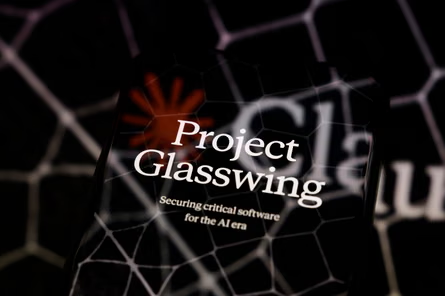
Project Glasswing logo
Anthropic announced Project Glasswing on 8 April to allow businesses to test Mythos on cybersecurity. Photograph: Samuel Boivin/NurPhoto/Shutterstock

Why is it a cause for concern?

Mythos represents tangible evidence, according to the UK’s AI Security Institute (AISI), of the disruptive capabilities of advanced AI. Ever since the arrival of OpenAI’s ChatGPT in 2022, experts have warned that AI could cause serious real-world damage.

There is also a wider point: that Mythos is an indication of the pace of progress in AI. Advanced models tend to be replicated swiftly by other firms, including developers of open-source models that are freely available to users. In a joint letter to business leaders last month, the UK technology secretary, Liz Kendall, and the security minister, Dan Jarvis, said businesses needed to “plan accordingly” for AI capabilities to “rapidly increase” over the next year. AI can, of course, be used to defend against cyber-attacks as well.

Another concern is that Mythos could fall into the wrong hands despite being withheld from public release. That fear came to fruition this week with Anthropic confirming a “handful” of users in a private online forum had gained access to the model.

However, there is also a question about the importance of the thousands of vulnerabilities that Mythos has flagged. Can they cause serious damage? Plus, highlighting an IT flaw is not the same as exploiting one.


Has Mythos been assessed by experts?

The AISI, which is the world’s leading AI safety body, has taken a look at Mythos and says it is a “step up” on previous models in terms of its threat to cybersecurity. Among the red flags are an ability to carry out attacks involving multiple steps and identifying IT flaws without human guidance.

It also achieved a first in the eyes of the AISI: successfully completing a 32-step simulation of a cyber-attack in a test created by the institute. It can attack weak, small IT systems, the AISI said, although it could not give a verdict on well-defended systems. The institute ended its assessment with an observation that is often stated elsewhere: AI systems can only get better from here.

However, other experts have said Mythos is more an evolution than a revolution. Aisle, a company that works on AI cybersecurity, analysed Anthropic’s main claims: that it had found thousands of zero-day vulnerabilities across large operating systems and browsers, including one in FreeBSD, a cousin to Unix. It found that other, far cheaper models were also able to find these problems. This did not mean that Mythos’s capabilities were not significant, they said, but that there was more nuance than Anthropic’s urgent tone implied.

There is also caution from experts that most breaches still come from well-established risks such as weak authentication and already known vulnerabilities that have not been patched.

Some experts suggest there is an element of hype around Anthropic’s claims about Mythos and how a startup estimated to be worth about $800bn (£592bn) has presented them. Mythos is undoubtedly a capable model. However, Anthropic’s dramatic announcement has given it significant airtime and centred its product in a broader, field-wide discussion of how AI might contribute to cyber-risk.


How are tech companies and banks involved?

About 40 companies, including Google, JP Morgan and Goldman, have been given early access to Mythos through an initiative called Project Glasswing, which is meant to give businesses a chance to test the AI model as part of their cyber defences. Anthropic says they will share what they learn “so the whole industry can benefit”.

However, the launch partners have given no detail about what they think Mythos is capable of, and how much of a threat it might present. 

That has not stopped banks and regulators from speculating about its potential impact. And for good reason: if Anthropic’s warnings are correct, having Mythos fall into the wrong hands could wreak havoc on banks and potentially put the wider financial system at risk. 

UK government modelling on a worst-case scenario bank hack, produced even before Mythos’s creation, suggested direct debits could fail, leaving rents, mortgages and wages unpaid, while online banking and cash machine withdrawals could be blocked. Commuters could be left in limbo as buses and petrol stations rejected payments. That could prompt panic, leading to a run on rival lenders, as customers pulled money from their accounts amid fear the disruption could spread.

Concern over Mythos’s prospective threats prompted the US treasury secretary, Scott Bessent, to call a meeting with bosses from big American banks, including Goldman and Citi, in Washington earlier this month.

UK regulators have added Mythos to the agenda at the Cross Market Operational Resilience Group meetings this week. This puts it in high-level discussions between senior bankers as well as officials from the Treasury, Bank of England, Financial Conduct Authority and National Cyber Security Centre.