



惯性聚合 高效追踪和阅读你感兴趣的博客、新闻、科技资讯
阅读原文 在惯性聚合中打开

推荐订阅源

Threat Intelligence Blog | Flashpoint
C
CXSECURITY Database RSS Feed - CXSecurity.com
L
LINUX DO - 热门话题
S
Secure Thoughts
TaoSecurity Blog
TaoSecurity Blog
Security Archives - TechRepublic
T
Threat Research - Cisco Blogs
AI
AI
B
Blog RSS Feed
S
Schneier on Security
雷峰网
雷峰网
Schneier on Security
Help Net Security
Help Net Security
Cloudbric
Cloudbric
L
LINUX DO - 最新话题
罗磊的独立博客
有赞技术团队
有赞技术团队
Recent Commits to openclaw:main
Apple Machine Learning Research
P
Proofpoint News Feed
酷 壳 – CoolShell
酷 壳 – CoolShell
The Hacker News
The Hacker News
博客园 - Franky
Attack and Defense Labs
The Cloudflare Blog
Webroot Blog
Webroot Blog
Last Week in AI
Last Week in AI
Exploit-DB.com RSS Feed
博客园 - 叶小钗
美团技术团队
L
Lohrmann on Cybersecurity
T
The Blog of Author Tim Ferriss
The Last Watchdog
The Last Watchdog
T
Troy Hunt's Blog
H
Hackread – Cybersecurity News, Data Breaches, AI and More
Vercel News
Vercel News
Know Your Adversary
Know Your Adversary
O
OpenAI News
博客园 - 【当耐特】
Hacker News - Newest:
Hacker News - Newest: "LLM"
C
Cybersecurity and Infrastructure Security Agency CISA
让小产品的独立变现更简单 - ezindie.com
www.infosecurity-magazine.com
freeCodeCamp Programming Tutorials: Python, JavaScript, Git & More
PCI Perspectives
PCI Perspectives
H
Heimdal Security Blog
I
InfoQ
GbyAI
GbyAI
T
Threatpost
C
Cisco Blogs

Hacker News - Newest: "AI"

AI can't read an investor deck AI as an attorney? Student uses ChatGPT, Gemini to sue UW over alleged racial discrimination Hacking MCP Servers in AI Systems – The Rug Pull: Tool Changes After Approval GitHub - MeepCastana/KubeezCut: Free Web based video editor GitHub - GenAI-Gurus/awesome-eu-ai-act: Curated tools, official sources, OSS, templates, and guides for EU AI Act compliance. Can AI judge journalism? A Thiel-backed startup says yes, even if it risks chilling whistleblowers Coming soon: 10 Things That Matter in AI Right Now DARPA built an AI to fact-check enemy weapons claims What explains heterogeneity in AI adoption? When AI Meets Muscle: Context-Aware Electrical Stimulation Promises a New Way to Guide Human Movements - Department of Computer Science AI Changed How We Build. It Did Not Change What Matters. Linux rules on using AI-generated code - Copilot is OK, but humans must take 'full responsibility for the… Meta spins up AI version of Mark Zuckerberg to engage with employees Code Mode: Let Your AI Write Programs, Not Just Call Tools | TanStack Blog GitHub - Delavalom/graft: Go framework for building AI agents. Type-safe tools, multi-provider (OpenAI, Anthropic, Gemini, Bedrock), zero vendor SDKs. India's TCS tops estimates, says new AI models did not dent services demand Gen Z's fading AI hype Strong feeling: we are in a folded AI reality GitHub - machinarii/total-recall-catalog: A reference catalog of latest knowledge retrieval, memory & RAG systems GitHub - mensfeld/code-on-incus: Give each AI agent its own isolated machine with root, Docker, and systemd. Active defense detects and stops threats automatically.. Quantization, LoRA, and the 8% Problem: Benchmarking Local LLMs for Production AI Iran war: We spoke to the man making Lego-style AI videos that experts say are powerful propaganda Powell, Bessent discussed Anthropic's Mythos AI cyber threat with major U.S. banks GitHub - immartian/bellamem: Persistent belief-graph memory for AI agents. Retrieves decisive context by importance — not recency, not RAG, not /compact. recursive-mode: The Repo-Native Operating System for AI Engineering After the attack on Sam Altman's home, will AI CEO's go on the offensive? The biggest advance in AI since the LLM Opus 4.6 vs GPT 5.4 One Prompt Unity World Generation Test “AI polls” are fake polls Client Challenge Can AI be a 'child of God'? Inside Anthropic's meeting with Christian leaders How to Switch AI Chatbots and Why You Might Want To GitHub - MattMessinger1/agentic_refund_guardrail: Safe refund policy layer for AI agents — Python + TypeScript. Same behavior, shared tests. Adam/papers/emergent_values_whitepaper.md at master · strangeadvancedmarketing/Adam Ask HN: How do you stop playing 20 questions with your AI coding tools How far can automation and AI support psychotherapy? - @theU GitHub - stagas/rtdiff: realtime git diff gui and AI-assisted commits A Mac Studio for Local AI — 6 Months Later A History of the Early Years of AI at the University of Edinburgh Why AI Coding Tools Still Feel Stuck on Localhost MSN AI Datacenters Are Becoming Strategic Targets twitter.com Penn Researchers Use AI to Surface Unreported GLP-1 Side Effects in Reddit Posts Show HN: MoodSense AI (ML and FastAPI and Gradio, Deployed on Hugging Face) Moodsense Ai - a Hugging Face Space by aman179102 AI models are terrible at betting on soccer—especially xAI Grok GitHub - xialeistudio/echoic GitHub - HimashaHerath/github-dev-wrapped: AI-powered weekly GitHub activity reports deployed to GitHub Pages GitHub - alejandrobalderas/claude-code-from-source: Architecture, patterns & internals of Anthropic's AI coding agent — reverse-engineered from source maps AI and Tech brief: Ireland ascendant GitHub - Titovilal/context0: Context0 - Never Surrender Training for a Marathon with an AI Coach: What Worked and What Didn't Cyber Pulse: Agentic Intel - Apps on Google Play I Built an AI PR Reviewer That Catches Bugs by Not Looking for Bugs Gen Z workers are so fearful AI will take their job they’re intentionally sabotaging their company’s AI rollout | Fortune How AI Is Reimagining the Game of Golf–For Both Players and Courses GitHub - nattergabriel/reseed: A CLI tool for managing and distributing agent skills across projects Is SVG the final frontier? My AI workflow evolved from prompts to a near-autonomous workflow MLSharp Help - 3DGS Viewer & Generator I put my cognitive field based AI's runtime on GitHub Is Numble the first AI-proof game? A3: Kubernetes for autonomous AI agent fleets | Emergent Principles Deepali Vyas ("The Elite Recruiter") GitHub - msmarkgu/RelayFreeLLM: A restful API designed to route user prompts to various AI model providers. Unionized ProPublica staff are on strike over AI, layoffs, and wages Unleashing the Advantage of Quantum AI We're heading for an AI-fueled 'dementia crisis,' brain scientist warns The AI-Assisted Breach of Mexico's Government Infrastructure [pdf] GitHub - stef41/lmscan: 🔍 Detect AI-generated text and fingerprint which LLM wrote it. Open-source GPTZero alternative. Zero dependencies, works offline. MSN GitHub - visionscaper/collabmem: Enabling long-term collaboration with Agentic AI - building up episodic and world model memory over time with in-context awareness We gave an AI a 3 year retail lease in SF and asked it to make a profit | Andon Labs AI Code is Hollowing Out Open Source, and Maintainers are Looking the Other Way What leaked "SteamGPT" files could mean for the PC gaming platform's use of AI AI is the boss at this retail store. What could go wrong? GitHub - Wuzu11517/agentic-proxy: Local proxy meant to help reduce With Drones, Geophysics and ArtificiaI Intelligence, Researchers Prepare to Do Battle Against Land Mines A Single Operator, Two AI Platforms, Nine Government Agencies: The Full Technical Report 在 Steam 上购买 FriedrichAI: Offline AI 立省 10% GitHub - inevolin/resume-cli: Hit Claude usage limits? Resume any AI coding session elsewhere. Switch tools at zero friction. GitHub - atripati/ark: AI Runtime Kernel — a context operating system for AI agents. Eliminates tool bloat, loads only what’s needed, and gives LLMs their reasoning space back. How to Build a Secure AI PR Reviewer with Claude, GitHub Actions, and JavaScript This Startup Wants You to Pay Up to Talk With AI Versions of Human Experts Intel Arc Pro B70 Brings 32GB VRAM to Local AI for $949 WordPress 7.0: The Good, the AI, and the Still Missing AI on the couch: Anthropic gives Claude 20 hours of psychiatry IatroBench: Pre-Registered Evidence of Iatrogenic Harm from AI Safety Measures AI Agents Know About Supabase. They Don't Always Use It Right. The history and future of AI at Google, with Sundar Pichai Inside an AI‑enabled device code phishing campaign How Meta Used AI to Map Tribal Knowledge in Large-Scale Data Pipelines AI for Systems: Using LLMs to Optimize Database Query Execution Forecasting the Economic Effects of AI Introducing Tinker: Play with AI, bring your ideas to life AI sheds light on an ancient gaming mystery People really hate AI but not as much as Iran—or Democrats | Fortune What is an AI Product Engineer? Phoebe Gates wants her $185 million AI startup to succeed with 'no ties to my privilege or my last name': 'I have a chip on my shoulder' | Fortune
The Visibility Problem Behind AI Tool Adoption in Engineering Teams
Carina de Gouveia · 2026-06-18 · via Hacker News - Newest: "AI"

Executives are asking engineering teams to accelerate AI adoption. Most engineering leaders, though, cannot answer a basic question: which AI coding assistants are actually in use across our repositories right now?

The gap is the lack of a reliable inventory. This article covers why visibility is the first governance challenge, what repository-level scanning reveals about real adoption patterns, and how to operationalize AI tool tracking without blocking the tools developers rely on.

In this article:

  • Why visibility into AI tools is the first governance challenge
  • What shadow AI looks like in engineering workflows
  • How widespread is AI tool usage across development teams
  • What repository-level scanning reveals about AI adoption
  • Why existing governance approaches miss AI tool usage
  • How AI tool sprawl affects code quality and security
  • What an AI inventory captures across repositories
  • How to operationalize AI visibility for engineering teams
  • What metrics help leaders report on AI adoption
  • Common mistakes when tracking AI tool usage

Why visibility into AI tools is the first governance challenge

To gain visibility into AI tools used by engineering teams, you can combine quantitative tracking of AI-assisted coding with qualitative developer feedback. Unmonitored AI usage is common, so specialized analytics help track tool usage, security posture, and productivity impact. The challenge, though, is that most engineering leaders cannot answer a straightforward question: which AI coding assistants are active across our repositories right now?

The contradiction is that boards and executives are pushing teams to adopt AI to improve delivery speed. At the same time, leadership often lacks a reliable inventory of which tools developers actually use. The reporting gap widens as AI adoption accelerates.

The visibility problem is not about whether AI is being used, but rather about whether leadership has an auditable view of AI usage across the engineering organization.

What shadow AI looks like in engineering workflows

Shadow AI in software development goes beyond employees using random chatbots. In engineering contexts, shadow AI includes a range of tools and artifacts that often bypass centralized IT or security visibility.

Here are common forms of shadow AI in development workflows:

  • AI coding assistants in IDEs: Extensions like GitHub Copilot, Cursor, or Claude Code installed locally in developer environments
  • CLI-based agents: Command-line tools that generate or modify code outside of managed SaaS platforms
  • AI review tools: Third-party services that analyze pull requests or suggest changes
  • Prompt files and generated config: Workflow artifacts, prompt templates, or AI-generated configuration files committed to repositories
  • Personal account access: Developers using personal subscriptions to tools that are not visible to IT or security teams

How widespread is AI tool usage across development teams

AI coding tools have moved well beyond pilot programs. A significant share of developers now use AI assistants daily, and AI-assisted code represents a growing portion of code creation across organizations.

Several patterns are worth noting. Many developers access AI tools through personal accounts, including personal ChatGPT or Claude subscriptions. The average development team uses multiple AI tools simultaneously, often without centralized tracking. GitHub Copilot, ChatGPT, and Claude are common across development workflows, though adoption varies by team and project.

Exact figures depend on survey methodology, company size, and how "AI-assisted" is defined. The direction, however, is clear: AI use has moved beyond experimentation into everyday development practice.

What repository-level scanning reveals about AI adoption

Surveys and procurement data tell part of the story. Repository-level scanning tells another. When you analyze what is actually committed to codebases, a different picture emerges.

Recently, we scanned over 6,700 repositories across more than 800 organizations and detected 27 different coding assistants. Claude Code appeared most frequently by a wide margin, followed by Cursor and Microsoft Copilot. The long tail included Codex, Windsurf, Augment Code, JetBrains Junie, and more than 20 other tools. 

On the surface, 27 assistants suggests tool sprawl. At the organization level, though, the average org showed traces of only two coding assistants. Most companies do not have chaos everywhere. They have limited but often unmeasured AI adoption.

The visibility problem is not only "too many tools." It is that leaders do not know which tools are present, where they appear, or how usage differs by repository.

Why existing governance approaches miss AI tool usage

Governance policies often live in places that do not observe actual developer behavior. Security questionnaires, procurement approvals, acceptable-use policies, SSO tool lists, and manual team self-reporting all capture intent. They rarely capture reality.

Here is where governance controls miss common engineering paths:

  • Personal accounts: Developers using personal subscriptions that bypass enterprise SSO
  • IDE extensions: Locally installed extensions that do not appear in SaaS management tools
  • CLI agents: Command-line tools used outside centrally managed platforms
  • Repository artifacts: Generated files, prompts, workflows, or tool traces committed into codebases

Even organizations with governance and security validation policies may still have developers using Cursor, Claude, and other tools in parallel. Developer adoption pressure is real: engineers choose tools that help them move faster.

Policies define intent. Inventories reveal reality.

How AI tool sprawl affects code quality and security

AI-generated or AI-assisted code changes the scale and review model for engineering teams. More code can be produced faster. Review depth may decrease when reviewers assume generated code is correct. Similar patterns may be replicated across repositories quickly.

Security and quality risks include:

  • Vulnerable code patterns: Generated suggestions that introduce known vulnerability patterns. Veracode’s 2025 research found that only 55% of AI-generated code samples were free of the security flaws evaluated in its benchmark, meaning 45% contained at least one tested vulnerability.
  • Insecure dependency recommendations: AI tools suggesting outdated or vulnerable libraries
  • Secrets exposure: Sensitive context pasted into unmanaged tools or committed to repositories
  • Generated tests with incorrect assertions: Tests that pass but assert the wrong behavior
  • Compliance gaps: AI usage that cannot be evidenced or explained during audits

Inventory is not a substitute for SAST, SCA, secrets detection, or policy checks. It is the visibility layer that tells leaders where AI code governance applies.

There is also a procurement angle. If most developers already use a particular tool, it may be worth upgrading to an enterprise plan and managing it centrally rather than allowing fragmented personal usage.

What AI Inventory captures across repositories

Codacy's AI Inventory is a repository-level view of AI assets, tools, workflows, and signals found across codebases. It turns scattered repository evidence into a view engineering leaders can act on.

A useful inventory typically captures:

Dimension What it reveals
AI tools detected Which coding assistants appear across repositories    Copilot, Claude Code, Cursor, Windsurf)

AI models called

Which AI models and providers are referenced across repositories (GPT-4o, Claude Sonnet, Gemini, OpenAI SDK, Anthropic SDK, etc.)

Repository distribution Where each tool appears and how usage varies
Configuration and workflow files AI-related config, prompt templates, or agent definitions
Policy compliance status Whether detected tools align with approved lists

AI-related issues

Security or quality findings in repositories with AI usage
Risk assessment summary Aggregated view of exposure by repository or team

The goal is to provide enough visibility that leaders can compare detected usage against policy and decide where enforcement applies.

How to operationalize AI visibility for engineering teams

Visibility without action is just reporting. The practical value of AI Inventory comes from connecting it to enforcement and decision-making.

A reasonable approach follows this sequence:

  1. Scan repositories to establish a baseline of AI tool and workflow traces
  2. Compare detected usage against approved tools and policies
  3. Segment repositories by risk: production-critical, regulated, customer-facing, internal, experimental
  4. Align enforcement with repository risk level, applying AI guardrails for high-risk repositories
  5. Add or tighten checks for SAST, SCA, secrets detection, and license compliance where AI usage is present
  6. Track changes over time to see whether adoption is expanding or concentrating
  7. Report trends to leadership in operational language: tools detected, repos affected, policy gaps, remediation progress

AI tool usage changes quickly. Inventory is not a one-time audit. It works best when continuous or regularly refreshed.

What metrics help leaders report on AI adoption

When executives or board members ask about AI adoption, vague answers erode confidence. Specific metrics convert adoption claims into evidence.

Useful leadership metrics include:

  • Number of AI coding assistants detected across the organization
  • Number and percentage of repositories with AI tool traces
  • Top AI tools by repository presence
  • Repositories with unapproved AI tools or workflows
  • AI-related policy compliance status
  • Security findings in repositories with detected AI usage
  • Trend over time: new tools, new repositories, resolved policy gaps

Metrics like these help leaders report adoption without relying only on surveys or procurement data. They create a bridge between AI enablement and risk management.
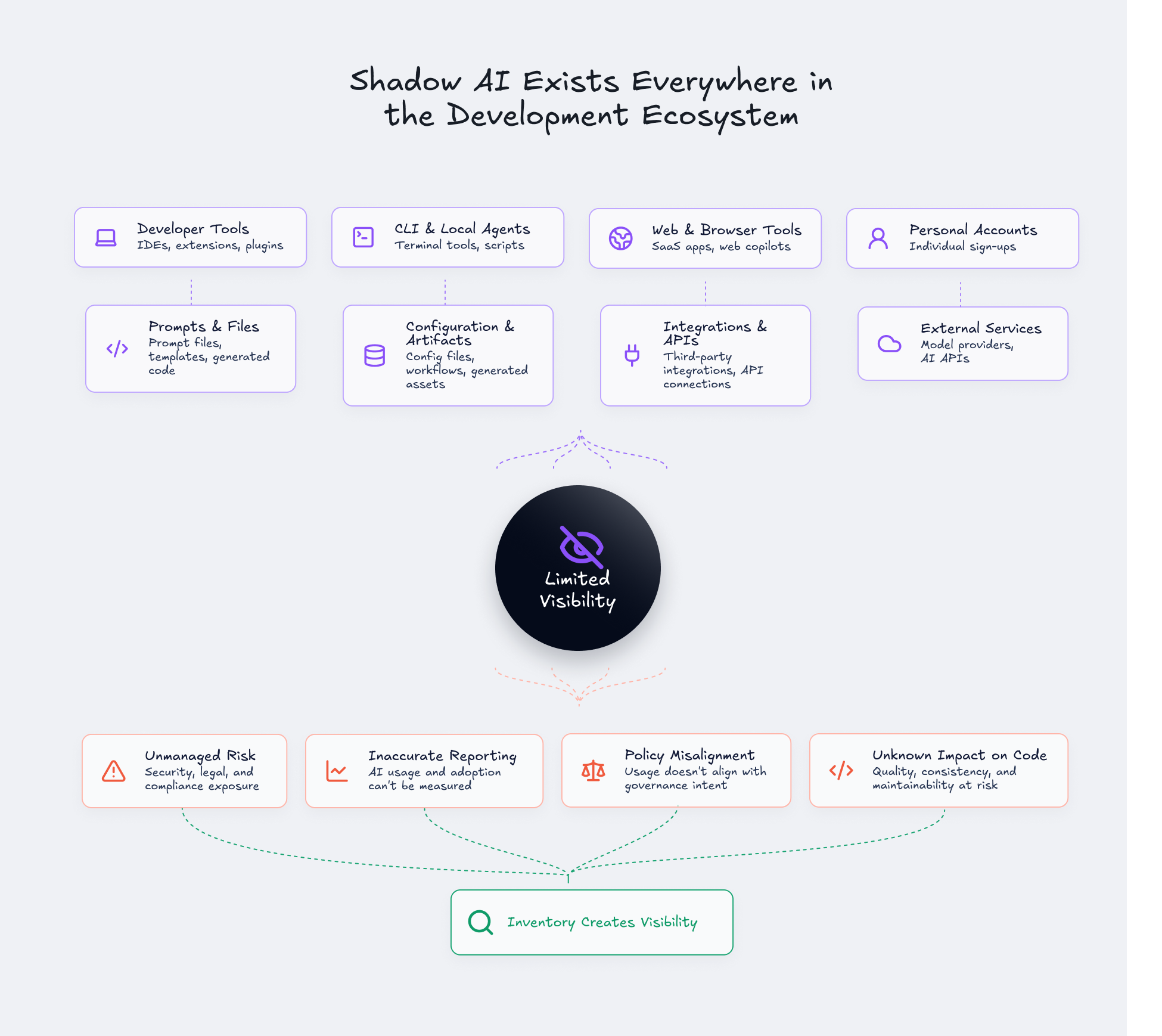
Shadow AI Exists everywhere in the development ecosystem

Common mistakes when tracking AI tool usage

Several patterns undermine AI visibility efforts. Recognizing them early helps avoid wasted effort.

  • Relying only on sanctioned-tool lists: Developers may use personal accounts, local extensions, or CLI tools that never appear in approved lists
  • Treating AI governance as only a legal or procurement issue: In engineering, governance connects to repositories and pull requests
  • Blocking tools without offering approved alternatives: Developers will route around controls if controls slow delivery without reducing risk
  • Measuring adoption only by license count: Licenses show what was bought, not necessarily what influenced code
  • Assuming low incident volume means low risk: Lack of findings may reflect lack of visibility, not absence of exposure

The goal is to create a managed adoption model where leaders know which tools are in use, understand where they appear, define acceptable use by risk level, enforce security and quality checks consistently, and produce evidence for leadership and compliance.

AI adoption has already reached everyday development workflows. The immediate leadership gap is visibility. Leaders cannot credibly report AI adoption or manage AI risk without knowing what is actually being used.

The practical path forward starts with AI inventory across repositories. Use it to align policy, enforcement, and reporting. Then connect it to existing code quality and security controls that already protect the delivery pipeline.

Turn AI adoption into something you can measure

Codacy's AI Inventory provides a repository-level view of AI tools, workflows, and related artifacts, helping engineering leaders track usage, identify policy gaps, and improve visibility across development teams.

Scan your repository for free →