


惯性聚合 高效追踪和阅读你感兴趣的博客、新闻、科技资讯
阅读原文 在惯性聚合中打开

推荐订阅源

奇客Solidot–传递最新科技情报
奇客Solidot–传递最新科技情报
S
Secure Thoughts
V2EX - 技术
V2EX - 技术
大猫的无限游戏
大猫的无限游戏
钛媒体:引领未来商业与生活新知
钛媒体:引领未来商业与生活新知
O
OpenAI News
D
DataBreaches.Net
The Cloudflare Blog
L
LangChain Blog
Last Week in AI
Last Week in AI
酷 壳 – CoolShell
酷 壳 – CoolShell
The Register - Security
MyScale Blog
MyScale Blog
Help Net Security
Help Net Security
Jina AI
Jina AI
T
The Blog of Author Tim Ferriss
T
The Exploit Database - CXSecurity.com
D
Darknet – Hacking Tools, Hacker News & Cyber Security
博客园 - 叶小钗
The Last Watchdog
The Last Watchdog
Exploit-DB.com RSS Feed
www.infosecurity-magazine.com
TaoSecurity Blog
TaoSecurity Blog
博客园 - 司徒正美
aimingoo的专栏
aimingoo的专栏
C
Cyber Attacks, Cyber Crime and Cyber Security
A
Arctic Wolf
T
Tenable Blog
Know Your Adversary
Know Your Adversary
Google DeepMind News
量子位
The Hacker News
The Hacker News
AWS News Blog
AWS News Blog
Apple Machine Learning Research
Vercel News
Vercel News
Hacker News: Ask HN
Hacker News: Ask HN
Scott Helme
Scott Helme
小众软件
小众软件
Recent Commits to openclaw:main
T
Threat Research - Cisco Blogs
G
GRAHAM CLULEY
H
Heimdal Security Blog
C
CXSECURITY Database RSS Feed - CXSecurity.com
博客园_首页
B
Blog
GbyAI
GbyAI
P
Palo Alto Networks Blog
美团技术团队
Hacker News - Newest:
Hacker News - Newest: "LLM"
博客园 - Franky

Hacker News - Newest: "AI"

AI can't read an investor deck AI as an attorney? Student uses ChatGPT, Gemini to sue UW over alleged racial discrimination Hacking MCP Servers in AI Systems – The Rug Pull: Tool Changes After Approval GitHub - MeepCastana/KubeezCut: Free Web based video editor GitHub - GenAI-Gurus/awesome-eu-ai-act: Curated tools, official sources, OSS, templates, and guides for EU AI Act compliance. Can AI judge journalism? A Thiel-backed startup says yes, even if it risks chilling whistleblowers Coming soon: 10 Things That Matter in AI Right Now DARPA built an AI to fact-check enemy weapons claims What explains heterogeneity in AI adoption? When AI Meets Muscle: Context-Aware Electrical Stimulation Promises a New Way to Guide Human Movements - Department of Computer Science AI Changed How We Build. It Did Not Change What Matters. Linux rules on using AI-generated code - Copilot is OK, but humans must take 'full responsibility for the… Meta spins up AI version of Mark Zuckerberg to engage with employees Code Mode: Let Your AI Write Programs, Not Just Call Tools | TanStack Blog GitHub - Delavalom/graft: Go framework for building AI agents. Type-safe tools, multi-provider (OpenAI, Anthropic, Gemini, Bedrock), zero vendor SDKs. India's TCS tops estimates, says new AI models did not dent services demand Gen Z's fading AI hype Strong feeling: we are in a folded AI reality GitHub - machinarii/total-recall-catalog: A reference catalog of latest knowledge retrieval, memory & RAG systems GitHub - mensfeld/code-on-incus: Give each AI agent its own isolated machine with root, Docker, and systemd. Active defense detects and stops threats automatically.. Quantization, LoRA, and the 8% Problem: Benchmarking Local LLMs for Production AI Iran war: We spoke to the man making Lego-style AI videos that experts say are powerful propaganda Powell, Bessent discussed Anthropic's Mythos AI cyber threat with major U.S. banks GitHub - immartian/bellamem: Persistent belief-graph memory for AI agents. Retrieves decisive context by importance — not recency, not RAG, not /compact. recursive-mode: The Repo-Native Operating System for AI Engineering After the attack on Sam Altman's home, will AI CEO's go on the offensive? The biggest advance in AI since the LLM Opus 4.6 vs GPT 5.4 One Prompt Unity World Generation Test “AI polls” are fake polls Client Challenge Can AI be a 'child of God'? Inside Anthropic's meeting with Christian leaders How to Switch AI Chatbots and Why You Might Want To GitHub - MattMessinger1/agentic_refund_guardrail: Safe refund policy layer for AI agents — Python + TypeScript. Same behavior, shared tests. Adam/papers/emergent_values_whitepaper.md at master · strangeadvancedmarketing/Adam Ask HN: How do you stop playing 20 questions with your AI coding tools How far can automation and AI support psychotherapy? - @theU GitHub - stagas/rtdiff: realtime git diff gui and AI-assisted commits A Mac Studio for Local AI — 6 Months Later A History of the Early Years of AI at the University of Edinburgh Why AI Coding Tools Still Feel Stuck on Localhost MSN AI Datacenters Are Becoming Strategic Targets twitter.com Penn Researchers Use AI to Surface Unreported GLP-1 Side Effects in Reddit Posts Show HN: MoodSense AI (ML and FastAPI and Gradio, Deployed on Hugging Face) Moodsense Ai - a Hugging Face Space by aman179102 AI models are terrible at betting on soccer—especially xAI Grok GitHub - xialeistudio/echoic GitHub - HimashaHerath/github-dev-wrapped: AI-powered weekly GitHub activity reports deployed to GitHub Pages GitHub - alejandrobalderas/claude-code-from-source: Architecture, patterns & internals of Anthropic's AI coding agent — reverse-engineered from source maps AI and Tech brief: Ireland ascendant GitHub - Titovilal/context0: Context0 - Never Surrender Training for a Marathon with an AI Coach: What Worked and What Didn't Cyber Pulse: Agentic Intel - Apps on Google Play I Built an AI PR Reviewer That Catches Bugs by Not Looking for Bugs Gen Z workers are so fearful AI will take their job they’re intentionally sabotaging their company’s AI rollout | Fortune How AI Is Reimagining the Game of Golf–For Both Players and Courses GitHub - nattergabriel/reseed: A CLI tool for managing and distributing agent skills across projects Is SVG the final frontier? My AI workflow evolved from prompts to a near-autonomous workflow MLSharp Help - 3DGS Viewer & Generator I put my cognitive field based AI's runtime on GitHub Is Numble the first AI-proof game? A3: Kubernetes for autonomous AI agent fleets | Emergent Principles Deepali Vyas ("The Elite Recruiter") GitHub - msmarkgu/RelayFreeLLM: A restful API designed to route user prompts to various AI model providers. Unionized ProPublica staff are on strike over AI, layoffs, and wages Unleashing the Advantage of Quantum AI We're heading for an AI-fueled 'dementia crisis,' brain scientist warns The AI-Assisted Breach of Mexico's Government Infrastructure [pdf] GitHub - stef41/lmscan: 🔍 Detect AI-generated text and fingerprint which LLM wrote it. Open-source GPTZero alternative. Zero dependencies, works offline. MSN GitHub - visionscaper/collabmem: Enabling long-term collaboration with Agentic AI - building up episodic and world model memory over time with in-context awareness We gave an AI a 3 year retail lease in SF and asked it to make a profit | Andon Labs AI Code is Hollowing Out Open Source, and Maintainers are Looking the Other Way What leaked "SteamGPT" files could mean for the PC gaming platform's use of AI AI is the boss at this retail store. What could go wrong? GitHub - Wuzu11517/agentic-proxy: Local proxy meant to help reduce With Drones, Geophysics and ArtificiaI Intelligence, Researchers Prepare to Do Battle Against Land Mines A Single Operator, Two AI Platforms, Nine Government Agencies: The Full Technical Report 在 Steam 上购买 FriedrichAI: Offline AI 立省 10% GitHub - inevolin/resume-cli: Hit Claude usage limits? Resume any AI coding session elsewhere. Switch tools at zero friction. GitHub - atripati/ark: AI Runtime Kernel — a context operating system for AI agents. Eliminates tool bloat, loads only what’s needed, and gives LLMs their reasoning space back. How to Build a Secure AI PR Reviewer with Claude, GitHub Actions, and JavaScript This Startup Wants You to Pay Up to Talk With AI Versions of Human Experts Intel Arc Pro B70 Brings 32GB VRAM to Local AI for $949 WordPress 7.0: The Good, the AI, and the Still Missing AI on the couch: Anthropic gives Claude 20 hours of psychiatry IatroBench: Pre-Registered Evidence of Iatrogenic Harm from AI Safety Measures AI Agents Know About Supabase. They Don't Always Use It Right. The history and future of AI at Google, with Sundar Pichai Inside an AI‑enabled device code phishing campaign How Meta Used AI to Map Tribal Knowledge in Large-Scale Data Pipelines AI for Systems: Using LLMs to Optimize Database Query Execution Forecasting the Economic Effects of AI Introducing Tinker: Play with AI, bring your ideas to life AI sheds light on an ancient gaming mystery People really hate AI but not as much as Iran—or Democrats | Fortune What is an AI Product Engineer? Phoebe Gates wants her $185 million AI startup to succeed with 'no ties to my privilege or my last name': 'I have a chip on my shoulder' | Fortune
The uncomfortable truth about AI and the American worker | Fortune
Nick Lichten · 2026-04-29 · via Hacker News - Newest: "AI"

Surveys consistently show that workers dread artificial intelligence. They worry it will render their skills obsolete, hollow out their roles, and eventually eliminate their paychecks altogether. That anxiety has shaped public discourse, union bargaining tables, and congressional hearings for the better part of three years. But a sweeping new analysis from Morgan Stanley Research offers a finding that cuts against the fear — and quietly illuminates something far more consequential about how AI is reshaping the American economy.

AI isn’t destroying jobs. It’s making workers dramatically more productive. And the workers are doing that extra production? They have no idea.

The numbers that should calm everyone down

The Morgan Stanley report, authored by Chief U.S. Economist Michael Gapen and a team of economists, examined industry-level output per employee across the U.S. economy and cross-referenced it with each industry’s degree of AI exposure. The results were striking: industries classified in the top quartile of AI exposure contributed 1.7 percentage points to the overall 2.4 percentage-point growth in productivity recorded over the four quarters through the end of 2025. A year earlier, those same industries had contributed just 0.7 percentage points. The acceleration is not subtle.
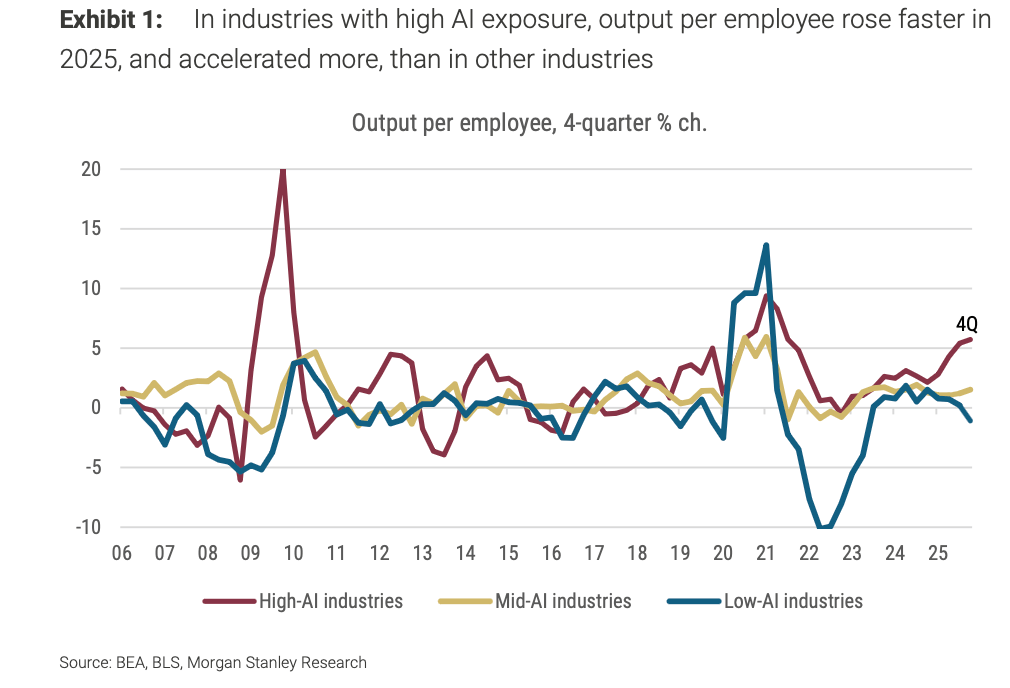
Here’s what makes the finding particularly revealing: that surge in productivity wasn’t produced by cutting headcounts. Employment trends across high-, medium-, and low-AI industries were broadly similar. What differed was output — how much those workers were producing. In high-AI industries, output accelerated sharply while employment growth stagnated. In low-AI industries, output actually slowed.

In economic terms, this appears to be a best-case scenario unfolding in real time: workers are not being displaced; they are being augmented. But psychologically and culturally, it creates a paradox. The workforce’s hatred of AI may look, from the outside, like a failure of economic literacy. Workers are thriving and don’t know it. Look closer, and a more sophisticated fear comes into view — one that the productivity data doesn’t address at all.

The 90% problem

But aggregate productivity numbers obscure a brutal internal sorting that is already underway inside companies. Tech executive and AI strategist Daniel Miessler, whose observations on the workforce have circulated widely in recent weeks, argued in a LinkedIn post that the real dynamic isn’t AI replacing workers — it’s AI allowing a small tier of top performers to absorb the work of everyone below them.

“AI can’t come anywhere close to replacing the top performers at a big company,” Miessler wrote. “But they’re spending millions a year on tens of thousands of employees in the bottom 75%… companies no longer want to pay millions a year for mediocre employees. They’d rather fire everyone but the best, and have them become 10x or 100x what they were by wielding AI.” The productivity boom, in this reading, isn’t lifting all boats. It’s concentrating leverage at the top while quietly marking a much larger cohort for displacement — not by machines directly, but by a smaller number of humans wielding them. An even darker outcome is whether those top 10% workers are just buying themselves a few more years before they’re displaced, too.

The AI tools driving this boom, technologist Shaun Warman pointed out in a recent blog post, are not priced at their actual cost. A serious individual user of a frontier model consumes roughly $80 to $150 of compute per month at real prices; the subscription that buys it runs $20. OpenAI has acknowledged publicly that even its $200-a-month enterprise tier loses money on its heaviest users. The reason for the subsidy, according to Warman, is simple and unsettling: “The user is not yet the customer. The user is the training set.” Every edit, regeneration, and follow-up question a worker fires into a frontier model is training data, aggregated across hundreds of millions of users and tens of billions of conversations.

“Synthetic data has crossed the quality threshold,” Warman argued. “Models can now generate, filter, and grade their own training data at a level competitive with raw human input. The frontier labs publish papers on this monthly.” The straightforward implication, he concluded, is that “the marginal value of a human edit is falling as the model’s ability to produce its own corrections rises.”

What happens when the subsidy ends?

Warman identified three forces that will close what he calls “the apprenticeship window” within three to five years: the aforementioned quality threshold; agentic self-play, allowing models to evaluate and improve themselves in domains with verifiable outcomes; and sheer scale, meaning that additional human feedback is hitting diminishing returns. When those forces converge, the subsidy that makes AI accessible to ordinary workers will lose its justification.

Warman’s predictions for what follows are stark: the $20 monthly tier will vanish or degrade into an advertising-supported shadow product; top capabilities get gated behind enterprise contracts with five-figure annual minimums; and in the most extreme scenario, the labs stop licensing AI as a tool altogether and simply become the operator — law firms, consulting shops, hedge funds — capturing the economic value themselves rather than sharing it.

The productivity data, in other words, is a snapshot of the apprenticeship phase — a period when workers’ and labs’ interests align almost perfectly. Both want better output. For now, both get it cheaply.

The Morgan Stanley economists note, carefully, that the pattern of rising output and stable employment “may change as AI adoption picks up.” That hedge deserves more weight than it typically receives — because the repricing, when it arrives, will not affect all workers equally. Large enterprises that can amortize six-figure AI contracts across thousands of employees will barely notice the transition. Workers at smaller firms, in lower-margin industries, or in the public sector — teachers, healthcare aides, municipal workers — face a starker calculus: the tools that made them more productive were priced below cost as a temporary subsidy, and the bill, when it comes, will be set by what large corporations are willing to pay, not what individual workers can absorb. The productivity gains currently showing up in the data may accrue broadly. The tools that generated them may no longer be broadly accessible.

Workers aren’t wrong to be wary of AI. They may just be sensing the right threat at the wrong moment — not the displacement that’s being measured, but the repricing that isn’t yet.

For this story, Fortune journalists used generative AI as a research tool. An editor verified the accuracy of the information before publishing.