





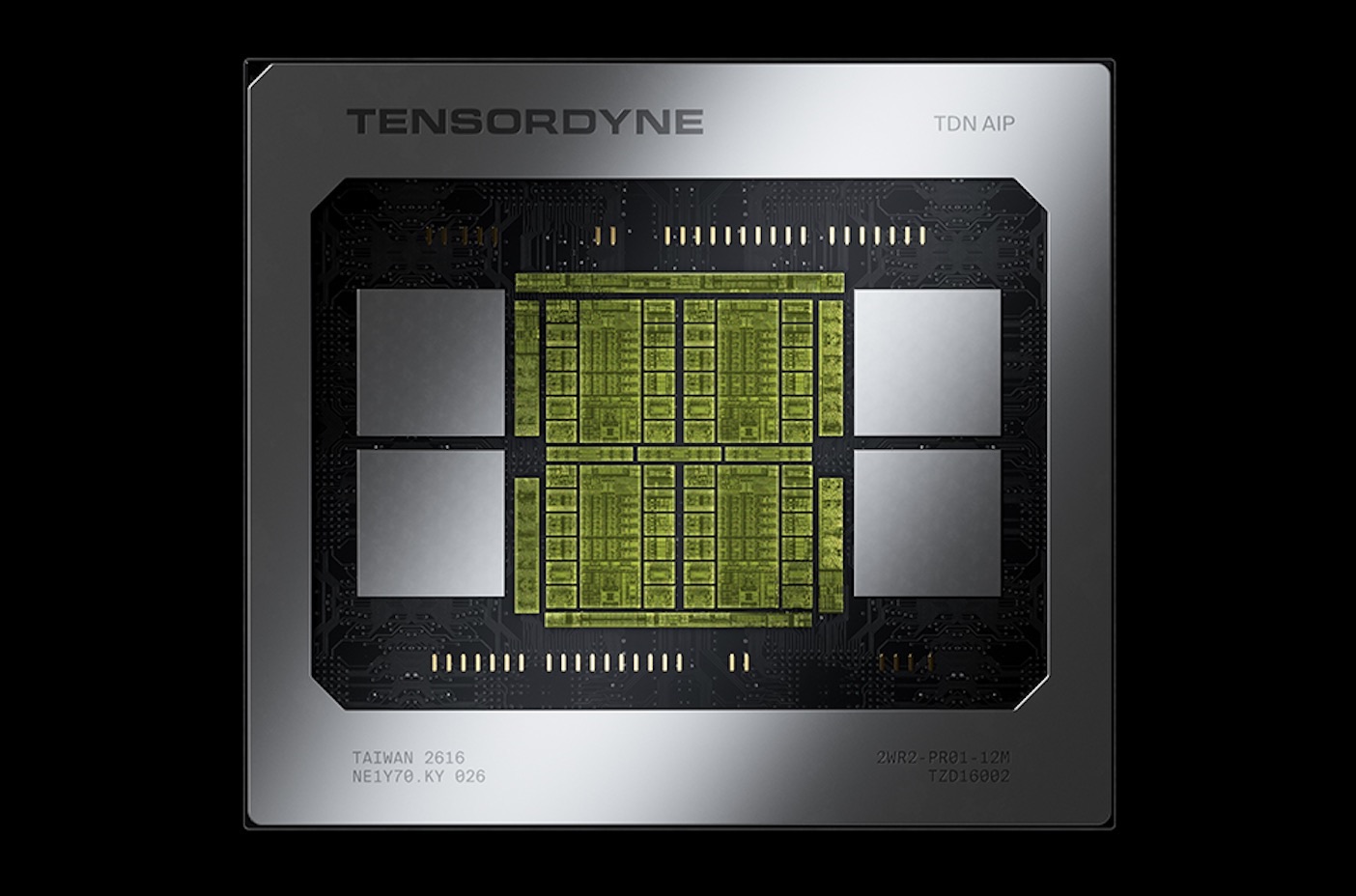
Tensordyne announced Napier, a 3nm AI processor and rack-scale inference platform built around proprietary logarithmic mathematics. The interesting part is not just another AI chip startup entering a crowded market, but the company’s claim that changing the math in the accelerator can reduce multiplier area, increase on-chip SRAM, and improve rack-level inference economics. For now, Napier is still a taped-out chip and 2027 system roadmap, so the big question is whether the performance and software claims survive contact with real deployments.
Tensordyne is positioning Napier as a way to attack both the speed and the cost of AI inference. Instead of building only around more conventional matrix-multiply resources, the company says its logarithmic math approach turns multiplication operations into additions. Adders are smaller and generally lower-power than multipliers, so the promise is more useful silicon area for memory and better system balance.

To that end, it is announcing an ecosystem to not just have a chip, but a cluster architecture.
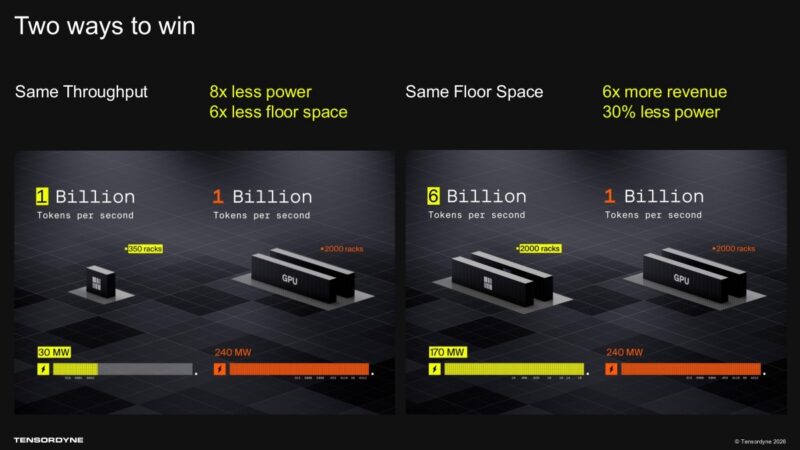
That matters because a lot of today’s AI infrastructure discussion is no longer just about peak accelerator TOPS or FLOPS. Long-context inference, agentic workflows, and mixture-of-experts models can become constrained by memory, interconnect, decode throughput, rack power, and cooling. Tensordyne’s argument is that a more balanced chip and rack design can deliver more tokens per rack and more tokens per megawatt than current high-end alternatives.
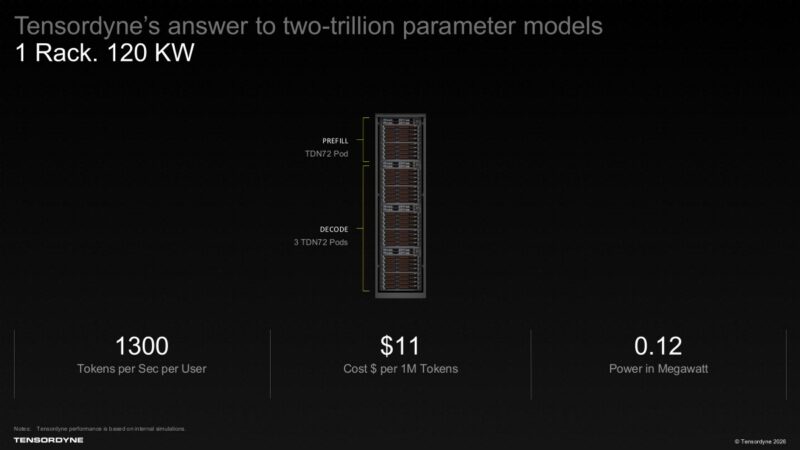
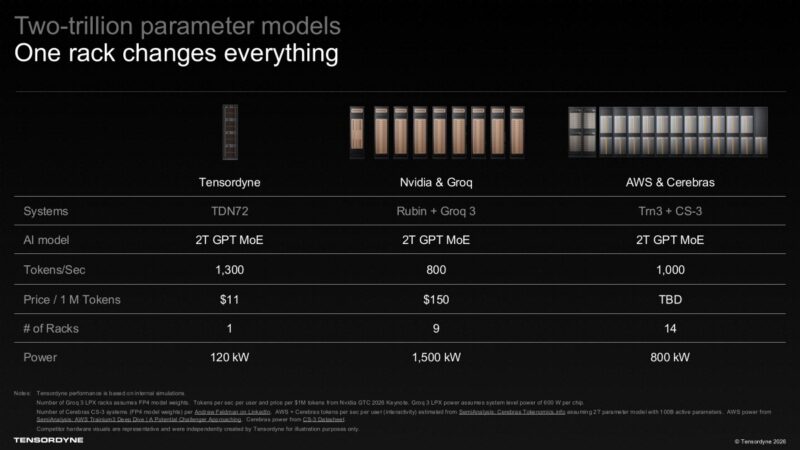
Tensordyne compares its TDN72 rack against larger multi-rack configurations for two-trillion-parameter GPT MoE models. In that comparison, the company says one 120kW TDN72 rack can reach 1,300 tokens per second per user, while NVIDIA and Groq require nine racks and 1.5MW, and AWS plus Cerebras require fourteen racks and 800kW. Those comparisons are attention-grabbing, but Napier is announcing product at this point.
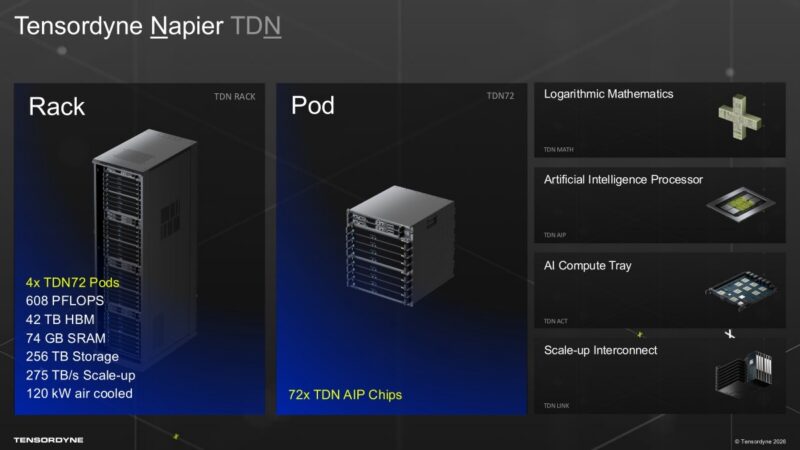
A full TDN72 system is designed around 72 nodes, 68 petaflops of total compute, and 42TB of HBM. Tensordyne says its capacity is aimed at models with up to 10 trillion to 20 trillion parameters, where the memory footprint and expert routing become major system-level challenges. This is also where rack-scale design matters, since simply adding accelerators does not help if the interconnect, memory, power, or cooling infrastructure becomes the limiting factor.
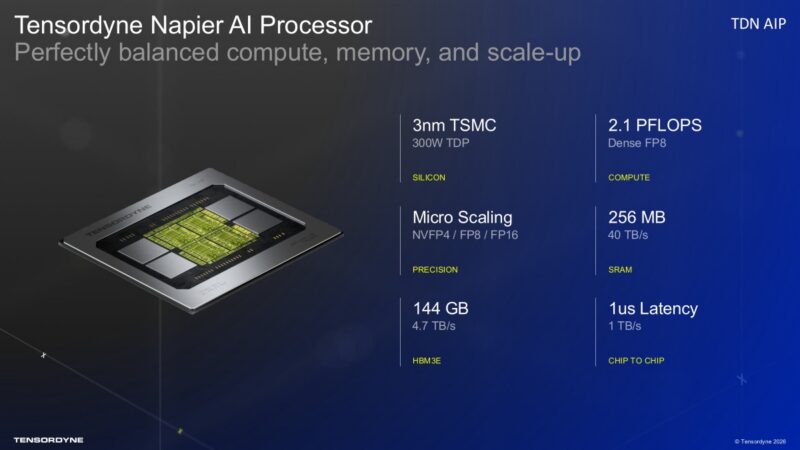
Napier itself is a 3nm TSMC chip with 138 billion transistors. Tensordyne lists 2.1 petaflops of compute per die, a 1.33GHz accelerator core, a 1.5GHz CPU, 256MB of SRAM, and 144GB of HBM3E. One of the more important claims is that Napier has five times the SRAM of NVIDIA Blackwell. If that holds up in useful workloads, the extra SRAM could help keep more data close to the compute fabric and reduce the penalty of moving data around the system.
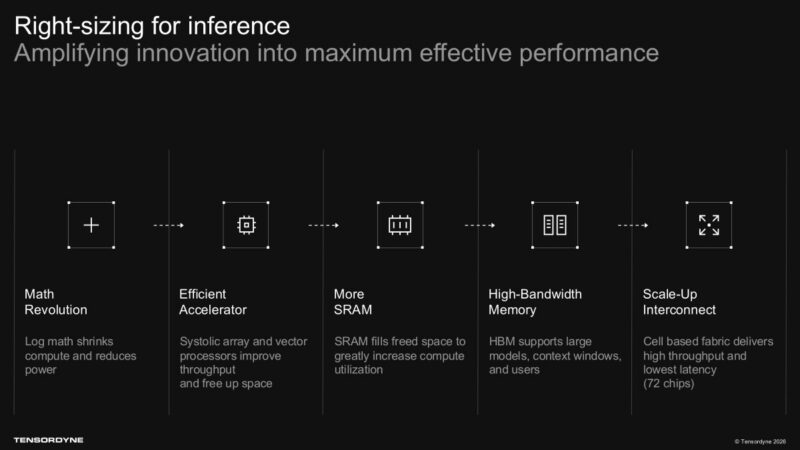
The logarithmic math concept is the architectural hook. Tensordyne says reducing the multiplier footprint leaves more room for SRAM, while a systolic array and vector processor handle throughput. That is a different way to frame the AI accelerator problem than simply counting more dense matrix math units. At the same time, it is also the part of the story that most needs third-party workload testing, since changing numerical approaches can have accuracy, software, and model-porting implications.
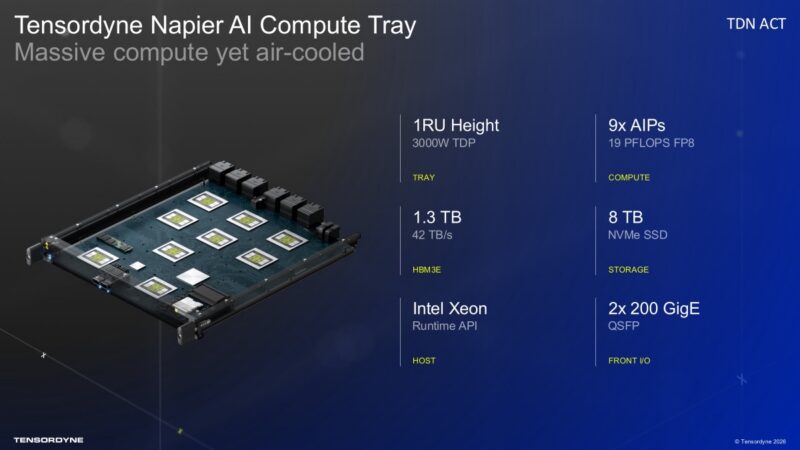
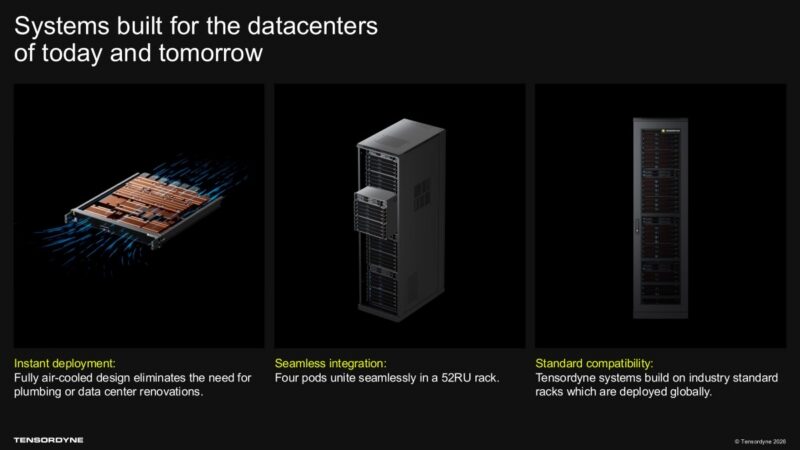
At the tray level, Tensordyne is packaging nine Napier chips into a 1RU AI Compute Tray with 1.3TB of HBM3E, 8TB of storage, Intel Xeon host CPUs, and dual 200GbE. Four trays make a TDN72 pod, and four pods fit in a standard 52RU rack. An important practical point is that Tensordyne is targeting an air-cooled system. Liquid cooling is used for large-scale AI, but Tensordyne is targeting an air-cooled system. Also interesting is that the front-end as 2x 200GbE seems to indicate that the Intel Xeon host CPUs will not be PCIe Gen6 where you can drive 800Gbps per x16 link.
Scale-up connectivity is another major part of the design. Tensordyne calls its interconnect TDN Link and says it can provide sub-microsecond chip-to-chip latency with 1TB/s of bandwidth across the 72-chip system. For mixture-of-experts and agentic AI workloads, the interconnect can matter as much as the accelerator because routing experts, moving activations, and keeping many users fed can expose latency and bandwidth limits. Instead of the NVL72 spine, this looks more like a traditional chassis switch networking solution.
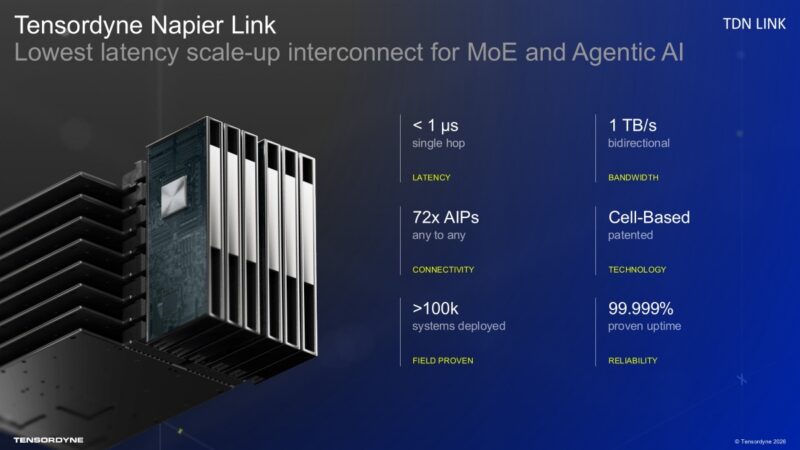
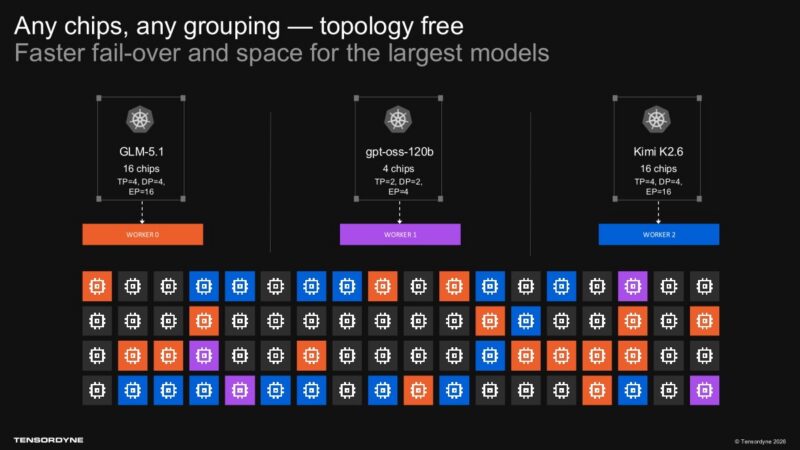
Topology flexibility is part of that same interconnect story. Tensordyne says any chips can be grouped for a workload, which would help with failover and model placement if the software stack can make that transparent. That is a useful claim for large deployments, but it is also an area where operational details matter. Cluster schedulers, model serving layers, failure handling, and observability need to work well before customers feel the benefit.
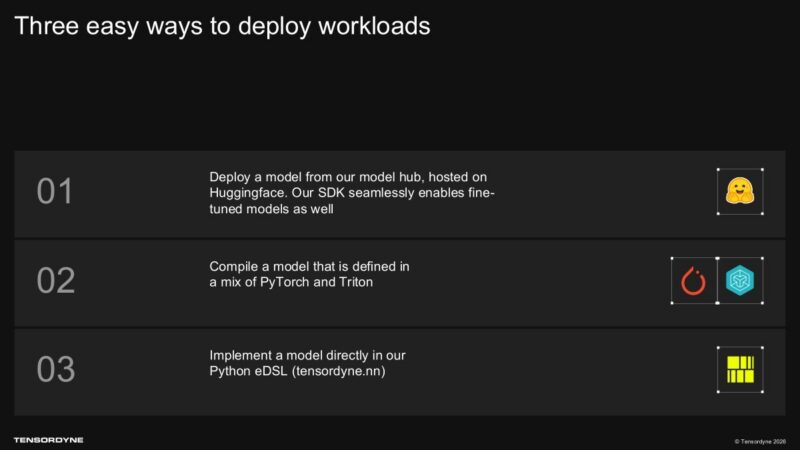
Software may end up being the harder part of the launch. Tensordyne is talking about a Hugging Face-hosted model hub with its SDK, direct compilation for PyTorch and Triton-defined models, and a custom Python eDSL called tensordyne.nn. NVIDIA’s CUDA ecosystem is a huge base of frameworks, kernels, profiling tools, deployment patterns, and developer habits. Any new AI accelerator has to make the software path feel easy enough that customers will try it.
Partners also matter here. Tensordyne says it is working with HPE and Juniper for chassis and infrastructure components, which should help the company look more credible as a systems vendor rather than only a chip developer. A 3nm tape-out through TSMC via Broadcom is a meaningful milestone, but rack-scale AI systems require a supply chain, platform validation, field support, and customers willing to bet workloads on a new architecture.
Timing is the other challenge. Tensordyne says beta programs are planned for Q1 2027, with system shipments expected by the end of Q2 2027. By then, NVIDIA, AMD, hyperscale internal silicon efforts, Cerebras, Groq, and other AI infrastructure options will have moved again. Napier needs to show that the claimed efficiency holds up in real model serving, real software stacks, and real customer operations.
Tensordyne Napier is one of the more interesting AI accelerator announcements because it is trying to change the math, not just scale differently from NVIDIA. Building an accelerator that has a similar form factor as NVIDIA and saying that you are cheaper tends not to be the way others have seen success, so the math change is interesting. The 3nm tape-out, 138 billion transistor figure, large SRAM claim, 42TB HBM rack configuration, and air-cooled TDN72 system all make this worth watching.
Still, the gap between a compelling launch and a successful AI platform is large. Performance per rack and performance per megawatt are exactly the right metrics to target. If Tensordyne’s technology works and can deliver in 2027, Napier could be a notable alternative for inference infrastructure. Perhaps we will start seeing deals on a multi-billion-dollar scale. Until then, this is an ambitious architecture with a lot still left to prove, so it will be interesting to watch.
此内容由惯性聚合(RSS阅读器)自动聚合整理,仅供阅读参考。 原文来自 — 版权归原作者所有。