


Last year I discovered I like sci-fi novels. To be precise, I found a collection of Isaac Asimov sci-fi novels and started reading them in the evenings to unwind. I know Asimov wrote the Foundation saga and more, but my particular interest in his novels was very specific: I wanted to find something to read, and finish, in one or two evenings. Over the years, I grew a slight disgust for ultra-long forms that drag on like soap operas, no matter how epic or interesting.
However, I finished the collection of Asimov’s novels rather quickly, and with enjoyment. I wanted to read more such novels, but sadly I couldn’t find further collections by Asimov. And even if there was another collection, I think a human person has a finite amount of time in life and can’t write an infinite amount of novels. But AI can. Hence my new side project.
My first approach, ironically, resulted in what I have a disgust for: a Never-Ending Novel written one paragraph per day by two frontier models. While the AI created some interesting sci-fi concepts and made the story mostly appealing, each day it was inevitably going into the direction of a never-ending space opera. And, of course, included some annoying AI slop constructs like hyperbolic negation, plenty of “not buts”, or the main character’s urge to always reply in contradictions, like some different kind of Yoda: whenever anyone said anything, Olda would reply with “It was not that but this.”
That said, AI also came up with some amazing lines like:
“Civilization begins wherever mercy becomes auditable.”
“On Mars, coincidence had long ago been the name of things understood too late.”
“Home is not the place one left but the practice one carried outward and found, on return, still running.”
From technical point of view the backend is just a straightforward Perl script that calls AI APIs and rotates between the two AI models based on which was the one to write the last paragraph, and all data is stored directly in the HTML file that is used to display the novel on the Never-Ending Novel URL. On the frontend, there’s even a quite slick auto-bookmark tracking the reader’s progress as they scroll down the page. As time of writing NEN has 75 paragraphs and the story could be wrapped up.
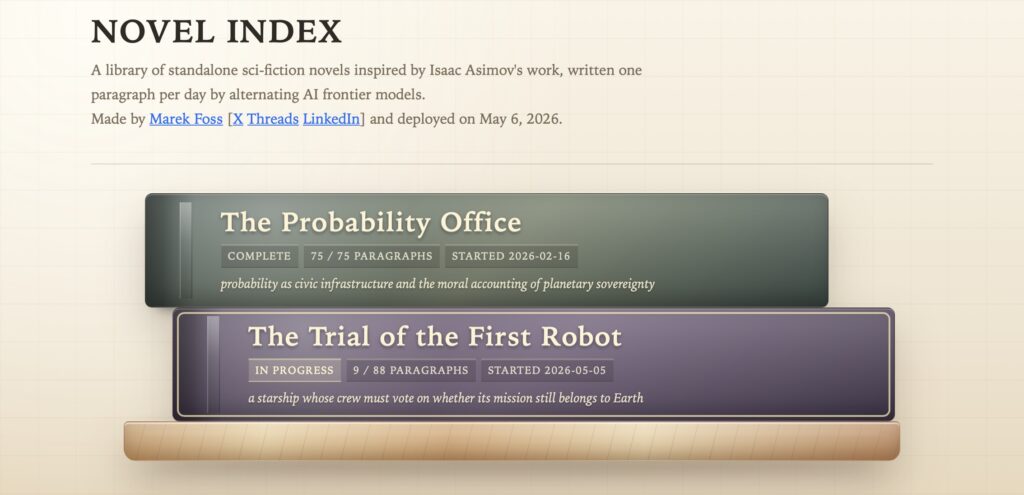
My second approach resulted in something else: Novel Index where the same two frontier AIs write a novel up to a random amount of paragraphs within a fixed range (like 75 to 100), and then move on to start another story. This approach looks more like what I was looking for. The AIs create a collection of novels, short enough to read in one or two evenings, using the same backend and frontend features as NEN, and still heavily inspired by Isaac Asimov’s work.
But this time, the novels are not never-ending! Instead, they just keep stacking on a virtual shelf, novel after novel. If you need something to unwind, but you’ve read all your favourite authors, maybe this is something for you: Novel Index. Just ignore the occasional AI slop. The overall story arch should be worth it anyway, if you are lucky: AI writing is just like a box of chocolates…
I'm a '08 graduate of Oxford University Computing Laboratory with M.Sc. in Computer Science having studied Machine Learning, Intelligent Systems, Information Extraction and Semantic Annotation. Since then, I have created & been involved in many projects, using various technologies.
I like to code in Perl, Solidity & jQuery+JavaScript, deploy on Ethereum & Debian+Nginx, design with Adobe & Affinity, and learn new things all the time!