








A few weeks ago I wrote about my friend who discovered Claude Code and disappeared for two months. He sent me screenshots of five Claude Code sessions running at once and told me he felt plugged into The Matrix. I get it. I have felt the same thing. It is insane what you can get done now. You even feel guilty for stopping.
The whole time he was building, I kept asking him one question.
What have you actually sold?
He never had an answer. Not because he’s lazy, he’s one of the smartest builders I know. He just never got around to the part where you talk to a customer and find out if any of it matters.
People are calling this the “AI last mile“ problem: everyone is building things like crazy, but they don’t get the products to market.
I think we have the order wrong.
Here is the loop I keep watching people fall into, my friend included.
You get an idea. You open up an AI agent. A weekend later you have a working prototype that would have taken a team of three a couple of months a few years ago. It feels amazing, so you keep going. You build the next idea, and the one after that. Every side project you ever shelved is suddenly alive again.
And then nothing happens, because you never put any of it in front of a person who might pay for it.
I know exactly why this happens, because it happens to me. I have ADHD, and building software with AI is the cleanest hit of dopamine I have ever found. Every prompt pays off in seconds, so my brain immediately wants the next one. You just keep building and building and building, because stopping feels like switching off the reward.
Selling never gives you that. A customer call can end in a flat no, and nobody hands you a dopamine hit for sitting with a stranger’s messy problem for an hour. So the selling, the customer conversations, the whole job of figuring out whether anyone actually wants this, all of it gets shoved to the end. It becomes the last mile, the boring part you tell yourself you’ll get to once the product is “ready.”
AI didn’t create this problem. Builders have always loved building more than selling. What AI did was make the building so cheap and so fast that the pile of unsold projects grew enormous almost overnight.
And before anyone says the fix is to go hire a salesperson, remember the catch. The people who are great at selling usually can’t build a thing, and AI hasn’t fixed that either. So we end up with builders who can make anything and won’t go sell it, and born closers who would sell anything and can’t make it. That’s the conundrum of this whole era.
The last mile didn’t get harder. It just got lonelier, because everything before it got so easy.
So here’s my actual point.
Talking to customers, understanding what they need, and creating demand for what you build is not the last mile.
It should be the first mile.
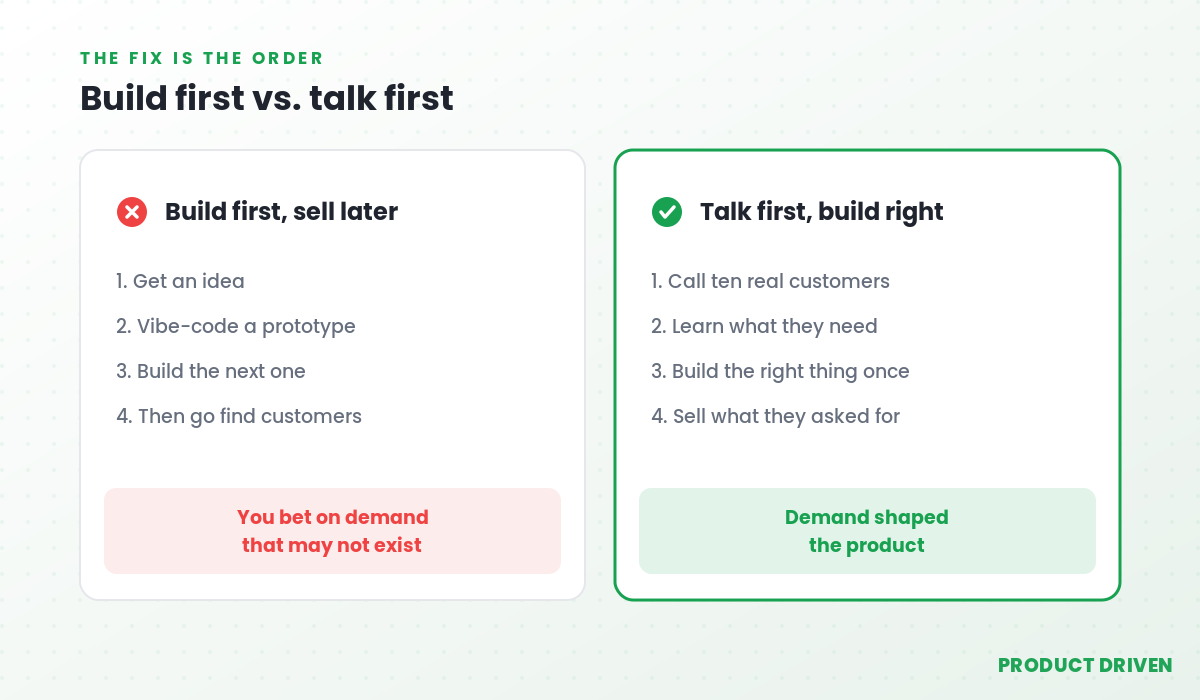
The whole reason the “last mile” feels so brutal is that people treat it as a step. Finish the product, then go find demand. But demand isn’t something you go collect at the end like signatures on a petition. It’s the thing that should have shaped the product in the first place.
When you build first and look for customers later, you are betting that the thing in your head matches a thing in the real world you have never checked. Most of the time it doesn’t, and you find out after you’ve sunk all the work in. When you talk to customers first, you build the right thing on the first try, or close to it, because you already know what they’re actually struggling with.
It’s the same work in a completely different order, and that order is the whole game. One way wastes the months, the other one saves them.
Let me make this concrete, because “talk to customers” is the kind of advice that sounds obvious and gets ignored.
Say you’re building a CRM. You can vibe-code a working CRM this weekend, with contacts, deals, and a pipeline view all wired up. It’ll demo great.
Now tell me who it’s for.
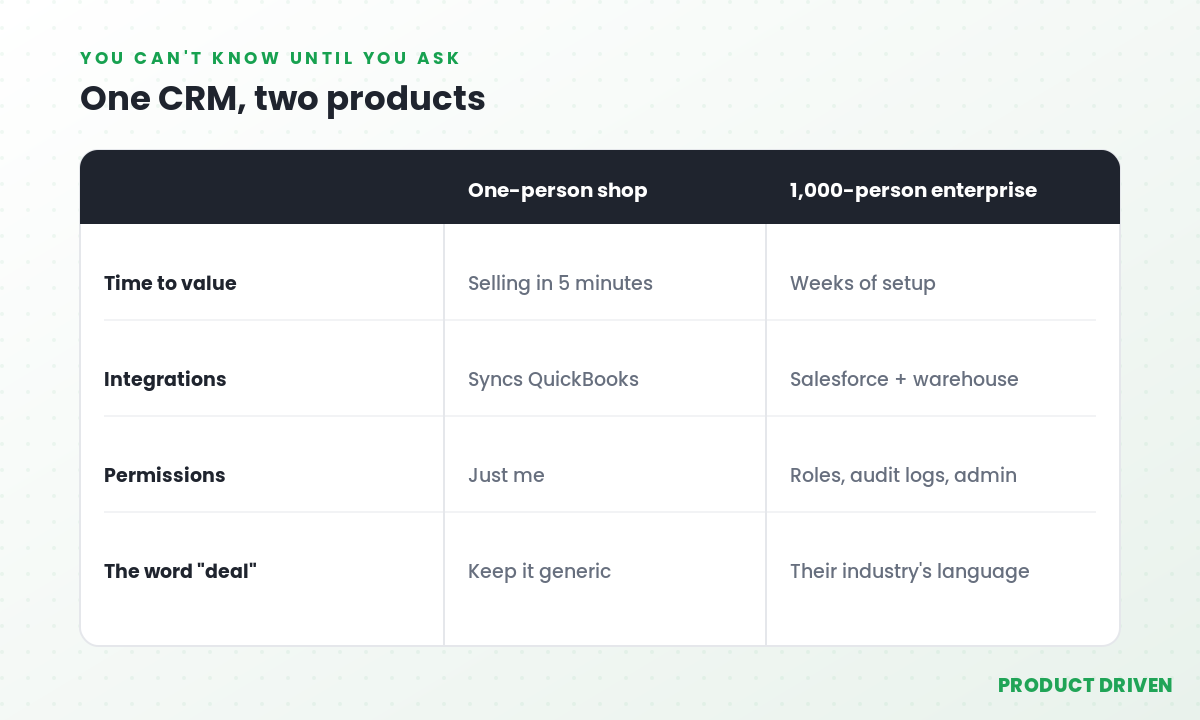
A CRM for a one-person shop and a CRM for a 1,000-person enterprise are not the same product at a different price. They’re different products. The solo operator wants to open it and be selling inside five minutes, while the enterprise wants permissions, audit logs, and an admin who decides who sees what. One of them syncs with QuickBooks; the other has to plug into Salesforce and a data warehouse nobody on your team has ever heard of.
Which industry? A CRM for a roofing company tracks job sites and material costs. A CRM for a law firm tracks matters and billable hours. The word “deal” means something different in each one, and if you get the vocabulary wrong, every person in that industry can smell that you don’t know their world.
You don’t learn any of this from your own head. You learn it by sitting with real people in a real vertical and listening until the nuances show up. Then you pick a lane on purpose, knowing what you’re saying no to. That one choice shapes the data model, the integrations, the onboarding, the pricing, and the words on the buttons.
None of that is the last mile. It’s the blueprint, and the build is just pouring concrete into it.
For a long time, the hard part of software was the building. That’s where the moat was. If you could ship something complex that others couldn’t, you won.
That moat is mostly gone. When anyone with a Claude subscription can prototype your product over a weekend, the code itself stops being the thing that protects you.
So what’s left? Everything that didn’t get automated: knowing exactly who you’re building for, understanding their problem better than they can explain it themselves, picking the right vertical and the right ten customers, and earning their trust. That work is slow and human, and AI can’t shortcut it, because it requires being in the room with people who don’t know what they want until you ask the right question.
This is the same thing I’ve believed since long before AI showed up, and it’s the whole reason I wrote Product Driven. Customers don’t buy cool code. They buy cool products. The expert in the problem beats the expert in the code every time, and that gap is wider now, not smaller, because the code stopped being the hard part.
At Full Scale, the engineers our clients love most have never been the ones who generate the most code. They’re the ones who ask what we’re building and why before they touch the keyboard. We hire and train for that on purpose, because it’s the part of the job that’s getting more valuable as everything else gets cheaper.
My friend will be fine. He’s too good not to be. But the next two months will look different if the first thing he does is call ten people who have the problem he wants to solve, before he opens a single terminal.
Build the thing. Just build it second.
Talk to the customer first.
此内容由惯性聚合(RSS阅读器)自动聚合整理,仅供阅读参考。 原文来自 — 版权归原作者所有。