


Somewhere on the 40th floor of a building you would recognize, a room full of people who could not create an email account without calling someone from IT is making the largest capital allocation decisions in the history of American business.
They are the board of directors, the people with fiduciary authority and a median age of 63+, the ones who vote on strategy and sign off on budgets whilst deciding the fate of hundreds if not thousands of workers.
The Conference Board's April 2026 report on AI governance found what anyone paying attention to this depressing (but vital) area already suspected: 83% of S&P 500 boards have identified artificial intelligence as a material risk, but only 2.7% of the directors sitting on those boards have any disclosed AI expertise.
It's essentially saying 83% of directors raised the alarm but only 2.7% could read the instrument panel to tackle the issue. This 30x canyon between those numbers is where $725 billion in spending decisions is being made and by their own admission, by the people least equipped in their own organizations to make them.
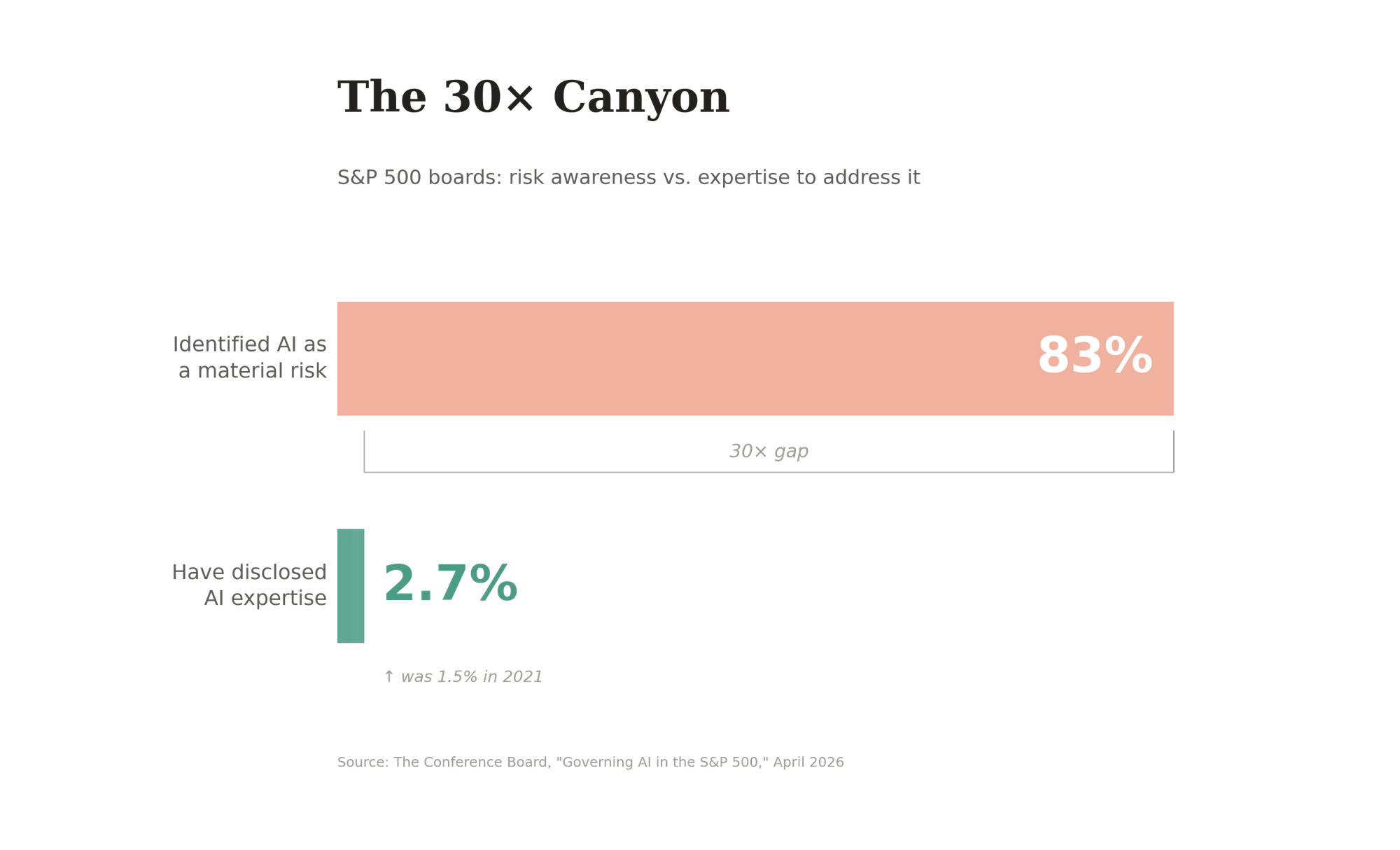
That 2.7% was 1.5% in 2021, so the expert bench has nearly doubled, which sounds encouraging until you picture what doubling actually looks like which is something like: having 2 buckets of water instead of one to tackle a 10 story fire.
Deloitte's Global Boardroom Program survey found 2 out of 3 board members reporting "limited to no knowledge or experience" with AI. Harvard Law School data found only 13% of S&P 500 companies have any directors with AI expertise on their boards at all. The companies employ 1000s of people who know this technology pretty darn well yet none of those people are sitting at the table where the money gets approved.
And these boards, their gas-leak detectors screaming, reached for a match rather than the experts in their company. $725 billion poured into a technology most of them have absorbed through magazine covers and dinner-party conversations with their adult children, approved by directors who identified the risk in their own filings and then, rather than hiring or using someone in their company who could evaluate it, simply wrote the check and hoped the spending itself would constitute a strategy, even if that means laying people off in the name of "AI."
Spencer Stuart's 2025 Board Index puts the average S&P 500 independent director at 63.6 years old. Departing directors average 68.5. The 66-to-70 cohort has swollen from 22% to 26% of boards since 2021, and 64% of companies with mandatory retirement policies now set the threshold at 75 or above, an age at which most professions would have handed you a watch and a cake two administrations ago yet very few people are being shown the door due to their age.
S&P 500 boards accrete like coral, each year depositing another thin layer that makes the structure more impressive, more rigid, and less capable of bending with the current, even as the decisions in front of them have become something the structure was never designed to hold. MIT's Center for Information Systems Research found a 14.7% point gap in return on equity between companies whose boards have digital and AI fluency and those whose boards do not.
Only 26% of boards discuss AI at every meeting, according to Protiviti. McKinsey found only 15% receive any AI-related metrics. Deloitte found 31% haven't put AI on their agenda at all. Yet almost all of these companies are making fundamental changes to their companies in the name of 'AI' without understanding it fully or having any grasp of the impacts.
On May 4, 2026, BCG published its "Split Decisions" survey of 625 leaders with the confession buried in the data: board directors with the lowest AI confidence are the most likely to say their organization is moving too slowly. The S&P 500 is being steered from the back seat by the passenger who understands the road least, eyes shut, screaming faster while the driver white-knuckles the wheel into a curve neither of them can see. 61% of CEOs said their boards are rushing AI transformation. 40% went further, saying their boards lack an informed view of how AI reshapes growth strategy. Board directors themselves are untroubled: 75% believe their AI knowledge is on par with or ahead of their peers, which would be hilarious if it wasn't so damning when you consider only 2.7% of them hold any expertise or credentials in this area and perfectly encapsulates how many of these directors are completely out of touch with their skills and the market.
The company the board thinks it is governing and the company the CEO is actually running have drifted so far apart they might as well be different organizations, tethered only by a signature line on a budget that the signing room cannot evaluate and the implementing room never requested.
BCG published those findings on May 4. Seven days later, McKinsey, Bain, and Capgemini (plus others) invested in OpenAI's Deployment Company. McKinsey had published its own diagnosis six months earlier — "The AI Reckoning" — naming the same governance failures it was now getting paid to fix. Essentially providing them with the best sales lead generator known essentially being: "here's a problem y'all don't understand, we have contributed to, but only we can help you solve it".
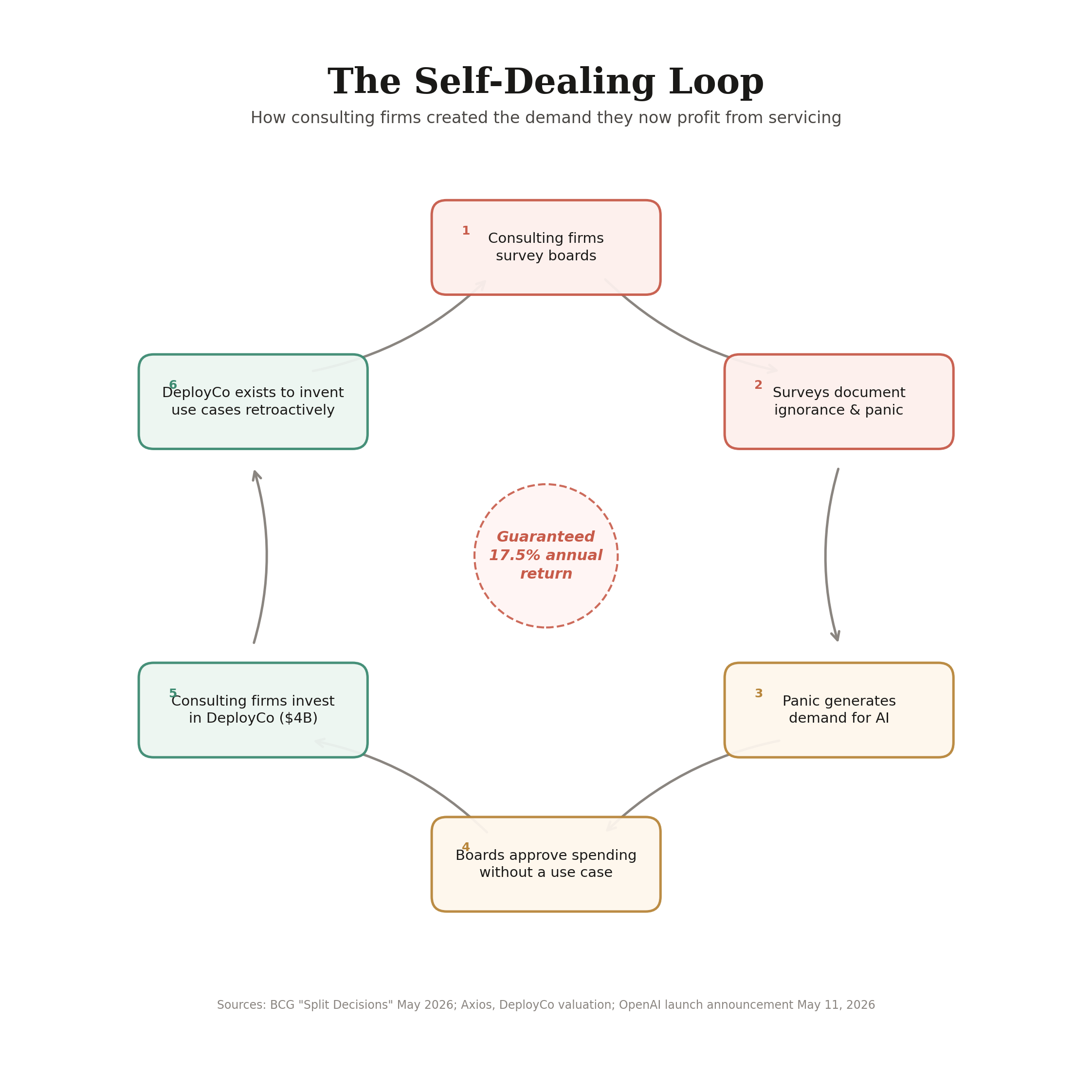
$4 billion launched the Deployment Company at a $14 billion valuation, which is a lot of confidence for an entity that didn't exist a week before the check cleared. OpenAI stated its consulting partners "sponsor more than 2,000 businesses worldwide." Which is incredibly rich because OpenAI is essentially admitting "these companies have not gotten value from AI".
The consulting firms survey the boards. The surveys document ignorance and panic. The panic generates demand that outruns any business case. Then the consulting firms bought into the entity that services that demand, and the PE backers followed, leaning on their own portfolio companies to become its customers. External investors receive a guaranteed minimum 17.5% annual return. The board directors approved the AI purchase without a use case. Now a separate company exists to invent one retroactively, staffed by people whose guaranteed returns depend on finding one whether it exists or not. The only reason it is a kafkasque nightmare is because inevitably this will lead to layoffs for hardworking employees who had no say in the situation. The disease wrote its own prescription, filled it at its own pharmacy, and sent the bill to the patient essentially.
Four hyperscalers alone have committed up to $725 billion in 2026 capex. Meta's guidance of $125 to $145 billion is 4 to 5 times the company's entire annual payroll and this is paid in the blood of employment.
Meta's capex is a volcano; it does not care what gets thrown into it. The company cut 8,000 employees in May 2026, saving roughly $3 billion a year, a ritual offering tossed into a spending commitment so large that the savings don't register as anything but smoke. Evercore ISI estimated the cuts cover 12% of the incremental depreciation drag — performed so the quarterly earnings call has a line about "operational efficiency" while the capex line climbs by a figure that dwarfs the savings by an order of magnitude. This is where I'd usually make a comment about the PR theater but at this point it's not even acting - it's just lying.
AI was the leading monthly reason cited for U.S. job cuts in both March and April 2026, per Challenger, Gray & Christmas: 49,135 AI-attributed cuts through April alone. Andy Challenger's summary functions as a thesis statement for the entire phenomenon: "Regardless of whether individual jobs are being replaced by AI, the money for those roles is."
MIT's GenAI Divide study found a 95% failure rate when enterprise generative AI projects attempt the jump from pilot to production, a number so lopsided it would be embarrassing for a coin flip. BCG's data tells a parallel story: only 5% of companies have the organizational maturity BCG calls "future-built" for AI, with 60% generating no material value. An NBER study of roughly 6,000 CEOs found the vast majority reporting little measurable impact on operations.
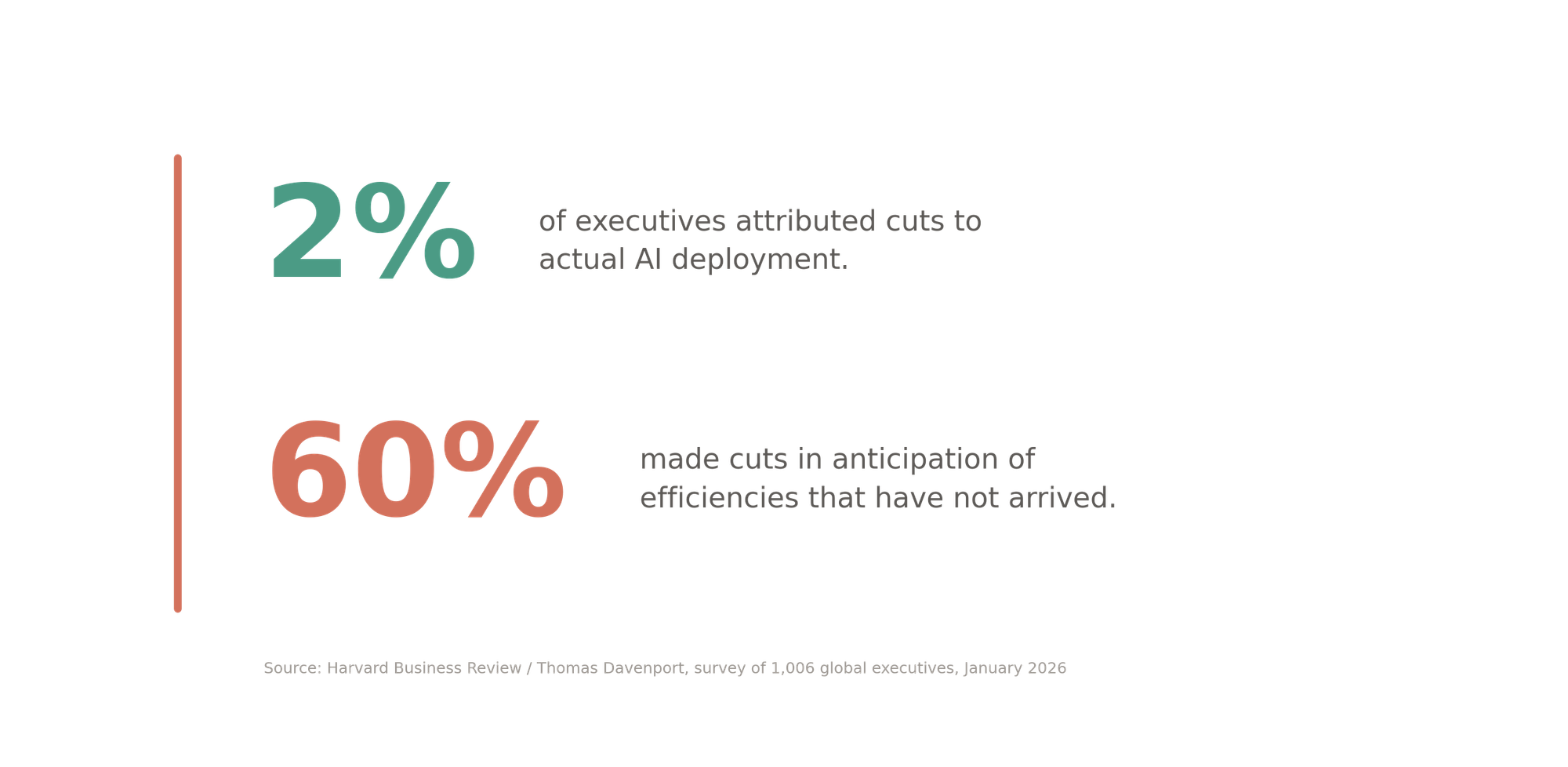
The next number is the cruelest. Only 2% of executives attributed major staff reductions to actual AI deployment. 60% made cuts in anticipation of efficiencies that have not arrived. They gutted the kitchen because someone saw a cooking show, and now the whole house orders takeout every night because nobody ever learned to use the stove.
The bet was never productivity, it was wage compression with a press release, a pattern where cutting headcount in AI's name became its own form of strategic theater that required no actual deployment to justify the damage.
BCG's AI Radar 2026, published by a firm that struck its own separate partnership with OpenAI two months before the Deployment Company launched, found 94% of organizations will continue or expand AI investments even if current initiatives fail in the next twelve months. Stopping would require the directors to admit they approved something they did not understand, and the people in that room did not get to that room by admitting they were wrong about anything, ever, to anyone. So rather than actually being 'leaders' they do what they know best - blame others and in this case that is the workers who again had 0 say.
Block CEO Jack Dorsey cut 40% of his workforce while posting gross profit up 26% year over year. In March 2025 he told employees the cuts had nothing to do with AI. Eleven months later the next round was pinned to it. Amazon shed roughly 30,000 employees while Q1 capex climbed 77%. Alphabet cut 1,500 while capex surged 107%.
A ratchet wrench only turns one direction: the cuts weaken the market, the weakened market drops the price of labor, the cheaper labor makes the next round of cuts painless, and each quarter the wrench clicks forward one more notch. ResumeBuilder found 88% of leaders making compensation cuts said the weak job market makes it easier to reduce wages without losing talent. No one pauses to check whether the AI investments those cuts are funding have delivered a return, because the consulting firms have already published next quarter's panic survey and the board directors are already calling an emergency session. Each quarter's turn dressed in a press release thanking employees for their resilience.
The question is not whether AI will deliver value. 5% of companies are already seeing real returns, and the technology will get better at finding problems worth solving.
But "eventually" is doing structural work in a sentence that also contains 100,000+ job cuts, $725 billion in capex, a 95% project failure rate, and a boardroom where 83 out of 100 companies identified the risk and fewer than 3 put anyone qualified on the board to assess it, where 2/3's of the directors admit they do not understand what they are deciding, where BCG's own data proves the least informed push the hardest, and where the firms that could close the knowledge gap took a $4 billion position in the company that profits from keeping it wide open.
It is the story of a room, a very expensive room, with very good catering and a view of a skyline that somebody else built, where the least qualified people in the building made the most consequential financial decision of a generation, funded it by cutting the paychecks and the jobs and the benefits of people who were never in that room and were never consulted, and who will face no accountability when the returns do not arrive. The consulting firms that sold the panic will be back next quarter to sell the remediation. The board will buy that too. Buying what they cannot evaluate is the one competency the room has never lacked, and the people whose livelihoods paid for the last round of purchases will not be at the table for the next one either.
After the cuts land, the survivors run the same quiet calculation, agreeing with every exec request and shipping whatever gets asked for, because pushing back in a room that just axed 40% of the kitchen staff is a career risk nobody takes twice.
Sources
The Conference Board, "Governing AI in the S&P 500: From Risk Disclosure to Board Readiness," April 22, 2026. https://www.conference-board.org/press/governing-AI-2026
Deloitte, "Global Boardroom Program Survey," published via Harvard Law School Forum on Corporate Governance, May 2025.
Harvard Law School Forum on Corporate Governance, S&P 500 board AI expertise data, 2025.
Spencer Stuart, "2025 S&P 500 Board Index." https://www.spencerstuart.com/research-and-insight/us-board-index
MIT Center for Information Systems Research (CISR), digital and AI fluency return on equity study.
Protiviti, board AI governance survey, 2025/2026.
McKinsey & Company, "The AI Reckoning," December 2025.
BCG, "Split Decisions: The BCG CEOs and Boards Survey," May 4, 2026. https://www.bcg.com/publications/2026/ai-governance-gaps-where-ceos-and-boards-disagree
BCG, "AI Radar 2026."
Axios, OpenAI Deployment Company valuation reporting, May 2026.
OpenAI, Deployment Company launch announcement and Tomoro acquisition, May 11, 2026.
Evercore ISI, Meta depreciation and capex analysis, May 2026.
Challenger, Gray & Christmas, AI-attributed job cuts report, March–April 2026.
MIT, "The GenAI Divide" study, enterprise generative AI project failure rates.
National Bureau of Economic Research (NBER), study of approximately 6,000 CEOs and senior executives on AI operational impact.
ResumeBuilder, survey on AI-driven compensation cuts, 2026. https://www.resumebuilder.com
Block Inc., SEC filings and employee communications, 2025–2026.
Meta Platforms Inc., Q1 2026 capex guidance and May 2026 workforce reduction disclosures.
此内容由惯性聚合(RSS阅读器)自动聚合整理,仅供阅读参考。 原文来自 — 版权归原作者所有。