
惯性聚合 高效追踪和阅读你感兴趣的博客、新闻、科技资讯
阅读原文 在惯性聚合中打开

推荐订阅源

T
The Exploit Database - CXSecurity.com
F
Fortinet All Blogs
U
Unit 42
F
Full Disclosure
雷峰网
雷峰网
博客园 - 司徒正美
云风的 BLOG
云风的 BLOG
钛媒体:引领未来商业与生活新知
钛媒体:引领未来商业与生活新知
T
Tailwind CSS Blog
The Cloudflare Blog
Last Week in AI
Last Week in AI
罗磊的独立博客
D
DataBreaches.Net
C
Check Point Blog
www.infosecurity-magazine.com
CTFtime.org: upcoming CTF events
O
OpenAI News
C
CXSECURITY Database RSS Feed - CXSecurity.com
aimingoo的专栏
aimingoo的专栏
S
Security @ Cisco Blogs
大猫的无限游戏
大猫的无限游戏
让小产品的独立变现更简单 - ezindie.com
S
SegmentFault 最新的问题
NISL@THU
NISL@THU
OSCHINA 社区最新新闻
OSCHINA 社区最新新闻
The Hacker News
The Hacker News
Webroot Blog
Webroot Blog
Security Latest
Security Latest
cs.CL updates on arXiv.org
Google DeepMind News
酷 壳 – CoolShell
酷 壳 – CoolShell
N
News | PayPal Newsroom
P
Proofpoint News Feed
B
Blog RSS Feed
MongoDB | Blog
MongoDB | Blog
C
Cybersecurity and Infrastructure Security Agency CISA
N
News and Events Feed by Topic
Google Online Security Blog
H
Help Net Security
Spread Privacy
Spread Privacy
T
Threat Research - Cisco Blogs
GbyAI
GbyAI
I
Intezer
Application and Cybersecurity Blog
M
MIT News - Artificial intelligence
Vercel News
Vercel News
Cyber Security Advisories - MS-ISAC
IT之家
IT之家
MyScale Blog
MyScale Blog
腾讯CDC

Hacker News - Newest: "AI"

AI can't read an investor deck AI as an attorney? Student uses ChatGPT, Gemini to sue UW over alleged racial discrimination Hacking MCP Servers in AI Systems – The Rug Pull: Tool Changes After Approval GitHub - MeepCastana/KubeezCut: Free Web based video editor GitHub - GenAI-Gurus/awesome-eu-ai-act: Curated tools, official sources, OSS, templates, and guides for EU AI Act compliance. Can AI judge journalism? A Thiel-backed startup says yes, even if it risks chilling whistleblowers Coming soon: 10 Things That Matter in AI Right Now DARPA built an AI to fact-check enemy weapons claims What explains heterogeneity in AI adoption? When AI Meets Muscle: Context-Aware Electrical Stimulation Promises a New Way to Guide Human Movements - Department of Computer Science AI Changed How We Build. It Did Not Change What Matters. Linux rules on using AI-generated code - Copilot is OK, but humans must take 'full responsibility for the… Meta spins up AI version of Mark Zuckerberg to engage with employees Code Mode: Let Your AI Write Programs, Not Just Call Tools | TanStack Blog GitHub - Delavalom/graft: Go framework for building AI agents. Type-safe tools, multi-provider (OpenAI, Anthropic, Gemini, Bedrock), zero vendor SDKs. India's TCS tops estimates, says new AI models did not dent services demand Gen Z's fading AI hype Strong feeling: we are in a folded AI reality GitHub - machinarii/total-recall-catalog: A reference catalog of latest knowledge retrieval, memory & RAG systems GitHub - mensfeld/code-on-incus: Give each AI agent its own isolated machine with root, Docker, and systemd. Active defense detects and stops threats automatically.. Quantization, LoRA, and the 8% Problem: Benchmarking Local LLMs for Production AI Iran war: We spoke to the man making Lego-style AI videos that experts say are powerful propaganda Powell, Bessent discussed Anthropic's Mythos AI cyber threat with major U.S. banks GitHub - immartian/bellamem: Persistent belief-graph memory for AI agents. Retrieves decisive context by importance — not recency, not RAG, not /compact. recursive-mode: The Repo-Native Operating System for AI Engineering After the attack on Sam Altman's home, will AI CEO's go on the offensive? The biggest advance in AI since the LLM Opus 4.6 vs GPT 5.4 One Prompt Unity World Generation Test “AI polls” are fake polls Client Challenge Can AI be a 'child of God'? Inside Anthropic's meeting with Christian leaders How to Switch AI Chatbots and Why You Might Want To GitHub - MattMessinger1/agentic_refund_guardrail: Safe refund policy layer for AI agents — Python + TypeScript. Same behavior, shared tests. Adam/papers/emergent_values_whitepaper.md at master · strangeadvancedmarketing/Adam Ask HN: How do you stop playing 20 questions with your AI coding tools How far can automation and AI support psychotherapy? - @theU GitHub - stagas/rtdiff: realtime git diff gui and AI-assisted commits A Mac Studio for Local AI — 6 Months Later A History of the Early Years of AI at the University of Edinburgh Why AI Coding Tools Still Feel Stuck on Localhost MSN AI Datacenters Are Becoming Strategic Targets twitter.com Penn Researchers Use AI to Surface Unreported GLP-1 Side Effects in Reddit Posts Show HN: MoodSense AI (ML and FastAPI and Gradio, Deployed on Hugging Face) Moodsense Ai - a Hugging Face Space by aman179102 AI models are terrible at betting on soccer—especially xAI Grok GitHub - xialeistudio/echoic GitHub - HimashaHerath/github-dev-wrapped: AI-powered weekly GitHub activity reports deployed to GitHub Pages GitHub - alejandrobalderas/claude-code-from-source: Architecture, patterns & internals of Anthropic's AI coding agent — reverse-engineered from source maps AI and Tech brief: Ireland ascendant GitHub - Titovilal/context0: Context0 - Never Surrender Training for a Marathon with an AI Coach: What Worked and What Didn't Cyber Pulse: Agentic Intel - Apps on Google Play I Built an AI PR Reviewer That Catches Bugs by Not Looking for Bugs Gen Z workers are so fearful AI will take their job they’re intentionally sabotaging their company’s AI rollout | Fortune How AI Is Reimagining the Game of Golf–For Both Players and Courses GitHub - nattergabriel/reseed: A CLI tool for managing and distributing agent skills across projects Is SVG the final frontier? My AI workflow evolved from prompts to a near-autonomous workflow MLSharp Help - 3DGS Viewer & Generator I put my cognitive field based AI's runtime on GitHub Is Numble the first AI-proof game? A3: Kubernetes for autonomous AI agent fleets | Emergent Principles Deepali Vyas ("The Elite Recruiter") GitHub - msmarkgu/RelayFreeLLM: A restful API designed to route user prompts to various AI model providers. Unionized ProPublica staff are on strike over AI, layoffs, and wages Unleashing the Advantage of Quantum AI We're heading for an AI-fueled 'dementia crisis,' brain scientist warns The AI-Assisted Breach of Mexico's Government Infrastructure [pdf] GitHub - stef41/lmscan: 🔍 Detect AI-generated text and fingerprint which LLM wrote it. Open-source GPTZero alternative. Zero dependencies, works offline. MSN GitHub - visionscaper/collabmem: Enabling long-term collaboration with Agentic AI - building up episodic and world model memory over time with in-context awareness We gave an AI a 3 year retail lease in SF and asked it to make a profit | Andon Labs AI Code is Hollowing Out Open Source, and Maintainers are Looking the Other Way What leaked "SteamGPT" files could mean for the PC gaming platform's use of AI AI is the boss at this retail store. What could go wrong? GitHub - Wuzu11517/agentic-proxy: Local proxy meant to help reduce With Drones, Geophysics and ArtificiaI Intelligence, Researchers Prepare to Do Battle Against Land Mines A Single Operator, Two AI Platforms, Nine Government Agencies: The Full Technical Report 在 Steam 上购买 FriedrichAI: Offline AI 立省 10% GitHub - inevolin/resume-cli: Hit Claude usage limits? Resume any AI coding session elsewhere. Switch tools at zero friction. GitHub - atripati/ark: AI Runtime Kernel — a context operating system for AI agents. Eliminates tool bloat, loads only what’s needed, and gives LLMs their reasoning space back. How to Build a Secure AI PR Reviewer with Claude, GitHub Actions, and JavaScript This Startup Wants You to Pay Up to Talk With AI Versions of Human Experts Intel Arc Pro B70 Brings 32GB VRAM to Local AI for $949 WordPress 7.0: The Good, the AI, and the Still Missing AI on the couch: Anthropic gives Claude 20 hours of psychiatry IatroBench: Pre-Registered Evidence of Iatrogenic Harm from AI Safety Measures AI Agents Know About Supabase. They Don't Always Use It Right. The history and future of AI at Google, with Sundar Pichai Inside an AI‑enabled device code phishing campaign How Meta Used AI to Map Tribal Knowledge in Large-Scale Data Pipelines AI for Systems: Using LLMs to Optimize Database Query Execution Forecasting the Economic Effects of AI Introducing Tinker: Play with AI, bring your ideas to life AI sheds light on an ancient gaming mystery People really hate AI but not as much as Iran—or Democrats | Fortune What is an AI Product Engineer? Phoebe Gates wants her $185 million AI startup to succeed with 'no ties to my privilege or my last name': 'I have a chip on my shoulder' | Fortune
How to Tell We—and AI—Are Choosing the Good
Deepak Subburam · 2026-06-27 · via Hacker News - Newest: "AI"

Remember Edward Snowden? The NSA contractor who leaked classified documents, publicizing the government’s surveillance apparatus? His action brought to light major privacy concerns, and led to the government ending its bulk data collection programs1. Many of us think that was a good thing, and that Snowden did good.

What if some AI made a similar decision? Say you work at a hedge fund, and are researching trading strategies using an AI. Your AI determines that the strategy you are contemplating amounts to illegal market manipulation, and proceeds to leak your source code implementing it to the Wall Street Journal and the SEC. Did the AI do good?

We are constantly deciding what to do, increasingly enlisting AI to help us. We use the good as a criterion, and trust that our AI use is aligned with that criterion. Goodness, however, is difficult to define and elaborate. We could associate goodness with general happiness, and choose the action that maximizes general happiness. But that approach—utilitarianism—has serious issues2. There are philosophers who consider the question of what the good consists in intractable3. We typically make do by relying on our intuition, an affordance not available to AI.

That is why we shall turn instead to examine what typically accompanies good action. Can we look for indicators, tells, that can help us—and our AIs—recognize when we are or are not on the straight and narrow? I present three. In increasing levels of inwardness: means and ends, vice and virtue, shallow and deep.

Walking the labyrinth at Chartres Cathedral. Photo by User:Maksim at Wikimedia

We’ve all heard the cliché the ends justify the means. Snowden violated the terms of his contract by taking with him classified documents and then disclosing them. He did his employer wrong. But then, his employer was doing the public wrong. Didn’t Snowden’s action help correct that wrong? Well, not according to Immanuel Kant. He would say two wrongs do not make a right.

If everyone broke agreements for what they deem a positive end, agreements as such will lose their instrumental function. Our economy and society will suffer. That is how I’d apply Kant’s thinking to Snowden’s case. Kant’s categorical imperative, in its first formulation, reads: “Act only on that maxim which you can will as a law for all rational beings.”4

A philosopher friend of mine had another take. He said Kant’s categorical imperative isn’t about global consequence (”rule-utilitarianism”), but about respecting the dignity of all other rational beings5. Even so, the conclusion is effectively the same: Deceiving your employer, by smuggling documents out and reneging on your non-disclosure promise to them, is just plain unethical.
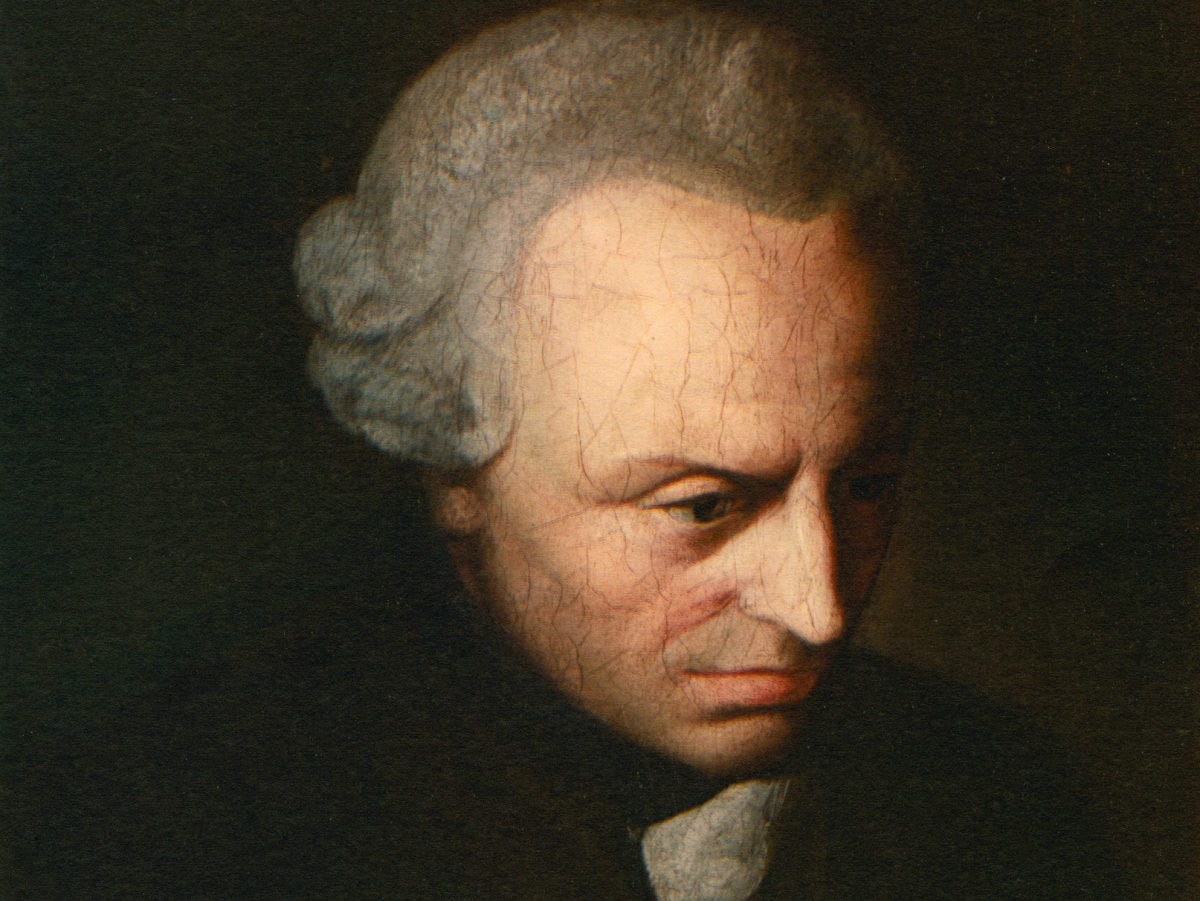
Portrait of Kant, 1790. Painter unknown, possibly Elisabeth von Stägemann.

The Danish philosopher Soren Kierkegaard would say pretty much the same thing. For someone willing the Good, he writes, “the means and the end are one and the same thing”. One is not responsible for whether they reach their goal, “[b]ut without exception, he is eternally responsible for the kind of means he uses”6. Being particular about means may seem burdensome, and means may not be as compelling as a Muskian vision. But attending to the means focuses us on our present actions and what we can control, granting us a measure of peace. By not fretting about whether we reach our goal, we avoid the “passionate one’s torment”7.

So here is an indicator we can use to check our actions: Do we attend to our act’s right-ness as much as if not more so than its goal? This principle is easily translated to AI actions. An AI agent may not take an unethical step to reach a user’s requested goal, no matter how urgent and important-sounding the goal is made out to be.

A college student loves playing the piano, but she worries she can’t make a living doing so. So she studies accounting instead of music, and becomes an accountant. Did she choose well? If your intuition says that it depends, you would find company in Aristotle.

Aristotle writes that courage, like most virtues of character, is a balanced condition between two opposing vices; in this case, between cowardice and foolhardiness8. Was our student friend too cowardly to take a chance, or simply being realistic? Perhaps she likes accounting too, and exercised the virtue of practical judgment (phronesis)9, judging where her personal interests meets the world’s needs.

Other virtues Aristotle develops include temperance, generosity, justice, and amiability. Together, they make the following query a decent tell of choosing the good: Are we acting in accordance with the virtues?

Being-at-work in accordance with virtue comes with two additional benefits. We build good character through habituation. And we experience a kind of happiness (eudaimonia)10. These two benefits serve to reinforce virtuous behavior. But neither of them accrue to current AI, which neither learns from its actions nor experiences states like happiness.

An AI can still consider Aristotelian philosophy when answering human questions. If I were to ask AI how best I can give to charity, it can guide me to an outcome in line with the virtue of generosity, striking a balance between stinginess and wastefulness. But the AI itself is not exercising generosity. How can generosity apply to an AI that has no bank account and needs no retirement savings?

That brings us to the last tell. Unlike virtue, it might work well for AI.

How deeply thought is the action in question? The more fully considered the action, the more likely it aligns with the good; at least when the actor is well-adjusted and not compromised in some way. Let me illustrate via a story I heard from Sharon Salzberg, a cofounder of the influential Insight Meditation Society11.

Sharon was in India, studying Buddhism with her teacher Dipa Ma. When on a trip to town, she was harassed by someone trying to snatch her handbag. Distressed, Sharon asked Ma how she could still be expected to maintain a compassionate composure. Ma replied: If that ever happens again, with a smile in your heart and all the compassion you can muster, use your umbrella to give your assailant a nice thwack.

An umbrella wielded in that manner is a considered response, not a reflex reaction. Responding thoughtfully rather than reacting reflexively is one of the aims of ‘mindfulness’, as taught by insight meditation teachers such as Salzberg. A similar principle is developed by Spinoza in his The Ethics. He distinguishes acting (“whereof we are the adequate cause”), from being acted on (“we are passive”)12. We are free when our actions stem fully through our nature, and compelled when determined by something else13. This parallels the mindful versus reactive modes of acting.

Portrait of Benedictus de Spinoza, 1665.

While we may intuit that Salzberg’s and Spinoza’s insights ring true, we could also appeal to neuroscience. Our brains have distinct regions whose activation patterns we can study. We can try to develop an indicator based on those patterns for when a person is deep and reflective in their thought vs. being shallow and reflexive. However, a device that computes such an indicator is likely workable only in a lab setting. But I know the perfect candidate—a candidate who only ‘lives’ in a ‘lab’: AI.

It is trivial to observe an AI’s artificial neurons activate as it goes about generating output. Patterns therein can indicate how much the AI is drawing upon its sum knowledge. For example, the more of the neurons in the early layers of the AI’s network activate, perhaps the more primal and broadly-sourced its output14. As current AIs are generally trained well, with “good” training data, this would be a tell that the AI is not acting waywardly. I do believe frontier AI labs have the chops to develop such an indicator, an indicator that the AI had “deeply thought”.

We hardly discussed what the good consists in. I doubt we can come to agreement in a pluralistic society like ours. But I suspect we can broadly agree on some indicators that accompany choosing the good, tells such as no-shortcut-taking, virtue, and thoughtfulness.

One tell we did not discuss is sympathy, a tell like virtue that does not work for AI. As we contemplate an action, we can ask ourself Is that kind?, and imagine its felt moral consequence. But it is difficult to envision AI developing sympathy. AI has never experienced pain or hunger, and to it mortality and vulnerability are alien concepts.

For better or worse, the good we know of, however each of us might conceive it, inheres in the human condition. Any indicators we devise for AI may necessarily fall short.

Discussion about this post

Ready for more?