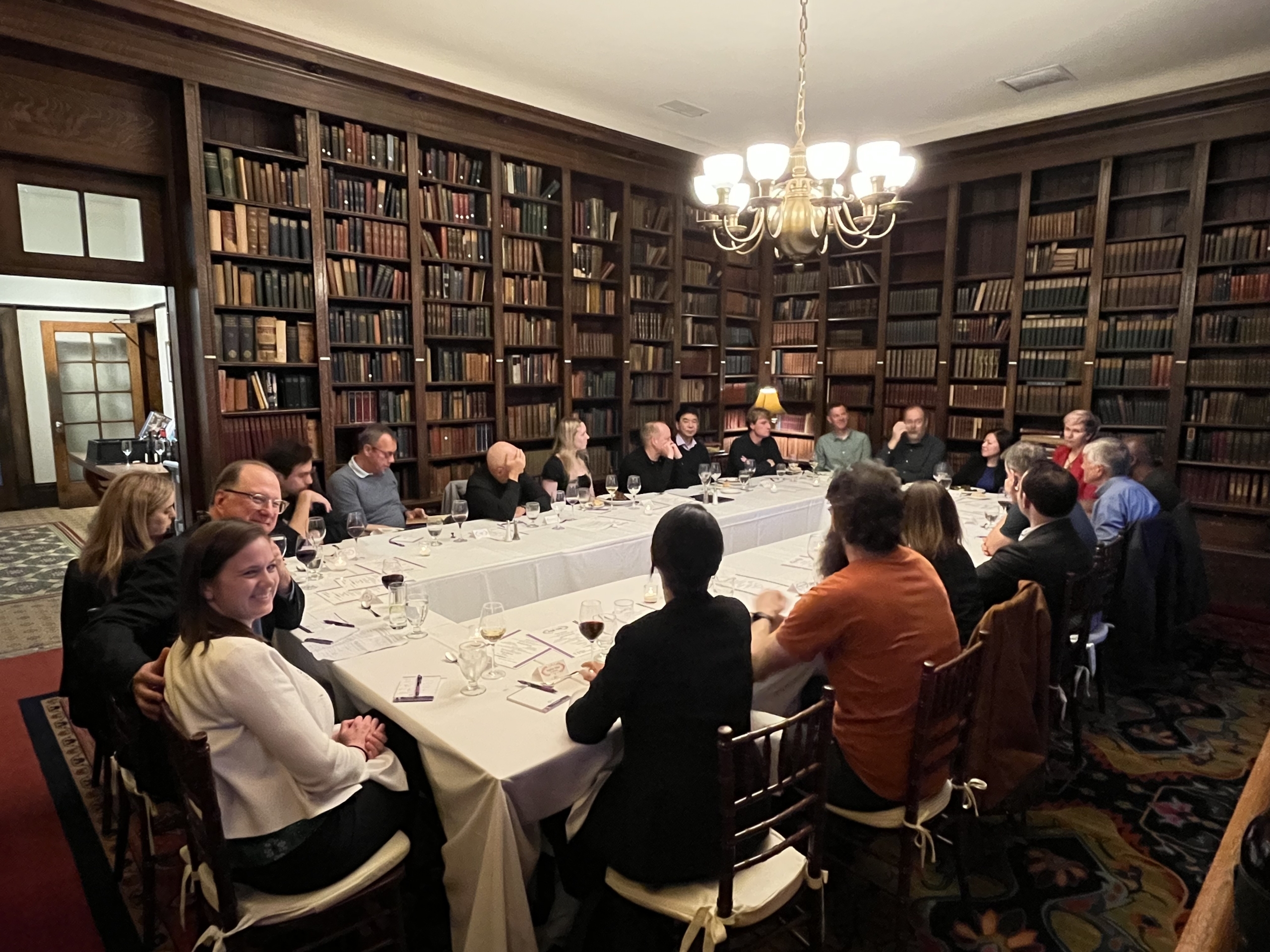
CRA-I Salon Gathering, Co-hosted by Dave Patterson (UC Berkeley/Google) and Jeff Dean (Google AI)
Contributions to this post were provided by Jeff Dean, Mark D. Hill, and Dave Patterson.
CRA-Industry (CRA-I) recently continued its series of intimate Industry Salon Gatherings, bringing together leaders to discuss the long-term trajectory of our field. Our latest session, organized by Mark D. Hill (University of Wisconsin-Madison & CRA) and CRA-I, took place on April 16, 2026 at the historic University Club of San Francisco and was sponsored by Laude Institute, which had just announced an ambitious and exciting slate of new research “AI moonshot” awards.
The evening featured a high-level conversation among 20 participants, co-hosted by Dave Patterson (UC Berkeley/Google) and Jeff Dean (Google AI). The Salon tackled a fundamental question: “What will computer systems look like in 2035, and how will they be designed?” The participants were researchers and leaders from West Coast academic institutions and technology companies, big and small. As the table below shows, the group was diverse in multiple dimensions, including career stage, with expertise centering on computer architecture but extending to software systems, AI models, and design methodology and tools.
Following the “Jeffersonian” dinner format, the evening was designed to forge deep connections and brainstorm visionary ideas. To ensure a frank and pre-competitive dialogue, the event operated under the Chatham House Rule, allowing for candid exchange while protecting the anonymity of the participants’ specific contributions.
The three-hour (!) conversation explored the intersection of architecture, software, AI, and future design methodologies. Here we highlight some key observations and conjectures made by Salon participants:
- We are in the midst of an AI revolution that appears to be even more impactful than the introduction of microprocessors, PCs, Internet, or smartphones.
- To drive future change, we must focus on metrics such as improving “intelligence” per Watt for efficiency and more AI tokens processed at fixed user-perceived latency for more “intelligence.”
- One lively topic was centered on the future of interfaces and abstractions that have been essential for humans to build complex systems. We explored two related questions: whether abstractions will continue to matter in the AI era, and, if they do, whether those abstractions must remain human-interpretable, allowing human/AI teams to advance the field together. The general view was that abstractions will continue to play an important role, not only for humans, but also helping AI systems to reason and coordinate. However, for communication and reasoning among agents, these abstractions need not be interpretable to humans, and may evolve beyond human comprehension. At the same time, there remains a need for human-interpretable abstractions to enable oversight, intervention and guidance by humans.
- We conjecture that in five years 10,000x more AI inference will be done worldwide, with these gains hypothetically coming from multiplicative progress of 50x in AI algorithms, 50x in system/hardware optimization/specialization, and 4x from further data center growth.
- We expect 50x AI algorithm progress for three reasons. First, Transformers have sparked a rapid series of AI inventions since the original paper in 2017, and the area is still ripe. There has been a clear trend in increased data and compute efficiency in training large models. Second, there is an existence proof that we can do much better since humans learning from birth to early adulthood are able to use 1,000x less input data than today’s largest ML models, suggesting that much more data-efficient learning algorithms are still possible.Third, deep analysis to determine what aspects of current AI technology are necessary for current levels of intelligence may reveal much more efficient methods for obtaining the same or better results.
- We expect 50x system/hardware progress from two trends. First, increased hardware specialization will lead to major improvements in efficiency. Second, AI to automate hardware design will enable much faster and lower-cost creation of this specialized hardware. AI is already greatly impacting the system/hardware design process. We expect many design flows to be accelerated or altered. For example, can Large Language Models iterate with improving formal tools and specification methods to “hill climb” design spaces, and can formal verification be accelerated by customized hardware? Moreover, AI is having a fundamental impact on software developers. We conjecture that future developers will write little code directly. Rather, they will manage teams of AI agents. And this in turn could dramatically accelerate software development for specialized hardware. How do we prepare students and professionals for this world?
- We expect a substantial increase in global data center capacity (perhaps 4x over the next five years), but recognize that non-technical forces are at play here. Expansion will be relatively larger if companies focus on scale out more than the above innovation opportunities. However, expansion could be much less due to community “techlash.”
- We discussed energy trends, including that solar was now significantly cheaper than other energy sources for new capacity, and that battery prices continued to fall, making solar+batteries a viable way of powering new datacenters and other energy needs. We also discussed other new sources of clean energy that are not yet commercially viable but might be in the next five years, such as fusion.
- Finally, acknowledging “tech-lash” brings us to opportunities and challenges that AI brings to society. Much of the public views AI as a potential disruption in their lives, fearing the negative more than embracing the positive. They may currently be correct. It is our job to ensure that we develop and encourage the societally- beneficial aspects of AI, and we discussed education and healthcare as two domains with considerable early positive benefits and enormous further potential. We also recognized negative aspects of AI usage in areas like easing the creation of misinformation and cyberattacks, and many expressed concern about society’s capacity to absorb substantial job disruption in short time scales. We conjecture that within the next few years, AI policy will be a major election factor. How do we make a public AI debate substantive? How do we ensure policymakers can make informed decisions about AI, so that we can sensibly regulate some of the negative consequences of AI without stifling the positive uses? As AI changes our world, how does that change university teaching, life-long learning, and job retraining? How does it alter university and industry research? Three hours are insufficient to answer these societal questions.
In their Turing Award lecture in 2018, Hennessy and Patterson asserted that we were beginning a Golden Age for computer architecture. The subsequent decade has shown them to be prescient.
This San Francisco gathering reinforced the value of bringing industry and academia together to look beyond the immediate product cycle. As noted by the organizers, the insights gained here will help shape the CRA roadmap for supporting the computing research ecosystem over the next decade.
As we went around the table to get everyone’s last comments, many mentioned how much they enjoyed the conversation and would love to do it again. Impressively, four of the invited leaders had to fly to San Francisco for the event and everyone stayed until the official end of the three-plus-hour reception and dinner. The feedback was overwhelmingly positive. One participant noted that it was “valuable to hear directly from the leaders of our community [about] their perspectives on the role of AI—both in how we design computers and the projected compute demand driving that design.” Another shared that the evening was “tremendously valuable for my own thinking on where the computing industry is and should be going, and for sharing thoughts to hopefully influence how others view technology advancement and its societal implications.”
If you are interested in participating in or hosting future CRA-I Salon Gatherings, please sign up for our mailing list or contact Helen Wright (hwright@cra.org).
Salon Participants
| First Name |
Last Name |
Affiliation |
| Doug |
Burger |
Microsoft Research |
| Jason |
Cong |
UCLA |
| Jeff |
Dean |
Google |
| Chris |
Fletcher |
Berkeley |
| Anna |
Goldie |
Ricursive Intelligence |
| Peter |
Harsha |
CRA |
| Mark |
Hill |
CRA/University of Wisconsin–Madison |
| Andy |
Konwinski |
Laude Institute |
| Alex |
Ksendzovsky |
The Biological Computing Co |
| Azalia |
Mirhoseini |
Stanford/Ricursive Intelligence |
| Dave |
Patterson |
Berkeley/Google |
| Chris |
Ramming |
CRA-Industry |
| Sophia |
Shao |
Berkeley |
| Ben |
Spector |
Flapping Airplanes |
| Ion |
Stoica |
Berkeley |
| Caroline |
Trippel |
Stanford |
| Natalia |
Vassilieva |
Cerebras Systems |
| Ralph |
Wittig |
AMD |
| Helen |
Wright |
CRA |
| Carole-Jean |
Wu |
Meta |






