



惯性聚合 高效追踪和阅读你感兴趣的博客、新闻、科技资讯
阅读原文 在惯性聚合中打开

推荐订阅源

Engineering at Meta
Engineering at Meta
D
Docker
IT之家
IT之家
博客园_首页
罗磊的独立博客
V
V2EX
OSCHINA 社区最新新闻
OSCHINA 社区最新新闻
美团技术团队
Y
Y Combinator Blog
博客园 - 聂微东
量子位
阮一峰的网络日志
阮一峰的网络日志
GbyAI
GbyAI
Microsoft Security Blog
博客园 - Franky
Martin Fowler
Martin Fowler
Jina AI
Jina AI
大猫的无限游戏
大猫的无限游戏
C
Check Point Blog
月光博客
月光博客
G
Google Developers Blog
B
Blog
T
The Blog of Author Tim Ferriss
爱范儿
爱范儿

Hacker News - Newest: "AI"

AI can't read an investor deck AI as an attorney? Student uses ChatGPT, Gemini to sue UW over alleged racial discrimination Hacking MCP Servers in AI Systems – The Rug Pull: Tool Changes After Approval GitHub - MeepCastana/KubeezCut: Free Web based video editor Can AI judge journalism? A Thiel-backed startup says yes, even if it risks chilling whistleblowers Coming soon: 10 Things That Matter in AI Right Now DARPA built an AI to fact-check enemy weapons claims What explains heterogeneity in AI adoption? When AI Meets Muscle: Context-Aware Electrical Stimulation Promises a New Way to Guide Human Movements - Department of Computer Science AI Changed How We Build. It Did Not Change What Matters. Linux rules on using AI-generated code - Copilot is OK, but humans must take 'full responsibility for the… Meta spins up AI version of Mark Zuckerberg to engage with employees Code Mode: Let Your AI Write Programs, Not Just Call Tools | TanStack Blog GitHub - Delavalom/graft: Go framework for building AI agents. Type-safe tools, multi-provider (OpenAI, Anthropic, Gemini, Bedrock), zero vendor SDKs. India's TCS tops estimates, says new AI models did not dent services demand Gen Z's fading AI hype Strong feeling: we are in a folded AI reality GitHub - machinarii/total-recall-catalog: A reference catalog of latest knowledge retrieval, memory & RAG systems GitHub - mensfeld/code-on-incus: Give each AI agent its own isolated machine with root, Docker, and systemd. Active defense detects and stops threats automatically.. Quantization, LoRA, and the 8% Problem: Benchmarking Local LLMs for Production AI Iran war: We spoke to the man making Lego-style AI videos that experts say are powerful propaganda Powell, Bessent discussed Anthropic's Mythos AI cyber threat with major U.S. banks GitHub - immartian/bellamem: Persistent belief-graph memory for AI agents. Retrieves decisive context by importance — not recency, not RAG, not /compact. recursive-mode: The Repo-Native Operating System for AI Engineering After the attack on Sam Altman's home, will AI CEO's go on the offensive? The biggest advance in AI since the LLM Opus 4.6 vs GPT 5.4 One Prompt Unity World Generation Test “AI polls” are fake polls Client Challenge Can AI be a 'child of God'? Inside Anthropic's meeting with Christian leaders
YouTube expands its AI likeness detection technology to c...
Sarah Perez · 2026-04-21 · via Hacker News - Newest: "AI"

YouTube is expanding its new “likeness detection” technology, which identifies AI-generated content, such as deepfakes, to people within the entertainment industry, the company announced on Tuesday.

The technology works similarly to YouTube’s existing Content ID system, which detects copyright-protected material in users’ uploaded videos, allowing rights owners to request removal or share in the video’s revenue.

Likeness detection does the same, but for simulated faces. The feature is meant to help protect creators and other public figures from having their identities used without their permission — a common problem for celebrities who find their likenesses have been used in scam advertisements.

The technology was first made available to a subset of YouTube creators in a pilot program last year before expanding more broadly to include politicians, government officials, and journalists this spring.
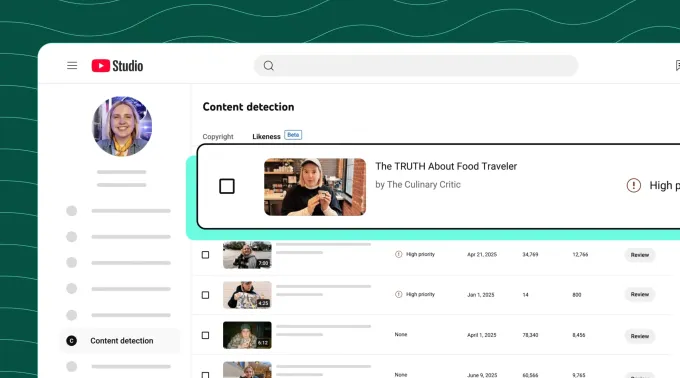
Image Credits:YouTube

Now YouTube says the technology is being made available to those in the entertainment industry, including talent agencies, management companies, and the celebrities they represent. The company has support from major agencies like CAA, UTA, WME, and Untitled Management, which offered feedback on the new tool.

Use of the likeness detection tool does not require entertainers to have their own YouTube channels.

Instead, the feature scans for AI-generated content to detect visual matches of an enrolled participant’s face. Users can then choose to request removal of the video for privacy policy violations, submit a copyright removal request, or do nothing. YouTube notes that it won’t remove all content, as it permits parody and satire content under its rules.

In the future, the technology will support audio as well, the company says.

Related to this, YouTube has also been advocating for similar protections at a federal level, with its support for the NO FAKES Act in Washington, D.C. This would regulate the use of AI to create unauthorized re-creations of an individual’s voice and visual likeness.

The company hasn’t yet said how many removals of AI deepfakes have been managed by the tool so far, but noted in March that the amount of removals was still “very small.”

When you purchase through links in our articles, we may earn a small commission. This doesn’t affect our editorial independence.

Sarah has worked as a reporter for TechCrunch since August 2011. She joined the company after having previously spent over three years at ReadWriteWeb. Prior to her work as a reporter, Sarah worked in I.T. across a number of industries, including banking, retail and software.

You can contact or verify outreach from Sarah by emailing sarahp@techcrunch.com or via encrypted message at sarahperez.01 on Signal.

View Bio