




 BBC
BBC
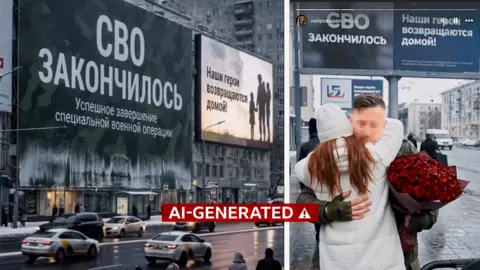
Rousing orchestral music plays over a video of a snowy Moscow street dotted with billboards celebrating an end to the war in Ukraine.
"The Special Military Operation is over," one fictional billboard reads, using the Kremlin-approved term for its war on Ukraine. "Our heroes are coming home."
Underneath, a beautiful, airbrushed woman pushing a stroller turns to see a man in military uniform and throws her arms around his neck in tears.
The 15-second AI-generated clip was posted on Instagram by a popular blogger with the online name Katya Jin, and the couple appear to be modelled on her and her husband.
In reality, like tens of thousands Russian soldiers, he disappeared at the front. His fate remains unknown.
AI-generated photos and videos featuring Russian soldiers have gained popularity on social media since mid-2025. They are most often posted by relatives of Russian servicemen fighting in Ukraine.
In nearly all of them, the soldiers are controversially portrayed as heroes defending their country and loved ones.
Ukraine and the destruction caused by Russia's invasion is usually absent, and judging by reaction online many Ukrainians who have seen the videos have been appalled.
For some grieving families, AI content provides a way to mourn their loved ones; in some cases, deepfakes featuring deceased people are used at funerals.
Responses online to such clips are sharply divided: some say they were brought to tears, while others see the practice as unethical and deeply disturbing.
Very little is yet known about the long-term psychological and social impact of this technology on the grieving process, says Katarzyna Nowaczyk-Basińska, a researcher at the Leverhulme Centre for the Future of Intelligence at the University of Cambridge.
"Creating 'deadbots' of Russian soldiers or deepfakes of fallen Russian soldiers returning from Ukraine is extremely complex and ethically difficult to assess in a clear-cut way," she says.
BBC Russian approached Katya Jin for comment, but she did not respond to our questions. Whether by coincidence or not, after we first reported her story, she removed her AI-generated content from Instagram and TikTok.
Until recently, she regularly posted AI videos to her 10 million TikTok followers and 50,000 Instagram followers, often alongside tutorials explaining how to make them.
Her own family's story became part of the sales pitch, and viewers could then order similar videos featuring their own loved ones.
Dozens of people said they wanted the same kind of content featuring deceased relatives. They just needed to submit photographs of themselves and their loved ones, and AI would then animate the material following specific prompts.
A couple can be shown in a specific setting or pose, and cinematic flair can then be added to the fake image. Heartfelt farewell letters can also be mocked up and placed in the hands of a deceased relative.
Many of the videos focus on soldiers killed at the front - a subject Russian authorities generally try not to draw attention to.
Usually these clips follow a set pattern: a man in uniform embraces his loved ones, then slowly walks up a staircase into a blue sky, often surrounded by angels. In others, the "ghost" of the dead soldier appears to embrace his family from heaven.
'You should be ashamed'
Anna Korableva from Kamensk-Uralsky, a town east of Yekaterinburg, began making AI-generated videos with her sister in May 2025.
The aim of her "Farewell video" project, she says, is to help people cope with "unfinished farewells" and give them a chance to "embrace" husbands, parents and children again.
"In the first months of working on these videos, I cried almost every day," she told the BBC. "Over time, I learned to separate my emotions from work. I try to focus on the technical side, to make sure the video turns out beautiful and worthy of someone's memory."
According to Korableva, most requests come from the families of soldiers killed on the battlefield in Ukraine since Russia launched its full-scale invasion in 2022.
Although the Russian government does not share reliable casualty figures, the BBC, together with Russian news outlet Mediazona and a team of volunteers, has so far verified the deaths of at least 225,000 Russian soldiers in the war.
The real death toll is believed to be much higher.
Other AI-generated videos circulating online feature Russian soldiers who are still alive and on the front line. In some clips, women wrap their husbands in angel wings, symbolically shielding them from harm.
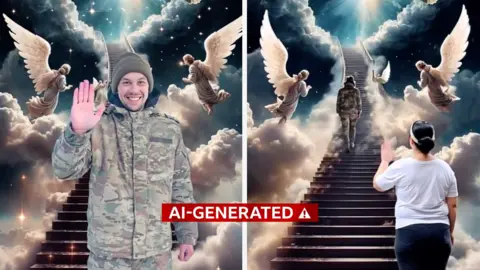
Unsurprisingly, these videos – in which Russian soldiers are portrayed as defenders and angels - provoke outrage among Ukrainians who encounter them online.
"You should be ashamed to show your 'heroes' who went to earn blood money by killing our children," one Ukrainian commented.
International generative AI tools have become difficult to access from Russia, and many have struggled to create such content themselves - turning instead to AI creators like Katya Jin and Anna Korableva.
In Russia, AI-generated military-themed photos and videos can cost between 200 roubles (£2) and 10,000 roubles (£100).
The quality varies. In some videos, the AI generates figures without limbs or produces grotesquely distorted faces.
As production costs are low, some creators have been able make substantial profits.
One AI-creator, Ulyana Lebed, who is also married to a Russian serviceman, has told the BBC she earns between 150-200,000 roubles (£1,500-£2,000) a month – roughly double the average monthly wage in Russia.
To some, this practice is akin to cashing in on grief.
"Be careful that loss doesn't come knocking at your door. Some subjects should not be touched — but you just wanted to make money," one user wrote beneath an AI-generated video of a dead Russian soldier.
Dubious value of AI-generated content
These AI soldier videos are part of a broader global "digital afterlife" industry, says Katarzyna Nowaczyk-Basińska.
Posthumous avatars are already being used in museums, courtrooms and political campaigns. So, she sees it as unsurprising that this technology becomes even more popular during wartime, when "death and loss are dominant themes".
Ethically, the political context makes such videos "deeply problematic", she says, and on a psychological level, she believes it is unclear whether AI visualisations help people deal with grief or deepen it instead.
"In a sense, we are all in the midst of a technological and cultural experiment," Nowaczyk-Basińska says.
Some who commissioned AI videos featuring deceased loved ones have told the BBC the clips did little to ease their pain.
"Could technology help me accept that I will never hug my son again? No. It's an illusion," one woman said.
"Psychologically, no, of course it didn't help - how could it?" said another woman, who had purchased an AI-generated photo of her late husband for his headstone.
However, she did hang two other AI-generated images in her bedroom.
And others suggested the videos provide a sense of connection – even if it was part of a fantasy, or virtual world.
"Thank you, AI, for this opportunity to be with my loved one," one Russian woman wrote beneath a "farewell video" of her husband. "Soon, it will be two years since you've been gone."