


Bone Keeper (2026) feels like a low-budget creature feature with a newer image pipeline running through it, and that pipeline feels like part of the creative decision-making rather than a layer of effects sitting on top. The film’s own credits list Howard J. Ford as writer, producer, cinematographer, editor, and director, and after watching the movie a few times I am almost certain he leaned into the strengths of generative AI at the time of production. The monster changes shape because AI has trouble remembering a body. The shots stay short because AI is better in bursts. The live-action material and synthetic material do not always line up cleanly, so the movie uses actors, caves, outfits, reaction shots, and continuity tricks to pull them together. I think that combination is the interesting part. It shows how AI can give new filmmakers and low-budget productions access to kinds of images, monsters, and scenes that would otherwise sit outside their reach.
The monster in Bone Keeper is an unstable, shapeless alien. The intro shows a meteor striking the earth, worms with circular mouths ringed with teeth, and a Cthulhu-like creature pouring itself into the ground all while shifting morphing and changing form. That instability was the first thing I kept noticing, and it ended up making the movie more interesting to me rather than less. It starts wormlike, drifts toward a tentacled mass, becomes something closer to a fleshy spider, then picks up skull-like shapes when the scene needs a different kind of threat. Reviews notice the same rough area from different angles: rough CGI-looking scenes, uneven effects, a glossy almost AI-generated opening, and general anxiety about AI slop.[6][7][8][9] I think the repetition of similar creature generations over the course of the film helps. It does not use the first worm generations at the end of the film. Each section gets its own relatively consistent creature design, and I am particularly enamored with the ugly-cute one wearing the yellow hard hat.
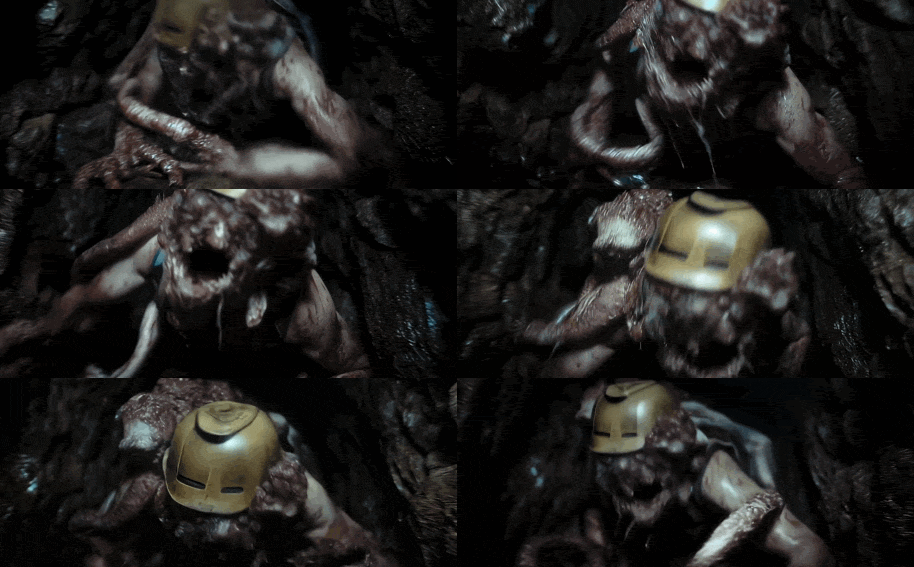
Generative AI video, when this movie was being produced, still struggles with memory. It can produce a convincing few seconds of motion, especially if the shot is dark, wet, smoky, or chaotic. Asking it to preserve one coherent body across a feature is a harder thing. Mass, silhouette, limb count, surface texture, and spatial relationship all have to survive the cut. That is a lot to ask from a system that is good at the immediate image and much worse at remembering what the image was five shots ago.
A shapeshifter gives that weakness a job. The movie does not need the creature to be anatomically loyal because the creature is already allowed to change. It reminds me of the monster from The Thing where the shapeshifting is a superpower and in this case the image instability has somewhere to go. I am not saying every inconsistency is intentional. I am saying the movie chose a monster type that can absorb more inconsistency than a werewolf, shark, dinosaur, or guy in a fixed suit.
That is where the access part becomes interesting. A small production may not be able to afford a full creature shop, a long VFX schedule, or a team of artists keeping every joint and surface consistent across the whole film. AI does not solve that cleanly, but it gives the filmmakers something to push against. The result is rough, but it is also a real attempt at scale from people who would normally have to imply more and show less.
The movie keeps its hardest shots small. The creature lunges, retreats, turns, flickers, or appears through blur and noise for a few seconds, and then the edit moves away. That is old horror grammar: hide the zipper, keep the puppet in shadow, and cut before the miniature gives itself away. Here the thing being hidden is temporal drift.
That could sound like an excuse, but it mostly plays like a sensible production choice. AI video can hold a feeling for a few seconds, so the movie buys those few seconds and spends them quickly. The edit does not ask the image to do more than it can do. When the monster appears in fragments, the fragmentary quality belongs to the creature as much as the workflow.
I liked that more than I expected to. The movie is not trying to make a clean studio monster and failing at the last mile. It is making a monster that benefits from being half-glimpsed, half-rendered, and always slightly different than the last time you saw it. Horror has always made bargains with what the production can actually show. This is just a new bargain.
The live-action parts still matter. FrightFest lists Howard J. Ford as director, with Sarah Alexandra Marks, Louis James, Tiffany Hannam-Daniels, and John Rhys-Davies in the cast.[1] Love Horror describes the film as shot in the UK, blending practical cave sets with visual effects, with Giordano Aita overseeing VFX.[2] Variety covered it as a commercial sales title starring Rhys-Davies, handled internationally by Reinvent Yellow.[3] The available record points to a real film production with synthetic pieces running through it, not a fully synthetic object with a poster attached.
What I kept noticing is how the movie seems to work reality into the synthetic material rather than only adding synthetic material on top of reality. The cave spaces, bodies, flashlights, weapons, and reaction shots give the generated pieces something to connect to. Sometimes the connection is clean enough. Sometimes the layers feel like they are next to each other instead of inside the same air. Even then, the movie keeps using real coverage as continuity glue.
There is a particularly well-executed sequence where one of the characters has lost a limb and is beset by the creature. You can see the actor blend into the action of the creature tearing apart a person wearing the same outfit as the actor. I am convinced this was done in reverse. They came up with a really cool monster-kill video generation sequence, then tailored the actor’s outfit and performance to fit that sequence. I love the idea of that approach.
That feels like an important trick for this stage of the tools. If AI cannot line up perfectly with reality, one answer is to build scenes where reality does not have to carry the whole impossible thing by itself. Let the synthetic shot establish a monster, a movement, a space, or a threat. Then use real actors, caves, props, and reaction shots to stitch that moment back into the movie. It is not seamless, but seamless is not the only useful target for low-budget horror.
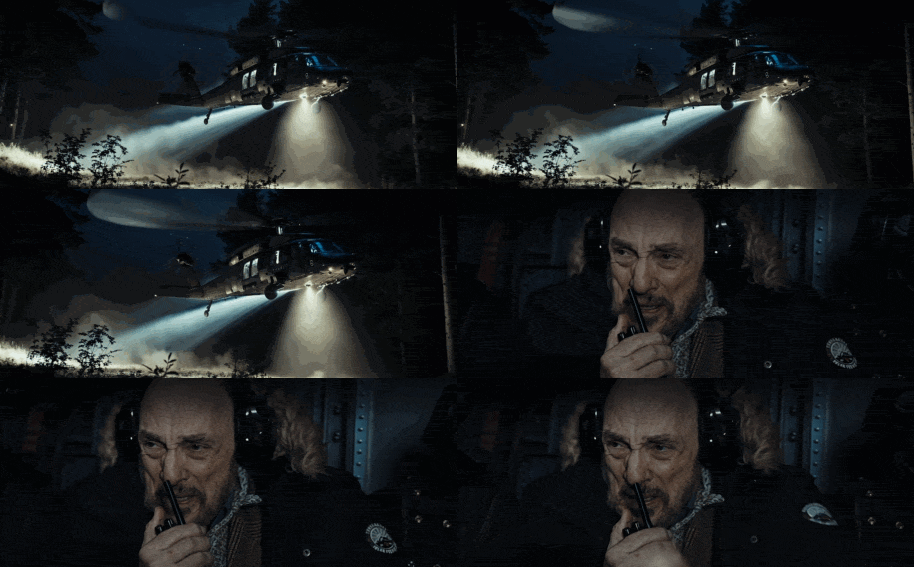
The film still has all the usual independent horror machinery. People move through cramped spaces, ignore local warnings, listen to a professor explain the creature, and make the genre decisions needed to keep the plot moving. That older structure matters in a practical way. It gives the AI material a skeleton.
A pure demo reel can show impressive images and still feel dead because nothing has to connect. Bone Keeper has enough ordinary movie around it that the synthetic pieces have jobs to do. A monster insert has to interrupt a scene. A cave extension has to sell a location. A strange movement has to give someone something to react to. The old machinery keeps asking the new material to behave like coverage.
Independent filmmakers have always worked this way in spirit. Use what you have, cut around what you cannot afford, suggest the expensive thing with the available thing, and stretch a creature reveal because rubber, latex, smoke, overtime, and pickup days all cost money. The new part is that the available thing can now produce monster coverage that used to be out of reach. It still has limits, but limits are easier to use than absence.
The background around Bone Keeper helps explain why this feels less like a one-off gag and more like an early production method, even if it does not prove the exact toolchain for this film. KoobrikLabs’ interview with Tom Paton frames AiMation around small-team AI filmmaking, post-first production, and long-form generative workflows. The page summarizes Where the Robots Grow as a feature built by nine people in under ninety days, and it places AiMation inside a push toward studio-less production infrastructure.[4] Dataconomy later covered Non Player Combat as an AI-generated survival series launched through AiMation Studios, produced through a generative pipeline and distributed through AiMation’s own app.[5]
The part I care about is access to the medium. I do not mean access to content, more feeds, or another pile of generated images. I mean access to production choices that used to be locked behind money and headcount: creature tests, environment extensions, impossible inserts, temp coverage that becomes final because it works well enough, and a small team trying a bigger visual idea without waiting for permission from a larger machine.
The boring documents and repeatable process are probably where that access really lives. Naming conventions, reference packs, version control, shot rules, review notes, and handoff logic are not romantic, but they are how messy tools become usable tools. The repeated story about a massive internal prompt or system guide belongs in that bucket, although I would not make the exact page count carry much weight without a cleaner public source. A prompt is less interesting than a workflow that lets a small team keep making decisions.
Eventually this rapid iteration and prototyping could make its way into more niche areas like selling a trailer or demo to gain funding. We could use it as part of storyboarding to actual gain more control of the final product. Generative AI assistance could be an integral part of the creative process and never be seen in the final cut of a film.
The generous reading does not require pretending the movie looks better than it does. The creature slips, the compositing is uneven, the cave imagery sometimes feels scrubbed too clean, and the synthetic layer sometimes eats into the physical one. If AI imagery already bothers you, this movie gives you plenty to notice. I still came away more interested in the use of the limits than in the failure to hide them.
Low-budget cinema has lived through awkward tool transitions before. Early digital CGI in smaller films had flat lighting, plastic models, rough integration, and weightless motion. A lot of it looked unfinished, but it also caught a real transition while artists and production teams were learning what the tools could carry. Then the tools improved, the artists improved, the pipelines improved, and the uneven first wave became sediment under normal production. This feels like one of those moments, only faster and stranger.
The thin version is easy to imagine. A missed pickup day becomes something to generate around. A creature that does not cut together gets another insert. Any hard production problem becomes a prompt instead of a decision. We will probably get plenty of movies like that. The better use is access to the hard parts of filmmaking, not escape from them.
That is where Bone Keeper works for me. The movie looks like a small team found a monster that could live inside the tool’s weaknesses. AI cannot remember a creature perfectly, so the creature mutates. AI cannot hold long complicated shots, so the movie cuts the monster into bursts. AI does not always line up cleanly with the physical world, so the film uses real coverage, genre structure, and reaction shots to pull the synthetic material back into continuity.
That makes it worth watching closely for now. Bone Keeper is not the endpoint, and I doubt anyone involved would claim it is. It is an early artifact from a moment when the tools are still awkward enough that you can see the workaround. What feels useful is the access: a small production got to attempt a monster it probably could not have attempted this way before.
LLM Disclosure: This post was written with AI assistance for research synthesis and drafting. An interesting note was that while I did my writing editing and research the AI models continually fought me on my certainty that there was generative AI video being used. Even my assertions about the credits for Howard J. Ford were faced with pushback until I explained that the movie credits start off giving him credit for all those production positions.
此内容由惯性聚合(RSS阅读器)自动聚合整理,仅供阅读参考。 原文来自 — 版权归原作者所有。