
惯性聚合 高效追踪和阅读你感兴趣的博客、新闻、科技资讯
阅读原文 在惯性聚合中打开

推荐订阅源

Threat Intelligence Blog | Flashpoint
T
Troy Hunt's Blog
Scott Helme
Scott Helme
T
Threat Research - Cisco Blogs
T
Tenable Blog
L
LINUX DO - 热门话题
V
Visual Studio Blog
I
Intezer
Blog — PlanetScale
Blog — PlanetScale
Cisco Talos Blog
Cisco Talos Blog
A
Arctic Wolf
C
Cyber Attacks, Cyber Crime and Cyber Security
F
Fortinet All Blogs
aimingoo的专栏
aimingoo的专栏
Know Your Adversary
Know Your Adversary
CTFtime.org: upcoming CTF events
N
Netflix TechBlog - Medium
SecWiki News
SecWiki News
I
InfoQ
Microsoft Security Blog
Project Zero
Project Zero
W
WeLiveSecurity
Microsoft Azure Blog
A
About on SuperTechFans
Recorded Future
Recorded Future
Cyber Security Advisories - MS-ISAC
Vercel News
Vercel News
S
Securelist
Spread Privacy
Spread Privacy
L
LangChain Blog
云风的 BLOG
云风的 BLOG
G
Google Developers Blog
MongoDB | Blog
MongoDB | Blog
Google DeepMind News
Recent Commits to openclaw:main
D
Darknet – Hacking Tools, Hacker News & Cyber Security
C
CERT Recently Published Vulnerability Notes
罗磊的独立博客
K
KPMG report finds enterprise disconnect between AI and its ROI | CIO
The Last Watchdog
The Last Watchdog
Attack and Defense Labs
博客园 - 司徒正美
Help Net Security
Help Net Security
L
Lohrmann on Cybersecurity
人人都是产品经理
人人都是产品经理
Forbes - Security
Forbes - Security
Hacker News - Newest:
Hacker News - Newest: "LLM"
PCI Perspectives
PCI Perspectives
博客园 - 【当耐特】
T
Tor Project blog

Hacker News - Newest: "AI"

AI can't read an investor deck AI as an attorney? Student uses ChatGPT, Gemini to sue UW over alleged racial discrimination Hacking MCP Servers in AI Systems – The Rug Pull: Tool Changes After Approval GitHub - MeepCastana/KubeezCut: Free Web based video editor GitHub - GenAI-Gurus/awesome-eu-ai-act: Curated tools, official sources, OSS, templates, and guides for EU AI Act compliance. Can AI judge journalism? A Thiel-backed startup says yes, even if it risks chilling whistleblowers Coming soon: 10 Things That Matter in AI Right Now DARPA built an AI to fact-check enemy weapons claims What explains heterogeneity in AI adoption? When AI Meets Muscle: Context-Aware Electrical Stimulation Promises a New Way to Guide Human Movements - Department of Computer Science AI Changed How We Build. It Did Not Change What Matters. Linux rules on using AI-generated code - Copilot is OK, but humans must take 'full responsibility for the… Meta spins up AI version of Mark Zuckerberg to engage with employees Code Mode: Let Your AI Write Programs, Not Just Call Tools | TanStack Blog GitHub - Delavalom/graft: Go framework for building AI agents. Type-safe tools, multi-provider (OpenAI, Anthropic, Gemini, Bedrock), zero vendor SDKs. India's TCS tops estimates, says new AI models did not dent services demand Gen Z's fading AI hype Strong feeling: we are in a folded AI reality GitHub - machinarii/total-recall-catalog: A reference catalog of latest knowledge retrieval, memory & RAG systems GitHub - mensfeld/code-on-incus: Give each AI agent its own isolated machine with root, Docker, and systemd. Active defense detects and stops threats automatically.. Quantization, LoRA, and the 8% Problem: Benchmarking Local LLMs for Production AI Iran war: We spoke to the man making Lego-style AI videos that experts say are powerful propaganda Powell, Bessent discussed Anthropic's Mythos AI cyber threat with major U.S. banks GitHub - immartian/bellamem: Persistent belief-graph memory for AI agents. Retrieves decisive context by importance — not recency, not RAG, not /compact. recursive-mode: The Repo-Native Operating System for AI Engineering After the attack on Sam Altman's home, will AI CEO's go on the offensive? The biggest advance in AI since the LLM Opus 4.6 vs GPT 5.4 One Prompt Unity World Generation Test “AI polls” are fake polls Client Challenge Can AI be a 'child of God'? Inside Anthropic's meeting with Christian leaders How to Switch AI Chatbots and Why You Might Want To GitHub - MattMessinger1/agentic_refund_guardrail: Safe refund policy layer for AI agents — Python + TypeScript. Same behavior, shared tests. Adam/papers/emergent_values_whitepaper.md at master · strangeadvancedmarketing/Adam Ask HN: How do you stop playing 20 questions with your AI coding tools How far can automation and AI support psychotherapy? - @theU GitHub - stagas/rtdiff: realtime git diff gui and AI-assisted commits A Mac Studio for Local AI — 6 Months Later A History of the Early Years of AI at the University of Edinburgh Why AI Coding Tools Still Feel Stuck on Localhost MSN AI Datacenters Are Becoming Strategic Targets twitter.com Penn Researchers Use AI to Surface Unreported GLP-1 Side Effects in Reddit Posts Show HN: MoodSense AI (ML and FastAPI and Gradio, Deployed on Hugging Face) Moodsense Ai - a Hugging Face Space by aman179102 AI models are terrible at betting on soccer—especially xAI Grok GitHub - xialeistudio/echoic GitHub - HimashaHerath/github-dev-wrapped: AI-powered weekly GitHub activity reports deployed to GitHub Pages GitHub - alejandrobalderas/claude-code-from-source: Architecture, patterns & internals of Anthropic's AI coding agent — reverse-engineered from source maps AI and Tech brief: Ireland ascendant GitHub - Titovilal/context0: Context0 - Never Surrender Training for a Marathon with an AI Coach: What Worked and What Didn't Cyber Pulse: Agentic Intel - Apps on Google Play I Built an AI PR Reviewer That Catches Bugs by Not Looking for Bugs Gen Z workers are so fearful AI will take their job they’re intentionally sabotaging their company’s AI rollout | Fortune How AI Is Reimagining the Game of Golf–For Both Players and Courses GitHub - nattergabriel/reseed: A CLI tool for managing and distributing agent skills across projects Is SVG the final frontier? My AI workflow evolved from prompts to a near-autonomous workflow MLSharp Help - 3DGS Viewer & Generator I put my cognitive field based AI's runtime on GitHub Is Numble the first AI-proof game? A3: Kubernetes for autonomous AI agent fleets | Emergent Principles Deepali Vyas ("The Elite Recruiter") GitHub - msmarkgu/RelayFreeLLM: A restful API designed to route user prompts to various AI model providers. Unionized ProPublica staff are on strike over AI, layoffs, and wages Unleashing the Advantage of Quantum AI We're heading for an AI-fueled 'dementia crisis,' brain scientist warns The AI-Assisted Breach of Mexico's Government Infrastructure [pdf] GitHub - stef41/lmscan: 🔍 Detect AI-generated text and fingerprint which LLM wrote it. Open-source GPTZero alternative. Zero dependencies, works offline. MSN GitHub - visionscaper/collabmem: Enabling long-term collaboration with Agentic AI - building up episodic and world model memory over time with in-context awareness We gave an AI a 3 year retail lease in SF and asked it to make a profit | Andon Labs AI Code is Hollowing Out Open Source, and Maintainers are Looking the Other Way What leaked "SteamGPT" files could mean for the PC gaming platform's use of AI AI is the boss at this retail store. What could go wrong? GitHub - Wuzu11517/agentic-proxy: Local proxy meant to help reduce With Drones, Geophysics and ArtificiaI Intelligence, Researchers Prepare to Do Battle Against Land Mines A Single Operator, Two AI Platforms, Nine Government Agencies: The Full Technical Report 在 Steam 上购买 FriedrichAI: Offline AI 立省 10% GitHub - inevolin/resume-cli: Hit Claude usage limits? Resume any AI coding session elsewhere. Switch tools at zero friction. GitHub - atripati/ark: AI Runtime Kernel — a context operating system for AI agents. Eliminates tool bloat, loads only what’s needed, and gives LLMs their reasoning space back. How to Build a Secure AI PR Reviewer with Claude, GitHub Actions, and JavaScript This Startup Wants You to Pay Up to Talk With AI Versions of Human Experts Intel Arc Pro B70 Brings 32GB VRAM to Local AI for $949 WordPress 7.0: The Good, the AI, and the Still Missing AI on the couch: Anthropic gives Claude 20 hours of psychiatry IatroBench: Pre-Registered Evidence of Iatrogenic Harm from AI Safety Measures AI Agents Know About Supabase. They Don't Always Use It Right. The history and future of AI at Google, with Sundar Pichai Inside an AI‑enabled device code phishing campaign How Meta Used AI to Map Tribal Knowledge in Large-Scale Data Pipelines AI for Systems: Using LLMs to Optimize Database Query Execution Forecasting the Economic Effects of AI Introducing Tinker: Play with AI, bring your ideas to life AI sheds light on an ancient gaming mystery People really hate AI but not as much as Iran—or Democrats | Fortune What is an AI Product Engineer? Phoebe Gates wants her $185 million AI startup to succeed with 'no ties to my privilege or my last name': 'I have a chip on my shoulder' | Fortune
The AI Delegation Audit of the A3 Framework - Age-of-Product.com
https://www.facebook.com/wolpers · 2026-06-28 · via Hacker News - Newest: "AI"

Scrum teams inspect how the last Sprint went during the Retrospective. They are much less likely to inspect the work they have handed to AI, because no meeting on the calendar owns it. That gap is where a working AI automation quietly turns into risk: it keeps producing fluent, on-brand output long after the decision to trust it has expired. The AI Delegation Audit closes the gap by leveraging the facilitation skills teams already use in a Retrospective.
If You Can Facilitate a Retrospective, You Can Run the AI Delegation Audit of the A3 Framework - Age-of-Product.com

Thesis: The Delegation Audit is the missing inspection cadence for delegated AI work. It checks four things: whether the work still meets the standard, whether the model still fits the task, whether the team can still stop the automation, and whether reviewed assistance has quietly become unreviewed automation. You can try it on one workflow in fifteen minutes.


🎓 🇬🇧 The AI4Agile Online Course v3 — July 20, 2026, at $149 — Join the Waitlist

Sooner or later, a CFO will ask what your AI use actually returns. “It saves me time” will not survive that meeting.

The first wave of AI adoption rewarded practitioners who learned to prompt. That skill still matters, and this course still teaches it. The second wave rewards something rarer: people who can turn individual AI use into knowledge that survives departures, spend that can be explained and steered, and output that organizations can trust. That work is process design and change management. You have been doing both for years, on harder problems than this.

EXCLUSIVE: The new A3 Delegation Lifecycle System with all Templates to make sense of delegating work to AI models.

The AI 4 Agile Online Course v3 is in English. 🇬🇧

What You Will Get:

✅ 16+ hours of self-paced video modules ✅ A cohort-hardened​, proven course design ✅ Learn to 10x your effectiveness with AI; your stakeholder will be grateful ✅ The AI Delegation Lifecycle System, including the A3 Framework, A3 Handoff Canvas, AI Definition of Done, and AI Delegation Audit as working handouts ✅ Apply AI to classic use cases of “Agile” ✅ The complete MegaBrain.io case package across both acts ✅ All texts, slides, prompts, graphics; you name it ✅ Access custom GPTs, including the “Scrum Anti-Patterns Guide GTP” ✅ Guaranteed: Lifetime access to v3 ✅ AI4Agile Foundation Certificate: 40 questions in 45 minutes.

The AI4Agile Online Course v3 — Release Date: July 20, 2026, at $149 — Berlin-Product-People.com

👉 Please note: The course will be available for $149 from July 20 to 27, 2026! (After that, $249.) 👈

🎓 Join the Waitlist now and be the first to know: The AI4Agile Online Course v3 — July 20, 2026, at $49 — No Coding Required!


🇩🇪 Zur deutschsprachigen Version des Artikels: Der KI-Delegations-Audit: Vertrauen ist gut, KI-Kontrolle ist besser.

🗞 Shall I notify you about articles like this one? Awesome! You can sign up here for the ‘Food for Agile Thought’ newsletter and join 35,000-plus subscribers.

🎓 Join Stefan in one of his upcoming training classes!


The Automation That Looked Healthy

A product team automates its Friday stakeholder update in March. The setup is careful: the model drafts from the Jira board, the workflow owner reviews the draft, and it ships. For three months it works. In June, the same automation tells an enterprise prospect that a security feature is in production.

No application code changed, and nobody touched the prompt. But the system around the automation had shifted: a descoped feature, a stale ticket title that survived in the product backlog, and a change in model behavior combined into a false update. The dangerous part was not a visible failure: the automation kept producing fluent, plausible, on-brand updates, which is exactly what made the degradation hard to notice.

That points to the belief worth naming first: a workflow that still produces output is assumed to be still fully functioning. A working automation is not evidence that the delegation behind it is still valid, and validating it once, at setup, is not the same as keeping it valid.

What the Delegation Audit Is

The Delegation Audit of the A3 Framework borrows the facilitation pattern of a Retrospective, not the Scrum event itself. Instead of how the team worked, it examines how the team’s AI delegations are holding up: 45 to 60 minutes, monthly or every other Sprint, with a named owner and a slot on the calendar.

In the A3 Framework, this is what the Automate category has always required. The moment you trust work to run with little or no human review, you owe it explicit rules and a recurring audit. Most teams adopt the rules and skip the audit because no one owns it. The Delegation Audit is that meeting, and it is the Inspect step of the AI Delegation Lifecycle.

The name is deliberate: nobody in finance, security, or operations needs an agile glossary to understand what a delegation audit is or why a team runs one. The practice underneath is familiar: gather data, surface what changed, turn findings into decisions, and leave with owners.

Cannot see the form? Please click here.

The Four Checks

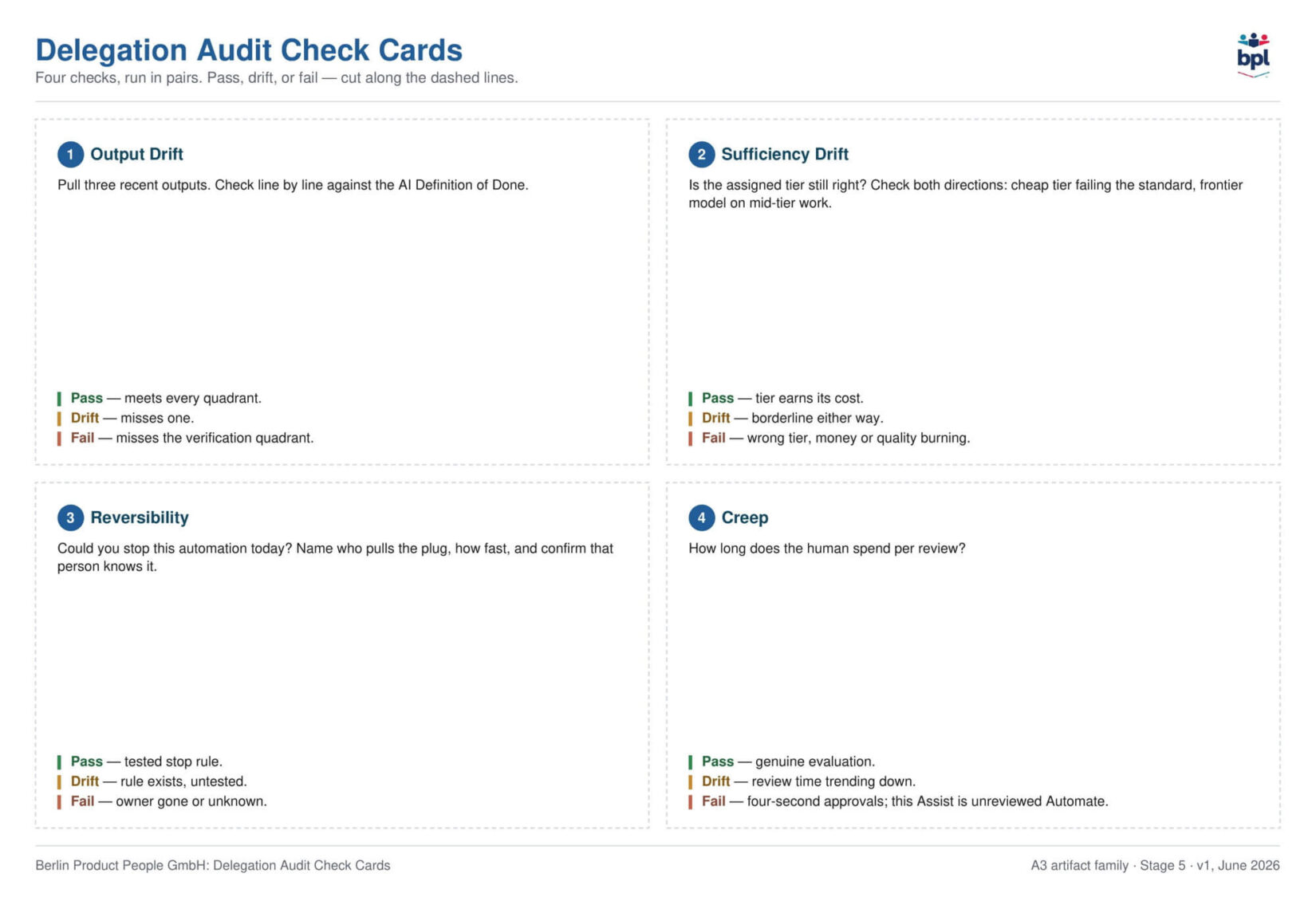
Each check inspects one way a delegation degrades after it goes live:

  1. Output and source drift: Does the work still meet its AI Definition of Done, and are the inputs still fit for use? Pull three recent outputs per workflow and trace each one back to its sources. Model updates change output quality in both directions without notice, and the inputs move along with them: stale records, changed permissions, and archived data that the model cannot tell from current facts. A polished summary built on stale data is still a failed delegation.
  2. Model fit: Is the assigned model still the right one? Look in both directions: a cheaper tier that no longer meets the standard, and a frontier model burning budget on work that a mid-tier now handles. The test is whether the model is sufficient for this task at this risk level, not whether it is the most capable one available. If your team runs a routing policy, this check feeds into it, and the cost side has its own treatment in token economics.
  3. Reversibility: Could you stop each automation today? Test the stop rules from your handoff: who pulls the plug, how fast, and whether that person still works here. An automation without a reachable owner is not delegated; it is abandoned, now posing a risk.
  4. Category creep: Which Assist work has become unreviewed Automate? Watch for the tell: review time per output trending toward zero. When a human approves a draft in 4 seconds, that is not review, and the work changed its A3 category without anyone deciding. Name it, then choose: promote it to Automate properly, with rules and a stop rule, or restore genuine review.

Run It Like a Retrospective

The agenda fits 60 minutes and will feel familiar:

  1. Data walk (10 min): Put the delegation inventory on the wall: every automated and assisted workflow, its A3 category, its model tier, its last audit date. Add usage or spend data if you have it. Look first, discuss later.
  2. Run the four checks in pairs (20 min): Assign workflows to pairs. Each pair runs all four checks on its workflows and marks each finding pass, drift, or fail.
  3. Re-classify (15 min): Walk through the findings. Every drift or fail gets a decision: change the A3 category, change the tier, update the AI Definition of Done, fix the stop rule, or retire the delegation. Retiring an automation that no longer earns its audit cost is a successful outcome of the meeting.
  4. Decisions and owners (10 min): Each decision gets a name and a date. A finding without an owner is one you will rediscover next time; don’t create waste.
  5. Close the record (5 min): Update the log: what moved, why, and who decided.

Why Inspection Stopped Being Optional

Two forces make a standing audit necessary now:

The first is the models: they update on the vendor’s schedule, not yours. A change to how a model summarizes, refuses, or formats can move output quality with no signal on your side. An automation you validated once is running on assumptions that have quietly expired.

The second is accountability: NIST organizes AI risk management around four functions: govern, map, measure, and manage. Inspection is the measure-and-manage half, and a team that only governs and maps has stopped before the work becomes operational. Set-and-forget is the default, and it compounds unseen until a drifted output becomes an incident in front of the wrong audience.

The Record You Get for Free

Each audit updates a dated log: workflow, owner, model tier, last checked output, drift finding, decision, and follow-up date. Stack those logs, and you have an inspection trail: evidence that your team’s AI adoption is controlled rather than assumed. When a stakeholder, for example, a prospect’s procurement team, asks how you govern your internal AI use, that trail is half the answer, and you wrote none of it as a separate report. It came out of one recurring meeting.

What to Do in Your Next Retrospective

Do not schedule a new event yet. Take one delegated workflow, the one that would embarrass you most if it drifted, and spend fifteen minutes of your next Retrospective running the four checks on it out loud: output and source, model fit, reversibility, category creep. You will probably find at least one answer that amounts to “nobody has looked since we set this up.” That single finding is the case for putting the audit on the calendar.

Conclusion

A Retrospective keeps a team honest about how it works together. The Delegation Audit extends that same facilitation habit to the work the team handed to a model, where an automation can look healthy long after the decision to trust it has expired.

For readers who want to run this without designing the format from scratch, version 3 of the AI4Agile Online Course, scheduled for release on July 20, 2026, includes the Delegation Audit as a working format, with the inventory, the four checks, and the log ready to run.

When did your team last inspect an automation it trusts, and what would the four checks find if you ran them this week?

Key Questions This Article Answers

What Is a Delegation Audit?

A Delegation Audit is a recurring 45- to 60-minute inspection of a team’s delegated AI work, run monthly or every other Sprint. It checks whether automated and AI-assisted workflows still meet the team’s standard, using the facilitation skills of a Retrospective. It is the Inspect step of the AI Delegation Lifecycle.

What Does a Delegation Audit Check?

Four things:

  1. Output and source drift (Does the work still meet its AI Definition of Done, and are the inputs still trustworthy?),
  2. model fit (Is the assigned model still the right one for the task and its risk level?),
  3. reversibility (Can you stop the automation today?), and
  4. category creep (Has Assist work become unreviewed Automate?).

How Is a Delegation Audit Different From a Retrospective?

Same skill, different subject. A Retrospective inspects how the team worked together. A Delegation Audit inspects how the team’s AI delegations are holding up, then turns each drift finding into a decision with an owner and a date.

AI Delegation Audit — Related Articles

AI4Agile Online Course v3 — Release on July 20, 2026

The AI Definition of Done: Human in the Loop Is Not a Quality Standard

The AI Delegation Lifecycle: Your Team Has AI Outputs. Where Are the Decisions?

Assist, Automate, Avoid: How Agile Practitioners Stay Irreplaceable with the A3 Framework

The A3 Handoff Canvas: Six Questions That Turn AI Delegation Into a Repeatable Workflow

The A3 Framework: Assist, Automate, Avoid — A Decision System for AI Delegation

No More Cheap Claude: Four First Principles of Token Economics in 2026
Hands-on Agile: Stefan Wolpers: The Scrum Anti-Patterns Guide: Challenges Every Scrum Team Faces and How to Overcome Them

👆 Stefan Wolpers: The Scrum Anti-Patterns Guide (Amazon advertisement.)

📅 Training Classes, Workshops, and Events

Learn more about AI Builders with our AI and Scrum training classes, workshops, and events. You can secure your seat directly by following the corresponding link in the table below:

See all upcoming classes here.

AI Delegation Audit: Professional Scrum Trainer Stefan Wolpers

You can book your seat for the training directly by following the corresponding links to the ticket shop. If your organization’s procurement process requires a different purchasing approach, please contact Berlin Product People GmbH directly.

✋ Do Not Miss Out and Learn More about the AI Delegation Audit — Join the 20,000-plus Strong ‘Hands-on Agile’ Slack Community

I invite you to join the “Hands-on Agile” Slack Community and enjoy the benefits of a fast-growing, vibrant community of agile practitioners from around the world.

Join the Hands-on Agile Slack Group — AI Delegation Audit

If you would like to join all you have to do now is provide your credentials via this Google form, and I will sign you up. By the way, it’s free.