


惯性聚合 高效追踪和阅读你感兴趣的博客、新闻、科技资讯
阅读原文 在惯性聚合中打开

推荐订阅源

Jina AI
Jina AI
The Hacker News
The Hacker News
F
Fortinet All Blogs
The GitHub Blog
The GitHub Blog
IT之家
IT之家
Vercel News
Vercel News
aimingoo的专栏
aimingoo的专栏
月光博客
月光博客
AI
AI
罗磊的独立博客
B
Blog
Threat Intelligence Blog | Flashpoint
博客园 - 聂微东
Google DeepMind News
爱范儿
爱范儿
Blog — PlanetScale
Blog — PlanetScale
Security Latest
Security Latest
C
Cyber Attacks, Cyber Crime and Cyber Security
C
Check Point Blog
D
DataBreaches.Net
T
Threat Research - Cisco Blogs
I
InfoQ
阮一峰的网络日志
阮一峰的网络日志
人人都是产品经理
人人都是产品经理
G
Google Developers Blog
Microsoft Azure Blog
P
Proofpoint News Feed
L
Lohrmann on Cybersecurity
freeCodeCamp Programming Tutorials: Python, JavaScript, Git & More
博客园 - Franky
C
Cybersecurity and Infrastructure Security Agency CISA
C
Cisco Blogs
MongoDB | Blog
MongoDB | Blog
P
Privacy & Cybersecurity Law Blog
Cisco Talos Blog
Cisco Talos Blog
P
Privacy International News Feed
cs.AI updates on arXiv.org
博客园_首页
I
Intezer
云风的 BLOG
云风的 BLOG
K
KPMG report finds enterprise disconnect between AI and its ROI | CIO
美团技术团队
Simon Willison's Weblog
Application and Cybersecurity Blog
Forbes - Security
Forbes - Security
T
Tailwind CSS Blog
腾讯CDC
T
Troy Hunt's Blog
Know Your Adversary
Know Your Adversary
U
Unit 42

Hacker News - Newest: "AI"

AI can't read an investor deck AI as an attorney? Student uses ChatGPT, Gemini to sue UW over alleged racial discrimination Hacking MCP Servers in AI Systems – The Rug Pull: Tool Changes After Approval GitHub - MeepCastana/KubeezCut: Free Web based video editor GitHub - GenAI-Gurus/awesome-eu-ai-act: Curated tools, official sources, OSS, templates, and guides for EU AI Act compliance. Can AI judge journalism? A Thiel-backed startup says yes, even if it risks chilling whistleblowers Coming soon: 10 Things That Matter in AI Right Now DARPA built an AI to fact-check enemy weapons claims What explains heterogeneity in AI adoption? When AI Meets Muscle: Context-Aware Electrical Stimulation Promises a New Way to Guide Human Movements - Department of Computer Science AI Changed How We Build. It Did Not Change What Matters. Linux rules on using AI-generated code - Copilot is OK, but humans must take 'full responsibility for the… Meta spins up AI version of Mark Zuckerberg to engage with employees Code Mode: Let Your AI Write Programs, Not Just Call Tools | TanStack Blog GitHub - Delavalom/graft: Go framework for building AI agents. Type-safe tools, multi-provider (OpenAI, Anthropic, Gemini, Bedrock), zero vendor SDKs. India's TCS tops estimates, says new AI models did not dent services demand Gen Z's fading AI hype Strong feeling: we are in a folded AI reality GitHub - machinarii/total-recall-catalog: A reference catalog of latest knowledge retrieval, memory & RAG systems GitHub - mensfeld/code-on-incus: Give each AI agent its own isolated machine with root, Docker, and systemd. Active defense detects and stops threats automatically.. Quantization, LoRA, and the 8% Problem: Benchmarking Local LLMs for Production AI Iran war: We spoke to the man making Lego-style AI videos that experts say are powerful propaganda Powell, Bessent discussed Anthropic's Mythos AI cyber threat with major U.S. banks GitHub - immartian/bellamem: Persistent belief-graph memory for AI agents. Retrieves decisive context by importance — not recency, not RAG, not /compact. recursive-mode: The Repo-Native Operating System for AI Engineering After the attack on Sam Altman's home, will AI CEO's go on the offensive? The biggest advance in AI since the LLM Opus 4.6 vs GPT 5.4 One Prompt Unity World Generation Test “AI polls” are fake polls Client Challenge Can AI be a 'child of God'? Inside Anthropic's meeting with Christian leaders How to Switch AI Chatbots and Why You Might Want To GitHub - MattMessinger1/agentic_refund_guardrail: Safe refund policy layer for AI agents — Python + TypeScript. Same behavior, shared tests. Adam/papers/emergent_values_whitepaper.md at master · strangeadvancedmarketing/Adam Ask HN: How do you stop playing 20 questions with your AI coding tools How far can automation and AI support psychotherapy? - @theU GitHub - stagas/rtdiff: realtime git diff gui and AI-assisted commits A Mac Studio for Local AI — 6 Months Later A History of the Early Years of AI at the University of Edinburgh Why AI Coding Tools Still Feel Stuck on Localhost MSN AI Datacenters Are Becoming Strategic Targets twitter.com Penn Researchers Use AI to Surface Unreported GLP-1 Side Effects in Reddit Posts Show HN: MoodSense AI (ML and FastAPI and Gradio, Deployed on Hugging Face) Moodsense Ai - a Hugging Face Space by aman179102 AI models are terrible at betting on soccer—especially xAI Grok GitHub - xialeistudio/echoic GitHub - HimashaHerath/github-dev-wrapped: AI-powered weekly GitHub activity reports deployed to GitHub Pages GitHub - alejandrobalderas/claude-code-from-source: Architecture, patterns & internals of Anthropic's AI coding agent — reverse-engineered from source maps AI and Tech brief: Ireland ascendant GitHub - Titovilal/context0: Context0 - Never Surrender Training for a Marathon with an AI Coach: What Worked and What Didn't Cyber Pulse: Agentic Intel - Apps on Google Play I Built an AI PR Reviewer That Catches Bugs by Not Looking for Bugs Gen Z workers are so fearful AI will take their job they’re intentionally sabotaging their company’s AI rollout | Fortune How AI Is Reimagining the Game of Golf–For Both Players and Courses GitHub - nattergabriel/reseed: A CLI tool for managing and distributing agent skills across projects Is SVG the final frontier? My AI workflow evolved from prompts to a near-autonomous workflow MLSharp Help - 3DGS Viewer & Generator I put my cognitive field based AI's runtime on GitHub Is Numble the first AI-proof game? A3: Kubernetes for autonomous AI agent fleets | Emergent Principles Deepali Vyas ("The Elite Recruiter") GitHub - msmarkgu/RelayFreeLLM: A restful API designed to route user prompts to various AI model providers. Unionized ProPublica staff are on strike over AI, layoffs, and wages Unleashing the Advantage of Quantum AI We're heading for an AI-fueled 'dementia crisis,' brain scientist warns The AI-Assisted Breach of Mexico's Government Infrastructure [pdf] GitHub - stef41/lmscan: 🔍 Detect AI-generated text and fingerprint which LLM wrote it. Open-source GPTZero alternative. Zero dependencies, works offline. MSN GitHub - visionscaper/collabmem: Enabling long-term collaboration with Agentic AI - building up episodic and world model memory over time with in-context awareness We gave an AI a 3 year retail lease in SF and asked it to make a profit | Andon Labs AI Code is Hollowing Out Open Source, and Maintainers are Looking the Other Way What leaked "SteamGPT" files could mean for the PC gaming platform's use of AI AI is the boss at this retail store. What could go wrong? GitHub - Wuzu11517/agentic-proxy: Local proxy meant to help reduce With Drones, Geophysics and ArtificiaI Intelligence, Researchers Prepare to Do Battle Against Land Mines A Single Operator, Two AI Platforms, Nine Government Agencies: The Full Technical Report 在 Steam 上购买 FriedrichAI: Offline AI 立省 10% GitHub - inevolin/resume-cli: Hit Claude usage limits? Resume any AI coding session elsewhere. Switch tools at zero friction. GitHub - atripati/ark: AI Runtime Kernel — a context operating system for AI agents. Eliminates tool bloat, loads only what’s needed, and gives LLMs their reasoning space back. How to Build a Secure AI PR Reviewer with Claude, GitHub Actions, and JavaScript This Startup Wants You to Pay Up to Talk With AI Versions of Human Experts Intel Arc Pro B70 Brings 32GB VRAM to Local AI for $949 WordPress 7.0: The Good, the AI, and the Still Missing AI on the couch: Anthropic gives Claude 20 hours of psychiatry IatroBench: Pre-Registered Evidence of Iatrogenic Harm from AI Safety Measures AI Agents Know About Supabase. They Don't Always Use It Right. The history and future of AI at Google, with Sundar Pichai Inside an AI‑enabled device code phishing campaign How Meta Used AI to Map Tribal Knowledge in Large-Scale Data Pipelines AI for Systems: Using LLMs to Optimize Database Query Execution Forecasting the Economic Effects of AI Introducing Tinker: Play with AI, bring your ideas to life AI sheds light on an ancient gaming mystery People really hate AI but not as much as Iran—or Democrats | Fortune What is an AI Product Engineer? Phoebe Gates wants her $185 million AI startup to succeed with 'no ties to my privilege or my last name': 'I have a chip on my shoulder' | Fortune
AI could help human scientists pick promising research topics
zeristor · 2026-05-01 · via Hacker News - Newest: "AI"
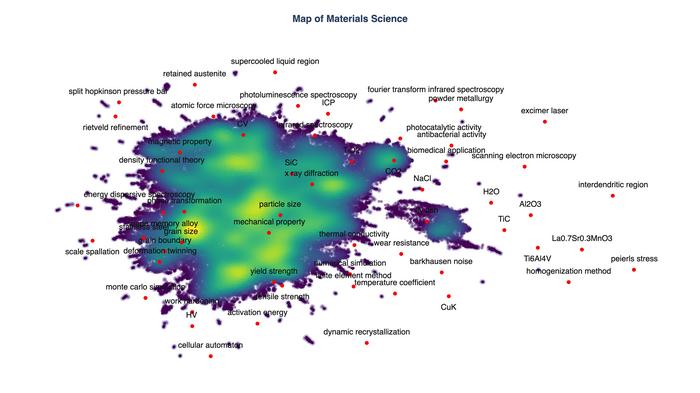
An AI-generated knowledge network of technical terms. It looks like a mostly green inkblot splatter, with purple edges (representing less well-connected terms) and yellow and red splodges (representing better-connected terms) in the interior. Some labels are visible. For example,
Making connections: An AI-generated knowledge network of technical terms illustrates trends and reveals new ideas for research in the materials sciences. (Courtesy: Thomas Marwitz, KIT)

Large language models (LLMs) could help human scientists identify interesting research topics that have not previously been explored, say scientists at Germany’s Karlsruhe Institute of Technology (KIT). By analysing abstracts in materials science publications and mapping connections between different concepts, the model was able to generate predictions for future areas of interest that the KIT team says are more precise than those produced by traditional, rule-based algorithms.

The number of research articles published each year is increasing so quickly that it is impossible for scientists to keep up with everything, observes team leader Pascal Friederich, who heads a KIT research group on artificial intelligence for materials sciences. While experienced scientists know how to find connections between research areas within their field, identifying links between these and other, unfamiliar topics is a different story.

Training the model

Friederich suspected that machine learning (ML) could help solve this problem by identifying hitherto unthought-of combinations of topics and expanding the list of areas to explore. To test this hypothesis, he and his colleagues used an open-source LLM called LLaMa-2-13B to zoom in on key words and phrases in abstracts of papers in materials science. They then used a database of manually labelled abstracts to train the model, fine-tuning it to focus on only the most relevant concepts. These initial training data can be iteratively extended by adding LLM annotations that have been checked and corrected by human researchers.

Using this model, the KIT team isolated approximately 510 000 chemical formulae and 3 600 000 concepts from the 221 000 abstracts in their database – an average of 2.3 chemical formulae and 16.3 concepts per abstract. After removing duplicates, these numbers dropped to around 52 000 unique formulae and 1 241 000 unique concepts.

The researchers then constructed a graph that included only the concepts that appeared at least three times in the journal articles, and that consisted of at least two words. The resulting knowledge network has approximately 137 000 nodes, one for each key word or phrase.

Connecting the nodes

The team used a second ML model to connect nodes when different terms are often mentioned together. “For example, if our LLM observes that terms like ‘perovskite’ and ‘solar cell’ appear more often together, it will draw a new link in the concept graph,” explains Thomas Marwitz, who began the study as part of his undergraduate thesis. “Then an ML model analyses trends in these links to predict which combinations of scientific concepts could become more significant in the next two or three years.”

Marwitz, who is now studying for a master’s in computer science, explains that the ML model does this by analysing how links between terms change over time. When certain concepts are becoming linked with increasing frequency, this may indicate that a new field of research is developing. On the other hand, a decrease in the number of links might imply than certain topics are attracting less attention.

The results of these analyses suggest that LLMs could indeed be used to direct researchers toward topic combinations that had previously received little attention, Marwitz says. In follow-up interviews conducted as part of the study, researchers in many fields confirmed that at least some of the AI-generated suggestions were genuinely innovative and promising. Some examples include: “conventional ceramic” + ”graphene oxide”, “tensile strain” + ”molecular architecture” and “multiphase structure” + ”selective laser melting”.

Not “an invention machine”

According to Friederich, the concepts extracted are more precise than was possible with rule-based approaches. The LLM’s capabilities also reduced the amount of manual annotation work required. For example, it was able to extract concepts that were not present verbatim in the text, while also removing “filler” words and making plural-to-singular conversions.

However, Friederich stresses that the technique is not an “invention machine” for automating scientific discoveries. “It is simply an analytic tool that can help to identify new ideas and opportunities for collaboration more effectively,” he says. “Our aim is to provide targeted support for scientific creativity.”

The study, which is detailed in Nature Machine Intelligence, is clearly only a first step on the way to true AI-supported science, he tells Physics World. “Much still needs to be done to improve the methodology behind our approach, extend its scope beyond just core materials science and extend the capabilities of the AI system from idea generation to autonomous hypothesis formulation, planning, execution, and analysis,” Friederich says.

He adds that the study was a departure from the group’s usual research, and it was not easy to get funding for it. “I hope that more such bold and exploratory research ideas will receive support in the future, given that LLM-based agentic systems are starting to perform standard research tasks with increasing reliability and complexity,” he says.