


惯性聚合 高效追踪和阅读你感兴趣的博客、新闻、科技资讯
阅读原文 在惯性聚合中打开

推荐订阅源

Google Online Security Blog
freeCodeCamp Programming Tutorials: Python, JavaScript, Git & More
Stack Overflow Blog
Stack Overflow Blog
GbyAI
GbyAI
Microsoft Azure Blog
I
InfoQ
F
Fortinet All Blogs
N
Netflix TechBlog - Medium
Martin Fowler
Martin Fowler
腾讯CDC
C
CERT Recently Published Vulnerability Notes
博客园 - 聂微东
L
LINUX DO - 热门话题
Y
Y Combinator Blog
H
Hackread – Cybersecurity News, Data Breaches, AI and More
Threat Intelligence Blog | Flashpoint
OSCHINA 社区最新新闻
OSCHINA 社区最新新闻
钛媒体:引领未来商业与生活新知
钛媒体:引领未来商业与生活新知
Microsoft Security Blog
cs.CL updates on arXiv.org
WordPress大学
WordPress大学
C
Cisco Blogs
A
Arctic Wolf
Latest news
Latest news
Jina AI
Jina AI
P
Proofpoint News Feed
博客园 - 叶小钗
Vercel News
Vercel News
T
Threat Research - Cisco Blogs
博客园 - 三生石上(FineUI控件)
K
Kaspersky official blog
C
Check Point Blog
H
Heimdal Security Blog
博客园 - Franky
小众软件
小众软件
The Register - Security
Application and Cybersecurity Blog
Google DeepMind News
AWS News Blog
AWS News Blog
The Hacker News
The Hacker News
T
The Exploit Database - CXSecurity.com
aimingoo的专栏
aimingoo的专栏
Project Zero
Project Zero
G
GRAHAM CLULEY
爱范儿
爱范儿
奇客Solidot–传递最新科技情报
奇客Solidot–传递最新科技情报
Scott Helme
Scott Helme
让小产品的独立变现更简单 - ezindie.com
Exploit-DB.com RSS Feed
NISL@THU
NISL@THU

Hacker News - Newest: "AI"

AI can't read an investor deck AI as an attorney? Student uses ChatGPT, Gemini to sue UW over alleged racial discrimination Hacking MCP Servers in AI Systems – The Rug Pull: Tool Changes After Approval GitHub - MeepCastana/KubeezCut: Free Web based video editor GitHub - GenAI-Gurus/awesome-eu-ai-act: Curated tools, official sources, OSS, templates, and guides for EU AI Act compliance. Can AI judge journalism? A Thiel-backed startup says yes, even if it risks chilling whistleblowers Coming soon: 10 Things That Matter in AI Right Now DARPA built an AI to fact-check enemy weapons claims What explains heterogeneity in AI adoption? When AI Meets Muscle: Context-Aware Electrical Stimulation Promises a New Way to Guide Human Movements - Department of Computer Science AI Changed How We Build. It Did Not Change What Matters. Linux rules on using AI-generated code - Copilot is OK, but humans must take 'full responsibility for the… Meta spins up AI version of Mark Zuckerberg to engage with employees Code Mode: Let Your AI Write Programs, Not Just Call Tools | TanStack Blog GitHub - Delavalom/graft: Go framework for building AI agents. Type-safe tools, multi-provider (OpenAI, Anthropic, Gemini, Bedrock), zero vendor SDKs. India's TCS tops estimates, says new AI models did not dent services demand Gen Z's fading AI hype Strong feeling: we are in a folded AI reality GitHub - machinarii/total-recall-catalog: A reference catalog of latest knowledge retrieval, memory & RAG systems GitHub - mensfeld/code-on-incus: Give each AI agent its own isolated machine with root, Docker, and systemd. Active defense detects and stops threats automatically.. Quantization, LoRA, and the 8% Problem: Benchmarking Local LLMs for Production AI Iran war: We spoke to the man making Lego-style AI videos that experts say are powerful propaganda Powell, Bessent discussed Anthropic's Mythos AI cyber threat with major U.S. banks GitHub - immartian/bellamem: Persistent belief-graph memory for AI agents. Retrieves decisive context by importance — not recency, not RAG, not /compact. recursive-mode: The Repo-Native Operating System for AI Engineering After the attack on Sam Altman's home, will AI CEO's go on the offensive? The biggest advance in AI since the LLM Opus 4.6 vs GPT 5.4 One Prompt Unity World Generation Test “AI polls” are fake polls Client Challenge Can AI be a 'child of God'? Inside Anthropic's meeting with Christian leaders How to Switch AI Chatbots and Why You Might Want To GitHub - MattMessinger1/agentic_refund_guardrail: Safe refund policy layer for AI agents — Python + TypeScript. Same behavior, shared tests. Adam/papers/emergent_values_whitepaper.md at master · strangeadvancedmarketing/Adam Ask HN: How do you stop playing 20 questions with your AI coding tools How far can automation and AI support psychotherapy? - @theU GitHub - stagas/rtdiff: realtime git diff gui and AI-assisted commits A Mac Studio for Local AI — 6 Months Later A History of the Early Years of AI at the University of Edinburgh Why AI Coding Tools Still Feel Stuck on Localhost MSN AI Datacenters Are Becoming Strategic Targets twitter.com Penn Researchers Use AI to Surface Unreported GLP-1 Side Effects in Reddit Posts Show HN: MoodSense AI (ML and FastAPI and Gradio, Deployed on Hugging Face) Moodsense Ai - a Hugging Face Space by aman179102 AI models are terrible at betting on soccer—especially xAI Grok GitHub - xialeistudio/echoic GitHub - HimashaHerath/github-dev-wrapped: AI-powered weekly GitHub activity reports deployed to GitHub Pages GitHub - alejandrobalderas/claude-code-from-source: Architecture, patterns & internals of Anthropic's AI coding agent — reverse-engineered from source maps AI and Tech brief: Ireland ascendant GitHub - Titovilal/context0: Context0 - Never Surrender Training for a Marathon with an AI Coach: What Worked and What Didn't Cyber Pulse: Agentic Intel - Apps on Google Play I Built an AI PR Reviewer That Catches Bugs by Not Looking for Bugs Gen Z workers are so fearful AI will take their job they’re intentionally sabotaging their company’s AI rollout | Fortune How AI Is Reimagining the Game of Golf–For Both Players and Courses GitHub - nattergabriel/reseed: A CLI tool for managing and distributing agent skills across projects Is SVG the final frontier? My AI workflow evolved from prompts to a near-autonomous workflow MLSharp Help - 3DGS Viewer & Generator I put my cognitive field based AI's runtime on GitHub Is Numble the first AI-proof game? A3: Kubernetes for autonomous AI agent fleets | Emergent Principles Deepali Vyas ("The Elite Recruiter") GitHub - msmarkgu/RelayFreeLLM: A restful API designed to route user prompts to various AI model providers. Unionized ProPublica staff are on strike over AI, layoffs, and wages Unleashing the Advantage of Quantum AI We're heading for an AI-fueled 'dementia crisis,' brain scientist warns The AI-Assisted Breach of Mexico's Government Infrastructure [pdf] GitHub - stef41/lmscan: 🔍 Detect AI-generated text and fingerprint which LLM wrote it. Open-source GPTZero alternative. Zero dependencies, works offline. MSN GitHub - visionscaper/collabmem: Enabling long-term collaboration with Agentic AI - building up episodic and world model memory over time with in-context awareness We gave an AI a 3 year retail lease in SF and asked it to make a profit | Andon Labs AI Code is Hollowing Out Open Source, and Maintainers are Looking the Other Way What leaked "SteamGPT" files could mean for the PC gaming platform's use of AI AI is the boss at this retail store. What could go wrong? GitHub - Wuzu11517/agentic-proxy: Local proxy meant to help reduce With Drones, Geophysics and ArtificiaI Intelligence, Researchers Prepare to Do Battle Against Land Mines A Single Operator, Two AI Platforms, Nine Government Agencies: The Full Technical Report 在 Steam 上购买 FriedrichAI: Offline AI 立省 10% GitHub - inevolin/resume-cli: Hit Claude usage limits? Resume any AI coding session elsewhere. Switch tools at zero friction. GitHub - atripati/ark: AI Runtime Kernel — a context operating system for AI agents. Eliminates tool bloat, loads only what’s needed, and gives LLMs their reasoning space back. How to Build a Secure AI PR Reviewer with Claude, GitHub Actions, and JavaScript This Startup Wants You to Pay Up to Talk With AI Versions of Human Experts Intel Arc Pro B70 Brings 32GB VRAM to Local AI for $949 WordPress 7.0: The Good, the AI, and the Still Missing AI on the couch: Anthropic gives Claude 20 hours of psychiatry IatroBench: Pre-Registered Evidence of Iatrogenic Harm from AI Safety Measures AI Agents Know About Supabase. They Don't Always Use It Right. The history and future of AI at Google, with Sundar Pichai Inside an AI‑enabled device code phishing campaign How Meta Used AI to Map Tribal Knowledge in Large-Scale Data Pipelines AI for Systems: Using LLMs to Optimize Database Query Execution Forecasting the Economic Effects of AI Introducing Tinker: Play with AI, bring your ideas to life AI sheds light on an ancient gaming mystery People really hate AI but not as much as Iran—or Democrats | Fortune What is an AI Product Engineer? Phoebe Gates wants her $185 million AI startup to succeed with 'no ties to my privilege or my last name': 'I have a chip on my shoulder' | Fortune
Context graphs: Why AI agents need three types of memory - Graph Database & Analytics
Alyssa Di Pasqualucci · 2026-06-26 · via Hacker News - Newest: "AI"

The transition from simple chatbots to truly autonomous systems represents the next significant evolutionary step in the field. We’re moving beyond the era of the “AI savant”—models capable of (sometimes) impressive intellectual feats within the confines of a chat interface. Those chatbots were uncoupled from the operational reality of the tasks they describe. While they seem knowledgeable in conversation, they remain systemically isolated. 

Agentic AI systems change that dynamic. Agents need to be able to navigate the practicalities of functional execution rather than simply discussing them. Importantly, if we’re going to entrust operational responsibilities to agents, they need to be dependable, even while non-deterministic models are at the heart of their processing loop.

To solve real problems reliably on a continuous, improving basis, agents need structured memory. They need to deal with facts, recency, and the fallout from decision-making, much as humans do. With the advent of context graphs, we have moved in a positive direction. 

Many AI agents today are unreliable because their memory, if it even exists, consists of a simple conversation buffer and static knowledge base. They read your goal, plan their actions, look up facts from one store, and run a similarity search in another. After many more loops, they forget the original plan or the reasoning behind their decisions and end up doing something different from the original goal.

Context graphs solve this problem. They provide a knowledge layer that allows agents to reason and act in an accurate, explainable, and governable manner over the long haul for production systems. 

What is a context graph?

Foundation Capital identified context graphs as a significant architectural trend in the infrastructure of agentic systems. They found that context graphs serve as sophisticated memory for agents—memory that is both smarter and more capable than simple logs. A context graph works by capturing decision traces and linking them directly to the entities in your data, ensuring that your agent’s reasoning is grounded in the actual state of the world.

Many AI researchers tend to bundle “context” into a single category related to decision-making, but as data practitioners we see a clear opportunity to refine and expand on the idea. Doing so allows us to construct a data architecture that provides a far more stable foundation for autonomous agents to operate within.

We envision context graphs as functionally aligned layers of agentic memory. This allows for simpler implementation and operations while improving the accuracy of the system. We propose a context graph (or agentic memory model) with three components: long-term memory for knowledge, short-term memory for conversation, and reasoning memory for decision traces.

Each type of memory is tailored to a different temporal and functional requirement, but they’re also interconnected. They can be used holistically, presenting a rich and timely world model that helps agents uphold dependability in production over the long haul.

Context graphs for agentic memory

A context graph connects three levels of memory:
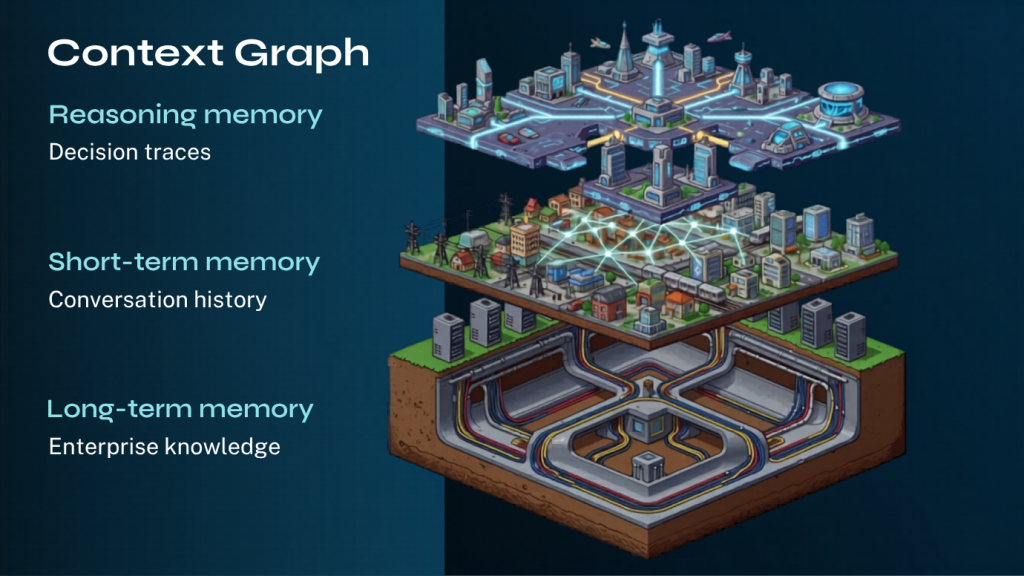
  • The foundation: Long-term memory for enterprise knowledge
  • The middle: Short-term memory for conversation history
  • The apex: Reasoning memory for decision traces 
A diagram of how context graph connects three levels of memory: reasoning, short-term, and long-term.

Our view of agentic memory is composable; each layer of memory connects to the others in a unified context graph. This “Sim City data model” allows for a highly flexible system in which an agent can query any or all graphs simultaneously, depending on its needs. Crucially, it enables us to scale and process each graph independently: storing one for rapid memory access, inspecting another through specific graph queries, or curating a third using graph algorithms.

Ultimately, the dependability of an autonomous agent over time is not merely a product of the model itself, but a direct reflection of the quality of this curated data infrastructure. Let’s take a closer look at each type of memory.

Long-term memory: Enterprise knowledge

At the base of the agent’s memory sits enterprise knowledge, made up of slow-moving facts—immutable truths that rarely require updating, such as a building’s geographic location or a nation’s capital. This is the agent’s long-term memory.

Many enterprises today have knowledge graphs. They tend to be high-fidelity and highly curated (by both experts and algorithms). While knowledge graphs are rich and mutable, the velocity of change in the data tends to be low. Good examples of knowledge graphs include bioinformatics that stores interactions between molecules and receptors, a digital twin of public transport systems that shows which rail lines might be delayed or a bridge closed for the day, and more. Both are rich and dynamic, but with relatively few updates per second.

The value is that knowledge graphs provide ground truth for your business domain. They augment and correct for the lossy training of the agent’s model by providing hard, curated facts about the domain to close gaps and help prevent hallucinations.

Short-term memory: Conversation history

In the middle sits the conversation history, which handles more volatile information, such as what the user asked, what the agent is working on, what it’s already done in previous sessions, or what knowledge it needs to accomplish the current task. This is the agent’s short-term memory.

Short-term memory captures the agent’s state, as well as conversation, session, and message history. It bridges the gap between general knowledge and specific action. The agent gains the context it needs to take actions, while avoiding context drift issues such as forgetting which tasks it’s already done or which related knowledge it used. Knowing a truck’s meaning is useless unless the agent knows what was discussed about it and where to find it, so it can make a useful decision. With a durable conversation history, an agent can reference its own state and messages and easily navigate to relevant knowledge. It also provides a durable context for multi-agent orchestration, enabling agents to understand what other agents are working on in real time.

Reasoning memory: Decision traces

Finally, at the top, we have the decision traces, or line-of-reasoning data, which capture the agent’s internal decision-making processes and its historical decision records. This three-tiered graph architecture isn’t just “more data.” It’s the navigational structure that allows an agent to work autonomously. This is the agent’s decisioning memory.

The decision graph provides transparency and explainability for both humans and agents to audit. The reasoning memory supports many concurrent decision-making processes, but once a decision is made, the decision, along with the reasons and tool uses, is stored as a decision trace. Through self-referential activity, the agent can tie together knowledge and conversations with its own decision traces to make good decisions and improve its decision-making capabilities over time.

Graphs, in context

You might reasonably ask if we have encountered this before in the form of graph databases. The answer is yes, with a caveat. All three graph layers in this architecture can be implemented with a graph database and easily queried with a query language like Cypher or GQL.

However, a movement towards APIs, like Neo4j Agent Memory, that both encapsulate database queries and offer useful functionality like entity resolution on behalf of the agent, while keeping the underlying data well-curated. Agentic memory APIs allow an agent to simply “remember” a fact (including entities and their associations), which is then mapped by underlying tools (such as entity resolvers) to the appropriate records in the appropriate tiers of the graph.

How to build a context graph

Neo4j Agent Memory makes it easy to build context graphs. It’s an open-source library that runs on top of any Neo4j instance and packages all three types of memory in the context graph. 
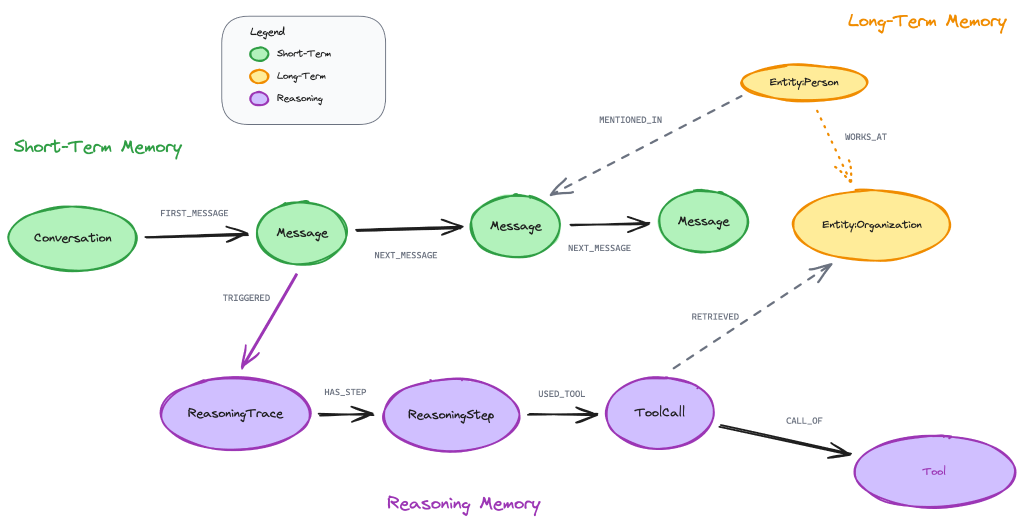
Knowledge graph of short-term, long-term, and reasoning memory.

Neo4j Agent Memory handles everything from modeling the graph schema, writing Cypher queries, and managing entity resolution to adding connections, summaries, and metadata, while keeping the underlying data clean and well-curated. It also plugs into existing agent frameworks like LangChain, Pydantic AI, LlamaIndex, CrewAI, and OpenAI Agents, so teams can add a context graph to an agent they’ve already built without rewriting the architecture.

An agent can simply call these memory tools via MCP or API to store something in its memory.  Or you can also use create-context-graph to easily build a full-stack agentic AI application from scratch—including a backend with a configured agent, a frontend with graph visualization, and a context graph of your domain.

Get started with context graphs

Autonomous, goal-oriented agents are the future of information systems. Building autonomous agents to be dependable is a challenge, but it can be met and exceeded by supporting your agents with the right platform. 

Context graphs give your agents a durable understanding of all your knowledge, conversations, and decisions. The three-tiered model works well because it allows agents to pick the right level(s) of data they need, while the connections in the graphs provide the context necessary for dependable agentic processing.