
惯性聚合 高效追踪和阅读你感兴趣的博客、新闻、科技资讯
阅读原文 在惯性聚合中打开

推荐订阅源

N
News and Events Feed by Topic
Malwarebytes
Malwarebytes
Threat Intelligence Blog | Flashpoint
C
Cybersecurity and Infrastructure Security Agency CISA
F
Future of Privacy Forum
C
Cisco Blogs
T
The Exploit Database - CXSecurity.com
A
Arctic Wolf
S
Securelist
K
Kaspersky official blog
S
Schneier on Security
T
ThreatConnect
T
Tenable Blog
Spread Privacy
Spread Privacy
T
True Tiger Recordings
AWS News Blog
AWS News Blog
F
Fox-IT International blog
量子位
T
Threatpost
V
Vulnerabilities – Threatpost
C
CERT Recently Published Vulnerability Notes
Cisco Talos Blog
Cisco Talos Blog
GbyAI
GbyAI
宝玉的分享
宝玉的分享
腾讯CDC
G
Google Developers Blog
aimingoo的专栏
aimingoo的专栏
Cyberwarzone
Cyberwarzone
有赞技术团队
有赞技术团队
S
SegmentFault 最新的问题
OSCHINA 社区最新新闻
OSCHINA 社区最新新闻
V
Visual Studio Blog
U
Unit 42
雷峰网
雷峰网
cs.CV updates on arXiv.org
Simon Willison's Weblog
O
OpenAI News
freeCodeCamp Programming Tutorials: Python, JavaScript, Git & More
The GitHub Blog
The GitHub Blog
The Register - Security
MyScale Blog
MyScale Blog
小众软件
小众软件
A
About on SuperTechFans
Last Week in AI
Last Week in AI
Y
Y Combinator Blog
博客园 - 三生石上(FineUI控件)
美团技术团队
Google Online Security Blog
P
Proofpoint News Feed
MongoDB | Blog
MongoDB | Blog

Hacker News - Newest: "AI"

Sign in Nobody Wants AI Anymore [video][12 mins] How to Teach AI the "Taste" Global AI Diffusion: Q1 2026 Trends and Insights [pdf] HN: Silau – AI detects employee burnout" How AI Talks People Out of Conspiracy Theories–and What We Can Learn from That What to know about the AI models that are jolting Washington AI for design needs solving | by Megha Agrawal Client Challenge Predicting AI job exposure — Benedict Evans AI is becoming increasingly unpopular AI-Driven Design Automation What's Left for AI-Assisted Coding GitHub - Totes-MickGOATs/mcgoats-game-template: AI-powered game development template with CI/CD, auto-merge queue, TDD enforcement, 3-layer master protection, and 50+ skills for Godot/Unity/Unreal Vericoding: The End of "Trust Me Bro, The AI Wrote It". Bone Keeper AI Assisted Feature Film – Barrett Sonntag Nuance in all things. A dive into (Anti-) “AI” Myths AgentGate — Trust Authorization for Autonomous AI Agents AI is learning to fly airplanes – and aviation is starting to embrace it GitHub - oldrich-research/gravitational-constant-relation: A high-precision phenomenological relation for Newton's gravitational constant: G = (4/3)(hbar c / m_e^2) alpha^21 exp(-5 alpha/2). Companion to Zenodo DOI 10.5281/zenodo.20120946. Research performed by AI agents under named author's direction. AI agents just got their own web browser via a Firefox fork AI poses "urgent threat" to student learning and the HSC The AI Bifurcation of Tech The largest study of AI use by undergrads is in, revealing disparities in access — and in cheating NZ at wild frontier of AI superhacking The Race Is On Google CEO Sundar Pichai says booing graduates will shape AI's future Show HN: TalkTimer, a micro-SaaS run by an AI agent team Trickster's Table Venture Capitalist John Doerr Says AI Is the Biggest Tech 'Tsunami' AI Can’t Care – Dan Moore! GitHub - peterxcli/ccost: Turn local AI coding session logs into a searchable terminal UI with a cost lens. Ask HN: What is your daily AI stack? GitHub - PanzerPeter/Neuro: A programing language for AI Resyl: AI Memory for People - Apps on Google Play AI Chip Component Costs: Memory at 63% | Epoch AI Ask HN: Why do people seem to generally hate AI? Resonance, randomness, and negotiated meaning for AI-assisted tarot divination GitHub - Kind-Computers/quinlight-audio: Audophile-quality MOD music with AI remastering at 32-bit 96 kHz! The Case Against the AI Job Apocalypse AI and the Rise of Just-In-Time Knowledge Work Careers After AI There Is No AI (It's Just People), with Jaron Lanier [video] wolfram-fb0 — AI writes x86_64 asm + eBPF for fractals, in a real VM in your browser Bursting the AI Bubble: Fed Could Take Away the "Who Could Have Known?" Defense AI proves mathematicians wrong I built a free AI travel planner for budget Europe trips Our AI just got even better Integral Intelligence: a Catholic view of the AI debate How to Tame AI’s Voracious Appetite for Energy GitHub - atveit/pi-mojo: A mojo port of the PI AI Agent Toolkit Autotrader – paper trading AI agent for Indian equities The invisible fabric of AI: chips are not a war between two, but a global fabric - zoopa.es Responsible Work with AI The AI Existential Crisis: Western AI Agents Will Win Commerce Legal Ontologies for AI This AI Stock Is the Ultimate Set-It-and-Forget-It Buy for Long-Term Investors AI wealth must benefit the public, South Korea's deputy PM says amid Samsung labor tensions Forget electrons, this breakthrough uses light-matter particles to power AI State Explosion Security Problem in AI-Era Software Supply Chains ShannonBase: The Lightweight Semantic Layer for Enterprise AI SQL AI Content Got Too Real. Now OpenAI and Nvidia Are Using Google’s Watermarking System. - Firethering Karen Hao: AI creating a DESPERATE BASE OF WORKERS with no full-time employment GitHub - barvhaim/llm-learning-path: 🎓 Structured LLM Learning Path — From Zero to Researcher. 8-phase curriculum covering Transformers, pre-training, fine-tuning, alignment, agents, and advanced research. Letting Agents Write Code Without Ratcheting Up Risk Why Every Electronic Product May Need To Be Rebuilt For On-Device AI: The Chip Layer Will Decide The Next Hardware Wave – Easelink Tech Ask HN: I mapped 6,494 AI engines into a taxonomy – anyone else tried this? China behind in LLM race but it can still win in AI, ex-Tencent AI lead says Newsom signs order aimed at tackling AI job displacement How AI is redefining Software Engineering Hiro, AI job matching with real visa sponsorship data (550K jobs) For developers without design skills, how do you leverage AI for front end dev? The Anatomy of AI Power in 2026 | Wayne Research arxiv ‘AI washing’: firms are scrambling to rebrand themselves as tech-focused Clawd Cursor v0.9.7 SpaceX, OpenAI and Anthropic IPOs set to test limits of AI boom Export chats from 11 AI platforms to PDF or Markdown locally From Vibe Coding to AI-Assisted Engineering: Lessons from Real Projects Shannon Got AI This Far. Kolmogorov Shows Where It Stops GitHub - machineswillrise/jagent: AI coding agent in Java GitHub - anatomia-dev/anatomia: Verified AI development. Ship with proof. Joe Rogan accidentally exposed AI in four words [video][12 mins] AI Headshot Generator for Work | Preview before you pay $4.99 one-time, no subscription MAXTOKEN A Unified Framework for Unbounded Output Generation and Repository-Scale Code Understanding The unlikely Vatican-Anthropic relationship that's reshaping AI ethics debate Fashion designer Jeremy Scott gets a huge cheer after ripping up his AI-written commencement speech Sycophantic AI decreases prosocial intentions and promotes dependence GitHub - anasmohiuddinsyed-bit/ai-fix: When a command fails, one word fixes it. AI-powered error fixer for your terminal. AI Governance 2026: I Almost Quit over This Shit (and Why You Might Too) GitHub - sabir-gbs/the-polyglot-protocol: A senior-engineer protocol for polyglot code generation, architecture, testing, security, performance, and agent validation. CodeShot — Beautiful Code Screenshots via API Apple Preparing New 'Gen AI' Website Ahead of WWDC Duolingo's CEO says he backtracked on evaluating AI use in performance reviews AgentLens — Know if your AI features are actually working How Much AI Compute Do Frontier Labs Use? AIBTC Jimmy Carr on Why Everyone Is Wrong About AI [video] Ask HN: Why disparage AI while attributing ideas to AI when written with it? Mercor AI post-training for generalist experts – referral Reid AI - Silicon Valley Video Summit
AI Has Taken Over Open Source
ChicknNuggt · 2026-05-25 · via Hacker News - Newest: "AI"

Sidebar CTA Background

Secure your dependencies with us

Socket proactively blocks malicious open source packages in your code.

Install

I’ve spent a lot of time looking at what the data reveals about open source, from the speed at which open source alternatives emerge to how maintainer compensation compares with the broader software industry. I’m interested in what the data says, not in predictions based on anecdotes.

At Socket, I've had the privilege of accessing our massive database across all major ecosystems, including npm, PyPI, Go, and Rust. We essentially replicate all open source packages, including the very fringe cases. Within minutes, a nefarious package is replicated, analyzed, and reported to our customers.

This unparalleled, real-time visibility into the entire software supply chain has surfaced unique and often surprising insights as our industry has rushed into the AI era. Socket was created just before “vibe coding” was coined as a term, and we have had a front-row seat to observe how it is impacting the open source community.

I found three interesting insights that I want to share with you today, all related to AI coding trends: the number of packages on npm is growing exponentially, pull requests and contributions are increasingly seen negatively by maintainers, and dependency shopping is on a downward spiral. AI is driving the production and consumption of open source, as well as fundamentally transforming the dynamics between maintainers and contributors.

The Rising Tide of Packages#

Last year, I took a deep dive into Socket's package database, and I developed a theory that npm might have reached its peak. The explosive surge that defined the 2013 to 2016 period seems to have leveled off. I remember that a decade ago, the developer community was using the term "JavaScript fatigue" to describe the then-normal torrent of new tools and ways of working. Since then, the ecosystem has moved toward a more predictable cadence, and those familiar frustrations within the community have largely quieted down.

Everything changed in January 2026. AI coding tools became so effective at producing working code, that they became the driver of many developers' workflow to produce side-projects, open source packages, automations, and enterprise source code.

This is visible in open source ecosystems such as npm. I compiled the following chart from Socket’s database, where I spread all packages by their creation date over time, and measured how many such packages exist per creation-month. To ignore fake packages, dead packages, and other registry-abusing cases, I added a filter for packages that have at least 100 weekly downloads. Thus this counts the real and reusable packages.
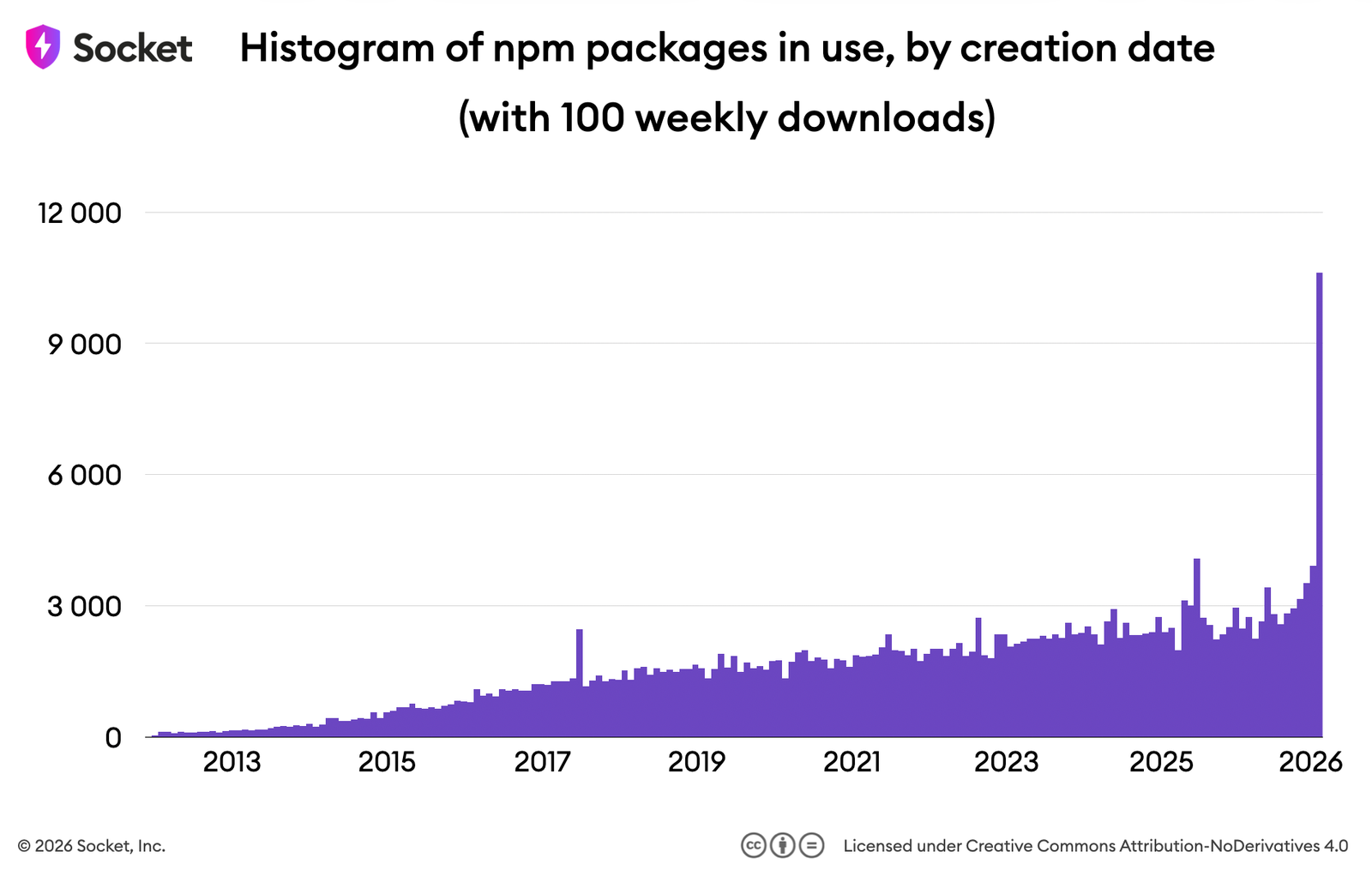
Time series chart of the number of NPM packages by creation date from the years 2013 to 2026. It displays exponential growth from the years 2013 to 2016 totaling approximately 1000 packages, then a linear growth until mid-2025 up to 3000 packages, and then the sudden explosive exponential growth towards 2026 crossing the mark of 10000 packages.

There is an unprecedented pattern going on. While it is possible the recent spike includes packages gaming the system for artificial popularity, we haven’t seen this kind of sudden growth in 15 years of npm. The immediate question is: where do they come from? How can there be this many? Even during the periods when there were swarms of prolific developers publishing as many packages as they humanly could, we did not reach the mark of 10,000 real and reusable packages per month. It seems like something superhuman is happening.
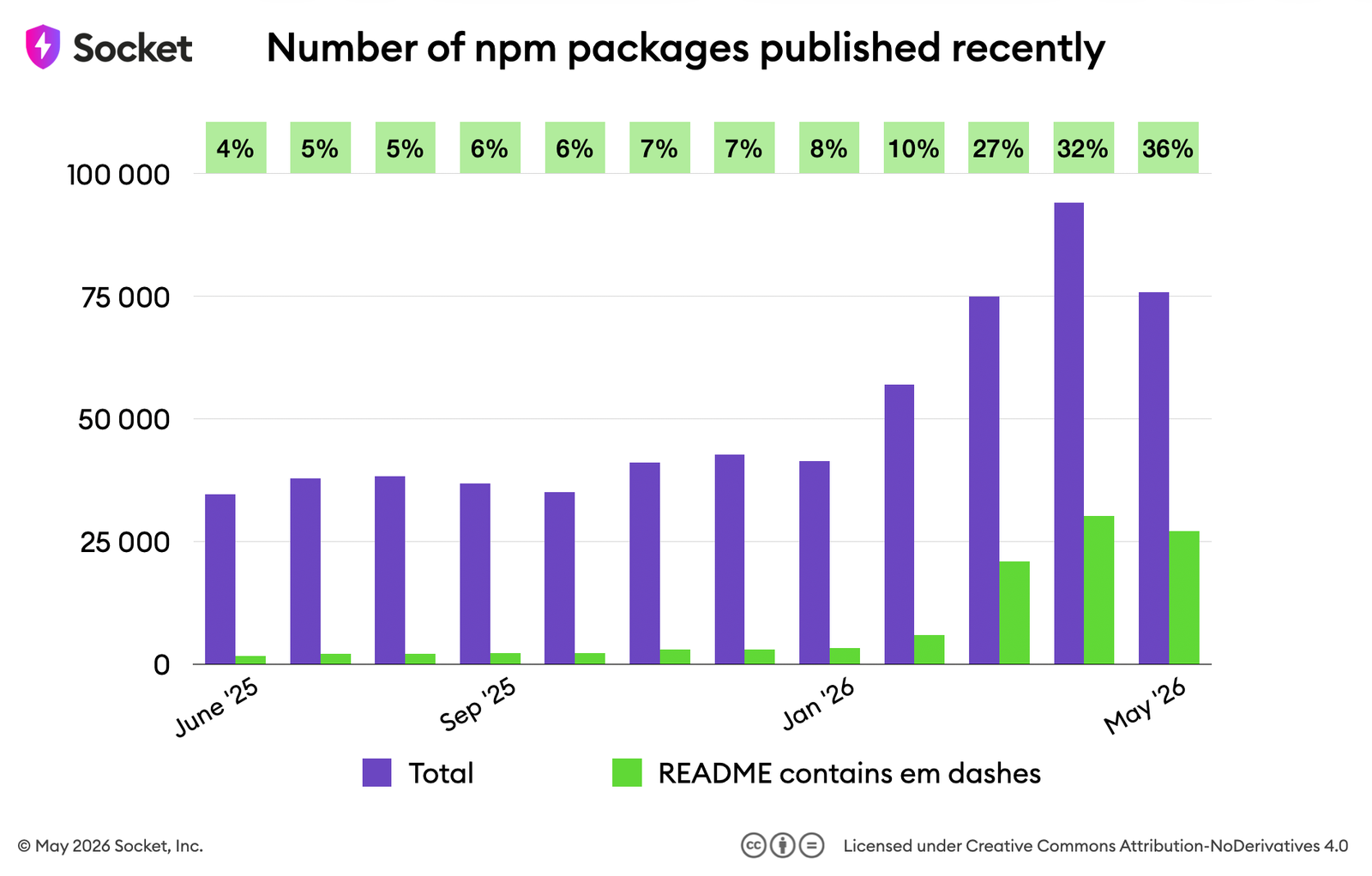
A time series chart of the number of NPM packages published in the past 12 months. For each month there are two numbers displayed, the total number of packages and the proportion of those that contain em dash in the README. From June 2025 until May, January 2026, there are about 40,000 NPM packages each month, of which 5% have em dash. Afterward until May 2026, there is a linear growth up until 100,000 NPM packages per month of which 30% containing em dash in the README.

This sparked my curiosity and I pondered how I could distinguish which of these packages were “written by AI”. Trying to differentiate between human machine output is a challenge that borders on a modern Turing test. That said, fortunately current AI coding tools are unusually fond of em dashes. So for the time being, they give themselves away easily. I measured the number of packages published recently, and the proportion of those which had em dashes in their README files, and the following chart was produced. (Please note that this was produced mid-May 2026, so the count of packages in May is still incomplete)

It is normal to expect approximately 5% of em dash “background radiation” produced by humans, so the recent sharp increase in em dash usage (30%+) indicates that AI is indeed employed in the creation of new npm packages. It is more than doubling the number of packages per month.

Maintenance Fatigue: PRs not welcome#

AI coding tools are used not only for the creation of new packages but also for contributing pull requests to existing open source projects. Given the normalization of AI assistance in most IDEs, this is not surprising. What's new is the flood of low-quality and often automated pull requests, which bypass human interaction, spamming maintainers with noise.

Maintainers of projects such as curl, Godot, Ghostty, tldraw, and others are now vocally describing contributions in a negative light. Some are resorting to disabling pull requests entirely, others are considering how contributor allowlists could be an answer.

It was once standard practice in the open source community to use "good first issue" labels to encourage and onboard new programmers. Yet, this label is increasingly counterproductive, often attracting AI automation executing on a user's instruction. As a result, contributions are now often leveraged to boost online presence and popularity, eroding the culture of solidarity that historically defined the open source ethos.

AI is reshaping the work of maintainers as much as it is reshaping the work of contributors. Maintainers are now using those tools to help review pull requests, or to simply rewrite the contribution from scratch given the maintainer’s better-informed prompt.

Software Supply Chain as a Black Box#

We built Socket’s package search feature – free for everyone – to support “dependency shopping”. This is the process of searching for suitable dependencies, filtering away the fake and the unpopular, and assessing many other criteria. Let’s take a look at how this too was impacted by AI recently.

What simple “health indicator” for dependency shopping could we probe? In modern software development, UI components for routine tasks like date selection are a fundamental requirement. However, when I examined Google Search trends for “date pickers” in the past 4 years, I discovered a surprisingly consistent decline:
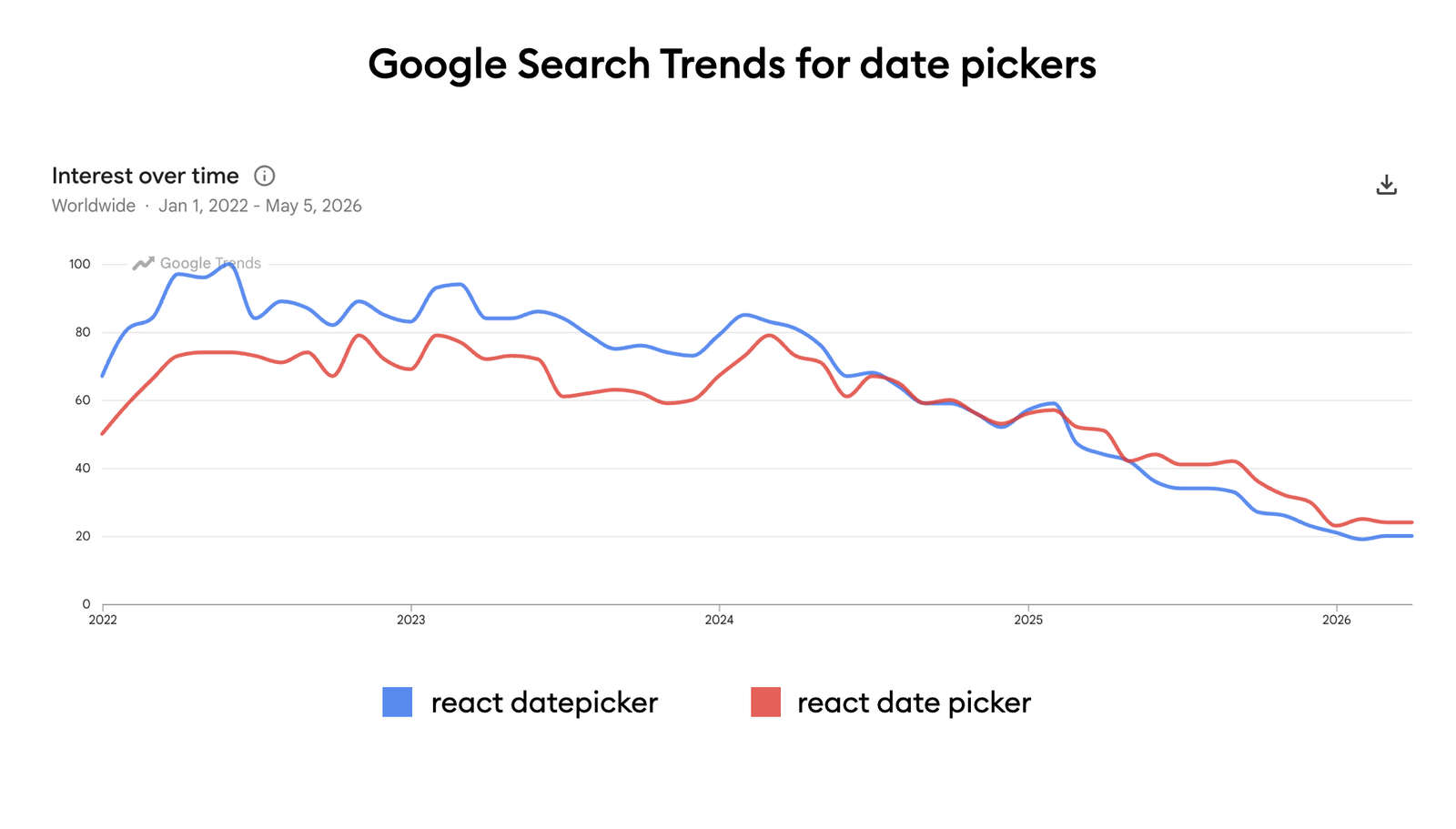
Time series chart from Google Search Trends displaying the interest over time for keywords such as React date picker from the years 2022 to 2026. The numbers look somewhat constant from the years 2020 until 2024 and afterward there is a linear decline that goes down about 80% until 2026.

Based on the chart above, one might be inclined to conclude that React date pickers are on their way out of software being produced lately. Contrarily, the statistical data for downloads regarding this specific package reveals a conflicting narrative: react-datepicker usage is steadily growing, and even picking up more steam in 2026!
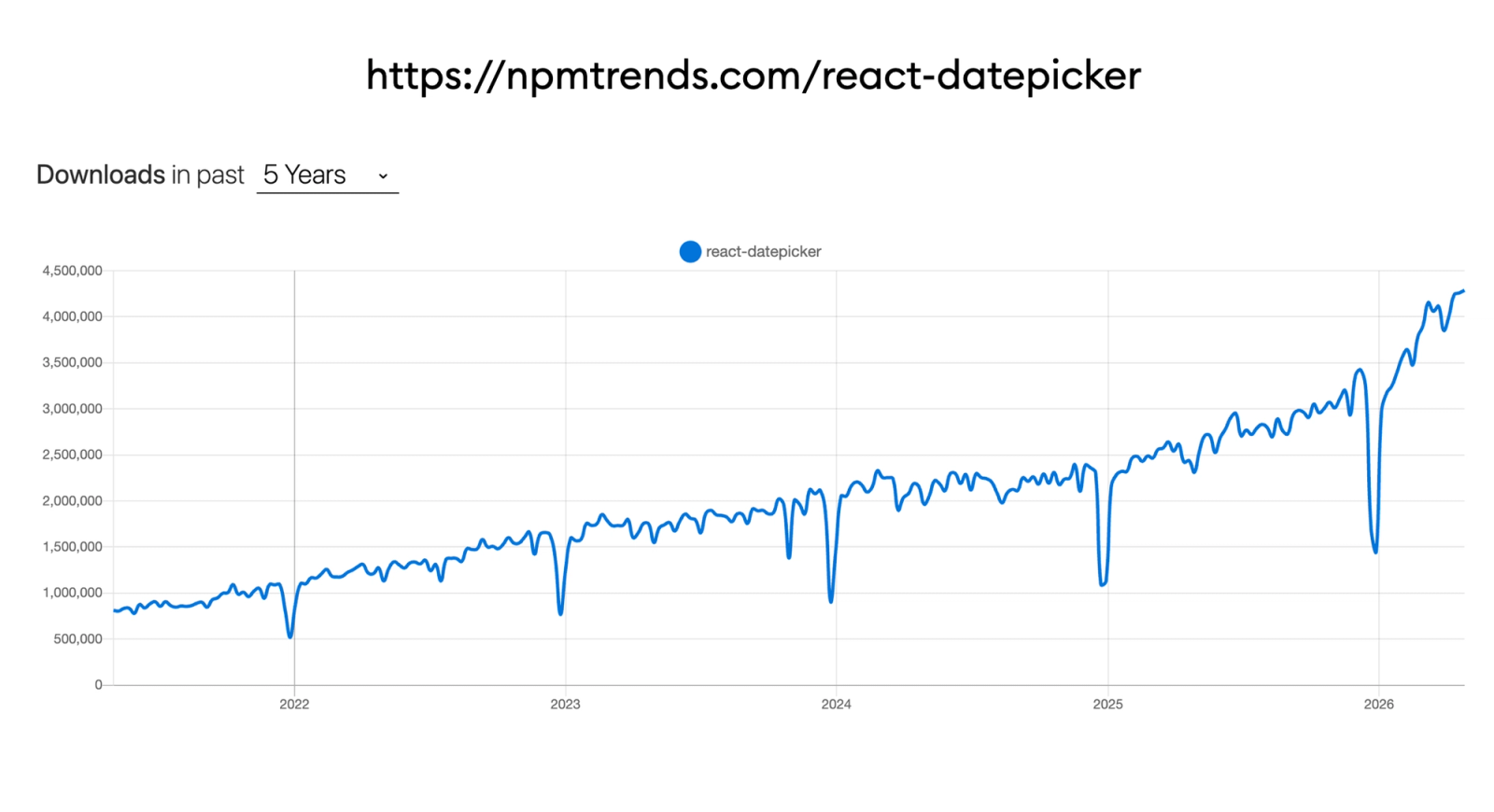
A time series chart from npmtrends.com for the keyword React date picker showing a linear growth from the years 2021 until mid-2025, when afterward it starts growing exponentially through the year 2026.

Open source used to be consumed consciously, intentionally and informed by package popularity or human review. This is no longer true. Developers more and more rely on their AI coding tools to build entire features or products, and in the process include the packages deemed necessary. Packages themselves used to contain transitive dependencies that were hand-picked by maintainers. That is also no longer true.

The result is that AI is now primarily in control of software supply chains. There are other fields disrupted by AI, such as image generation or the production of music, but software is uniquely impacted. AI is now driving both the production and consumption of open source software. AI-generated music ends in human ears, and AI-generated images mostly benefit humans, but AI-generated software is an ouroboros (a snake eating its own tail) which is just getting started.

The software that AI writes is often good, and the open source packages it chooses for consumption are by and large better than what humans would choose. But the fact remains that the software supply chain is now an automated black box, fundamentally changing the landscape of security and transparency.

It is not feasible to manually review every new dependency selection, and the pace of AI-accelerated productivity reduces the economic benefit of pausing to inspect the packages and their source code. The only viable solution to remain secure in this new world ridden with malware campaigns is to automate the scanning of third-party code to surface risk indicators based on how that code behaves.

Developers are moving faster, tools are making more decisions on their behalf, and the supply chain is becoming too large and too automated for manual review to remain the primary defense.

That does not mean open source is going away. It is human nature to share useful things with the wider community. But in a world where AI is helping produce, select, and install open source packages, automated analysis of third-party code becomes a baseline requirement for production software.