






TL;DR: Fuse gives every ad platform its own dedicated AI brain. Ask about TikTok in plain English and get an analyst-grade answer, complete with cross-channel context and budget recommendations, built entirely from your real, saved data. Zero hallucinations by design: the AI never invents a number.
Connecting to an advertising platform sounds like it should be a solved problem. You get an access token, you call an API, you get your numbers back. In practice, every platform speaks its own dialect, and the moment you try to put an AI assistant on top of all of them, those little dialect differences turn into real engineering decisions.
This is the story of how we connect Fuse to TikTok Ads, why TikTok was its own kind of puzzle, and the architecture we landed on so that you can ask a question in plain English and trust every number that comes back.
We already supported Meta and Google before we added TikTok, so we went in assuming it would look roughly the same. It didn't.
A few examples of where TikTok marches to its own beat:
None of these are dealbreakers. But added together, they're a good reminder that "connect to the ad platform" is never one job. It's a fresh translation problem for every channel, and that realization shaped everything that came next.
What marketers actually want is simple to say and hard to deliver: ask a question in plain English (like "how did my TikTok campaigns do last month?") and get back numbers you can actually act on.
The naive approach is to let the AI talk directly to the ad platform and improvise. We didn't do that, for three reasons:
So instead of one AI improvising across everything, we gave each platform its own dedicated brain.
Under the hood, every platform we support (TikTok, Meta, Google, LinkedIn, Klaviyo, Shopify, and more) gets its own self-contained module: a connector that knows that platform's dialect, paired with an AI "brain" that knows how to answer questions about it.
Each of these brains works at two speeds:
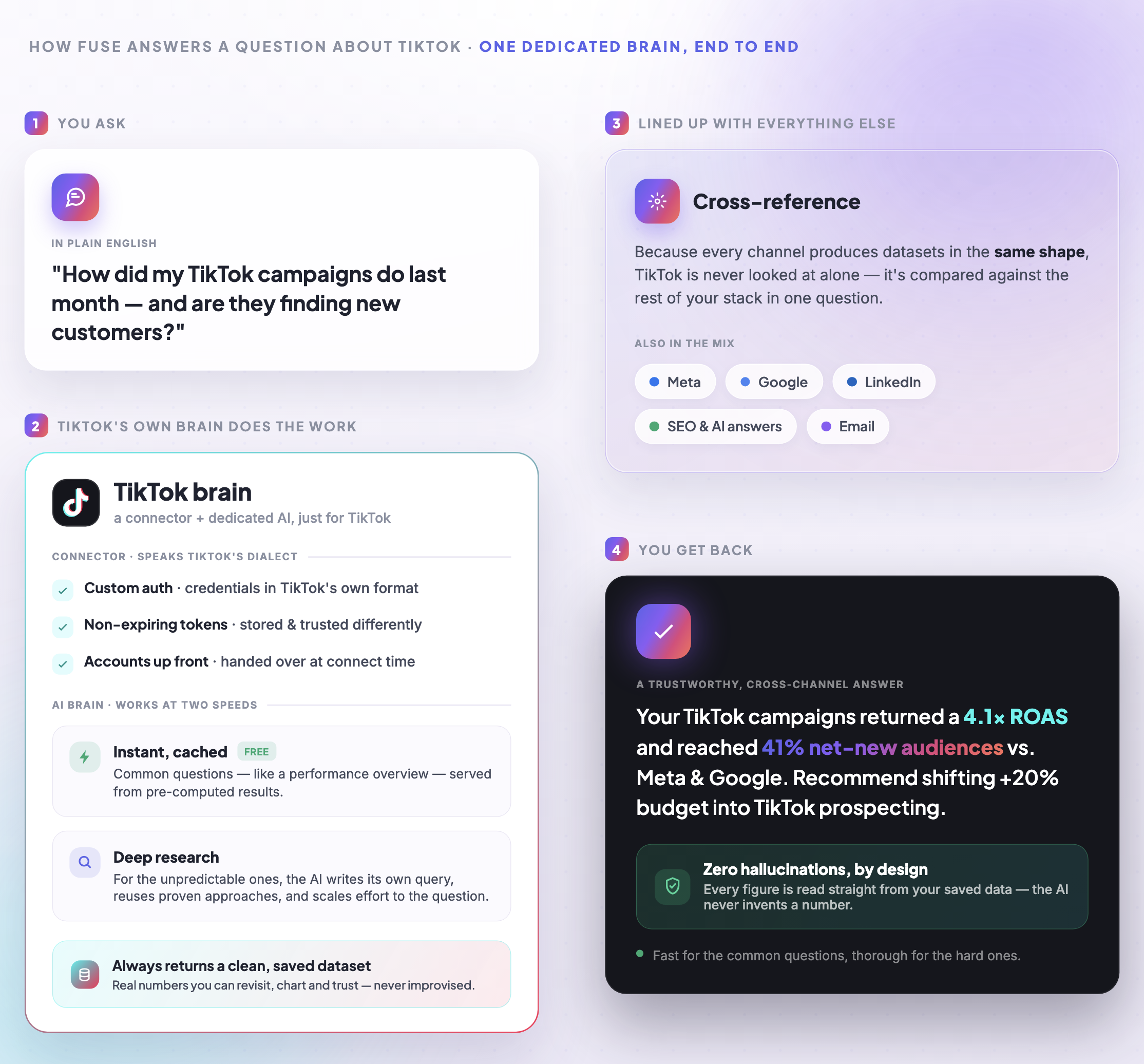
The big win of this design is consistency. Adding a new platform doesn't mean rewiring the whole assistant. It means building one more self-contained brain that plugs into the same slots as all the others. The TikTok quirks we mentioned earlier stay neatly contained inside the TikTok module, instead of leaking out and complicating everything else.
This is where Fuse stops being a dashboard and starts being an analyst. In that deeper research mode, the platform's brain works like your own AI marketing analyst: instead of picking from a short menu of pre-built reports, it figures out exactly what data your question needs, writes its own query to go get it, and comes back with the answer and what to do about it.
It's smart about how hard it works, too:
Here's where giving each platform its own brain really pays off. Because every channel produces clean, saved datasets in the same shape, the AI can pull them together and reason across all of them at the same time.
So TikTok Ads never has to be looked at in isolation. The same question can pull in everything else you've connected:
That turns simple reporting into genuine cross-channel intelligence. Instead of "how did TikTok do?", you can ask the harder, more useful questions:
Here's what that looks like in practice. Ask "how did my TikTok campaigns do last month, and are they finding new customers?" and Fuse doesn't just echo a metric back. It comes back with the analysis: your TikTok ads returned a 4.1x ROAS, your best paid channel, and 41% of the people they reached were brand-new, not audiences you're already paying for on Meta or Google, so it recommends shifting more budget into TikTok prospecting. Every figure in that answer is read straight from your saved data, and the AI never made one up.
Answering questions like that means lining up data from several platforms that each speak their own dialect, normalizing it, and reasoning over the whole picture. That's exactly what the per-platform-brain design makes possible, and it's what turns Fuse from a reporting tool into a genuinely advanced AI analyst for your entire marketing stack.
You don't need to care about access tokens or sandboxes to feel the difference:
Want to see this on your own data? Browse the full list of integrations, compare pricing, or book a demo.
此内容由惯性聚合(RSS阅读器)自动聚合整理,仅供阅读参考。 原文来自 — 版权归原作者所有。