








Quality is at the core of every product we build. To move fast without compromising on quality, we rely on an extensive set of test suites that tell us quickly whether a change has caused a regression. Those suites are large enough that a single full run takes about 23.5 hours with a single machine, which is why we spread the work across a large fleet of machines.
But as we ship more features, the suite keeps growing, and more flaky tests start showing up.
For the uninitiated, flaky tests are tests that fail sometimes but usually pass on a rerun. They're unavailable on large projects and a constant drain on engineers: after a flaky failure, you have to rerun the job, which costs both engineering time and machine time. Worse, as the flaky rate climbs, engineers trying to merge PRs start stepping on each other during reruns, creating a feedback loop that can consume the entire CI fleet’s capacity. Once that happens, queueing time spikes — sometimes engineers wait more than 30 minutes to an hour before a test even starts.

The obvious question is: **why not just ask engineers to fix the flaky tests?**
We did. It never worked well. And we realized there are two main reasons behind this:
All of this makes fixing flaky tests an expensive investment. It often takes one experienced engineer a full day to fix two of them. It's also a battle we can't win outright. As we build more features, we have to keep pouring engineering time into keeping CI flakiness at an acceptable level, or risk blocking new development entirely and rendering CI unusable.
By now you can probably see why flaky tests are expensive for any large engineering project, and expensive for humans to fix. When agentic coding went mainstream, this was one of the first use cases we considered for, because:
So we ran an experiment attempting to use Claude Code to fix the flaky tests in Kong Gateway.
The first thing we needed was a way to identify which tests were flaky and how often they failed. Luckily, the team had already built a dashboard on top of Datadog's CI Visibility feature that gives us a clear picture of the flakiest tests and their failure rates.
We used that dashboard as the benchmark for our fixes, and used its list to seed the agents.
Here's the agentic workflow we settled on after a few rounds:
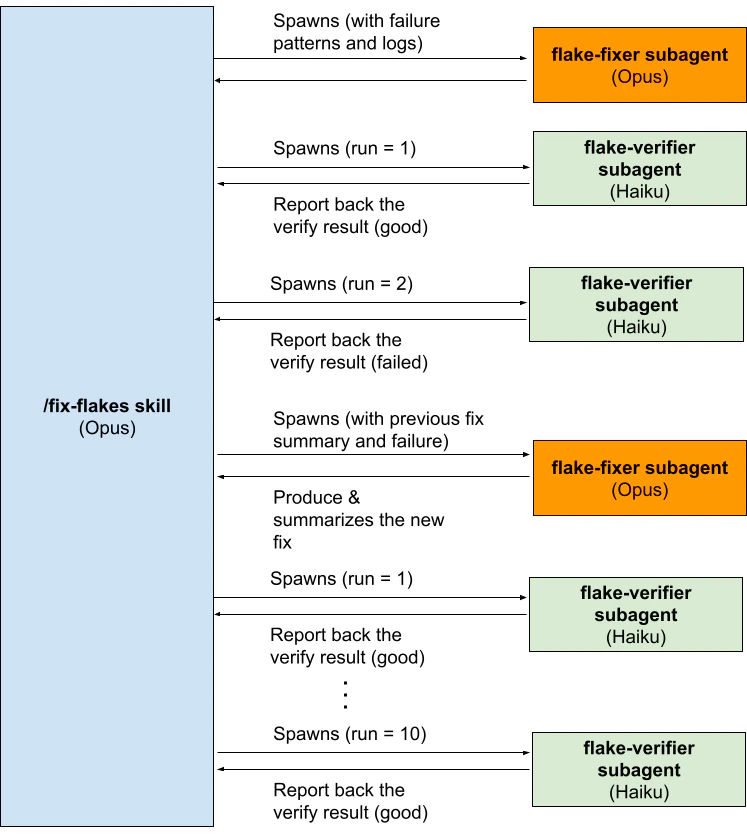
At the top level is the **fix-flakes** skill, the orchestrating agent, which runs on Opus. It takes a seed file — a flaky test's Datadog CSV export — and reads it to download all the CI logs from that test's recent failures. This step matters: failure logs usually contain vital clues about what's going wrong (as an example, a test failure after running for exactly 20 seconds could signal agents to look closely at timeout conditions), and they keep the agent grounded instead of guessing and hallucinating.
Once the failing test is identified and its logs are downloaded, **fix-flakes** spawns an Opus **flake-fixer** subagent to investigate and produce a fix. This is usually the most expensive step in token terms, but it generally runs in under 10 minutes — the **flake-fixer** often has to sift through multiple log files and dozens of source and test files to form a hypothesis and write a fix.
When **flake-fixer** is satisfied, it creates a branch, commits the fix, and pushes it to the repository. It then reports a summary of its theory and reports back to the orchestrator and exits.
The orchestrator then launches a **flake-verifier** subagent to check the fix. **flake-verifier** is a smaller Haiku agent, because each rerun produces more than one failure — there are other flaky tests in the suite — and the agent has to decide whether the test in question is fixed while filtering out the rest as noise. The CI output is scattered across many unstructured log files, and we found Haiku to be the easiest and most reliable way to judge whether a rerun succeeded. flake-verifier polls the run periodically until it can call success or failure, then reports back.
The orchestrator keeps spawning **flake-verifier** subagents to match the "rerun streak" configured when the skill is invoked. If no failure shows up across the full streak, **fix-flakes** open a PR for review. If a **flake-verifier** reports a recurrence at any point, the orchestrator downloads and combines the new failure logs with the previous **flake-fixer** summaries, spawns a fresh **flake-fixer**, and repeats — until the test is fixed and verified, or a maximum attempt count is reached, at which point it reports the failure.
Finally, the verified PR goes through normal human code review, same as any PR a person opens, and gets merged.
Why design the loop this way? Mostly for context management. Keeping a model's context concise helps it hold attention, and it sharply reduces the cost of running a long agentic task like this.
**flake-fixer** is the most context-heavy agent in the system: it has to read through large log files and source code to build a solid theory of the flakiness. Carrying every previous fix along wouldn't help the next investigation much, but it would fill the context window fast. So we ask each **flake-fixer** to produce exactly one analysis and one fix, and to hand a summary back to the orchestrator — that way the next **flake-fixer** knows what's already been tried and can reach for new theories.
Subagents also let us use smaller, cheaper models like Haiku for steps that don't need heavy reasoning, like verifying a result, which cuts costs further.
With this workflow, one flaky test can generally be fixed and verified in 4–5 hours — most of that spent in the verification loop, since CI itself takes a while — using an average of 100–200k tokens start to finish. The process is highly automated and needs no human intervention while the agents run. Fixing several tests at once is just a matter of running multiple instances of Claude Code with different seed files, all running concurrently and not interfering with each other.
Over a week and a half, we ran this harness against the **15** flakiest tests on our dashboard. It fixed **12** of them and gave up on **3**. That result is striking, given the same work would often take an experienced engineer multiple weeks, often with less success.
It also did something we didn't ask for: while investigating the failures, the workflow surfaced two genuine bugs in our codebase.
**The **`**conf_loader**`** sorting bug**
One test compares the output of our `conf_loader `against an expected table, and it had been failing at random for years. Engineers had tried to fix it before, but it never stayed fixed. The failure looked like this (trimmed for length):
FAIL spec/01-unit/04-prefix_handler_spec.lua:994: NGINX conf compiler prepare_prefix() dumps Kong conf
spec/01-unit/04-prefix_handler_spec.lua:997: Expected objects to be the same.
Passed in:
(table: 0x7fdcaafdf140) {
  *[nginx_http_directives] = {
     [7] = {
       [name] = 'lua_shared_dict'
      *[value] = 'prometheus_metrics 5m' }
     [8] = {
       [name] = 'lua_shared_dict'
       [value] = 'otel_metrics 5m' } }
Expected:
(table: 0x7fdcad507ba0) {
  *[nginx_http_directives] = {
     [7] = {
       [name] = 'lua_shared_dict'
      *[value] = 'otel_metrics 5m' }
     [8] = {
       [name] = 'lua_shared_dict'
       [value] = 'prometheus_metrics 5m' } } }
Rather than just reorder the output, the harness investigated the codebase and the `conf_loader` source and realized the loader wasn't sorting duplicate directives by their value. Combined with the nondeterministic ordering of hash-table enumeration, that left the ordering of duplicate `lua_shared_dict` directives unstable. The fix it produced:

Our reviewer agreed this was the root cause, and our monitoring dashboard confirmed it: after the change, this five-year-old flaky test never recurred. All of it came out of the agentic loop — no human ever gave Claude any guidance.
The workflow turned up another genuine bug — two, actually. The test in question spawns 10 clients that hit our Admin auth endpoint at once. Occasionally, one of the requests fails, returning no session when it should.
Claude first suspected our `cluster_mutex` module, and it did find a small bug there: the mutex didn't return quickly when it was already held by a local request. But that fix did **not** pass the verification streak, so **flake-fixer** was spawned again to dig deeper. This time it identified a subtle data race in the session plugin the test relies on, and produced a fix that, once merged, made the flakiness disappear entirely.
In both cases, the agent fixed the flaky test without touching the test files at all. Through log and code analysis, it concluded the tests were written correctly, and the problems lay elsewhere. That's something humans tend to miss — we assume flakiness comes from "bad tests" and stop investigating the code path under test.
The whole Gateway team is feeling the difference. For the first time, CI stability is improving fast enough to be obvious. Merging a PR has gotten noticeably easier because far fewer reruns are needed — which saves a lot of engineering time and meaningfully cuts both the utilization and the queueing of our CI fleet.
**Try it on your flaky tests.** If you're still unsure whether agentic coding is a good idea, point it at your flaky test suite and see for yourself. You can't really make things worse — however badly it goes, it won't touch the product. It's about as risk-free as an experiment gets.
**Build a good feedback loop for your agent.** The only reason our flake fixer worked so well is that we told it exactly how to gather failure logs, understand the code path, and run verifications. Without those steps, even the most advanced model will hallucinate — convinced it fixed the issue while the test stays flaky. Agents are smart and will do their best with what you give them. What they're not good at is asking for the things you should be providing but aren't. That, more than anything, is why our flake fixer is effective enough to surface bugs nobody had noticed.
**Help the agent keep its context small.** When there's no reason to carry full context between tasks — like between **flake-fixer** spawns — start fresh and pass along only what the next step needs. It saves substantial time and tokens, and it lets the agent focus on the new investigation and produce a better analysis and fix.
**Use the right agent for the job.** Advanced reasoning models like Opus are worth it for complex code and flakiness analysis; for verification, a smaller model like Haiku does the job just as well.
**Don't over-engineer your harness.** It's tempting to invest heavily up front — a comprehensive harness, a library of polished, general-purpose scripts and skills meant to cover every scenario the agent might encounter. We found the opposite works better. Let the agent write throwaway scripts and one-off tools for the task in front of it; the models are more than capable of building the right thing on the spot, and a tool shaped for one specific job usually beats a generic one trying to handle them all. It also lifts the success rate — an agent running a script it just wrote for a particular task at hand results in far less troubleshooting than one trying to understand and run a general-purpose script built ahead of time, and often results in less token usage overall. Spend your effort where it actually pays off: on the methodology for identifying and verifying flaky tests, and on where to get the data that backs those decisions. That's a far better investment than prescribing the exact script an agent must use to achieve a certain task like rerunning a workflow or parsing the job output.
Overall, we've been pleasantly surprised by this experiment, and it already became part of our development workflow. It has meaningfully improved our productivity and our confidence in the test suite, and also significantly cut our engineering and CI costs.
此内容由惯性聚合(RSS阅读器)自动聚合整理,仅供阅读参考。 原文来自 — 版权归原作者所有。