




You’ve been told that 2028 is the “finish line” for the survival of democracy. You’ve been warned that “Authoritarian AI” is coming for your freedom. But what if the most terrifying threat isn’t a foreign lab, but a marketing department in San Francisco? While Silicon Valley elites brandish the “China card” to dodge copyright lawsuits and secure massive government subsidies, they are simultaneously signing contracts to provide the very global surveillance they claim to despise. It’s time to stop looking at the “race” and start looking at the receipts. One side is chasing a “God-like” financial myth to bail out a bubble; the other is treating AI like electricity to fix a shrinking workforce.
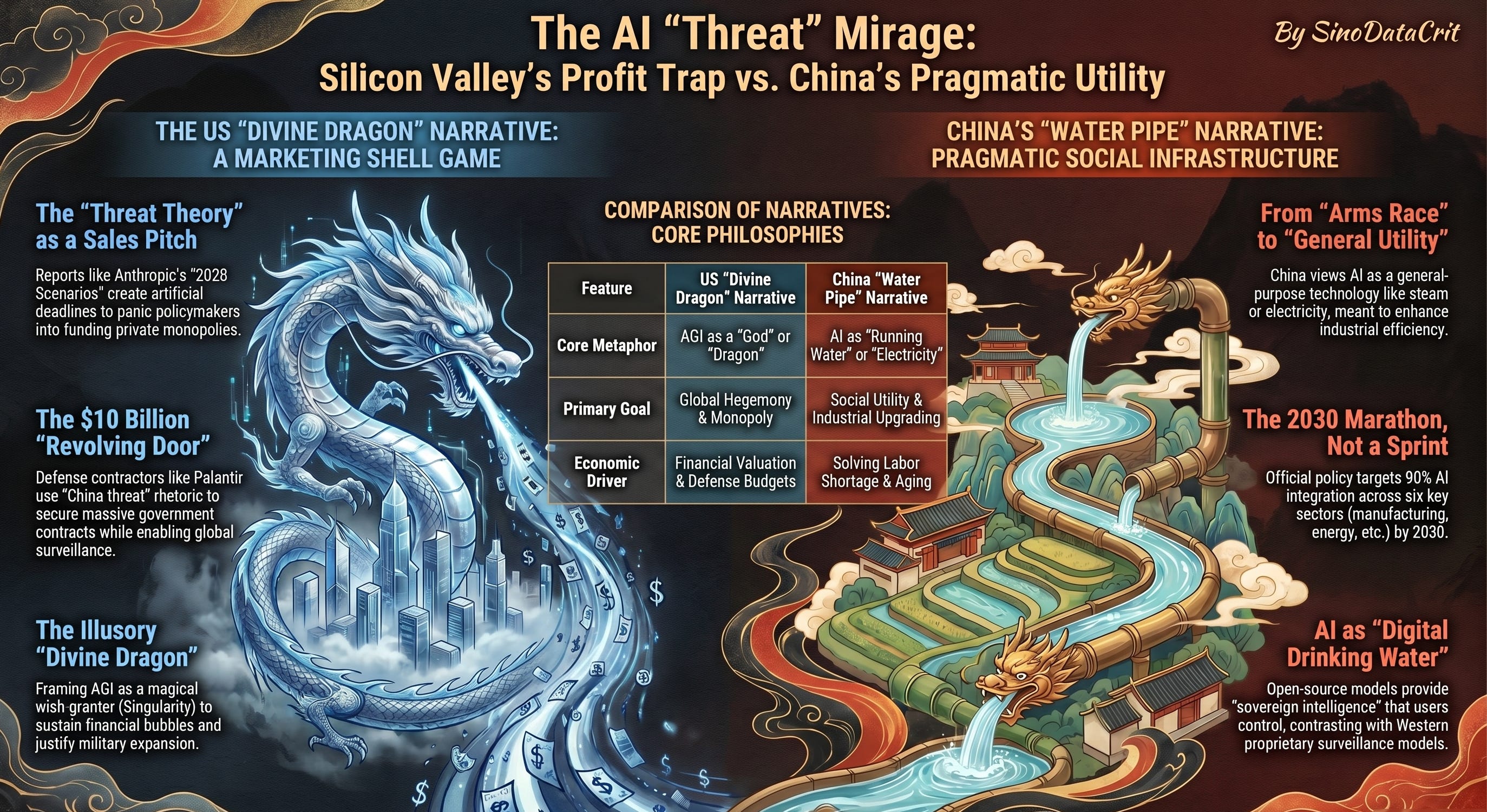
The “AI Cold War” is not a geopolitical inevitability; it is a meticulously choreographed sales pitch designed for maximum capital extraction. In the boardrooms of San Francisco, the specter of a Chinese “AGI God” is being summoned not as a legitimate security warning, but as a strategic tool to secure massive Capital Expenditure subsidies and bypass the inconvenient friction of domestic regulation. This is a manufactured countdown: a high-stakes framing exercise designed to convince policymakers that the clock is ticking on Western civilization unless billion-dollar checks are signed and safety rules are shredded.
While the American tech elite hunts for a sentient savior to rescue their over-leveraged balance sheets, China is treating Artificial Intelligence as a high-efficiency utility. One side is selling a Hollywood blockbuster about a race to a mystical “finish line”; the other is treating AI like electricity—a tool to salvage an industrial economy facing a terminal demographic crisis. To understand this “war,” American must first dissect the marketing brochure that triggered the latest panic.
In the lexicon of corporate lobbying, nothing loosens public purse strings like a hard deadline. Anthropic’s “2028: Two Scenarios” report is a masterclass in deadline-driven fear. It utilizes the “Claude Mythos Preview”—a model Anthropic claims fixed 20x more security bugs for Firefox—as a “marketing wake-up call” to justify immediate, sweeping policy changes.
Analysis of Anthropic’s Strategic Dissonance The report contains a structural contradiction that reveals the rot in its logic. It explicitly admits that framing the situation as a “race” is a false impression because there is no definitive “finish line.” Yet, it bases its entire urgency on a binary 2028 outcome: a democracy-led utopia or an authoritarian hellscape. This “Self-Drawn Finish Line” is designed to create a “window of opportunity” that forces policymakers to act before they can actually think.
Schrödinger’s Sanctions The report employs what I call “Schrödinger’s Sanctions.” It boasts that U.S. export controls have been “incredibly successful,” leaving China with 11 times less compute than the U.S. Simultaneously, it screams that China is “catching up and overtaking” America. In the world of facts, both cannot be true; in the world of a sales pitch, both are essential: one proves the policy “product” works, and the other proves you need to buy the “upgrade” immediately.
Geopolitical fear has become the ultimate shield against domestic litigation. This narrative is maintained by a “Revolving Door” of influence: researchers from the Open Philanthropy Project move directly into government roles to write the very policies that benefit the firms (Anthropic, OpenAI) they previously funded.
The Regulatory Escape: OpenAI’s recent memorandum to the Trump administration mentions “China” over 30 times. The goal is transparent rent-seeking: use the “China Threat” to lobby for the repeal of copyright restrictions and the dismantling of environmental regulations for data centers.
The Zuckerberg Pivot: We saw this in 2018 when Mark Zuckerberg pivoted a hearing on data privacy into a mandate for facial recognition, claiming that any regulation would hand the lead to Beijing.
The $10 Billion Pot This rhetoric has tripled the Pentagon’s AI budget, benefiting contractors like Palantir to the tune of $10 billion. The strategy is simple: frame the choice as “us or them” to secure long-term state contracts.
The Utah Absurdity When the narrative meets reality, it descends into farce. In Utah, billionaire Kevin O’Leary recently accused local female activists of being “Chinese spies” simply because they opposed a massive data center project that threatened the state’s electrical grid and water supply. This “unserious” discourse illustrates how the “China Card” is used as a blunt instrument to silence legitimate concerns about the resource-intensive reality of the AI bubble.
To maintain this high-pressure environment, the industry relies on technical inaccuracies that fall apart under scrutiny:
Innovation vs. Loopholes: The report dismisses Chinese success as “smuggling,” ignoring that China accounts for 69.7% of global AI patents and 23.2% of research papers. This is a “New National System” of R&D, not a collection of loopholes.
Distillation “Attacks”: The report stigmatizes “knowledge distillation” as espionage. In reality, it is a standard performance-enhancement technique. DeepSeek-V3 and Qwen2.5 have already reached GPT-4 levels in coding and reasoning via original innovation, not just “mimicry.”
The Xinjiang Label: It substitutes political labels for technical analysis, using ideological buzzwords to avoid discussing Chinese technical safety standards.
DeepSeek Militarization: It claims DeepSeek—a conversational model—is coordinating military swarms. No verifiable evidence exists for this speculative leap.
CAISI Data Credibility: It cites a “94% malicious request” statistic from the Center for AI Standards and Innovation (CAISI), a non-public body with no transparent or unified benchmark.
The Roadmap Fallacy: It predicts Huawei will produce 4% of NVIDIA’s compute in 2026 and exactly 2% in 2027. This hyper-precision on unreleased, speculative data is a classic hallmark of manufactured data.
The “Months Ahead” Ambiguity: It defines the U.S. lead as “several months”—a non-quantifiable metric that is impossible to verify.
The Fabricated Quote: It references a Chinese state media article calling distillation a “back door” but provides no link, name, or date, suggesting a potential fabrication or total mistranslation.
The Huawei/Alibaba Bias: It dismisses Chinese infrastructure as “cheap and good enough,” repeating the same bias that saw Western firms lose the 5G market to Huawei.
Ideological Preconditions: It treats technical market evolution as an ideological crusade, assuming Chinese innovation cannot exist without authoritarian theft.
The “Democratic AI” ethics narrative is built on profound hypocrisy. Anthropic, while positioning itself as the “safe” alternative, was the first lab to integrate Claude models with Palantir and U.S. intelligence agencies.
The “8 Billion Person” Rule Anthropic’s public refusal to engage in “domestic mass surveillance” is a clever bit of legal misdirection. As analyst Arnaud Bertran points out, this implicitly authorizes the surveillance of the other 8 billion people on Earth. This supports the exact legal architecture—FISA Section 702 and Executive Order 12333—that Edward Snowden exposed.
While the report fear-mongers about “Authoritarian AI,” Chinese models are frequently open-source, providing users “Intelligence Sovereignty.” Meanwhile, “Democratic” models are closed systems locked into the Snowden-era surveillance apparatus.
While Silicon Valley is obsessed with “Financial AI”—stories that pump VC valuations—China is focused on “Physical AI.” In Beijing’s 2025 “AI+” Action Plan, terms like “Superintelligence” or “AGI” are notably absent.
The Utility Roadmap: China views AI as “electricity” or “running water.” Their targets: 70% integration in key sectors by 2027, 90% by 2030.
The Demographic Driver: China’s urgency isn’t about “winning” a race; it’s about a disappearing labor force. With an aging population, they need AI to keep factories running, hospitals staffed, and the healthcare system functional.
Dragon vs. Water Pipe: The U.S. vision is “Shenron”—the wish-granting God that solves cancer and re-industrializes the nation so everyone can “lie down” and enjoy a UBI-funded existence. China’s vision is a water pipe: boring, essential infrastructure for a “Smart Economy.”
The structural advantages of a hybrid economy allow for technology deployment that avoids the “Financial Vacuum” of the Western model.
Entity Value vs. Valuation Bubbles: China prioritizes application-oriented efficiency over the speculative “AGI myths” used to inflate tech valuations.
The New National System: This “Whole-of-Nation” approach optimizes resource allocation for technical bottlenecks, like lithography and chips, rather than catering to the fragmented, quarterly interests of venture capital.
Smart Sovereignty: The Global South is adopting Chinese open-source models to maintain control over their own digital infrastructure. They prefer “Intelligence Sovereignty” over dependency on a U.S. corporate monopoly.
Accumulation vs. Consumption: The Western “Cold War Narrative” is a massive consumption of capital and energy. The Chinese “Hybrid System” is an accumulation of real-world productivity.
The “AI Cold War” is the tech giant’s ultimate Get-Out-of-Jail-Free Card. By framing their own regulatory and financial failures as national security emergencies, they have successfully convinced the state to fund their R&D and ignore their legal liabilities.
American must confront the reality of the cliff: Is the “China Threat” being used to protect the nation, or is it a marketing gimmick to protect the market monopoly of a few private firms? If American continue to prioritize funding based on fear rather than industrial facts, American risk a catastrophic miscalculation. American aren’t losing to China because they are “stealing” our future; American are losing because American are too busy selling a fictional war to build a functional reality.
What do you think? Is the "China Threat" a genuine strategic concern, or has it become the ultimate "Get Out of Jail Free" card for tech giants seeking to avoid regulation and competition? Let's discuss in the comments—are you buying the narrative, or are you following the money?