
惯性聚合 高效追踪和阅读你感兴趣的博客、新闻、科技资讯
阅读原文 在惯性聚合中打开

推荐订阅源

Spread Privacy
Spread Privacy
P
Palo Alto Networks Blog
P
Proofpoint News Feed
AI
AI
Help Net Security
Help Net Security
S
Securelist
T
Troy Hunt's Blog
K
KPMG report finds enterprise disconnect between AI and its ROI | CIO
C
Cisco Blogs
Scott Helme
Scott Helme
Hacker News - Newest:
Hacker News - Newest: "LLM"
Vercel News
Vercel News
Exploit-DB.com RSS Feed
CTFtime.org: upcoming CTF events
B
Blog
GbyAI
GbyAI
Recent Commits to openclaw:main
D
Darknet – Hacking Tools, Hacker News & Cyber Security
P
Proofpoint News Feed
S
Security Affairs
Cisco Talos Blog
Cisco Talos Blog
AWS News Blog
AWS News Blog
T
Tenable Blog
H
Help Net Security
NISL@THU
NISL@THU
F
Fortinet All Blogs
博客园_首页
G
GRAHAM CLULEY
L
LINUX DO - 最新话题
P
Privacy International News Feed
G
Google Developers Blog
博客园 - Franky
Cyber Security Advisories - MS-ISAC
cs.CL updates on arXiv.org
Security Archives - TechRepublic
The Register - Security
L
LangChain Blog
aimingoo的专栏
aimingoo的专栏
T
Tor Project blog
P
Privacy & Cybersecurity Law Blog
量子位
C
Cyber Attacks, Cyber Crime and Cyber Security
Forbes - Security
Forbes - Security
S
Secure Thoughts
Simon Willison's Weblog
D
Docker
Recorded Future
Recorded Future
博客园 - 三生石上(FineUI控件)
L
Lohrmann on Cybersecurity
T
Tailwind CSS Blog

Hacker News - Newest: "AI"

AI can't read an investor deck AI as an attorney? Student uses ChatGPT, Gemini to sue UW over alleged racial discrimination Hacking MCP Servers in AI Systems – The Rug Pull: Tool Changes After Approval GitHub - MeepCastana/KubeezCut: Free Web based video editor GitHub - GenAI-Gurus/awesome-eu-ai-act: Curated tools, official sources, OSS, templates, and guides for EU AI Act compliance. Amazon AI Cancelling Webcomics Can AI judge journalism? A Thiel-backed startup says yes, even if it risks chilling whistleblowers Coming soon: 10 Things That Matter in AI Right Now DARPA built an AI to fact-check enemy weapons claims What explains heterogeneity in AI adoption? When AI Meets Muscle: Context-Aware Electrical Stimulation Promises a New Way to Guide Human Movements - Department of Computer Science AI Changed How We Build. It Did Not Change What Matters. Linux rules on using AI-generated code - Copilot is OK, but humans must take 'full responsibility for the… Meta spins up AI version of Mark Zuckerberg to engage with employees Code Mode: Let Your AI Write Programs, Not Just Call Tools | TanStack Blog GitHub - Delavalom/graft: Go framework for building AI agents. Type-safe tools, multi-provider (OpenAI, Anthropic, Gemini, Bedrock), zero vendor SDKs. India's TCS tops estimates, says new AI models did not dent services demand Gen Z's fading AI hype Strong feeling: we are in a folded AI reality GitHub - machinarii/total-recall-catalog: A reference catalog of latest knowledge retrieval, memory & RAG systems GitHub - mensfeld/code-on-incus: Give each AI agent its own isolated machine with root, Docker, and systemd. Active defense detects and stops threats automatically.. Quantization, LoRA, and the 8% Problem: Benchmarking Local LLMs for Production AI Iran war: We spoke to the man making Lego-style AI videos that experts say are powerful propaganda Powell, Bessent discussed Anthropic's Mythos AI cyber threat with major U.S. banks GitHub - immartian/bellamem: Persistent belief-graph memory for AI agents. Retrieves decisive context by importance — not recency, not RAG, not /compact. recursive-mode: The Repo-Native Operating System for AI Engineering After the attack on Sam Altman's home, will AI CEO's go on the offensive? The biggest advance in AI since the LLM Opus 4.6 vs GPT 5.4 One Prompt Unity World Generation Test “AI polls” are fake polls Client Challenge Can AI be a 'child of God'? Inside Anthropic's meeting with Christian leaders How to Switch AI Chatbots and Why You Might Want To GitHub - MattMessinger1/agentic_refund_guardrail: Safe refund policy layer for AI agents — Python + TypeScript. Same behavior, shared tests. Adam/papers/emergent_values_whitepaper.md at master · strangeadvancedmarketing/Adam Ask HN: How do you stop playing 20 questions with your AI coding tools How far can automation and AI support psychotherapy? - @theU GitHub - stagas/rtdiff: realtime git diff gui and AI-assisted commits A Mac Studio for Local AI — 6 Months Later A History of the Early Years of AI at the University of Edinburgh Why AI Coding Tools Still Feel Stuck on Localhost MSN AI Datacenters Are Becoming Strategic Targets twitter.com Penn Researchers Use AI to Surface Unreported GLP-1 Side Effects in Reddit Posts Show HN: MoodSense AI (ML and FastAPI and Gradio, Deployed on Hugging Face) Moodsense Ai - a Hugging Face Space by aman179102 AI models are terrible at betting on soccer—especially xAI Grok GitHub - xialeistudio/echoic GitHub - HimashaHerath/github-dev-wrapped: AI-powered weekly GitHub activity reports deployed to GitHub Pages GitHub - alejandrobalderas/claude-code-from-source: Architecture, patterns & internals of Anthropic's AI coding agent — reverse-engineered from source maps AI and Tech brief: Ireland ascendant GitHub - Titovilal/context0: Context0 - Never Surrender Training for a Marathon with an AI Coach: What Worked and What Didn't Cyber Pulse: Agentic Intel - Apps on Google Play I Built an AI PR Reviewer That Catches Bugs by Not Looking for Bugs Gen Z workers are so fearful AI will take their job they’re intentionally sabotaging their company’s AI rollout | Fortune How AI Is Reimagining the Game of Golf–For Both Players and Courses GitHub - nattergabriel/reseed: A CLI tool for managing and distributing agent skills across projects Is SVG the final frontier? My AI workflow evolved from prompts to a near-autonomous workflow MLSharp Help - 3DGS Viewer & Generator I put my cognitive field based AI's runtime on GitHub Is Numble the first AI-proof game? A3: Kubernetes for autonomous AI agent fleets | Emergent Principles Deepali Vyas ("The Elite Recruiter") GitHub - msmarkgu/RelayFreeLLM: A restful API designed to route user prompts to various AI model providers. Unionized ProPublica staff are on strike over AI, layoffs, and wages Unleashing the Advantage of Quantum AI We're heading for an AI-fueled 'dementia crisis,' brain scientist warns The AI-Assisted Breach of Mexico's Government Infrastructure [pdf] GitHub - stef41/lmscan: 🔍 Detect AI-generated text and fingerprint which LLM wrote it. Open-source GPTZero alternative. Zero dependencies, works offline. MSN GitHub - visionscaper/collabmem: Enabling long-term collaboration with Agentic AI - building up episodic and world model memory over time with in-context awareness We gave an AI a 3 year retail lease in SF and asked it to make a profit | Andon Labs AI Code is Hollowing Out Open Source, and Maintainers are Looking the Other Way What leaked "SteamGPT" files could mean for the PC gaming platform's use of AI AI is the boss at this retail store. What could go wrong? GitHub - Wuzu11517/agentic-proxy: Local proxy meant to help reduce With Drones, Geophysics and ArtificiaI Intelligence, Researchers Prepare to Do Battle Against Land Mines A Single Operator, Two AI Platforms, Nine Government Agencies: The Full Technical Report 在 Steam 上购买 FriedrichAI: Offline AI 立省 10% GitHub - inevolin/resume-cli: Hit Claude usage limits? Resume any AI coding session elsewhere. Switch tools at zero friction. GitHub - atripati/ark: AI Runtime Kernel — a context operating system for AI agents. Eliminates tool bloat, loads only what’s needed, and gives LLMs their reasoning space back. How to Build a Secure AI PR Reviewer with Claude, GitHub Actions, and JavaScript This Startup Wants You to Pay Up to Talk With AI Versions of Human Experts Intel Arc Pro B70 Brings 32GB VRAM to Local AI for $949 WordPress 7.0: The Good, the AI, and the Still Missing AI on the couch: Anthropic gives Claude 20 hours of psychiatry IatroBench: Pre-Registered Evidence of Iatrogenic Harm from AI Safety Measures AI Agents Know About Supabase. They Don't Always Use It Right. The history and future of AI at Google, with Sundar Pichai Inside an AI‑enabled device code phishing campaign How Meta Used AI to Map Tribal Knowledge in Large-Scale Data Pipelines Forecasting the Economic Effects of AI Introducing Tinker: Play with AI, bring your ideas to life AI sheds light on an ancient gaming mystery People really hate AI but not as much as Iran—or Democrats | Fortune What is an AI Product Engineer? Phoebe Gates wants her $185 million AI startup to succeed with 'no ties to my privilege or my last name': 'I have a chip on my shoulder' | Fortune
AI for Systems: Using LLMs to Optimize Database Query Execution
Mehmet Hamza Erol, Xiangpeng Hao, Federico Bianchi, Ciro Greco, · 2026-04-03 · via Hacker News - Newest: "AI"

We worked in collaboration with Stanford University, the University of Wisconsin–Madison, and Bauplan to test whether LLMs can optimize database query execution plans. The results show that LLM-guided plan rewrites can improve execution performance without modifying the database engine itself.

Recent advances in AI have been driven by improvements in the underlying systems infrastructure. But this relationship does not have to be asymmetric: AI and LLMs can also be used to optimize the functional components of large-scale systems themselves. Our recent paper shows how AI can be used for database query optimization.

Traditional query optimization relies on cost-based estimators that calculate execution paths using statistical models and predefined heuristics. When executing a query like "find all sci-fi shows with space travel," the optimizer must decide on an execution strategy: Should it first filter for sci-fi shows and then check which have space travel, or vice versa? If the data is spread across multiple tables (e.g., a shows table and a genres table), which table should be scanned first and how should they be joined? The optimizer answers these questions by estimating how many rows will match each condition, then choosing the actual plan (the order of the operations) with the lowest estimated cost.

However, these estimates often assume attribute independence. Consider a streaming service dataset where you want to find shows that are both "sci-fi" AND "have space travel." If 15% of shows are sci-fi and 8% feature space travel, assuming independence would estimate that 1.2% of shows match both criteria (15% × 8%). However, space travel shows are overwhelmingly sci-fi, so the actual overlap is closer to 7%—nearly 6 times higher than predicted.

In fact, these systems generally function well but struggle when heuristics fail to account for semantic correlations within the schema or data. As noted in an example by Lohman (2014), cardinality estimation is the dominant source of optimizer inefficiency because row-count misestimates propagate through the cost model and can lead to systematically poor choices of join order, access paths, and physical operators. This order-of-magnitude error leads to suboptimal physical plans that require substantial engineering effort to correct manually.
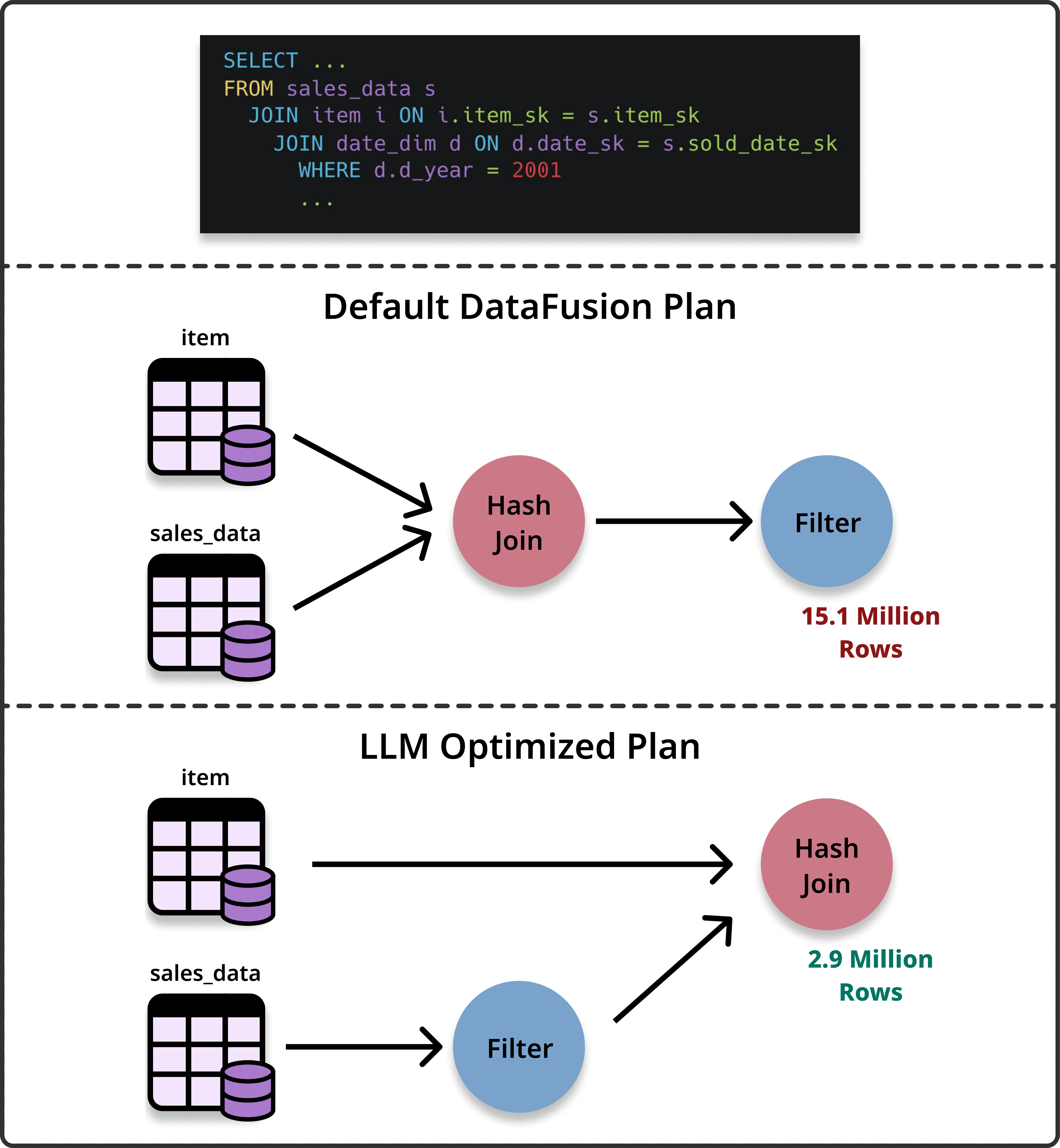
Semantic-aware join optimization. By pushing the selective `date` filter earlier, the LLM reorders the plan so the sales fact table is pruned from 15.1M to 2.9M rows before the join, yielding a much faster query.

Is query optimization a solved problem?

The persistence of these estimation errors shows that physical planning is not a solved problem, particularly for complex OLAP workloads where functional dependencies are common.

To address this, we introduce DBPlanBench, a harness that exposes the query execution process of the Apache DataFusion engine. This system exposes the internal physical operator graph, including join strategies and partitioning schemes, to an LLM. The primary technical challenge here is the information density inherent in raw physical plans, which contain verbose file paths, partition metadata, and type encodings that fill up the context window quickly.

Without careful serialization, the entire plan can exceed 2M characters, making it impossible for LLMs to reason over the inputs effectively and efficiently. Our harness implements a serialization layer that traverses the engine's physical operator graph and maps heterogeneous objects into a unified, token-efficient JSON schema.
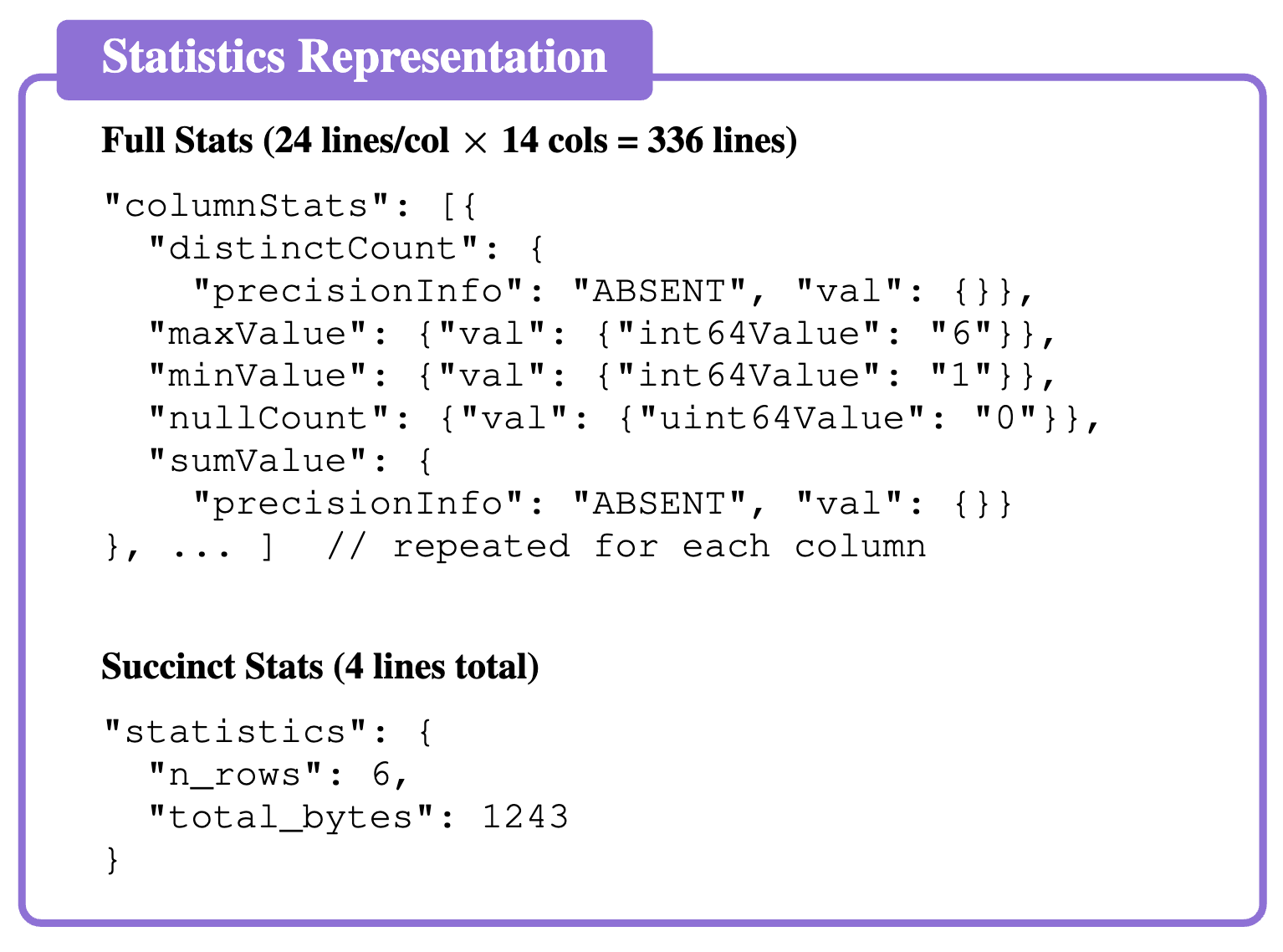
An illustrative snippet of compressing engine statistics for a single table. The full JSON includes many execution-irrelevant fields (e.g., `precisionInfo`, per-column min/max and null counts), while the succinct stats keep only the main signals such as `n_rows` and `total_bytes`.

This representation deduplicates file-level statistics and removes execution-irrelevant fields, resulting in a payload approximately 10x smaller than the native serialization.

DBPlanBench thereby converts the optimization task from a statistical computation into a semantic reasoning problem, in which the LLM analyzes the plan's topology to identify logical flaws in join ordering.
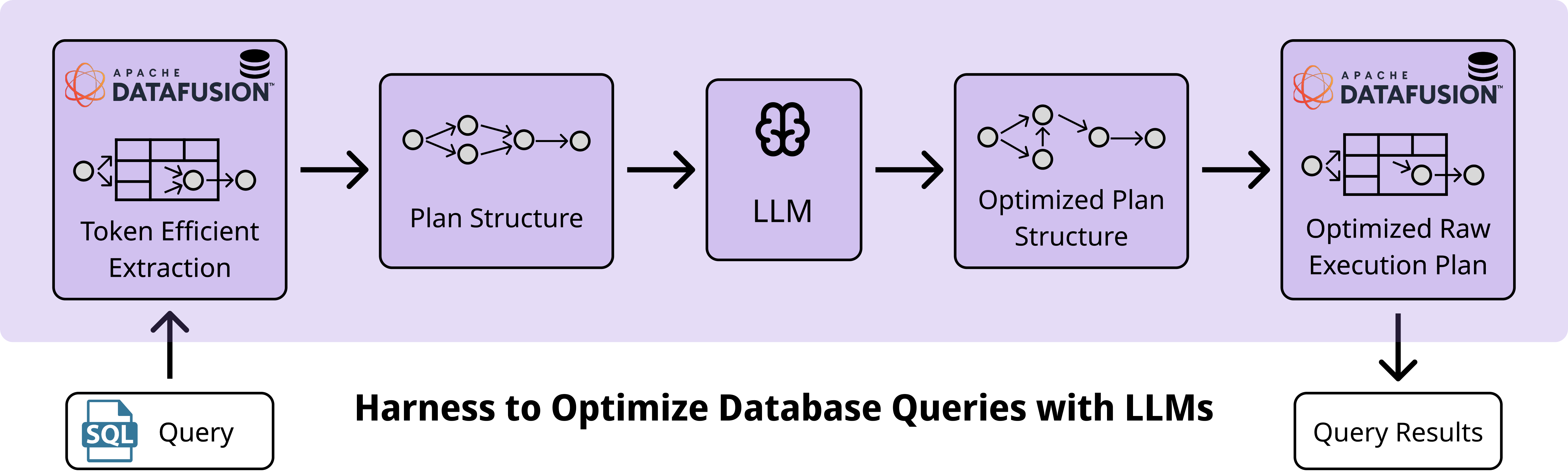
Our optimization harness to optimize physical plans inside DataFusion.

To implement these fixes safely, we instruct the LLM to avoid regenerating an entire physical plan from scratch; instead, it applies targeted edits to DataFusion’s existing physical plan, reducing the risk of syntax errors or invalid plan topology. Concretely, the LLM generates JSON Patches (RFC 6902) that describe localized edits, such as swapping join sides or reordering nodes. These patches are orders of magnitude smaller than the full plan and are applied directly to the serialized graph, ensuring the structural integrity of the execution DAG.
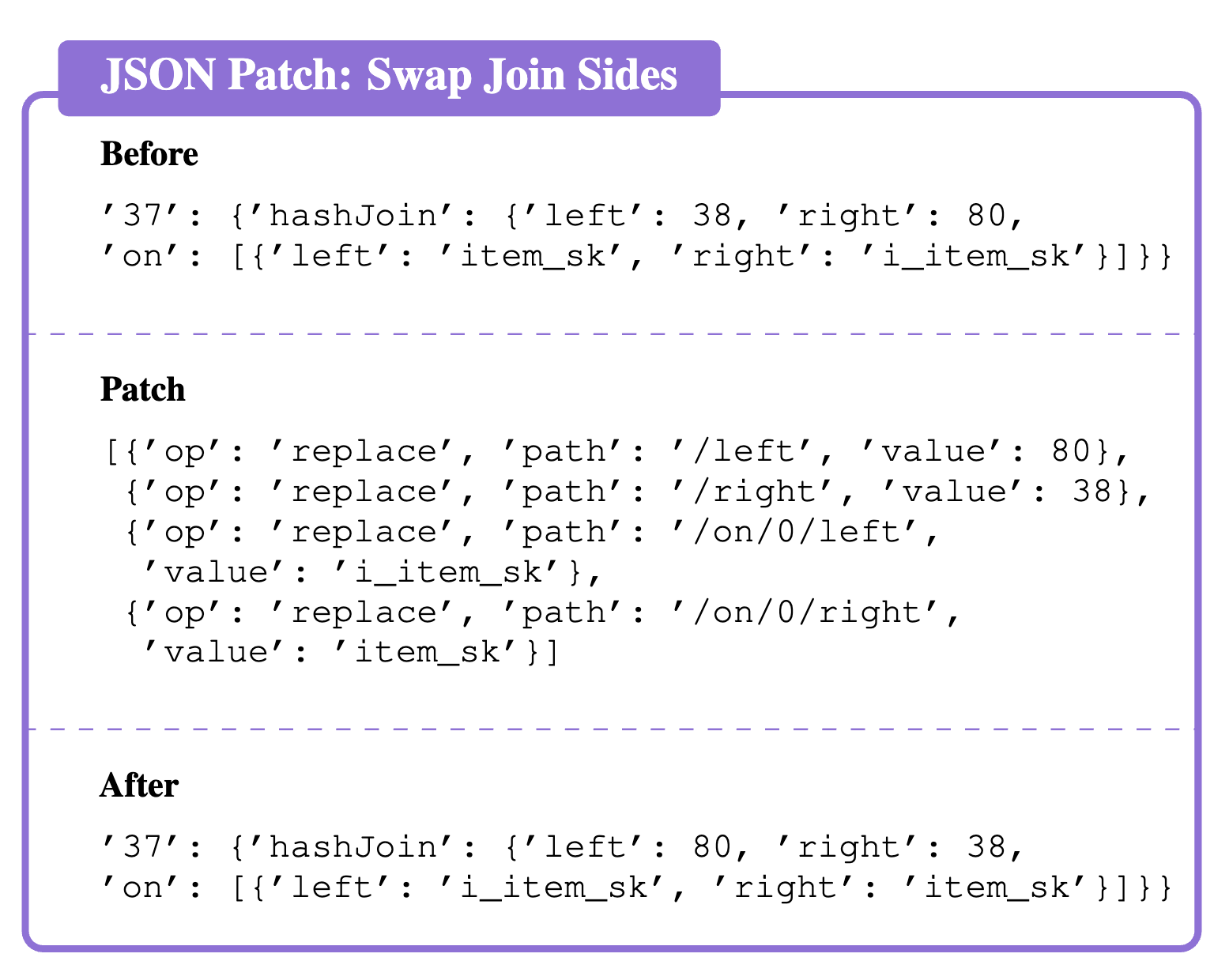
Example JSON Patch that swaps the left and right inputs of a hashJoin, updating both child IDs and join keys. It illustrates how a small, localized patch can rewrite a join (e.g., to put the smaller table on the build side) without regenerating the whole plan.

A case study

The consequences of statistical estimation failures are measurable in both query latency and system resource consumption. In a specific query generated from a derived version of TPC-DS involving cross-channel sales, the default DataFusion optimizer prioritized joining a smaller item table (36K rows) before a larger date dimension table (73K rows), assuming the smaller join was cheaper. This heuristic failed to account for the high selectivity of the filter d_year=2001 on the date dimension. The LLM-optimized plan inverted this order, applying the date filter early to prune the sales fact table from 15.1 million rows to 2.9 million rows before subsequent joins.

This structural optimization resulted in a 4.78x speedup for the query. More significantly, the resource footprint decreased drastically. The optimized plan reduced the aggregate hash-table build time from 10.16 seconds to 0.41 seconds and slashed total build memory usage from 3.3 GB to 411 MB. The experiments showed that, on generated query workloads for TPC-H and TPC-DS, the median speedups hovered around 1.1x to 1.2x, and the method also delivered much larger gains on some complex multi-join queries, for example, speedups of up to 4.78×, with several others in the 1.5-1.7x range.

Evolutionary plan patching

We evolve query plans through iterative refinement. The system generates candidate improvements (via JSON patches) using GPT-5, validates each change, and keeps patches that reduce latency. Once these patches are applied, the system tries again to generate new candidates starting from the new plans. By building on successful optimizations across multiple steps, this evolutionary approach achieves better speedups than simply sampling many plans independently.

Not all queries can be effectively optimized, as the plans might already be optimal, but we find that in our sampled datasets, 60.8% of those queries could be optimized by more than 5%. The following figure shows the improvements on one of our derived datasets:
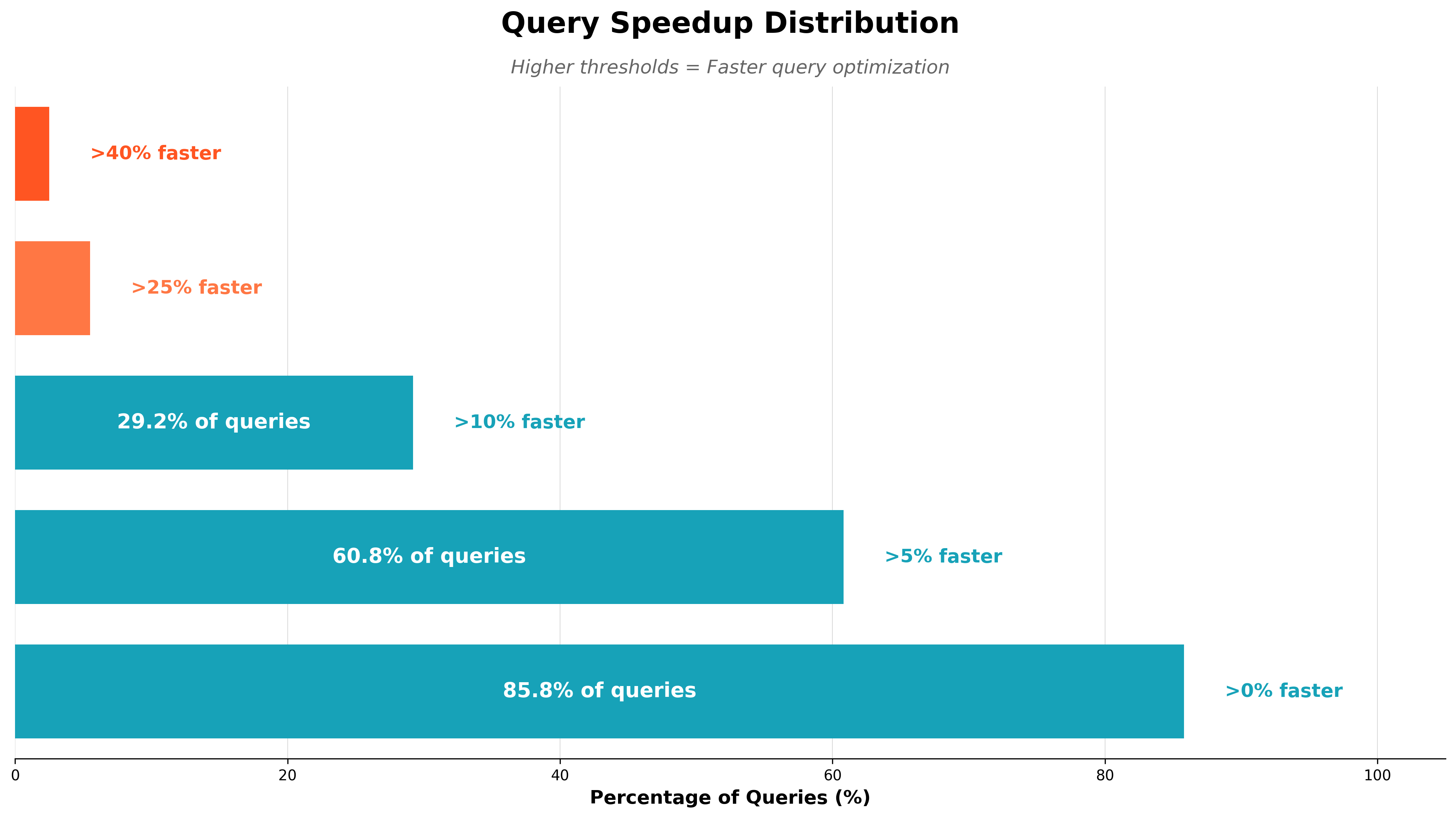
Speedup distribution on one of the tested datasets (120 queries). While we can optimize a larger portion of queries, it’s interesting that we can optimize ~30% of the queries to have a speedup of more than 10%.

Transferring speedups across scale factors

The benchmarks we use expose a scale factor parameter that scales table cardinalities while keeping the underlying schema fixed. In practice, this lets us build a smaller prototype database (e.g., Scale Factor 3, or SF3) and a larger production-like database (e.g., SF10) that share the same structure but differ only in size.

Because exploring many candidate plans on full-scale data is expensive (each step requires executing the query plus paying and waiting for LLM-generated patches), we first discover good optimized plans on SF3 using evolutionary search. For each query, we then transfer the best SF3 plan to SF10 using a deterministic, rule-based script. This script matches scan operators across scales via normalized schema / projection / predicate signatures and rewrites the SF3 optimized plan into a runnable SF10 plan, preserving structural edits such as join reorderings and join-side swaps while enforcing safety checks (e.g., no dangling references, valid DAG topology).

Empirically, every optimized plan we selected at SF3 could be successfully transferred to SF10, and the resulting speedups closely tracked the original ones. This validates a practical “optimize small, deploy large” workflow: run the expensive search once on a compact replica of the workload, then lift the resulting plans to larger production databases with minimal additional engineering effort.
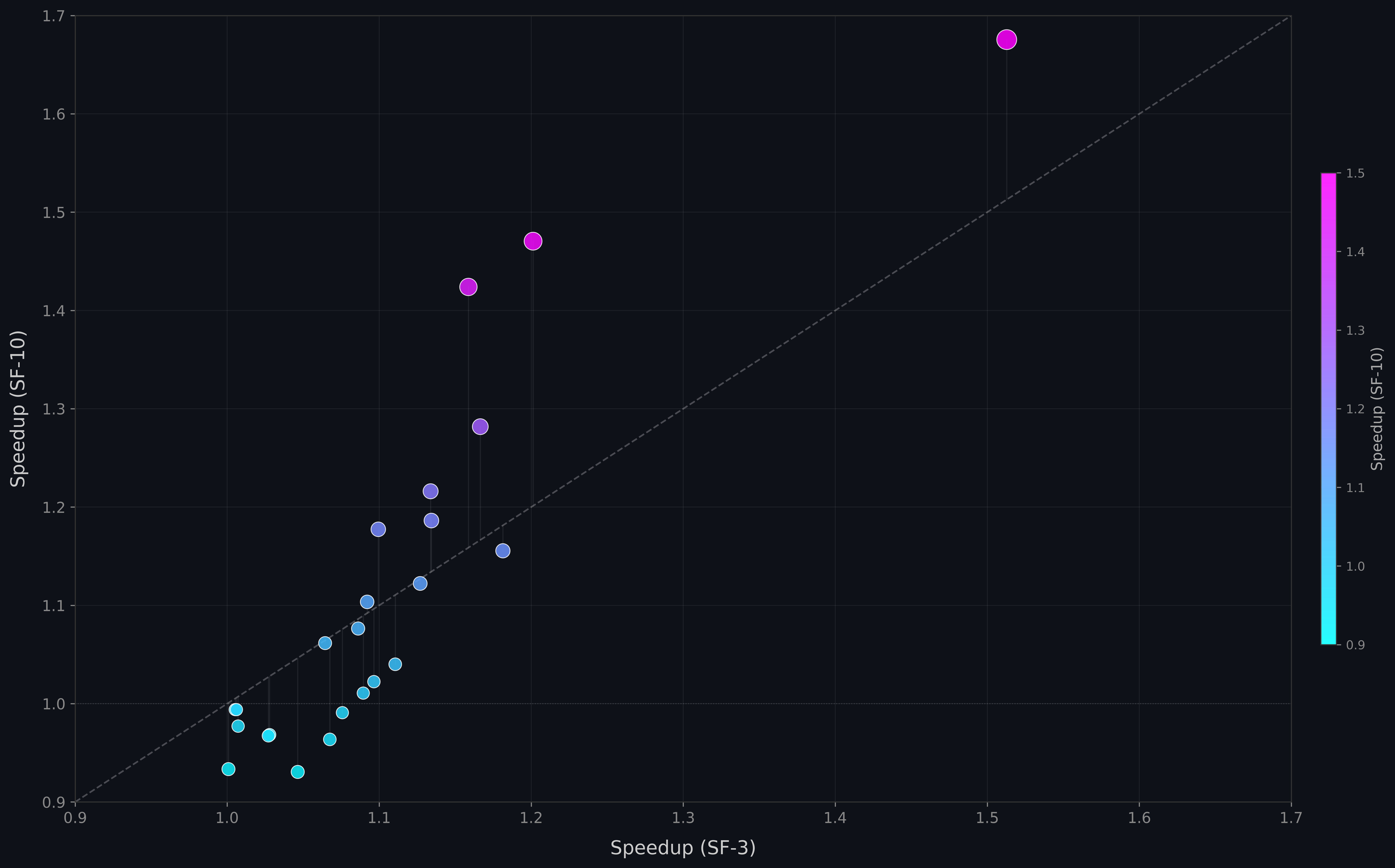
Scatter plot comparing Speedup SF-3 and SF-10 with color and size indicating Speedup SF-10 values.

Speedups found on the small SF3 databases largely carry over to the larger SF10 ones. Each point is a query, comparing its speedup at SF3 (x-axis) and SF10 (y-axis).

Conclusion

DBPlanBench establishes that LLMs can effectively function as semantic cardinality estimators to correct physical plan errors that statistical heuristics miss. By combining compact plan serialization with evolutionary patch search, the system achieves significant reductions in execution time and memory pressure without requiring changes to the core database engine. The harness and code are released as open-source for further research.

References

Lohman, G. Is query optimization a “solved” problem? ACM SIGMOD Blog, April 2014. URL: https://wp.sigmod.org/?p=1075. Accessed: 2026-01-26.