






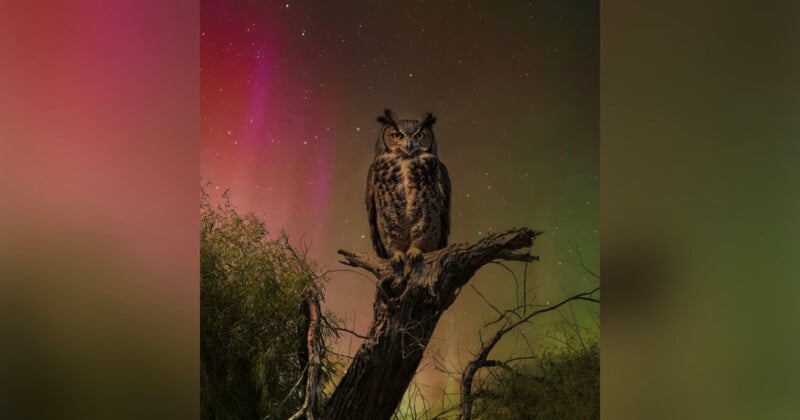
Yet another photo contest has attracted significant attention in the online photography community for all the wrong reasons. The winning photo in the National Wildlife Federation’s (NWF) recent Garden for Wildlife Photo Contest was disqualified following public outcry. However, the NWF and photographers disagree on why the winning photo violated competition rules.
The winning photo, shown in a screenshot below, drew immediate negative reaction and skepticism when the National Wildlife Federation shared the photo contest winners on its Instagram page.
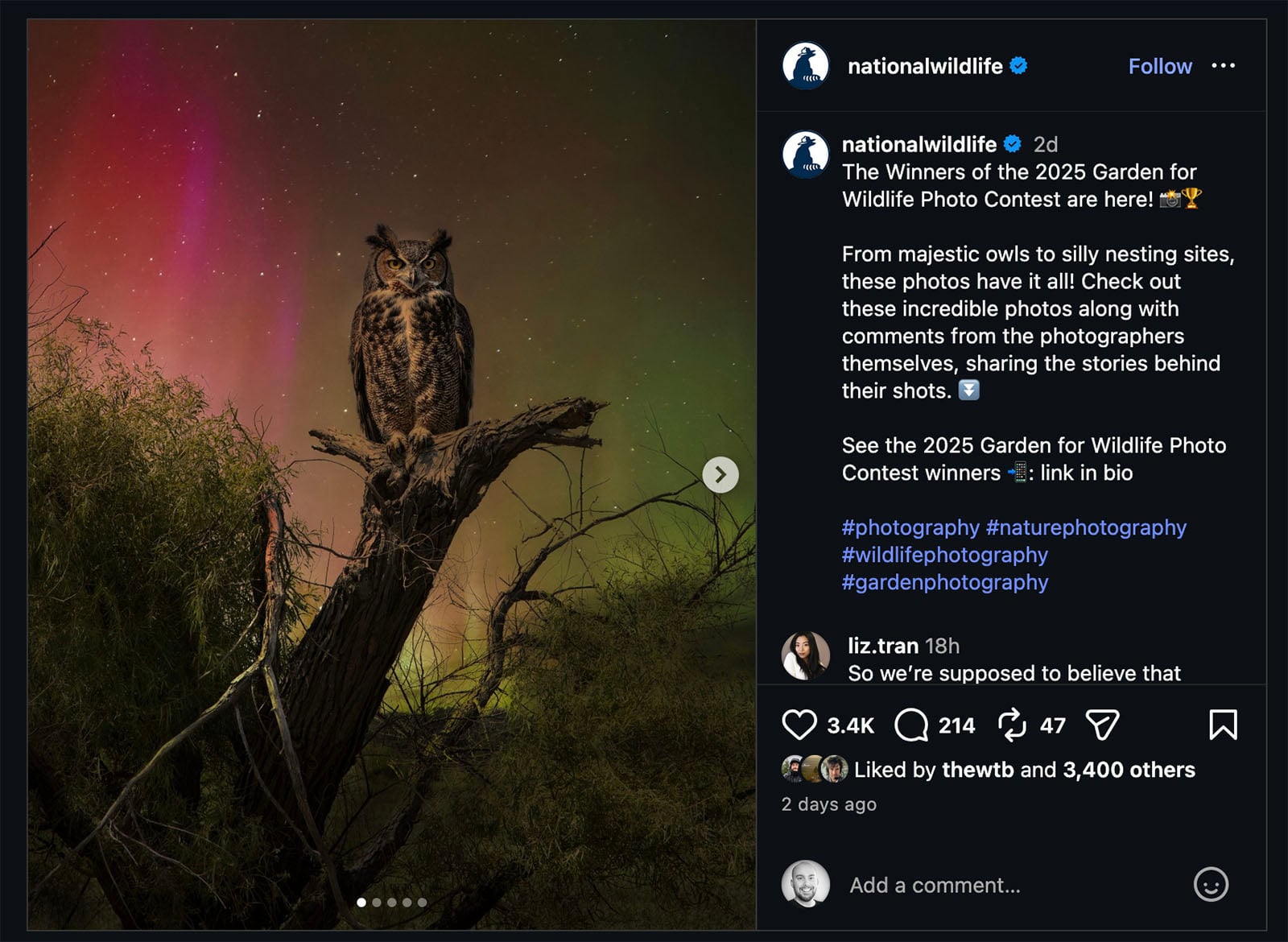
Many photographers and nearly all of the commenters on NWF’s post accused the winning photographer, Kellie Carter, of using AI to create the winning shot.
Photographer Liz Tran quickly attacked the plausibility of the winning photo.
“So we’re supposed to believe that the grand prize winner had red auroras in Pawhuska, Oklahoma in June 2025?! Auroras strong enough for a single exposure shot where the owl isn’t moving at all…” Tran commented on Instagram.
As Tran tells PetaPixel, and NWF separately says it verified, there was a G4 geomagnetic storm that could have caused auroras over northern Oklahoma, where Carter allegedly took the shot. However, Tran, an expert nature photographer with extensive experience photographing auroras and owls, coincidentally, says it is extremely unlikely that Carter’s image is possible.
“With the Great Horned Owl photo, even with minimal critical thinking you can see that it doesn’t make sense and even more so when you read the photo description. There was a G4 geomagnetic storm in June 2025 that would have made auroras in northern Oklahoma possible but it would require a minimum of a 10-second exposure with a f/2.8 or faster lens. So it just would not be possible to capture the aurora and the owl in a single exposure at the time, place, and with the lens this person claims to have taken it,” Tran tells PetaPixel.
Supposing for a moment that the photo is a composite of real shots that Carter took, and no AI was used at all, that would still be a disqualifying factor as composites are not allowed. Neither are AI-generated images, for that matter. Entrants must be single, “camera-made digital images.” Composites are strictly forbidden, and NWF says this is why Carter’s photo was ultimately disqualified.
But was the former winner actually a composite, or was it AI?
“You have professional bird photographers and worldwide respected guides telling you this is 100% AI… probably a decent idea to at least consider the reality,” said OM System Ambassador and professional bird photographer Ben Knoot.
“Credibility totally lost for the organization,” added Nikon Ambassador Jenny Wong.
As Wong tells PetaPixel, contests are a “breeding ground” for “bad morals and ethics.”
“AI generated images is not only not photography; its existence for generating images and videos is destroying the nature that we love and advocate to protect. There’s always going to be bad actors out there be it baiting, wildlife harassment, or AI generated images — when confronted with these accusations it should be investigated immediately. This would have been a great opportunity for NWF to take accountability and share the story of how they got bamboozled, shine light on the dangers of AI and the impacts of such technology on nature and the data center projects they are against,” Wong says.
As MIT explained last year, generative AI technology poses dire risks for the environment.
Again, National Wildlife Federation maintains that the winner was disqualified because it was a composite, not because the image was AI-generated.
Liz Tran isn’t convinced.
“Witnessing a very obviously AI generated photo win a national nature photography competition is disheartening for multiple reasons. Firstly, I would hope that the NWF would know what Great Horned Owl feet look like and that it would raise enough suspicion to request a RAW file for prize verification. Secondly, the ethics of nature photography would never allow for AI usage in image generation or manipulation because of the environmental impact of AI,” Tran tells PetaPixel.
Regarding the RAW file comment, NWF does not require RAW photos for its photo contests, citing a desire to keep them accessible to more photographers, including those who don’t use cameras with RAW capture capabilities. While hardcore photographers may very well scoff at such a thing, it is true that some cameras, like cheaper point-and-shoots and older smartphones, don’t offer RAW.
That doesn’t address the other concerns, though.
“No chance the owl would be that sharp in a real long exposure photo. And where is the lighting coming from? The website says this photo was supposedly taken in Oklahoma. Even during the most severe geomagnetic storms, green columns of aurora are not visible that far south, as the green is the lowest color and would be hidden behind the curvature of the earth. Only a faint green at the base of the red curtains would be possible,” comments whale acoustics expert and wildlife photographer Nicole Schriber.
”Anatomically impossible for an owl to have all four talons of one foot facing forward. And that’s the least of my concerns with this image,” adds Gerry Scully.
“Those definitely aren’t Great Horned Owl feet… I have no idea whose they are, but they’re gonna want those back,” comments Amanda’s Nature Photography.
While it is difficult to prove beyond a shadow of a doubt that the image is AI-generated, at least in part, there are plenty of other reasons to believe Carter could have entered an AI image into a photo contest. Numerous experienced photographers are confident she has done it before, including with another NWF contest.
Carter had previously entered a different NWF photo contest. Although the page has since been deleted, Wong sent a screenshot to PetaPixel showing an impossible “photo.”
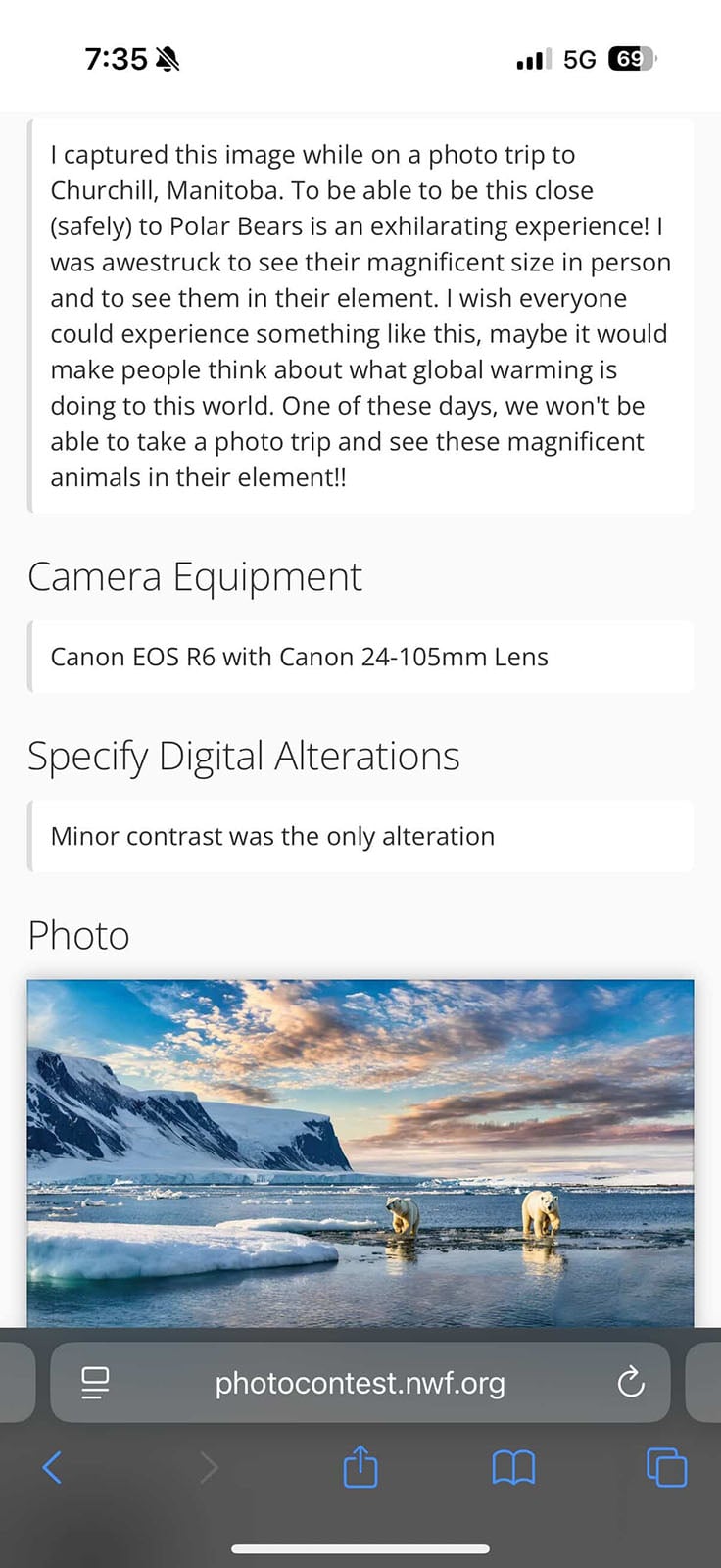
“This is not Churchill and clearly both the image and the caption was created with AI,” Wong says. She would know.
Wong sent through another dubious photo that Carter has entered into a photo contest.
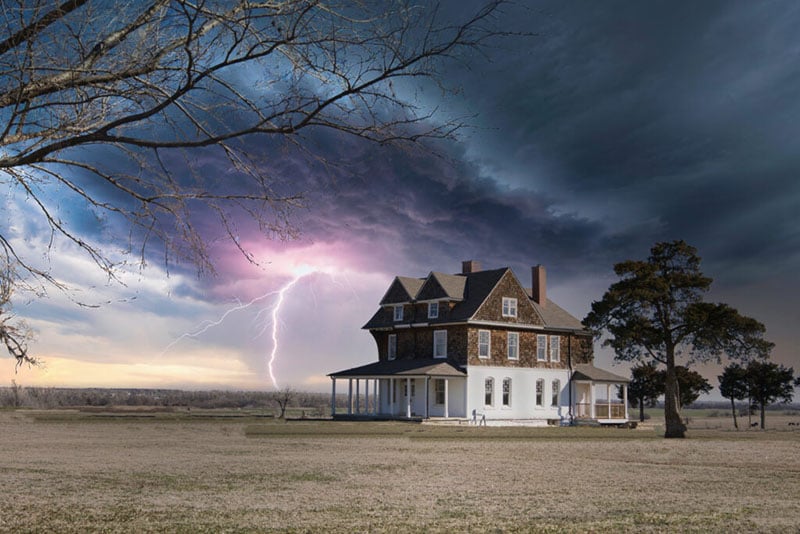
This photo won the Weather category in 405 Magazine‘s The Great Local Photography Contest in 2023.
“This intense February storm was rolling by Fort Reno when I captured this amazing bolt of lightning. The storm stayed just north of us, which let the sun bring out all of the intense colors in the clouds. I used my Canon R6 and Canon 24-105mm R series lens to capture the image,” Carter said.
It, frankly, looks implausible. Just like the owl photo that initially won NWF’s recent contest, and just like the polar bear photo up above that NWF has since removed from its website.
“Also the lens and camera is always the same — she claims to have used the 24-105 with the polar bear image and the aurora image with owl,” Wong adds.
An RF 24-105mm f/4 isn’t exactly a go-to wildlife lens, and certainly an unlikely candidate to take a night photo of a great horned owl.
Liz Tran had other suspicious examples to share, all images that Carter won photo contest awards with.

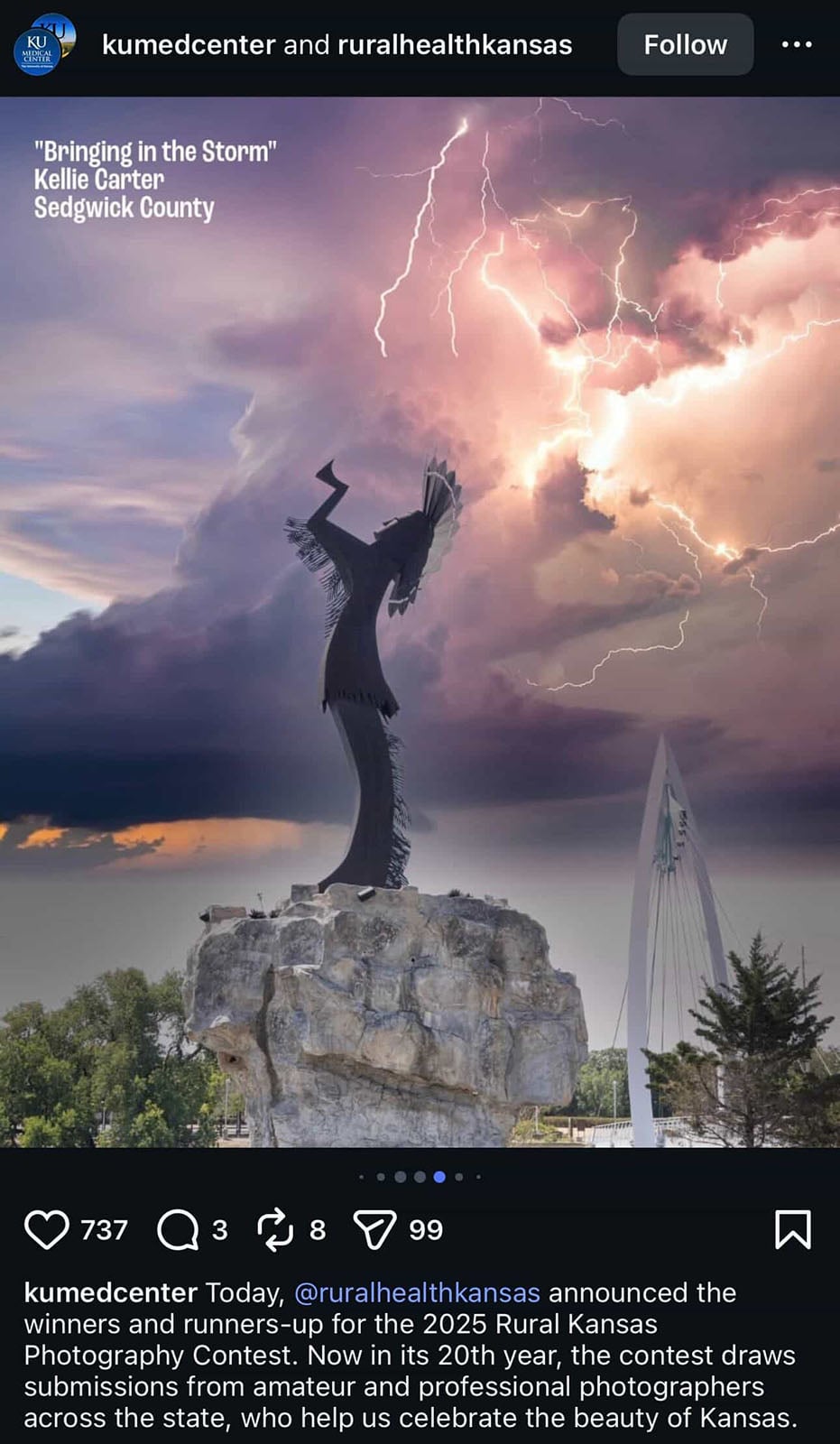
In fact, Carter’s only real online presence is through photo contests like the ones above. It’s weird for a photographer not to have an online presence in this day and age. That alone isn’t proof of wrongdoing, of course, but its oddness takes on a greater meaning in the overall context. It also means there’s no way to contact Carter for an explanation.
But there’s more to the story than the winning owl photo that many experienced photographers don’t believe. There’s also NWF’s initial response to the outcry, which left a lot to be desired.
After dozens of comments accused Carter of using AI, NWF commented a couple of times on Instagram with jokes. ”We love owl the attention to detail, but we do not allow AI generated images in our photo contest,” NWF said in a now-deleted comment.
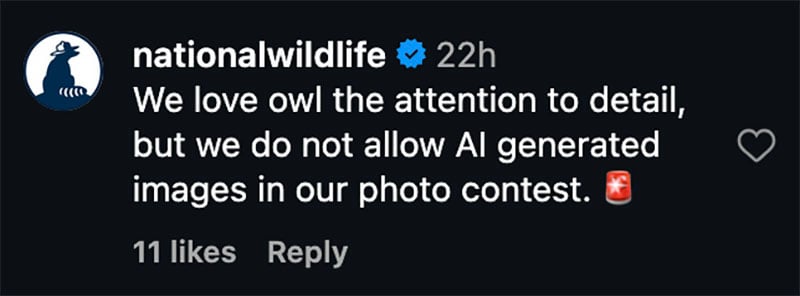
In direct response to someone who again remarked on Carter’s photo being generated by AI, NWF replied, “No AI here, just T(Al)ented photographers!”
Although NWF tells PetaPixel that upsetting people was “certainly not the intent,” it is a bad look to reply to legitimate concerns with puns. It is dismissive.
NWF maintains that ultimately, its “actions and swift response to the feedback speaks for itself on how seriously we took folks’ comments.”
”We are deeply appreciative of the public engagement and people’s concerns about the image,” NWF continues.
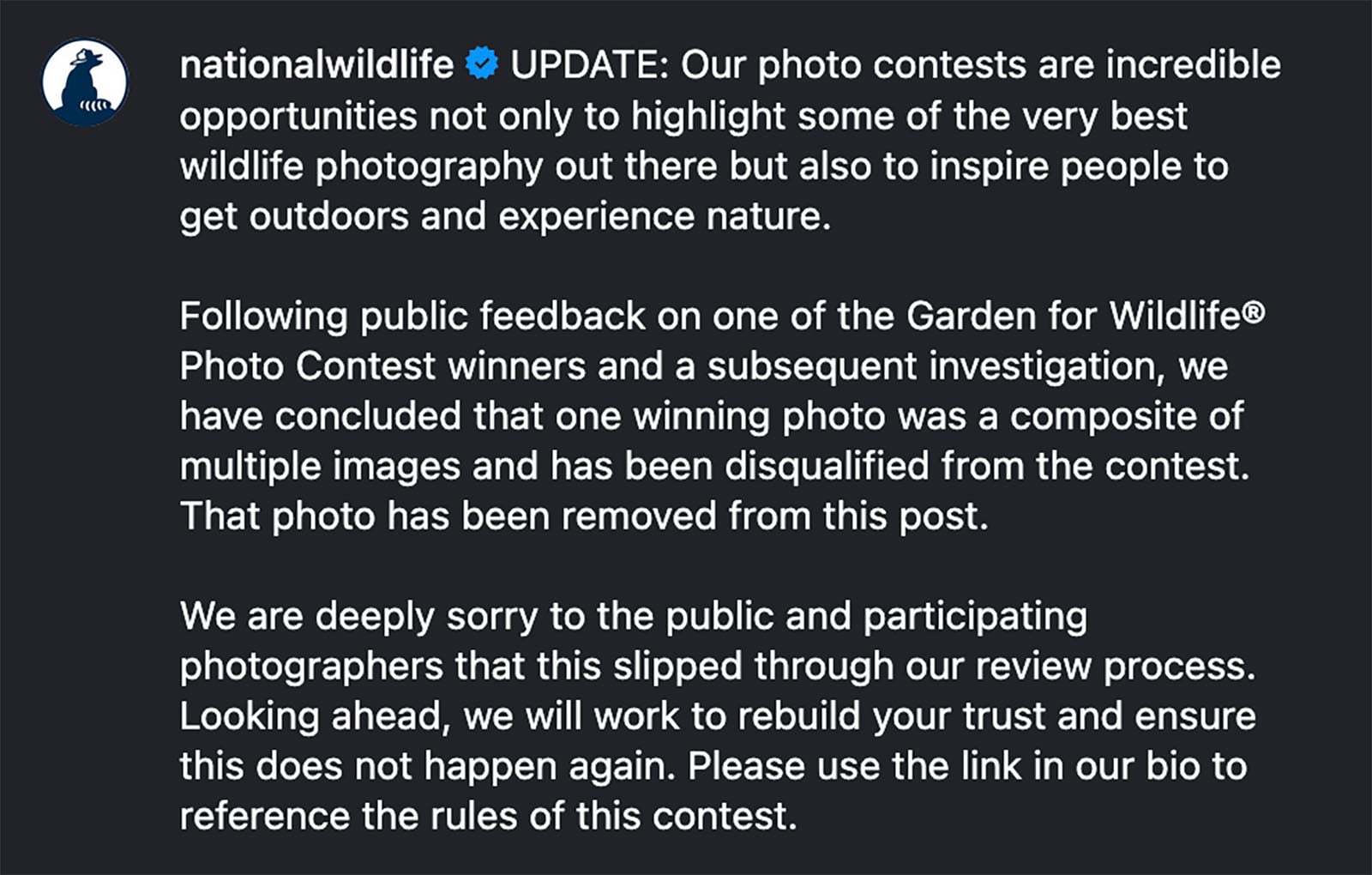
“The National Wildlife Federation’s photo contests are incredible opportunities to not only highlight some of the very best wildlife photography out there, but also inspire people to get outdoors and experience nature,” NWF says.
“Following multiple comments on one of the Garden for Wildlife® Photo Contest winners post and a subsequent investigation, we have concluded that the winning photo was a composite of multiple images and has been disqualified from the contest. We reached this conclusion after contacting the photographer and comparing the photo they submitted to the contest and with other photos and information they provided.
“Not all photographers shoot in RAW format, so we used a combination of the metadata in the submission and information gathered in our subsequent investigation to reach the composite conclusion.
“We are deeply sorry to the public and participating photographers that this slipped through our initial review process. We will be in touch with the other entrants to rectify the situation. We also will make additional changes to future contest procedures to prevent this from happening again and to rebuild trust.”
While it is not yet clear what these changes to future contest procedures will be, NWF confirmed that it has contacted the competition’s runner-up to let them know that they have now won the grand prize, which matters quite a lot because it came with a $1,000 cash prize.
As for whether or not NWF will be able to get the $1,000 it already awarded to Carter back is unknown, but photographer Nicole Land is now the grand prize winner for her close-up shot of a yellow garden spider.
There is another factor to consider, entering the NWF’s Garden for Wildlife photo contest isn’t free. Photographers can enter 10 photos for $15, 15 photos for $20, or up to 20 shots for $25, which also comes with a one-year digital subscription to NWF’s National Wildlife magazine. At least for a little while, photographers had paid money to get cheated.
It’s good that the National Wildlife Federation did ultimately investigate Carter’s winning image and disqualified it. It obviously violates the rules, one way or another. It’s either a composite or, much more likely, partially AI-generated. However, it’s puzzling that it even reached that stage of the judging process. With so many photographers being instantly skeptical of the shot as soon as they saw it, it’s interesting that it didn’t set off any alarm bells at NWF before the prizes were determined. But even major photography contests get bamboozled, as Sony and Hasselblad know.
And, of course, sometimes photos that people think are AI are actually not. It is happening more and more lately, as people start to conclude that anything that seems a little unusual isn’t real.
However, that doesn’t mean that an appropriate response to photographers raising concerns about potential AI use is to make light of it. The National Wildlife Federation wound up in the right place in the end, and that matters. But everything else matters, too. When experienced photographers who care deeply about their craft make noise, the only correct response is to listen and take it to heart, rather than double down using wordplay. Evoto learned that lesson earlier this year.
“Photo contests can be a breeding ground bad morals and ethics of which nature pays the price. This isn’t new, there’s been many questionable images that have won in years and gained so much notoriety it inspires copycats. It’s the photo community at large that often force accountability,” Jenny Wong tells PetaPixel.
That’s certainly what happened here. It was photographers who got this wrong righted, even if took a little time.
It’s not a matter of if something like this happens again in a photo contest, but when.
PetaPixel could only find evidence of Kellie Carter through photo contests they had entered, none of which included links to an online portfolio or usernames for social media accounts, so Carter could not be reached for comment.
此内容由惯性聚合(RSS阅读器)自动聚合整理,仅供阅读参考。 原文来自 — 版权归原作者所有。