








Two things are true about the new Stanford hiring study: the finding everyone quotes is real, and much of the commentary around it seems to have stopped at the abstract.
That gap is how a narrow result about one badly built tool turned into a verdict on the whole industry and a new way for career influencers to farm job-seeker panic.
The viral Stanford paper (Algorithmic Monocultures in Hiring) is real research and worth reading, but it studied one narrow, game-based tool called pymetrics, not "AI hiring" as a whole. Most of the panic comes from people generalizing one vendor into an entire industry.
The one finding worth keeping: company-wide fairness audits can look clean while individual jobs discriminate. Pooled together, pymetrics passed the usual adverse-impact screen, but split into 1,746 positions, ~11% worked against Black applicants. If you audit hiring only at the company level, you should change it!
The scary "rejected everywhere" story barely exists in the data. 84% of applicants applied to just one position; only 0.02% applied to ten. When the authors directly simulated the nightmare, not one person was rejected by every model.
The tool itself is the real story. pymetrics trains on a company's current employees as "good" and random profiles as "bad", so it learns who resembles the existing staff, not who can do the job. And there's no evidence in the study that it predicts performance at all. It's biased and unvalidated.
The authors admit nearly all of this in the limitations section. The research was careful and hedged. What wasn't careful was the chain that turned it into "AI is rejecting you everywhere", every step dropped a qualifier the authors put there on purpose.
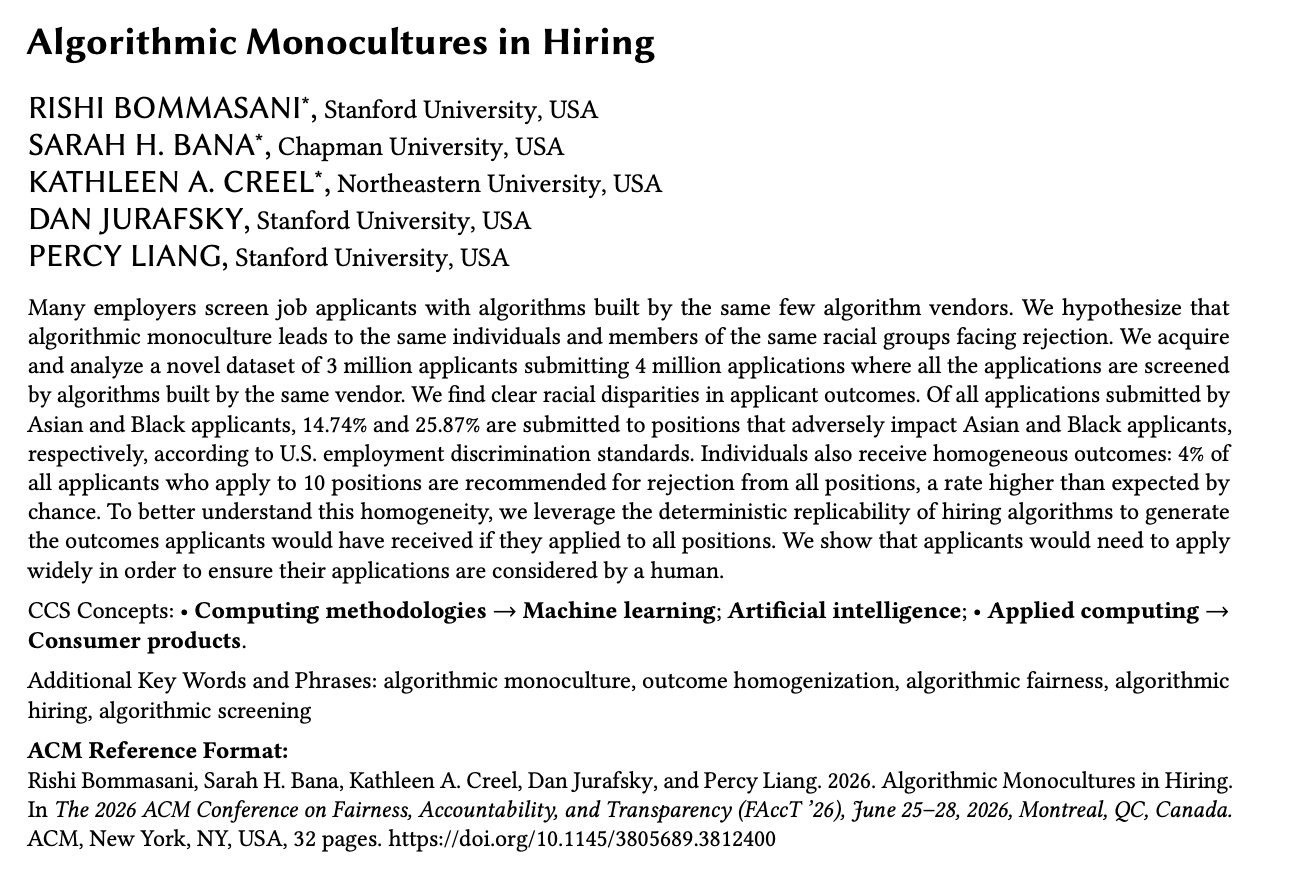
The paper in question: Algorithmic Monocultures in Hiring (FAccT 2026).
The research paper is called Algorithmic Monocultures in Hiring. Its core idea is the concept of "monoculture": if every employer runs candidates through the same handful of AI vendors, then one biased model doesn't just hurt you at one company, it locks you out everywhere at once. Reasonable worry, and as it turns out, reasonable doubts.
To study it, the researchers got four years of real hiring data from a single vendor and checked whether the same people and the same racial groups, kept getting filtered out.
So far, so good. Then you find out which vendor.

Resemble the people already hired, or don't. That's the entire science.
It looks at vendor named pymetrics. Not résumés and not an applicant tracking system.
pymetrics is a tool where you play games. Yes, games. You play 12 to 16 of them that supposedly measure things like risk-taking, processing speed, planning. 12 of those games are the same whether you're applying to a warehouse or a finance desk.
A model scores your gameplay and spits out one of two words: "recommend" or "do not recommend” (why companies pay for that?). That's it. Oh, and about 42% of the time, it says "do not recommend”.
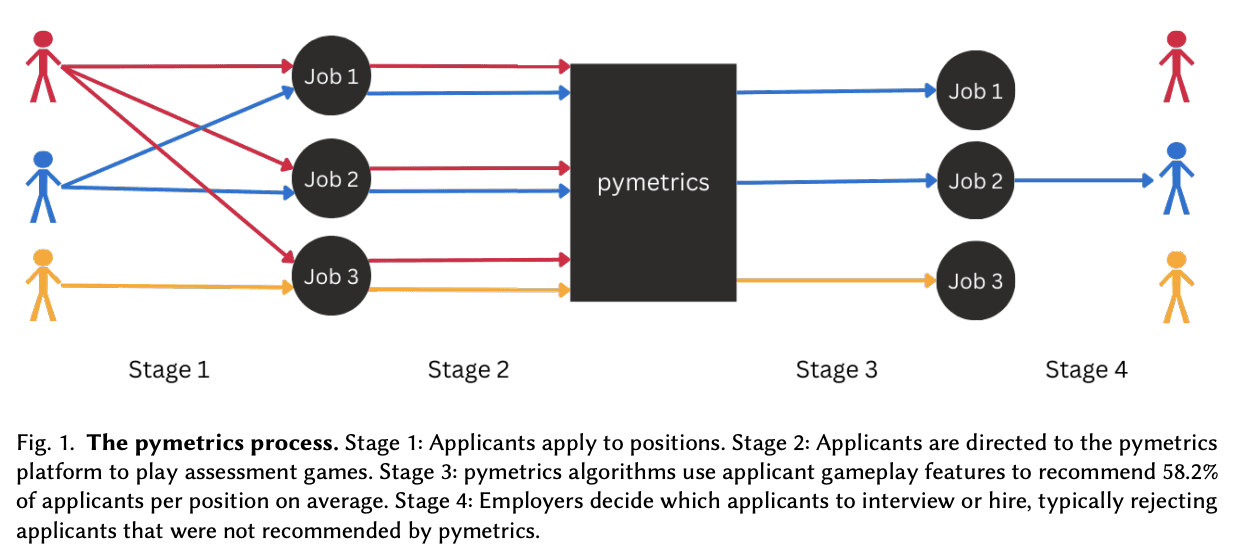
pymetrics process authors describe in the paper
For each company, the model is trained on at least 50 of that company's current employees as the examples of "good" and random people as "bad". No, the "good" group isn't top performers.
It's whoever currently holds the job. At least in this study, nothing shows those incumbents were actually strong performers.
And the "bad" group isn't people who failed the role, or got fired, or underperformed. It's random strangers.
So the model never learns the thing you'd actually want like what separates a strong hire from a weak one for your organization. It learns something far dumber: do you look like the people already on the payroll or do you look like a random person off the street?
As a bonus, your score even gets cached for 330 days. Apply elsewhere within the year and you're often judged on the same saved gameplay, twice. Yay!
But hey, at least the dataset is genuinely big: 4.2 million applications, 3.4 million people and 156 employers.
pymetrics had previously checked its own fairness by pooling every applicant together. Pooled like that, it passed the usual adverse-impact screen. Black applicants passed at 52.5%, white at 58.3%. The researchers correctly pointed out that this is the wrong way to validate a selection tool.
US employment law (Title VII) evaluates each job separately, not the company-wide blend. So they split the data into 1,746 positions and looked again. Bias the average had hidden showed up: roughly 11% of jobs worked against Black applicants (10.6% after statistical correction), and about a quarter of Black applications landed in those jobs.
This is the contribution, and it's a good one. Averages can hide discrimination. If you only audit your hiring at the company level, this is definitely something to consider. Good takeaway, worth keeping.
So, good, but…
it raises a data-governance question worth flagging for anyone buying these tools.
In standard corporate compliance, official Equal Employment Opportunity Commission (EEOC) data is strictly firewalled. It is completely optional for candidates and sits in an isolated repository that legally cannot feed into automated assessment engines or decision-making tools.
So what's the race data doing inside the assessment vendor's dataset, mapped to scores across 156 employers?

provided by the authors of the research paper
The answer is mundane, and that's the point. It's voluntary self-ID, collected by pymetrics. Only 40% of applicants gave it and each employer chooses whether to let the vendor collect it at all. All legal. All standard. And a completely different stream from the protected EEO-1 filing.
To sum it up, your candidates are handing demographic data to a third party, on a screen you don't control, governed by a setting your procurement team probably never reviewed.
Is the vendor doing anything illegal? No. Is your company-level compliance audit ever going to see this? Also no. Well - yay?
Now the problems with the paper.
The whole paper is built on a word: MONOCULTURE. The idea that everyone gets funneled through the same dominant system, so one biased model poisons the whole market.
To make that sound real and scary, the opening cites HireVue: used by over 60% of the Fortune 100 and 8 of the 10 biggest federal agencies. Frightening number, right?
Except they didn't study HireVue. They studied pymetrics. A different, much smaller company. A competitor. HireVue is a different product category: structured interviews and job previews, methods that can be scientifically valid when properly designed. But this paper doesn't test HireVue's version of them, so I won't pretend it validates them either. pymetrics does games.
And nobody ever explains how those Fortune 100 companies actually use HireVue. It may be one stage in a process that also has structured interviews, work samples, reference checks.
Researcher's own results section admits the scary version of monoculture - the same model judging you at multiple companies - happens in, their words, "rare instances" with "limited" impact, "because very few applicants apply to positions at different employers served by the same underlying pymetrics model".
So they switch to studying a weaker, looser definition instead. The headline concept barely shows up in the data. They led with HireVue's scale to make it sound everywhere but their own numbers say it isn't.
Look at their own numbers. 84% of applicants applied to exactly one position. Over 95% applied to one or two. Exactly 522 people - 0.02% - applied to ten. The "rejected everywhere" nightmare needs you to apply widely through the same vendor. Almost nobody did.
The flagship "apply to 10, rejected from 10" stat is pulled from a sliver of the data so thin you could miss it and to make the effect look bigger, they had to simulate a world where people applied far more broadly than they actually do.
The mechanism is there, but thin in the data they actually have (and note: this dataset only sees pymetrics-mediated applications. Someone might apply to thirty jobs and hit pymetrics once. So even "applied once" understates how rarely the same-vendor trap could spring).
"But people mass-apply now," you might say. True. And it cuts against the paper. Their data ends in 2022, before the AI-application surge. More to the point, that surge runs on frictionlessness: one-click apply, keyword filters and résumés fired off by the hundred.
You cannot one-click through 16 behavioral games. Their own data shows it. Applicants averaged 1.24 applications. Nobody was grinding through pymetrics at scale, because the format makes it impossible. The mass-apply era floods a different system than the one the study measured.
To show the rejections cluster because of the shared algorithm and not just normal hiring, the paper needs something to compare against. A world with no single shared algorithm.
They use an older study: Kline et al. (2022), 83,000 résumés sent to 108 big US companies. In that data, rejections look independent, like separate decisions by separate companies. In pymetrics, they clump together. So, the paper says, the algorithm must be the cause.
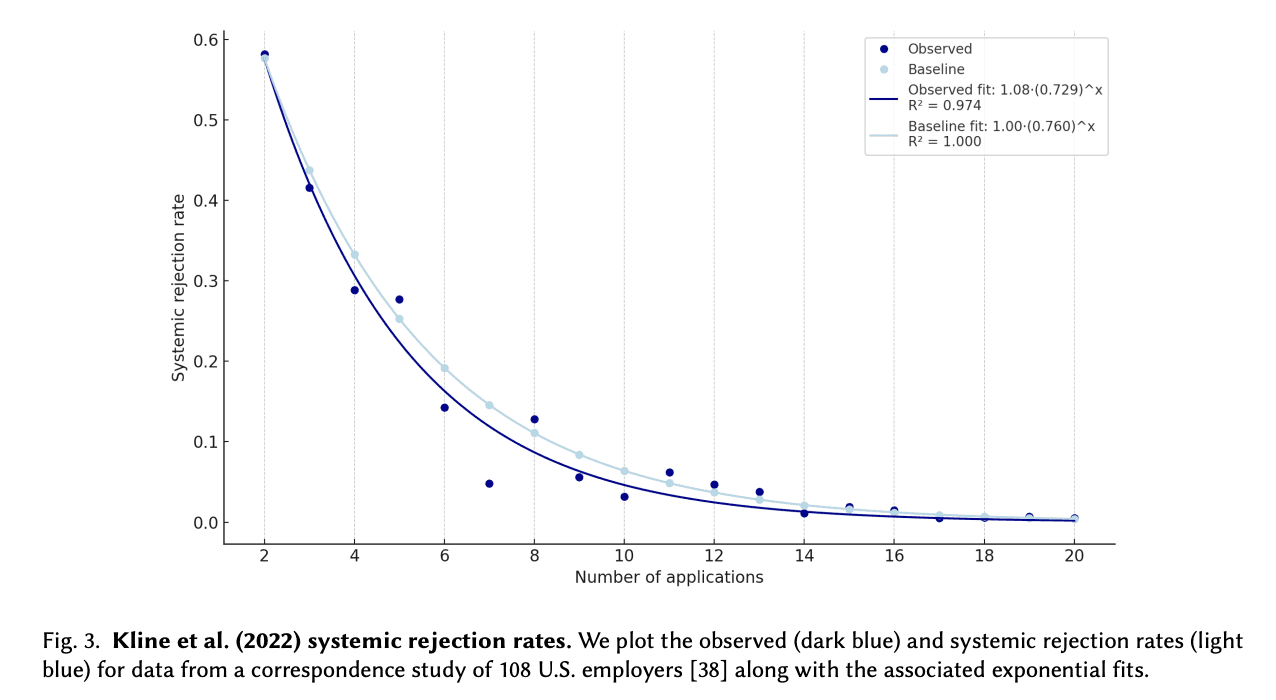
This is the "normal hiring" benchmark - human screening at 108 companies. The dots that actually happened (dark) sit almost exactly on the dots you'd expect if every employer decided on their own (light).
Nice story. The catch: the two datasets barely look alike, and the paper admits it.
In the Kline study, about 23–25% of résumés got a callback. In pymetrics, about 50% "pass"
Kline only covers entry-level US jobs. pymetrics covers everything from entry-level to director, all over the world. The most common city in the data isn't even American (it's London)
Kline measures human callbacks. pymetrics measures one algorithm's score. So it's not really "algorithm vs. no algorithm". It's two totally different processes, at different job levels, in different countries.
Authors math adjusts for the different pass rates, so you can't dismiss the finding as a pass-rate artifact. But the adjustment stops there, it does nothing about the geography, the seniority, or the human-vs-algorithm gap. It corrects for how often people pass, not who's in the pool or what's making the decision.
And their own conclusion is that the clustering "may be a distinctive feature of centralized algorithmic assessment". May. That's the honest, hedged version, a reasonable hypothesis, not a proven fact. The paper said "may", but the headlines said "does".
The paper's emotional core is the idea of being "algorithmically blackballed", frozen out of the whole job market because the same model rejects you everywhere.
So they tested it. They took 1,000 applicants and ran each one against every pymetrics model - all 495 of them - to see who'd be locked out.
The result, in their own words: "no sampled applicant is rejected by every pymetrics model". Not one. The single worst-off person still got recommended by 52 jobs.
When they directly simulated the nightmare scenario, nobody was locked out everywhere. Everyone was recommended by at least one model somewhere which is weaker than "hireable" (a recommendation just puts you in a pile a human still reviews), but it flatly undercuts the "blackballed across the whole market" version.
Then comes the "you'd need to apply to 25 jobs" line. But that number comes from a made-up world: they inflated each applicant's real ~1.2 applications into 145 hypothetical ones, then counted. It's a model on top of a model.
And it's a strange thing for the coverage to turn into advice, telling people to apply to 25 jobs to avoid being "rejected everywhere" in a dataset where no one was rejected everywhere.
Not that people aren't applying to hundreds of jobs anyway.
The paper notes that older research found heavy discrimination in human résumé screening, the famous studies where "Jamal" got fewer callbacks than "Greg".
The thing pymetrics replaced was also biased. Human résumé screening showed big racial callback gaps too. The model was trained on human data.
So the real question was never "is the algorithm biased?". Anything trained on human-derived outcomes carries a serious risk of reproducing human bias, unless the target, the features, and the validation are carefully built, which here they weren't.
The question that matters is: is it more or less biased than the process it replaced, head to head?
The paper can't answer it. No human-screening comparison for the same jobs. Its one human reference point is a different dataset entirely.
So the question a hiring team actually cares about - should I use this, or go back to old, good humans? - goes untouched.
Public commentary treats any algorithmic bias as uniquely disqualifying, while forgetting the human baseline is biased too. The paper itself is more careful than that, but the takeaway still gets flattened into "the algorithm is biased, case closed". Measured against perfection, it fails. Measured against the recruiter it replaced, we have no idea. And neither do the authors.
This is the one almost no coverage mentions and it's in the paper's own limitations section. The researchers admit they have no measure of whether pymetrics predicts job performance. None.
To be clear, this is a separate problem from the bias, not an excuse for it. The two stack: the tool shows uneven pass rates by race and nobody has shown it does the one thing a selection tool exists to do. An invalid tool can still discriminate efficiently. You don't get to wave away the bias by pointing at the missing validity, or vice versa. It fails on both axes at once.
So we have a tool that:
trains on current employees as the "good" examples, meaning it learns to reproduce whoever already works there, not who's actually good at the role;
uses random people as the "bad" examples, not people who failed the job, just random database profiles;
cuts off "recommend" vs "not recommend" at a flat 0.5 score with no stated link to any real outcome;
reuses your old game scores for 330 days, which would mechanically lock someone out if they kept hitting pymetrics employers, except the data shows almost nobody does (that's Problem 2). So it's a latent design flaw, not the active market-wide trap the framing implies;
and has zero evidence it predicts performance.
Put it together. This isn't a well-built instrument that happens to be biased. It's a similarity-matcher. It copies the existing workforce and calls it science! Yay!
Don't overcorrect into "the study is junk". It isn't. In fact, there are several good recommendations, especially for the policies. One of them: audit each position separately, not the company average. They even catch a real flaw in NYC's algorithmic-hiring law (Local Law 144), the city's own guidance tells auditors to merge all the data together, which is exactly how you bury position-level bias.
But be precise about what was shown:
pymetrics is a poorly designed tool - trained on incumbents, no validity evidence, arbitrary cutoff - and it reproduces the makeup of the people already there. That tells us about pymetrics. It tells us almost nothing about whether good, validated algorithmic hiring helps or hurts fairness, because no such system was in the study.
Every place the paper stretches, it stretches the same direction, toward "more universal, more systemic, more alarming":
First sentence in the paper. "Over 90% of US employers use hiring algorithms" → really a Accenture survey of 2,250+ executives across the US, UK, and Germany, where 90%+ said they use recruitment software (an ATS/RMS) to filter or rank candidates.
"Monoculture is everywhere (HireVue!)" → findings are from pymetrics; HireVue does no work in the analysis.
"Applicants rejected everywhere" → 0.02% applied to ten jobs; 84% applied to one.
"AI hiring is biased" → a tool of unknown validity shows unequal pass rates.
Here's the twist. Almost every problem I've listed? The researchers admit it themselves, in the limitations section nobody quotes.
That it might not generalize beyond one game-based tool - they say so.
That they never measured whether it predicts job performance - they say so.
That they can't tell if rejected people would've been good hires - they say so.
That their human comparison isn't a clean control - they say so.
That none of this proves anything illegal — they say so.
This is a careful paper. Hedged, caveated, honest about what it doesn't know. The problem was never the research. It's what happened after: abstract becomes press release, press release becomes influencer thread, influencer thread becomes "AI is rejecting you everywhere".
Every step dropped a qualifier the authors put there on purpose. So read the paper. Just read past the abstract, to the part where the scientists tell you, in their own words, exactly how far their findings do and don't go.
If you're choosing hiring tools, the takeaway isn't "avoid algorithms". It's: ask the vendor two questions they hate. What did you train it on? And can you show it predicts performance? If the answers are "our current employees" and "no", you're not looking at selection science.
Paper: Bommasani, Bana, Creel, Jurafsky & Liang, "Algorithmic Monocultures in Hiring," FAccT 2026. Worth reading in full, including the limitations section the headlines skipped.
Ready to build your technical team with greater precision?
We help startups, scaleups, and enterprises reduce avoidable hiring costs and reallocate time and capital toward product, performance, and growth. Let’s discuss how placementist can bring scientific rigor to your technical hiring.
此内容由惯性聚合(RSS阅读器)自动聚合整理,仅供阅读参考。 原文来自 — 版权归原作者所有。