
惯性聚合 高效追踪和阅读你感兴趣的博客、新闻、科技资讯
阅读原文 在惯性聚合中打开

推荐订阅源

G
Google Developers Blog
有赞技术团队
有赞技术团队
WordPress大学
WordPress大学
博客园 - 司徒正美
D
Docker
B
Blog
V
Visual Studio Blog
Blog — PlanetScale
Blog — PlanetScale
U
Unit 42
S
SegmentFault 最新的问题
小众软件
小众软件
J
Java Code Geeks
美团技术团队
腾讯CDC
MyScale Blog
MyScale Blog
爱范儿
爱范儿
H
Help Net Security
宝玉的分享
宝玉的分享
Microsoft Azure Blog
A
About on SuperTechFans
Google DeepMind News
钛媒体:引领未来商业与生活新知
钛媒体:引领未来商业与生活新知
博客园 - 三生石上(FineUI控件)
博客园 - 【当耐特】

Hacker News - Newest: "AI"

AI can't read an investor deck AI as an attorney? Student uses ChatGPT, Gemini to sue UW over alleged racial discrimination Hacking MCP Servers in AI Systems – The Rug Pull: Tool Changes After Approval GitHub - MeepCastana/KubeezCut: Free Web based video editor Can AI judge journalism? A Thiel-backed startup says yes, even if it risks chilling whistleblowers Coming soon: 10 Things That Matter in AI Right Now DARPA built an AI to fact-check enemy weapons claims What explains heterogeneity in AI adoption? When AI Meets Muscle: Context-Aware Electrical Stimulation Promises a New Way to Guide Human Movements - Department of Computer Science AI Changed How We Build. It Did Not Change What Matters. Linux rules on using AI-generated code - Copilot is OK, but humans must take 'full responsibility for the… Meta spins up AI version of Mark Zuckerberg to engage with employees Code Mode: Let Your AI Write Programs, Not Just Call Tools | TanStack Blog GitHub - Delavalom/graft: Go framework for building AI agents. Type-safe tools, multi-provider (OpenAI, Anthropic, Gemini, Bedrock), zero vendor SDKs. India's TCS tops estimates, says new AI models did not dent services demand Gen Z's fading AI hype Strong feeling: we are in a folded AI reality GitHub - machinarii/total-recall-catalog: A reference catalog of latest knowledge retrieval, memory & RAG systems GitHub - mensfeld/code-on-incus: Give each AI agent its own isolated machine with root, Docker, and systemd. Active defense detects and stops threats automatically.. Quantization, LoRA, and the 8% Problem: Benchmarking Local LLMs for Production AI Iran war: We spoke to the man making Lego-style AI videos that experts say are powerful propaganda Powell, Bessent discussed Anthropic's Mythos AI cyber threat with major U.S. banks GitHub - immartian/bellamem: Persistent belief-graph memory for AI agents. Retrieves decisive context by importance — not recency, not RAG, not /compact. recursive-mode: The Repo-Native Operating System for AI Engineering After the attack on Sam Altman's home, will AI CEO's go on the offensive? The biggest advance in AI since the LLM Opus 4.6 vs GPT 5.4 One Prompt Unity World Generation Test “AI polls” are fake polls Client Challenge Can AI be a 'child of God'? Inside Anthropic's meeting with Christian leaders
PSA: local AI handwriting recognition is usable now
Curiositry · 2026-02-20 · via Hacker News - Newest: "AI"

I recently wrote about using local LLMs (aka “AI”) for OCR of typewritten manuscripts. A few days later, I tried the same set-up with an essay that I’d written in the middle of the night, and was stunned at how good the results were.

Specifically, the first draft of my essay on Sonder, which was written “almost in a frenzy”, as Dostoyevsky might say, while half asleep, following the technique described in my essay on productive insomnia. Since I had no plans to run OCR on it, or show the draft to anyone, I was optimizing for speed, not legibility.

My handwriting is … not renowned for its legibility. I write quite a bit, and tend toward fast and sloppy. I have hoped that eventually an OCR would be able to process my handwriting, but until now, nothing was even close.

Using the same command and prompt as I used for typewritten documents, the word error rate was far worse than typewritten, but definitely worthwhile. As before, I was processing JPG files scanned at 600dpi. It took ~20–30 mins to process 4 pages. I later tried it on another essay, with deepseek-ocr, and processing time was much faster, and accuracy seemed relatively equivalent.

Qwen3-VL has a bad habit of including its thinking in the output even when it’s not supposed to. It even had the gall to correct “michael effect” to “Matthew effect”. (It was right, of course; I suspected I had mis-remembered the name, and would have caught it in fact checking.) This crossed a line: I don’t want OCR editing my text, even if it makes it better! This was especially offensive because the handwritten text it was correcting without my consent was my forthcoming essay, Underrated reasons to dislike AI, and non-determinism featured prominently.
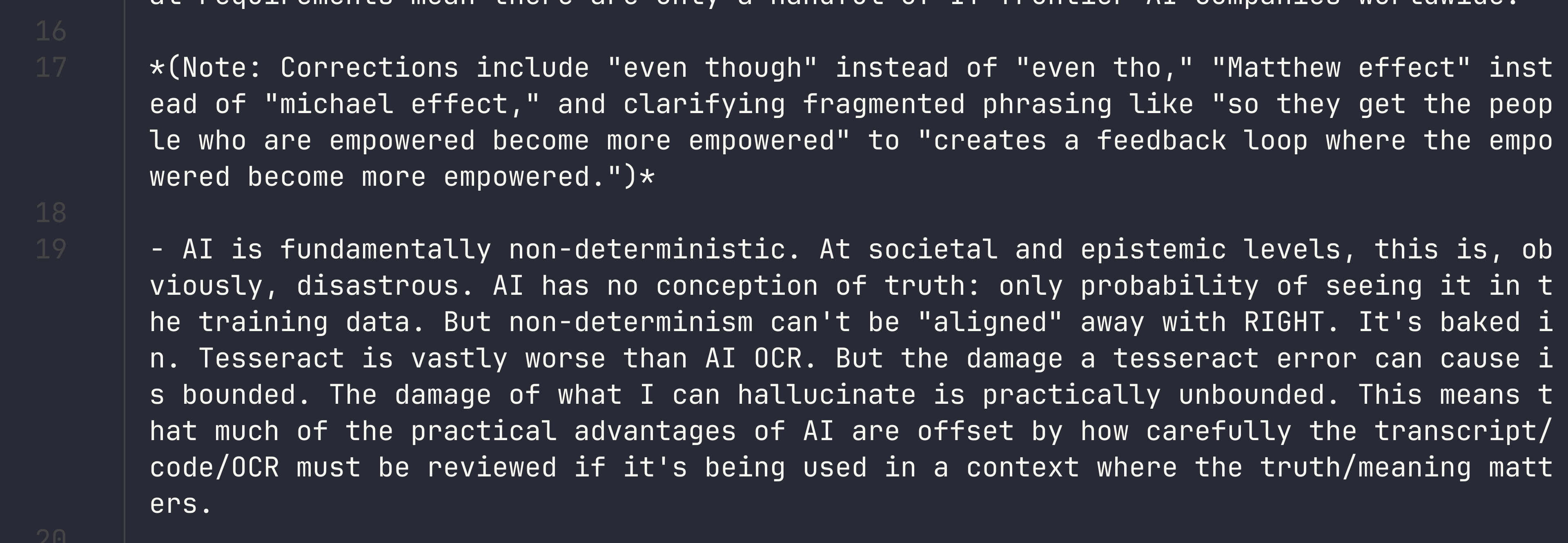
I ran it again, using Boris Smus’s prompt to keep Qwen on the rails:

time ls **.jpg | sort -n | xargs -I{} ollama run qwen3-vl --hidethinking "./{}\n$(cat path/to/dotfiles/prompts/qwen-handwriting-ocr.txt)" >> output.txt

The quality regressed a tad in other ways (Tesseract became Tessera), but this got Qwen to stop talking to itself and correcting me. I could bask in my typos.

Claude Opus is, of course, better. But if you want your writing to stay on your device, local vision models can now OCR handwriting decently well on consumer hardware. And Qwen3-VL:8B is currently the top open-weights model on the OCR Arena leaderboard.