


Three days. Two physical attacks on Sam Altman’s San Francisco compound. One New Yorker exposé that interviewed more than a hundred people and put many on the record using words like fantasist, dissembler, and sociopath.1
Three weeks later, Altman was on X writing “the world needs more love” and inviting his sworn enemy to a launch party.2

Sam Altman@sama
@AndrewCurran_ he can come if he wants world needs more love
4:13 AM · May 2, 2026 · 220K Views
396 Replies · 82 Reposts · 4.23K Likes
Everyone is asking the same question: did Sam Altman finally chill out?
In my opinion, wrong question.
The right question is technical: what happens when a CEO runs the visible part of William Benoit’s thirty-year-old image repair framework in twenty-one days, with two billion dollars a month in subscription revenue on the line?3
Before we go further, one disclaimer.
This is not a hit piece. I am not arguing Sam Altman is “really” anything. Maybe the warm version is the strategic one. Maybe it is the authentic one his colleagues have always known, now visible in public. Both can be true. Andrew Bosworth, Meta’s CTO, has said the more confident Zuckerberg of 2025 is the man employees have always known internally; the same may apply here.4
Personally, I like Altman and like more this version of Altman. He is more legible. I want to look at how the playbook runs and what it does to the company. The character question belongs to him. The pattern question is the one I’m asking.
I didn’t notice it as a single event. I noticed it gradually.
First the profile photo changed. Then the bio went lowercase: “AI is cool i guess.” Then the joke tweets started landing more often. By May 2, when I saw “the world needs more love,” it was no longer a moment of recognition. It was the accumulation tipping into something undeniable. This man is doing something.
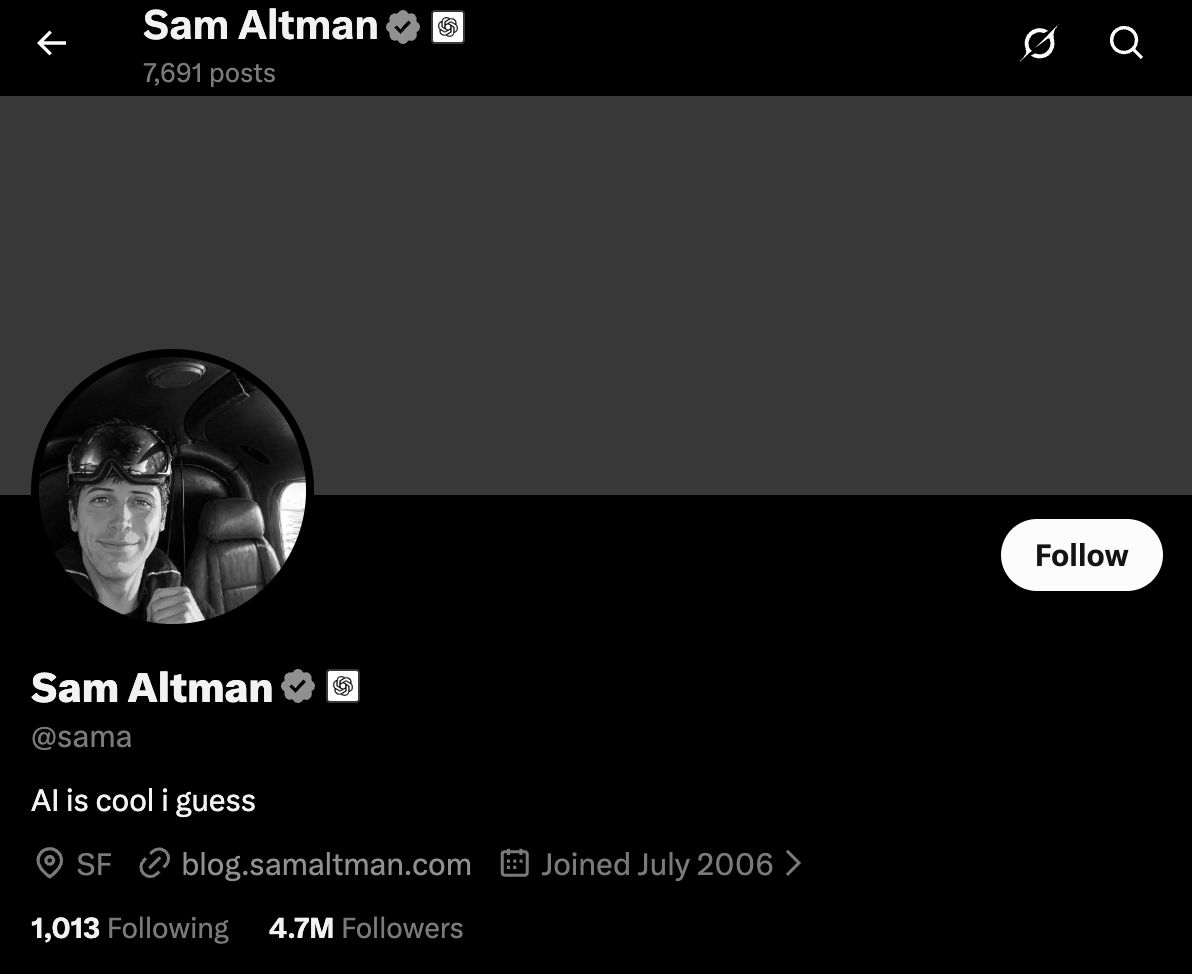
The chronology comes first. Whether the sequence is deliberate or instinctive is a question for after the dates.
April 2, 2026. OpenAI announces the acquisition of TBPN, the podcast that had defined Silicon Valley’s house style of insider, brisk, performative-but-not-too-polished discourse.5 This is eight days before the first physical attack on Altman’s compound and eleven days before the New Yorker piece drops. The format infrastructure for the warm pivot is in place before the crisis arrives.
April 10, 2026. A 20-year-old carrying an anti-AI manifesto throws a Molotov cocktail at the gate of Sam Altman’s San Francisco compound. The suspect is arrested. No one on-site is injured.
April 12, 2026. Two days later, a man and woman drive past Altman’s house, double back, and fire a gun in the direction of the property. Both are arrested.6
April 13, 2026. The New Yorker publishes Ronan Farrow and Andrew Marantz’s “Sam Altman May Control Our Future — Can He Be Trusted?” Over a hundred sources, many on the record. Multiple use the words fantasist, dissembler, and sociopath.
April 13–15, 2026. Altman publishes a blog post that includes a photograph of his husband and their newborn child. He writes: “Words have power too. There was an incendiary article about me a few days ago.”7
April 23, 2026. OpenAI ships GPT-5.5. Altman’s launch thread on X is structured like a podcast host’s segment: anchor intro (“GPT-5.5 is here”), value prop, social-proof reposts from OpenAI insiders (roon, Pietro Schirano, Noam Brown), niche in-joke (“very jakub-coded”), pricing card. His bio is updated to “AI is cool i guess.”
April 26, 2026. Altman attempts Gen Alpha slang on X: “we still get looksmaxxed on frontend a little but we IQmog hard now.” Within hours, Tyler Cosgrove of TBPN, a host now technically working under OpenAI, publicly corrects the usage.
April 30, 2026. Altman posts on X: “all of these ‘which is better’ polls are silly. use codex or claude code, whatever works best for you. i am grateful we live in a time with such amazing tools, and grateful there is a choice.”9 Three months earlier, after Anthropic’s Super Bowl campaign mocked ChatGPT’s plan to introduce ads, Altman had called Anthropic “dishonest,” “authoritarian,” and an “expensive product to rich people.”7 The Elon-party invite two days later is not the first warm pivot of this cycle.
May 2, 2026. Altman shares an RSVP link for OpenAI’s GPT-5.5 launch party and adds that Elon Musk “could come if he wants to. The world needs more love.” The federal trial Musk et al. v. Altman et al. is in active session in Oakland. Days earlier, presiding judge Yvonne Gonzalez Rogers had warned both men to “control your propensity to use social media to make things worse outside this courtroom.”
May 5, 2026. The party. This essay was written that morning.
Twenty-one days, from a Molotov to “the world needs more love.”
So what is this, technically?
The framework is William L. Benoit’s. He called it Image Repair Theory and published it in 1995.8 It is a typology of five strategies that organizations and individuals use when their reputation is attacked. It has held up for thirty years because it is testable.9
Benoit identifies five strategies. Each is a different answer to the same question: what do you do when someone names a thing about you, publicly, that damages you?
Denial. Refute the accusation. Argue it didn’t happen, or that you didn’t do it.
Evasion of responsibility. Concede the act but argue you weren’t really to blame: accident, provocation, lack of information, good intentions.
Reducing offensiveness of the event. Concede the act, but reframe the meaning. Bolster (highlight your good qualities), minimize (it wasn’t that bad), differentiate (compare favorably to worse acts), transcend (point to higher considerations), attack the accuser, or compensate the victims.
Corrective action. Demonstrate that you have changed the conditions that caused the offense, or that you’ll repair the damage.
Mortification. Confess fully. Apologize. Beg forgiveness. Benoit, drawing on Kenneth Burke, calls this “dying to yourself.”
Benoit’s framework is descriptive. It has also been tested. A Penn State experiment ran all five strategies head-to-head against a single product-harm crisis, and reducing offensiveness consistently produced the highest reputation-related perceptions.10 On the evidence, it is the dominant strategy.
Now look back at the chronology with the framework in hand.
The first thing to notice is what is missing. Altman has not denied the New Yorker piece on the record. There is no point-by-point refutation, no defamation suit, no competing statement contesting the fantasist and sociopath quotes. He has also not mortified. There is no full apology, no “I have heard the criticism and am sorry.” The closest he came was the blog-post line “Words have power too. There was an incendiary article about me a few days ago,” which is a redirect, not a confession.
What he is doing maps to two specific Benoit strategies: reducing offensiveness and corrective action by behavior. The May 2 Elon-invite tweet is a bolster. Reposting OpenAI engineers during the GPT-5.5 launch is a transcend. The TBPN acquisition is corrective action in an unusually ambitious form. Altman did not fix how he is described. He bought the format he describes himself in.
Whether by instinct or by counsel, he is running the strategy the literature says works.
What is new is the speed.
Benoit’s case studies (Tylenol, Exxon Valdez, Bill Clinton, Hugh Grant, Tonya Harding) unfold over months and years. The dynamics work at the speed of newsprint and quarterly reporting. Mark Zuckerberg’s analogous arc, which Section V looks at in detail, took seven years: Cambridge Analytica in 2018, MAGA Mark in 2025.
Sam Altman ran the visible part of the same playbook in twenty-one days.
Compressed Image Repair: Benoit’s strategies executed on a timeline the theory was never built for. Same five strategies. Same dominant choice. Different velocity.
The right-strategy question was answered thirty years ago. Altman is using that answer. The open question is what changes when the visible part of the playbook runs in weeks instead of years.
The compression is the part that is genuinely new. Benoit didn’t write about visible windows this short. He couldn’t have. The infrastructure that makes them possible didn’t exist.
The first mechanism is narrative velocity. A New Yorker piece in 1996 took weeks to land in public consciousness, mediated by letters to the editor, op-ed responses, and trade-press follow-ups. The Farrow piece was screenshotted and remixed on X within hours. Faster intake means the response window also collapses. You no longer have months to plan a repair statement. You have days. The execution window is minutes.
I have seen this at the operational level. At Turkey’s largest e-commerce site, where I worked as an SEO consultant, a single service complaint that went viral on X would produce visible negative-keyword clusters across our organic traffic within hours. Controversies involving influencers we had no formal relationship with did the same thing. The comms team would still be drafting a response when the search ecosystem had already moved. The lag between social signal and search-result reality had collapsed. Founders running monthly-subscription products are operating in that same compressed dynamic, with much larger numbers attached.
The second mechanism is capital reflex. Microsoft’s reputation problems in 2014 hit annual enterprise contracts. Slow renewals. Multi-quarter recovery. OpenAI’s base is shaped differently. The bulk of its revenue is monthly: consumer subscriptions at $20 for ChatGPT Plus, $8 for the ChatGPT Go tier launched globally in January 2026, with ads now testing on Free and Go users in the U.S.11 Enterprise seats bill closer to SaaS than to a five-year deal. The pressure on this base is real and currently public. In late April 2026, the Wall Street Journal reported that OpenAI had missed multiple internal revenue targets and that CFO Sarah Friar had warned colleagues the company might struggle to meet future compute commitments if growth did not accelerate.12 Sentiment shifts hit unit economics within a single billing cycle. A founder who reads as a sociopath in April risks subscriber churn in May. A founder who reads as a host in May reduces it in June. The pressure is on the monthly P&L, and the monthly P&L is currently under public scrutiny.
The third mechanism is media format infrastructure. In 1996 you could, at best, learn how to talk to journalists. In 2026 you can buy them. OpenAI’s TBPN acquisition in early April bought more than distribution. It bought format literacy: the ability to launch products in the house style that podcasts and X threads already speak. The GPT-5.5 launch thread on April 23 did not need to translate itself into the discourse. It was already in the discourse’s native dialect.
The fourth mechanism is the meta-loop. A SiliconSnark piece analyzing Altman’s launch-thread tone went up two days after the launch and was itself screenshotted into the next round of takes. By the time most observers form an opinion about an Altman tweet, they have already absorbed two or three pieces of meta-commentary about it. The image signal does not just reach an audience anymore. It shapes how the audience reads the next signal.
Put together, the four mechanisms compress the visible window of an image-repair cycle. The deeper transformation may still take years. What changes is when the impact arrives.
I did not watch Mark Zuckerberg’s transformation in real time. What caught me was the contrast.
The frozen face in the 2018 congressional hearings, sitting on a booster cushion, blinking at senators about Cambridge Analytica.13
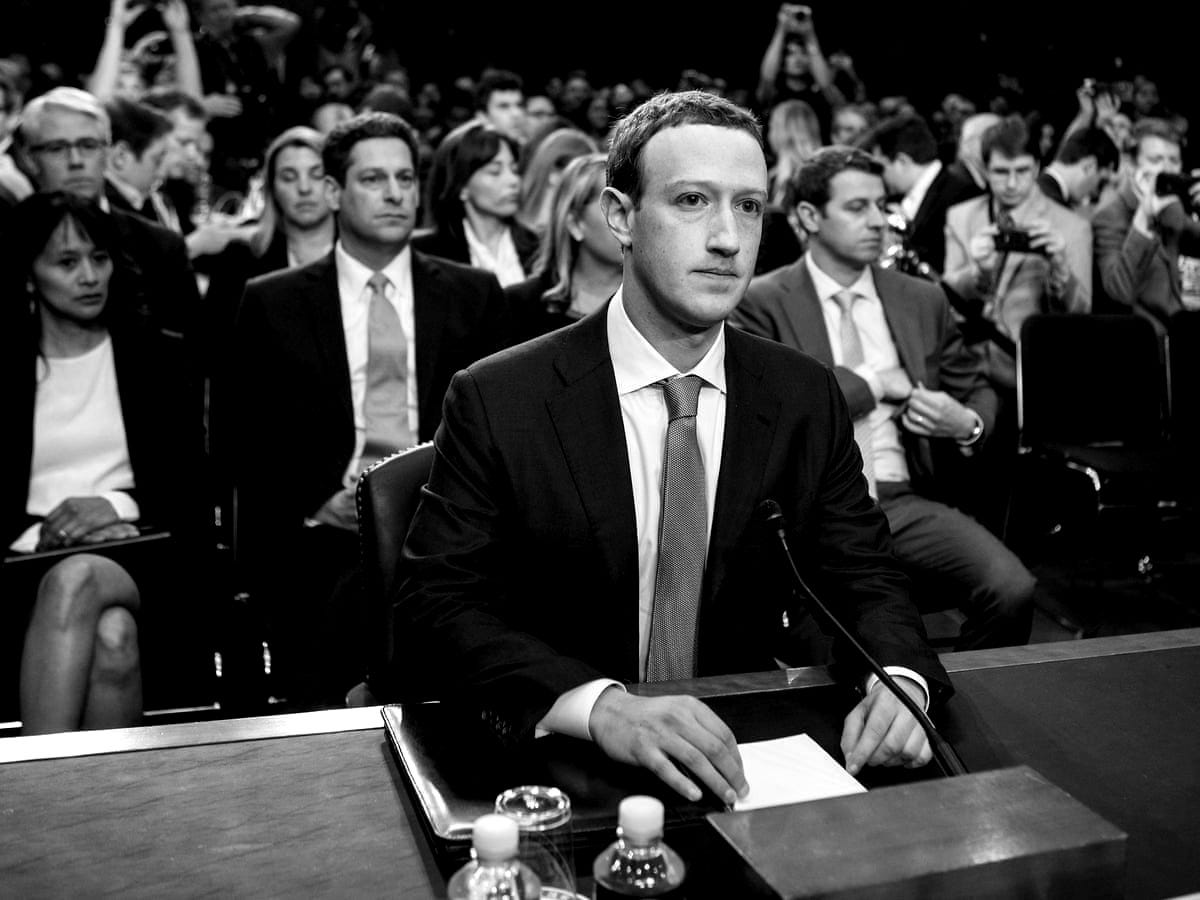
Then, six years later, the Bloomberg Originals interview with Emily Chang, where the same man wakesurfs on Lake Tahoe with his wife, talks about teaching his daughters critical thinking, jokes about being “a pretty intense person,” and quotes the Roman Empire on what makes a human a human.
Meet the New Mark Zuckerberg, the title called it. By the time I noticed the change, the change was complete.
Zuckerberg ran the same Benoit playbook Altman is running now. His arc took seven years. Altman’s is three weeks old.
Cambridge Analytica broke in March 2018. The next four years were a slow grind of reducing offensiveness and corrective action: hiring Nick Clegg to handle politics, distancing Zuckerberg from the more controversial parts of the role, polling users on their feelings about him. In 2020, Peter Thiel sent Zuckerberg an email arguing that he should rebrand as a Millennial spokesperson rather than a Boomer construct of how a well-behaved Millennial is supposed to act. Zuckerberg agreed.
The public-facing part started in 2022. Jiu-jitsu lessons. A slow shift toward MMA. Then designer shirts with Latin slogans (Carthago delenda est, patha mathos), gold chains, a $900,000 Greubel Forsey watch, a luxuriant ginger mullet.14
In TechCrunch’s words, he stopped looking like the kid who got bullied and started looking like the kid who would do the bullying.15
By 2024 the persona shift had a name. People at Meta called him Maga Mark. By January 2025 the company had abandoned third-party fact-checking, removed DEI programs, replaced Nick Clegg with Republican lobbyist Joel Kaplan, and put Zuckerberg on the Joe Rogan podcast extolling MMA as a place that “celebrates aggression.”16
Andrew Bosworth, Meta’s CTO, has said the public is finally seeing the Zuckerberg his colleagues have always known internally.
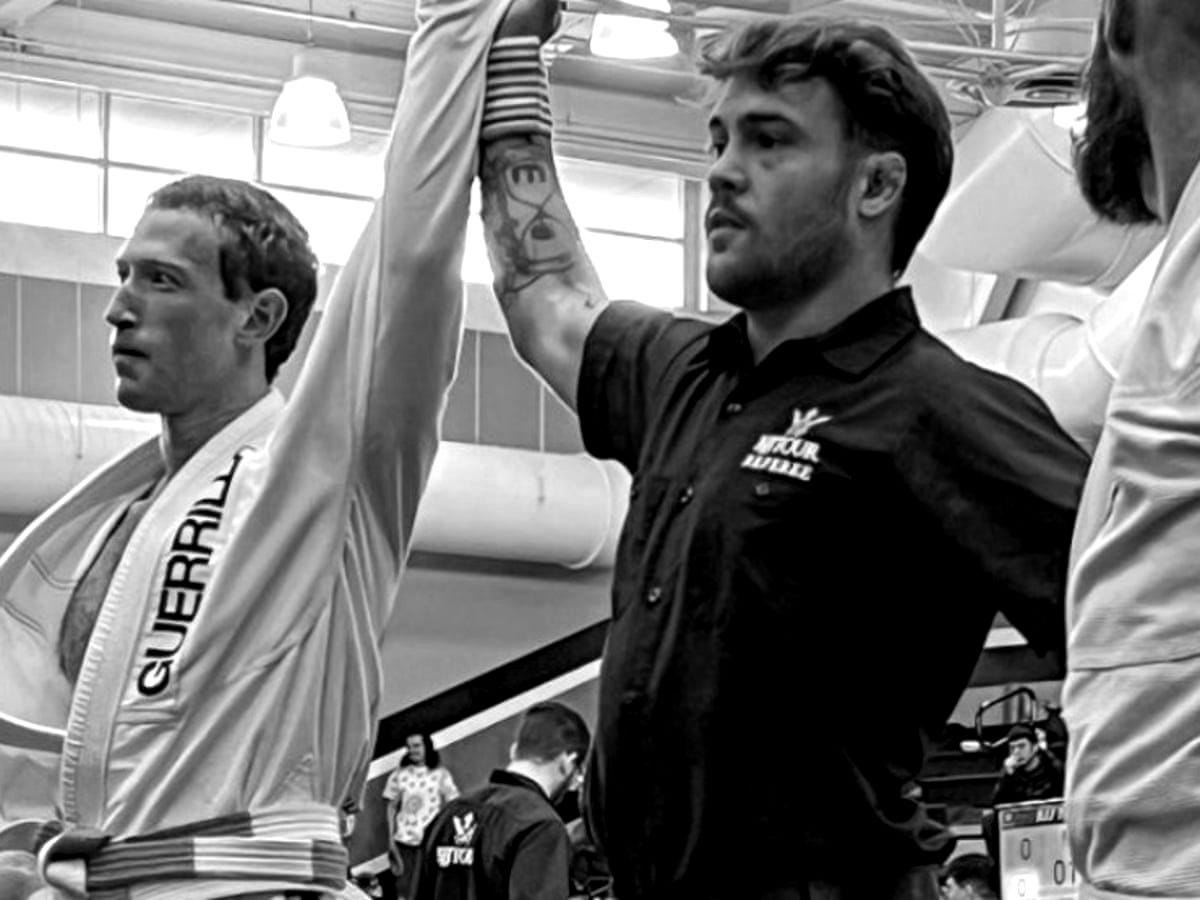
Zuckerberg’s playbook is the same five-strategy framework Altman is now running. The bolster (jiu-jitsu, family), the transcend (open-source AI evangelism, free-expression rhetoric), the corrective infrastructure (Republican lobbyist, fact-check abandonment) are all there.
But Zuckerberg’s transformation took seven years to complete. Cambridge Analytica in 2018 to MAGA Mark in 2025. Eighty-four months of annual hardware launches, quarterly earnings calls, and election-cycle media coverage in between.
Sam Altman is three weeks in. Whether his process completes the way Zuckerberg’s did is an open question. What is already true is that the visible impact came faster.
Zuckerberg’s case shows the playbook works. Nadella’s case shows it pays.
When Satya Nadella took over Microsoft in February 2014, the company had a problem money could not directly fix. The brand was old. The dominant perception, especially among developers, was bloatware, vendor lock-in, telemetry, the company that had bought Nokia for $7.3 billion and could not make a phone. The stock was around $37. Market cap, around $300 billion. Apple was twice as valuable. Amazon was eating cloud. The Windows-and-Office annuity was paying the rent, but the next thing was nowhere visible.17
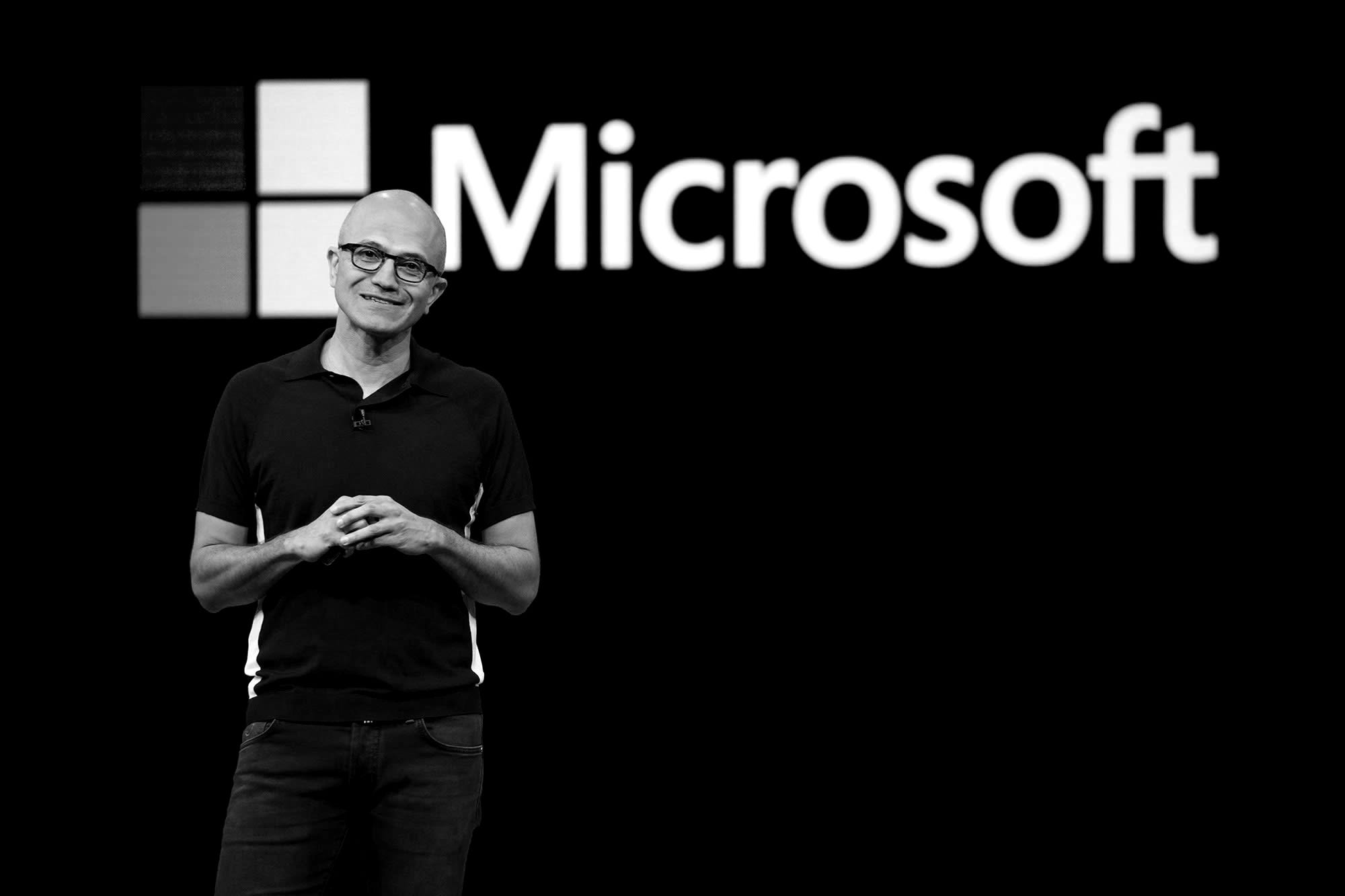
Nadella did not start with a product strategy. He started with a personal one.
His first moves were tonal. A listening tour across the company. A public apology for a clumsy answer about gender pay at the Grace Hopper conference, followed by visible engagement with women-in-tech groups.18 An internal mantra borrowed from Carol Dweck’s psychology research: “know-it-all” had to become “learn-it-all.”19 He stopped using the word “competitive fire” the way Steve Ballmer had used it. In his 2017 autobiography he wrote: “Microsoft is known for rallying the troops with competitive fire. The press loves that, but it’s not me.”
Wall Street took a while to notice the persona shift had a return profile. By 2024, ten years in, the numbers had compounded into something rare. Stock up over 1,000%. Market cap above $3 trillion. Microsoft briefly the most valuable public company in the world. A Barclays analyst described Nadella as standing out “from the typical very strong ego CEO.” A Wedbush analyst said he treats “the person making food in the cafeteria, an engineer, finance executive, a customer” the same way.
The persona was not the only cause. Azure, the GitHub acquisition, the OpenAI investment, the rapid pivot away from Windows-as-religion. All of those were product and capital decisions. But the shape of those decisions came from the cultural reset. A know-it-all Microsoft does not buy GitHub for $7.5 billion and let it stay developer-led, does not invest $13 billion in a startup and accept second billing on the partnership, does not put its CEO on a plane to maneuver Sam Altman back into OpenAI on the weekend of November 2023.
Those were learn-it-all moves.
Nadella’s case is the empirical evidence that Compressed Image Repair has a commercial counterpart. A founder warming up does not just defuse criticism. It opens product, partnership, and personnel options that a colder version of the same company cannot run. The market re-rates the company over time as those options compound.
The relevant question for Altman is whether the persona shift unlocks the same kind of optionality.
One difference matters. Nadella had ten years of low-volatility execution behind him before the market fully priced the reset. Altman has the Wall Street Journal questioning his data-center spend three weeks into his. The clock is faster. The patience is shorter. The meaning of warm CEO is being tested under a much harsher light.
Meaning transfer is the academic name for why one person’s posture moves a corporate brand. The 2018 study that mapped it most carefully comes from Stefan Scheidt and three co-authors, published in the Journal of Product & Brand Management.
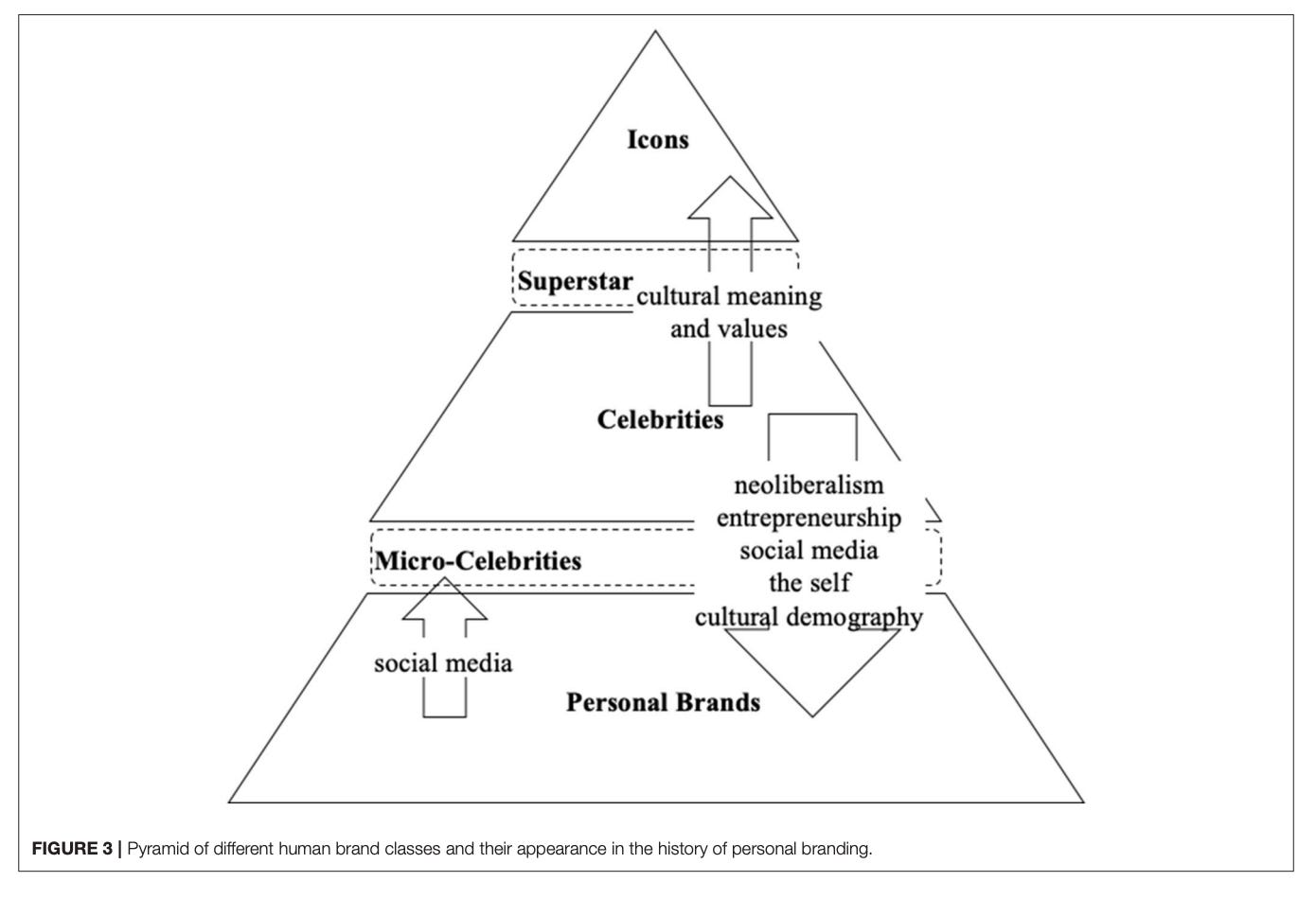
They measured the flow of personality attributes between celebrity CEOs and the corporate brands they front. Across sixteen attributes (famous, creative, international, transparent, progressive, credible, professional, and others), they found statistically significant transfer in both directions. CEO to corporate brand, F(12,119)=6.306, p=0.000. The reverse, brand to CEO, also significant.20
In plain English: a CEO’s image flows into the brand, and the brand’s image flows back into the CEO. Both effects are large enough to measure, and they happen continuously.
The mechanism is associative cognitive processing. When the audience encounters the CEO, they update the brand. When they encounter the brand, they update the CEO. After enough exposure, the two share an attribute set. This is why a single founder change can move a corporate-perception index, and why a corporate scandal can damage a founder’s personal credibility.
A 2024 study by Prachi Gala in Marketing Letters (Springer) measured the financial side of the same phenomenon. Gala and her co-authors analyzed 725 CEO-related news events at 125 firms covered in leading U.S. outlets between 2009 and 2019, and quantified what each category of news did to consumer evaluation and stock price.21
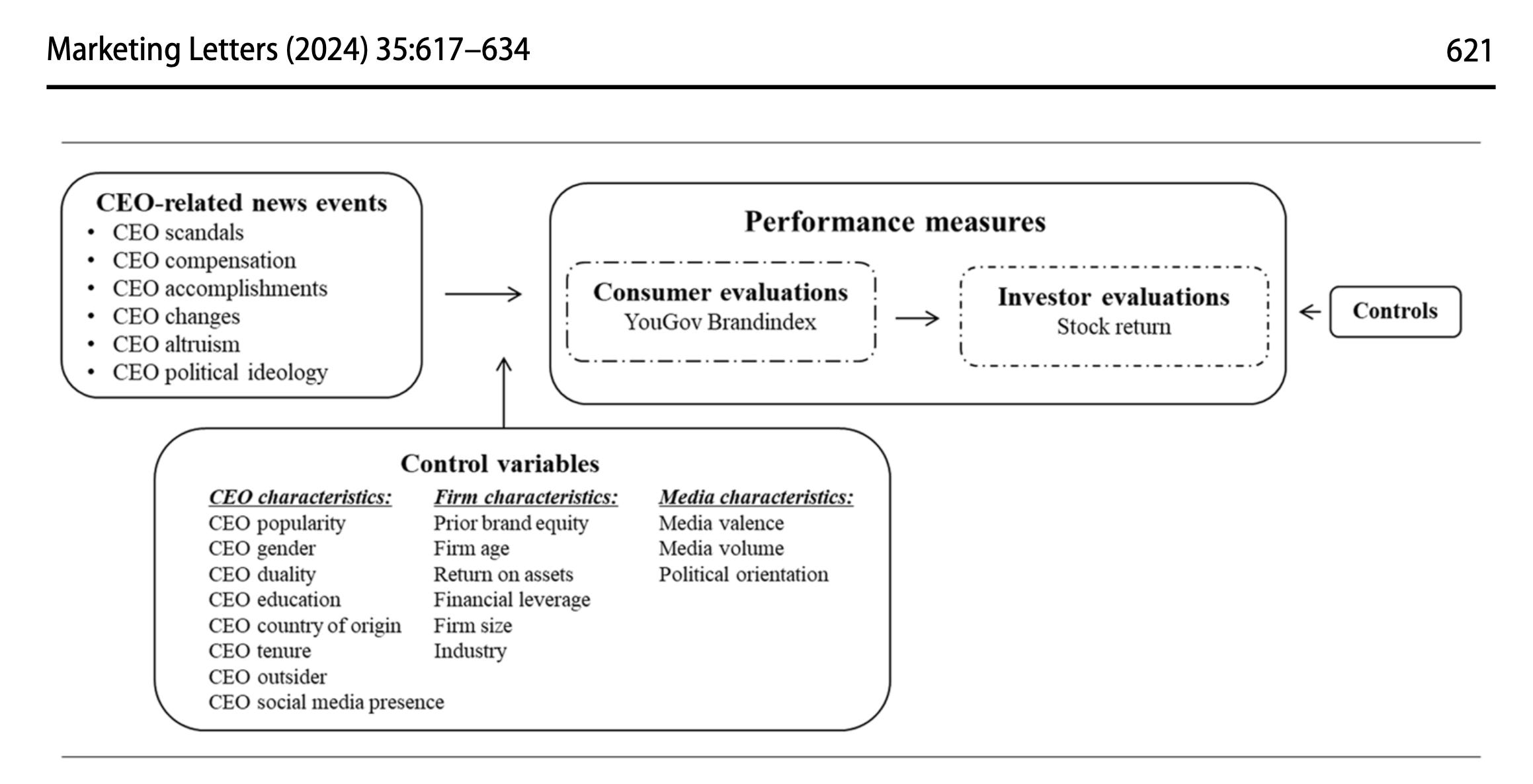
The results were stark. CEO scandals cut consumer evaluations by an average of thirteen percent, with the damage persistent sixty days later. The corresponding stock-market loss averaged just over five hundred million dollars per event, with an abnormal average return (AAR) of minus 0.77 percent. Both numbers were larger than the equivalents for product-harm crises (-0.59% AAR) and voluntary product recalls (-0.54% AAR). On the other side of the ledger, news about CEO altruism produced positive consumer-evaluation lifts. So did news about CEO political ideology, though that lift decayed over time.21
Place the Farrow piece on this taxonomy.
A 25,000-word New Yorker feature with more than a hundred named sources, multiple of them calling the CEO a fantasist, a dissembler, and at points a sociopath, is, in Gala’s typology, a CEO scandal at the high end of the severity range. The empirical baseline without intervention: roughly a thirteen-percent consumer-evaluation hit, persistent for sixty days, and an AAR of minus 0.77 percent. For a company with an $852 billion valuation, that is not a rounding error.
Compressed Image Repair is, in this frame, an inoculation. Each warm-pivot move maps to a Gala-altruism cue: the engineer reposts during the GPT-5.5 launch, “the world needs more love” on May 2, the codex-or-claude-code peace gesture on April 30, the photograph of the husband and the newborn published days after the Farrow piece. Stacked, they produce something close to the lift Gala’s altruism category measures.
The bidirectional half of Scheidt et al. matters too. When the audience updates the CEO toward warm host, they update the brand. The same product that reads as “sociopath’s tool” in early April reads as “host’s tool” three weeks later. The deployment friction inside an enterprise procurement committee drops accordingly. The CFO who would have escalated a ChatGPT Enterprise contract for additional review has fewer reasons to.
The persona shift is not cosmetic. It is the leading edge of brand-attribute movement, which is the leading edge of revenue.
Section VIII puts numbers on it.
The top-line is moving in the direction the persona shift would predict.
As of late February 2026, OpenAI reported 900 million weekly active ChatGPT users, fifty million paying consumer subscribers, and more than nine million paying business users. Annualized revenue had crossed $25 billion by March, up from $20 billion in January. The company was generating roughly $2 billion a month in run-rate revenue. Valuation: $852 billion.11
Enterprise was the more interesting line. By April, OpenAI had announced enterprise revenue at forty percent of total, with parity to consumer projected by year end.11 ChatGPT for Work reached seven million seats, up forty percent in two months. ChatGPT Enterprise seats were 9× year-over-year. The company had crossed one million paying business customers in November 2025.3
Third-party tracking told a similar story. Ramp, which observes corporate card and bill-pay activity at more than 50,000 U.S. businesses, found that 36.8 percent of American businesses paid for OpenAI products by December 2025. The same data set put Anthropic at 16.7 percent and Google at 4.3 percent.22 OpenAI’s lead, in this slice, was more than double its closest competitor.
So far, this is the trajectory a warm-pivot story would predict: a consumer base expanding, business adoption accelerating faster than rivals, brand-attribute “trust” rising in the same months when scrutiny was at its peak.
Then the Wall Street Journal dropped its April 28 piece.12
The report, which OpenAI publicly disputed, said the company had missed multiple monthly revenue targets in early 2026, fallen short of its internal goal of one billion weekly active users by year-end 2025, and was experiencing subscriber defections. CFO Sarah Friar had warned colleagues that the company might not be able to fund its future computing contracts if growth did not accelerate. SoftBank, which holds a 13 percent stake, fell ten percent in Tokyo on the news.
Two readings are available. They are not mutually exclusive.
The optimistic reading: the persona pivot is already doing its job, and the WSJ piece reflects pressure that would have been worse without it. ChatGPT Go’s projected 36-fold growth, the ads pilot that OpenAI’s own update described as showing “no impact on consumer trust metrics” in March, and the seven-million-seat enterprise growth all happened during a period when the brand could have been hemorrhaging. Without the warm pivot, the April WSJ piece might have been the second crisis on top of a first.
The pessimistic reading: the persona pivot has not yet unlocked the trajectory the company actually needs. OpenAI’s own projections assume Plus subscribers drop eighty percent (from roughly 50 million to 9 million), Go subscribers grow 36-fold (to 112 million), and advertising contributes more than a third of revenue by 2030. That is a structurally different company than the one selling $20 monthly subscriptions today. The warm pivot is, in part, a trust-engineering exercise for the audience that will receive ads in the chat window. Whether that engineering completes before the compute bill arrives is the open question.
Both readings can be true at once. The visible impact has arrived, the way Section IV said it would. The deeper transformation, the one that re-rates the company’s revenue mix and unit economics, is still being constructed in real time. Three weeks of warm posting cannot, by itself, rebalance a P&L that depends on a future advertising market.
What three weeks of warm posting can do is buy the time and the trust to keep building.
Founder transformations of this kind tend to be over-determined. They do not happen for a single reason. They happen when several pressures align in the same window. Looking at Altman’s twenty-one days, four pressures were operating simultaneously, each strong enough to motivate the move on its own. The question is not which one caused the pivot. The question is which combination made the pivot inevitable.
First, subscription growth dependency.
This is the most empirically supported hypothesis, and the most commercially urgent. Sixty percent of OpenAI’s revenue still comes from consumers,11 and the company’s own projections assume that mix gets rebuilt twice over the next four years. Plus subscribers are projected to drop eighty percent. ChatGPT Go subscribers are projected to grow 36-fold. Advertising is projected to deliver more than a third of revenue by 2030.12 Every one of those projections requires consumer trust at a level the brand has not historically needed. Ads in the chat window only work if the user keeps the chat window open. ChatGPT Go scales to 112 million subscribers only if the brand reads as friendly enough for the user who would never have paid $20 for Plus. The warm pivot is, among other things, an engineering exercise for that audience.
Whether Altman did the pivot consciously for this reason is a different question from whether the pivot serves it. The data says it serves it.
Second, enterprise trust building.
Every empirical finding from Section VII argues for this. Gala’s 2024 study put the average CEO scandal cost at five hundred million dollars in market cap and a thirteen-percent persistent drop in consumer evaluation.21 Scheidt’s bidirectional meaning transfer means those CEO-level signals migrate into the brand attributes that procurement committees and CFOs read when they evaluate enterprise contracts.20 OpenAI is in an active enterprise land-grab against Anthropic, which Ramp shows it leads by more than 2× in U.S. business adoption.22 A “fantasist / dissembler / sociopath” reading of the CEO is not a reading any procurement committee wants attached to a multi-million-dollar Enterprise contract. Warm host is. The optionality Section VI described (buying GitHub developer-led, accepting OpenAI partnership second-billing) was a function of Microsoft’s CEO being legible to the buying side. Altman is now running the same calculus, three weeks in.
The trial gives this hypothesis its specific shape. The federal jury sitting in Oakland is, in part, a proxy for the enterprise audience. Twelve people watching how Altman handles himself under attack is a stand-in for every CFO who will spend the next year deciding whether OpenAI is a vendor they trust at scale.
Third, physical safety.
This one is harder to quantify and easier to under-rate. April 10 was a Molotov cocktail at the gate. Forty-eight hours later, gunshots near the property. These were not theoretical reputational risks. They were a man and a woman driving past Altman’s house with a firearm, and a twenty-year-old with an anti-AI manifesto and an incendiary device.6 Whatever else the warm pivot does, it lowers the temperature on the public character that radicalized those individuals. Posting like a podcast host is not the posture of a “dangerous AI prophet.” It is the posture of someone trying to read as a peer.
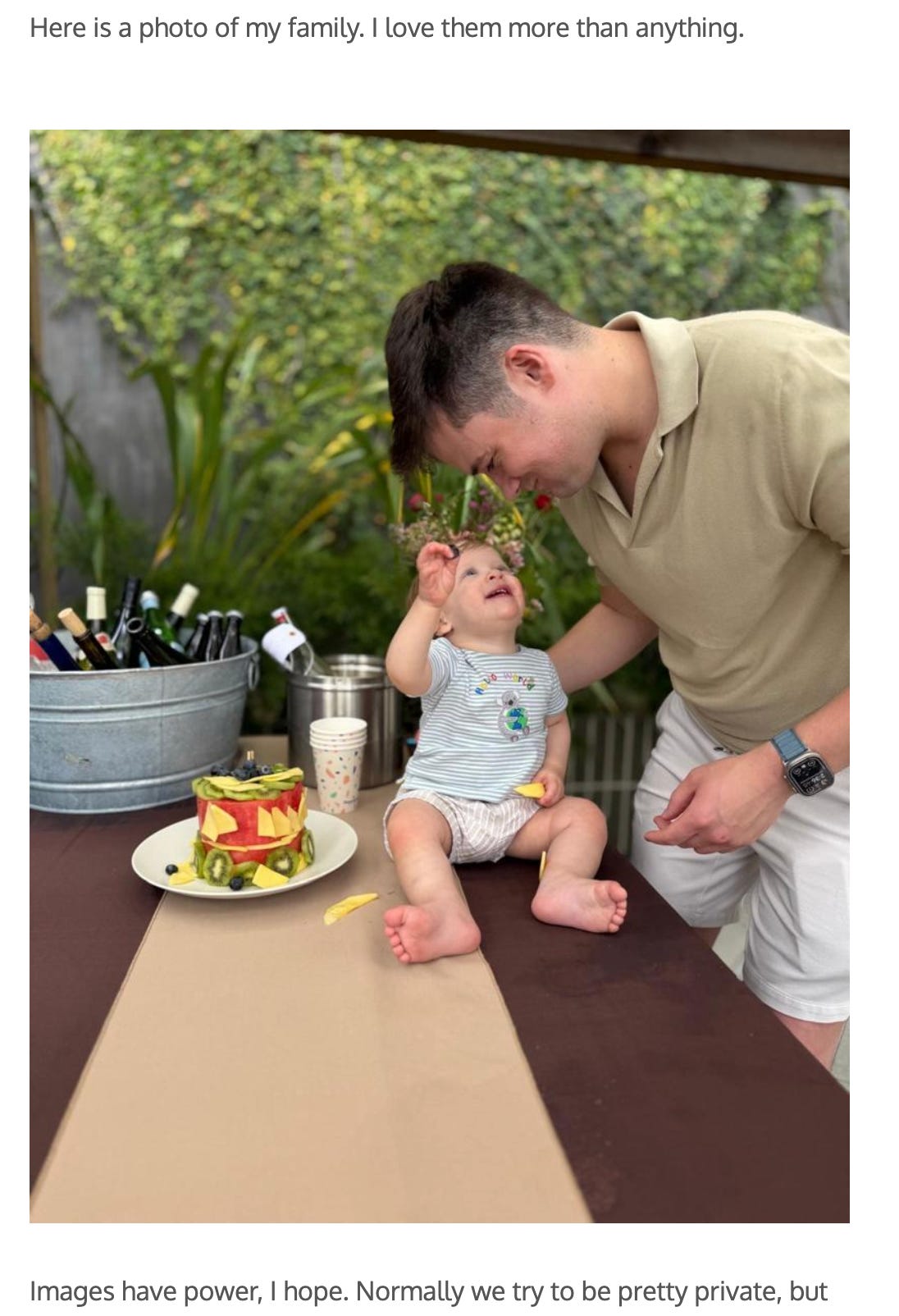
The blog post Altman published days later, with the photograph of his husband and their newborn child, is the cleanest evidence that the safety calculus is in the mix.6 It is not a press strategy. It is a plea.
Fourth, trial pressure.
The Musk vs. Altman federal trial in Oakland is, by itself, a structural argument for tonal restraint. Judge Yvonne Gonzalez Rogers warned both men in late April to “control your propensity to use social media to make things worse outside this courtroom.”2 Altman’s response was not to go silent. It was to invert the tone of his X presence in the same week. The May 2 “world needs more love” tweet, two days after the warning, is not just a brand pivot. It is also legal posture, the kind that can be entered into evidence and read as cooperative under judicial scrutiny.
The April 30 codex-or-claude-code conciliation tweet sits inside the same logic. A court watching how a defendant talks about competitors is not the same as a marketing audience watching it. Altman knows this.
No single hypothesis explains the pivot fully. Each pressure points to the same response from a different angle: commercial pressure on a subscription mix that gets rebuilt twice in four years, strategic pressure on enterprise procurement at the moment of the Anthropic land-grab, the personal urgency of two physical attacks inside forty-eight hours, and a federal courtroom listening for tonal posture that can be entered into evidence. Four independent vectors, all aligned in the same April.
This is what over-determined transformations look like. They do not happen because of one trigger. They happen because, at a particular moment, the cost of not moving exceeds the cost of moving on multiple independent axes at once. Altman, in late April 2026, was past that point on four axes simultaneously.
The pivot was the move with the lowest aggregate downside. Whether it has the upside the projections need is the question Section X turns to.
I followed an academic trail. William Benoit’s image repair theory from 1995. Scheidt et al.’s 2018 study on bidirectional meaning transfer between celebrity CEOs and corporate brands. Prachi Gala’s 2024 paper quantifying the cap-loss of CEO scandals. Satya Nadella’s documented 2014 reset and the ten years of compounding it produced.
The working assumption I tested against those sources is simple: what we are watching with Sam Altman is not a personality story. It is a PR-building campaign running at AI velocity, with academic playbooks behind it and commercial pressure underneath.
The evidence supports the assumption.
Altman’s behavior maps to Benoit’s reducing offensiveness combined with corrective action by behavior with unusual fidelity. The TBPN acquisition is corrective action in its most ambitious form. Not a corrective statement, but a corrective infrastructure. The chronology shows the warm pivot was loaded before the crisis arrived, not improvised after. The numbers already moving (consumer subscriber growth, enterprise lead at 2× the closest competitor, 36.8% U.S. business adoption) are consistent with the inoculation Gala’s framework predicts. The numbers wobbling (missed revenue targets, subscriber defections, the Wall Street Journal piece) are consistent with a transformation that has started but has not yet completed.
Both can be true at once.
What I am not arguing is that Sam Altman planned all of this consciously. The four motivation hypotheses in Section IX point to over-determination: subscription dependency, enterprise trust, physical safety, and a federal courtroom in Oakland, all pushing toward the same response from different angles. The pivot was the move with the lowest aggregate downside given those pressures, whether deliberately chosen or instinctively reached for. Whether it has the upside the projections need is the open question.
Over the next twelve months I’ll be watching three things, in this order. The marketing language around ChatGPT Go and the cheaper tiers, to see whether it shifts from developer-tool framing to utility framing. OpenAI’s enterprise hires, to see whether trust-and-safety roles get reweighted upward and a financial-services-trained VP shows up on the org chart. And Altman’s own vocabulary on AI risk, to see whether tail risk gives way to responsible acceleration in the public record. None of these will appear in a press release before they appear in the founder’s posture. That is what the leading-indicator frame predicts.
I’ll write a follow-up on May 5, 2027, exactly one year from this essay’s date stamp. If the framework was right, the next twelve months will say so on the record. If it wasn’t, they’ll say that too, and I’ll publish the post-mortem with the same byline.
What we’ll see, we’ll see together.
Bosworth, Andrew, quoted in: “How Mark Zuckerberg unleashed his inner brawler.” Financial Times, June 19, 2025. https://on.ft.com/4ldPDpl
OpenAI. “OpenAI acquires TBPN.” Company announcement, April 2, 2026. (Listed in OpenAI press feed, see [^3].)
SiliconSnark. “Sam Altman Has Started Posting Like He Bought a Tech Talk Show Because He Did.” April 25, 2026. https://www.siliconsnark.com/sam-altman-has-started-posting-like-he-bought-a-tech-talk-show-because-he-did/
Benoit, William L. “Image Repair Discourse and Crisis Communication.” Public Relations Review 23, no. 2 (1997): 177–86.
https://eric.ed.gov/?id=EJ547153
BN, Asim. “OpenAI Reports 900M Weekly ChatGPT Users, 50M Subscribers, 9M Paying Business Users.” Digital Information World, February 28, 2026. https://www.digitalinformationworld.com/2026/02/openai-reports-900m-weekly-chatgpt.html↩︎
Sen, Meghna. “OpenAI Statistics 2026: Users, Revenue & Market Share.” Panto AI, April 7, 2026. https://www.getpanto.ai/blog/openai-statistics↩︎
Babu, Juby. “OpenAI to test ads in ChatGPT in bid to boost revenue.” Reuters, January 16, 2026. https://www.reuters.com/business/openai-begin-testing-ads-chatgpts-free-go-tiers-2026-01-16/ | Ads to be tested on Free and ChatGPT Go users in the U.S.; Plus, Pro, Business and Enterprise tiers remain ad-free; ChatGPT Go launches globally at $8/month.
OpenAI. “Testing ads in ChatGPT” + “Introducing ChatGPT Go, now available worldwide.” Company blog posts, January 16, 2026. https://openai.com/blog/testing-ads-in-chatgpt | https://openai.com/index/introducing-chatgpt-go/ | March 26, 2026 update on the ad pilot: “no impact on consumer trust metrics, low dismissal rates of ads, ongoing improvements in relevance”; expansion to Canada, Australia, New Zealand
Silberling, Amanda. “Mark Zuckerberg’s makeover: Midlife crisis or carefully crafted rebrand?” TechCrunch, May 16, 2024. https://techcrunch.com/2024/05/16/mark-zuckerbergs-makeover-midlife-crisis-or-carefully-crafted-rebrand
Swain, Marianka. “The transformation of Mark Zuckerberg – from Democrat luvvie to Trump sympathiser.” The Telegraph, January 13, 2025. https://www.telegraph.co.uk/world-news/2025/01/13/transformation-mark-zuckerberg-democrat-luvvie-trump
Scheidt, Stefan, Carsten Gelhard, Juliane Strotzer & Jörg Henseler. “In for a penny, in for a pound? Exploring mutual endorsement effects between celebrity CEOs and corporate brands.” Journal of Product & Brand Management, 2018. https://run.unl.pt/bitstream/10362/36190/1/SScheidt_CGelhard_JStrotzer_JHenseler_In_2018.pdf | Key finding: MANOVA F(12,119)=6.306, p=0.000 confirms statistically significant bidirectional meaning transfer between celebrity CEOs and corporate brands across 16 personality attributes.
Gala, Prachi. “Breaking the news: how does CEO media coverage influence consumer and investor evaluations?” Marketing Letters (Springer), February 29, 2024. https://link.springer.com/article/10.1007/s11002-024-09720-y | Key empirical findings: CEO scandals → −13% consumer evaluation persistent at 60 days, −$500M average market cap impact, AAR −0.77%. CEO altruism + political ideology news → positive consumer evaluation.