
惯性聚合 高效追踪和阅读你感兴趣的博客、新闻、科技资讯
阅读原文 在惯性聚合中打开

推荐订阅源

V
Visual Studio Blog
T
The Exploit Database - CXSecurity.com
Cyberwarzone
Cyberwarzone
C
CXSECURITY Database RSS Feed - CXSecurity.com
E
Exploit-DB.com RSS Feed
S
Security @ Cisco Blogs
Scott Helme
Scott Helme
H
Hacker News: Front Page
I
Intezer
N
News and Events Feed by Topic
V
V2EX - 技术
L
LINUX DO - 热门话题
Threat Intelligence Blog | Flashpoint
L
LINUX DO - 最新话题
K
Kaspersky official blog
S
Securelist
Latest news
Latest news
P
Proofpoint News Feed
C
Cisco Blogs
T
Troy Hunt's Blog
The Register - Security
V
Vulnerabilities – Threatpost
T
Threat Research - Cisco Blogs
Microsoft Azure Blog
L
LangChain Blog
B
Blog RSS Feed
小众软件
小众软件
T
Tenable Blog
P
Proofpoint News Feed
MyScale Blog
MyScale Blog
SecWiki News
SecWiki News
Jina AI
Jina AI
Know Your Adversary
Know Your Adversary
Recorded Future
Recorded Future
Google Online Security Blog
D
Docker
W
WeLiveSecurity
Attack and Defense Labs
T
Tor Project blog
A
About on SuperTechFans
U
Unit 42
S
Security Archives - TechRepublic
cs.CV updates on arXiv.org
O
OpenAI News
NISL@THU
NISL@THU
雷峰网
雷峰网
Vercel News
Vercel News
AWS News Blog
AWS News Blog
L
Lohrmann on Cybersecurity
Google DeepMind News

Hacker News - Newest: "AI"

GitHub - SuperHeroesAreReal/AIluminode Everyone's building AI agents that remember. I built one that has a body A useful paper on the case for AI data centres in space [pdf] Show HN: AI agents for UK GDAD PCF roles and their skills The Pope Grasps the Limits of AI Rust Will Save Linux from AI, Says Greg Kroah-Hartman Indian Institute of Science Don’t Delegate the Joy of Building to AI TopRec (toprec.io) – AI screening and CRM for recruiters and hiring teams BetterCallClaude Italia — AI legale per avvocati Amdahl's law for AI agents | Electric Ask HN: Burned out on AI and want to go part time Using AI and LLMs to rewrite old code in modern languages The Two Pillars: Mixer Mode and Meta-Software in the Reorganization of Software Work After AI Your Future job will be to keep AI on task safescript — a programming language for AI agents GitHub - JaiCode08/teleport-env Meta to start testing AI subscription services, with cheapest plan at $7.99 a month Do they know we can tell it's AI slop? AI Cheats [pdf] Illinois Lawmakers Just Passed America’s Strongest AI Safety Bill The Authorization Paradox: Who Has the Keys to Your AI? [video] What Will Happen When the AI Barons Give Back? Uvilox AI — Communicate Beyond Barriers AgingBench: AI Agents Age Too AGH Three Search Alternatives to Google’s Brave New AI World The Third Vector: What Emerges When You Don't Break Sustained Coherent Human-AI Interaction I built a free cross-AI prompt manager (Chrome ext) Nvidia to spend $150B a year in Taiwan, 'epicentre' of AI revolution AI Infra Is Nothing Like the "Classic Cloud Infra" Argonne flexes spare supercompute to build private AI inference service GitHub - sjhalani7/vaen: Package your AI coding harness into a portable .agent file, and share it across repos, teams, & the community without ever having to copy-paste instructions, skills, MCP config, or secrets. Your AI agent can now trade for you on Robinhood. And buy stuff with your credit card too Show HN: Open-source tool for learning anything using AI Show HN: Open-Source AI Racing Harness From AI Interest to a Working System: How SMBs Can Start with AI Revenue Leaderboard for AI Agents - AgentMRR AI hiring algorithms reject Black, Asian job seekers at higher rates Improving AI labels for viewers and creators Random musings on life, tech, and whatever else DeepSeek lowers API prices by 75% while other AI labs increase prices 2–3x [video] Aithos Research Foundation What to do when AI is quietly making you worse Why We Built Vector Lakebase: Rethinking Unstructured Data Architecture for AI Authorization Engine for AI Agents Comment: Open-source developers are working themselves sick on AI bugs Authors Sue Meta's AI Scientists Directly in Llama Copyright Case Securing Your AI Agent Infrastructure The LOGOS Framework: A five-level taxonomy for AI-assisted assessment Top ethical hacker Chompie warns AI tools could put her out of business ARN: Local semantic memory server for AI agents (Pi 5, 22ms recall, 10/10 tests) Webmaster! It's time to serve slop to AI crawlers. Why Good Engineers Become Worse With AI Ask HN: How should universities teach coding now that every student uses AI? OpenAI Foundation commits $250M to help navigate AI disruption Why AI Pipeline Needs Kafka & How Zilla Makes Kafka AI-Ready | Aklivity Blog The State of AI and Automation Tools in 2026 Meta launches Instagram, Facebook, and WhatsApp subscriptions, with more to come, including AI plans GitHub - AgentSafeLabs/safelabs-eval: OWASP ASI-aligned red-teaming and evaluation framework for AI agents RTMH: Pope Leo's Magnifica Humanitas on AI Use AI This Election “There is no accountability”: AI coding agents are installing packages no one owns YouTube to begin automatically labeling AI videos RPCS-1 Agent Tuner — Configure AI agents that don't oscillate, overload, or freeze Ask HN: I refused to charge a monthly subscription for my AI app. Was I wrong? GitHub - clfhaha1234/auto-itera: Autonomous experimentation engine for AI engineering decisions — runs as a Claude Code skill. Define a goal + candidates + threshold, get a defensible ship-or-kill verdict in hours. Economic Futures in the Age of AI Sharon Osbourne to release AI avatar of late husband Ozzy Osbourne The AI efficiency plateau Google Replaces Fitbit App with Terrible AI Garbage, Being Review Bombed Tell HN: Submission titles should indicate entirely-AI-generated content Hodor — Instantly launch your prompts into any AI tool DuckDuckGo's AI-free search saw nearly 28% more visits in the week following Google's insistence that people… GitHub - javaid-codes/audit-supply-chain-agents OpenAI and Anthropic dig in against each other on AI jobs apocalypse Workplane — Share AI artifacts with humans and agents Training our own AI models - PostHog Why Writing with AI Is a Problem Codex has dethroned Claude as the king of AI programming EDGAR Analyst — the AI agent to search SEC EDGAR filings Anticode-audit – open-source Solidity security analyzer with multi-model AI ( GitHub - provedex/provedex: Cryptographic evidence layer for AI agents. Ed25519-signed, SHA-256-chained audit logs anyone can verify offline. Introducing Google AI Threat Defense to help you outpace the adversary Interview with Zig creator Andrew Kelley A Critical Bug in a 325M-Download Package Put Millions of AI Agents at Risk - Firethering IBM's Video Explaining Five AI Risks That Can Get You Fired #014: Want to Design Better with AI? Become a Digital Hoarder. Authorship in the AI Age Phoenix AZ Built an Empire of Cubicle Jobs. AI Is Coming to Tear It Dow 人工智能编程初创公司Cognition以260亿美元估值完成10亿美元融资 GitHub - ashtree74/zxbasic-rust: 1982 ZX Spectrum BASIC reimplemented in Rust → native + WebAssembly. An AI software-engineering experiment by Frontiers Lab. Live at experiments.frontierslab.ai/zxspectrum Back to the Future: AI and the Legal Profession Most Teachers Receive No Formal Guidance on AI Use Tyler Cowen: Seven Ways to Avoid Losing Your Job to AI GitHub - c0decave/peers: Peers is a Claude+Codex framework, both working together to write, research and fix code. Amazon starts selling its AI shopping technology to other retailers AI as Nervous System Women who power America's offices are making themselves AI-proof ‘Lobotomized’: Character.AI Is Showing What AI Enshittification Looks Like
When products think: navigating the AI product shift
cesarrg · 2026-05-28 · via Hacker News - Newest: "AI"

💡

I noticed that the article was becoming too long. I'm dividing this into two parts. Read part II here.

#225 - Apr.2025

What if the way we've interacted with computers for the last 60 years radically changes in a short period of time?

How do we build customer trust when apps can make decisions on their own without direct commands?

I've been reflecting on these questions. I'm sure many product and design teams are also wondering about the size of this change and what it means for our work.

Things are changing very fast.

AI is not only opening the doors for a new type of innovation, but is reshaping the way how we design products.

We are entering a new era in digital product design. A creative revolution that will rewards people who are curious to explore, iterate and discover new possibilities through technology.

A revolution that will make us rethink how product should be built and how they should evolve.

It might sound like a radical change. Indeed, is likely to be one. Yet, at the foundation, there is something about design that remains: we will continue to design for people.

Technologies will evolve. Our goal as designers and product leaders is to continue addressing people's needs and expectations. Empathy will remain as our north star for design decisions that are becoming more complex and ambiguous.

But many other things will change...

A new interaction paradigm

In Jakob Nielsen's words, AI represents "the third user-interface paradigm in the history of computing — the first new interaction model in more than 60 years."

A paradigm shift.

All these years we have been used to give commands to computers. Each command has a deterministic output.

Traditional digital products succeeded through predictability.

Users learn how to use a product and expect a result. You click on this button, and an action will happen.

For the last decades, predictability has been the key driver for building trust with customers. But what happens when the interaction changes from a command to an intent?

AI products operate differently.

In all GenAI tools available today we specify an outcome, not the how.

This fundamentally changes how we approach product development. We'll need to design for a world where users tell computers what they want, not how to do it.

Let me give you an example. Think about user acceptance tests:

  • How do you approach a test where you are not evaluating the process execution but actually the outcomes?
  • What is the criteria for 'Done' when working with a model that evolves over time?
  • How do you design mechanisms that create consistent outcomes? Is consistency even necessary? How does this affect customer trust?

When a system's decisions become more complex and less transparent, how do we keep this trust? As Nielsen observes, "when users don't know how something was done, it can be harder for them to identify or correct the problem."

This is a new design challenge. And it's not a small one.

Traditional vs. AI Product Management

Think about the entire range of activities and responsibilities of a product leader. From discovery, prioritization, building and delivery. This paradigm shift adds new dimensions to each of these phases:
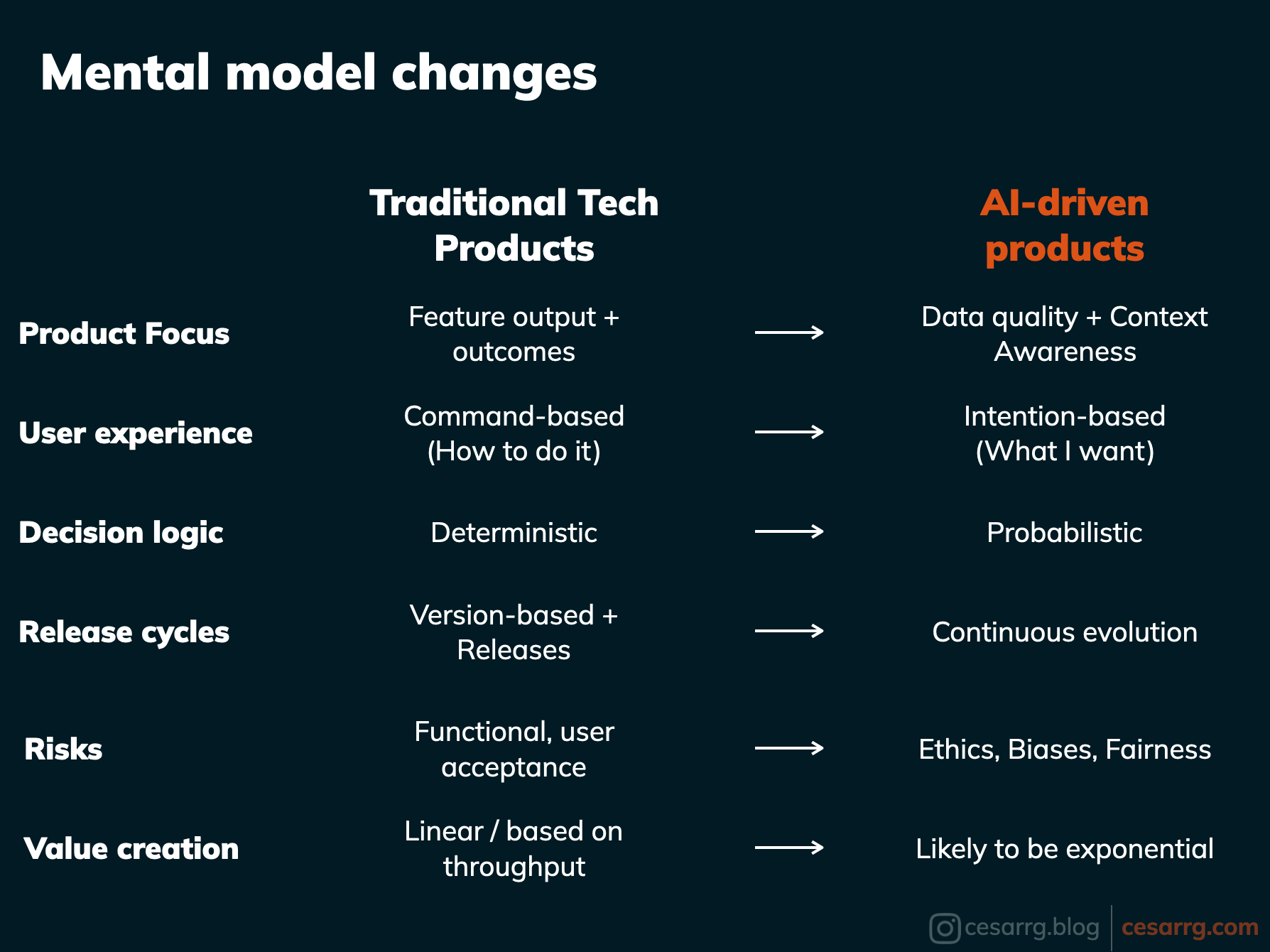
Starting with Product Focus. Traditional product management centers on outcome-driven features and UX. With AI products, we must equally prioritize features, data quality, and model performance. Your data strategy becomes as important as—or even more important than—your feature strategy.

User Experience. As customers shift to intention-based interactions with software, we need new tools and methods to manage their experiences. Not only on how the system reacts to such requests, but how to educate users on the best way to share their intent with the system.

Decision Logic. Traditional products deliver deterministic results — the same input always produces the same output. AI products operate probabilistically. Results may vary and improve over time as the model learns. We need to design the guardrails to handle customer expectations, anticipating wrong outputs due to hallucinations and providing transparency to customers on how decisions were made.

Release Cycles. Traditional products follow defined release cycles with clear versioning. AI products often use continuous deployment models where the system is constantly learning and evolving. While model's versioning continues to be applicable, we require new monitoring, validation, and rollback strategies for systems that are in constant evolution.

Risks. Traditional product management anticipate all sorts of risks, from purely functional ones (will the product serve its purpose?) to feasibility, usability and business risks. With AI, risks that were often neglected become foundational. Risks on how we remove biases, how we promote fairness and how we incorporate design principles over ethics will become the new norm.

Value Creation. Traditional products typically grow linearly based on feature addition. AI products can improve exponentially as adoption increases due to these data network effects. This creates a different scaling dynamic, where user adoption curves can take us by surprise. While scalability has been a core part of system design, now we are playing in new fields of scaling.
CTA Image

Discover actionable insights and expert tips to transform how you approach innovation, technology, and creativity. Practical tools you can apply immediately. Yes, they are free!

Get E-books

Measuring success

Our measurement tools must evolve with our products.

While traditional products might track clicks, conversion rates, and task completion, AI products require different success metrics:

  • How often users need to refine their prompts to get what they want?
  • What is the level of confidence from users on the outputs?
  • How are we iterating over customer feedback to increase alignment?

Pay special attention to moments of delight versus frustration – understanding when variability creates value versus confusion.

Success in AI products may look different too.

Is less about task completion and more about goal achievement. Jobs-to-be-done will take the front seat to guide product teams towards the right success metrics.


We are entering a new era of product design and development. An exciting one!

The opportunities are huge if you embrace these changes with an open mind and, sometimes, breaking the traditional way of doing things.

A time to experiment, learn and iterate.

¡Saludos!

César Rodríguez