



惯性聚合 高效追踪和阅读你感兴趣的博客、新闻、科技资讯
阅读原文 在惯性聚合中打开

推荐订阅源

K
KPMG report finds enterprise disconnect between AI and its ROI | CIO
W
WeLiveSecurity
L
LINUX DO - 最新话题
IT之家
IT之家
S
SegmentFault 最新的问题
T
The Blog of Author Tim Ferriss
博客园 - 聂微东
Google Online Security Blog
Forbes - Security
Forbes - Security
N
News | PayPal Newsroom
T
Troy Hunt's Blog
Last Week in AI
Last Week in AI
月光博客
月光博客
博客园 - 三生石上(FineUI控件)
S
Security Affairs
N
News and Events Feed by Topic
S
Securelist
美团技术团队
有赞技术团队
有赞技术团队
T
Tailwind CSS Blog
TaoSecurity Blog
TaoSecurity Blog
C
Cybersecurity and Infrastructure Security Agency CISA
J
Java Code Geeks
A
Arctic Wolf
Blog — PlanetScale
Blog — PlanetScale
量子位
D
Darknet – Hacking Tools, Hacker News & Cyber Security
The GitHub Blog
The GitHub Blog
Webroot Blog
Webroot Blog
OSCHINA 社区最新新闻
OSCHINA 社区最新新闻
F
Full Disclosure
云风的 BLOG
云风的 BLOG
Apple Machine Learning Research
K
Kaspersky official blog
Google DeepMind News
Know Your Adversary
Know Your Adversary
S
Schneier on Security
Application and Cybersecurity Blog
钛媒体:引领未来商业与生活新知
钛媒体:引领未来商业与生活新知
Microsoft Security Blog
D
DataBreaches.Net
Cisco Talos Blog
Cisco Talos Blog
L
LangChain Blog
Cyber Security Advisories - MS-ISAC
U
Unit 42
cs.CV updates on arXiv.org
宝玉的分享
宝玉的分享
Hacker News - Newest:
Hacker News - Newest: "LLM"
MongoDB | Blog
MongoDB | Blog
S
Security @ Cisco Blogs

Hacker News - Newest: "AI"

AI can't read an investor deck AI as an attorney? Student uses ChatGPT, Gemini to sue UW over alleged racial discrimination Hacking MCP Servers in AI Systems – The Rug Pull: Tool Changes After Approval GitHub - MeepCastana/KubeezCut: Free Web based video editor GitHub - GenAI-Gurus/awesome-eu-ai-act: Curated tools, official sources, OSS, templates, and guides for EU AI Act compliance. Can AI judge journalism? A Thiel-backed startup says yes, even if it risks chilling whistleblowers Coming soon: 10 Things That Matter in AI Right Now DARPA built an AI to fact-check enemy weapons claims What explains heterogeneity in AI adoption? When AI Meets Muscle: Context-Aware Electrical Stimulation Promises a New Way to Guide Human Movements - Department of Computer Science AI Changed How We Build. It Did Not Change What Matters. Linux rules on using AI-generated code - Copilot is OK, but humans must take 'full responsibility for the… Meta spins up AI version of Mark Zuckerberg to engage with employees Code Mode: Let Your AI Write Programs, Not Just Call Tools | TanStack Blog GitHub - Delavalom/graft: Go framework for building AI agents. Type-safe tools, multi-provider (OpenAI, Anthropic, Gemini, Bedrock), zero vendor SDKs. India's TCS tops estimates, says new AI models did not dent services demand Gen Z's fading AI hype Strong feeling: we are in a folded AI reality GitHub - machinarii/total-recall-catalog: A reference catalog of latest knowledge retrieval, memory & RAG systems GitHub - mensfeld/code-on-incus: Give each AI agent its own isolated machine with root, Docker, and systemd. Active defense detects and stops threats automatically.. Quantization, LoRA, and the 8% Problem: Benchmarking Local LLMs for Production AI Iran war: We spoke to the man making Lego-style AI videos that experts say are powerful propaganda Powell, Bessent discussed Anthropic's Mythos AI cyber threat with major U.S. banks GitHub - immartian/bellamem: Persistent belief-graph memory for AI agents. Retrieves decisive context by importance — not recency, not RAG, not /compact. recursive-mode: The Repo-Native Operating System for AI Engineering After the attack on Sam Altman's home, will AI CEO's go on the offensive? The biggest advance in AI since the LLM Opus 4.6 vs GPT 5.4 One Prompt Unity World Generation Test “AI polls” are fake polls Client Challenge Can AI be a 'child of God'? Inside Anthropic's meeting with Christian leaders How to Switch AI Chatbots and Why You Might Want To GitHub - MattMessinger1/agentic_refund_guardrail: Safe refund policy layer for AI agents — Python + TypeScript. Same behavior, shared tests. Adam/papers/emergent_values_whitepaper.md at master · strangeadvancedmarketing/Adam Ask HN: How do you stop playing 20 questions with your AI coding tools How far can automation and AI support psychotherapy? - @theU GitHub - stagas/rtdiff: realtime git diff gui and AI-assisted commits A Mac Studio for Local AI — 6 Months Later A History of the Early Years of AI at the University of Edinburgh Why AI Coding Tools Still Feel Stuck on Localhost MSN AI Datacenters Are Becoming Strategic Targets twitter.com Penn Researchers Use AI to Surface Unreported GLP-1 Side Effects in Reddit Posts Show HN: MoodSense AI (ML and FastAPI and Gradio, Deployed on Hugging Face) Moodsense Ai - a Hugging Face Space by aman179102 AI models are terrible at betting on soccer—especially xAI Grok GitHub - xialeistudio/echoic GitHub - HimashaHerath/github-dev-wrapped: AI-powered weekly GitHub activity reports deployed to GitHub Pages GitHub - alejandrobalderas/claude-code-from-source: Architecture, patterns & internals of Anthropic's AI coding agent — reverse-engineered from source maps AI and Tech brief: Ireland ascendant GitHub - Titovilal/context0: Context0 - Never Surrender Training for a Marathon with an AI Coach: What Worked and What Didn't Cyber Pulse: Agentic Intel - Apps on Google Play I Built an AI PR Reviewer That Catches Bugs by Not Looking for Bugs Gen Z workers are so fearful AI will take their job they’re intentionally sabotaging their company’s AI rollout | Fortune How AI Is Reimagining the Game of Golf–For Both Players and Courses GitHub - nattergabriel/reseed: A CLI tool for managing and distributing agent skills across projects Is SVG the final frontier? My AI workflow evolved from prompts to a near-autonomous workflow MLSharp Help - 3DGS Viewer & Generator I put my cognitive field based AI's runtime on GitHub Is Numble the first AI-proof game? A3: Kubernetes for autonomous AI agent fleets | Emergent Principles Deepali Vyas ("The Elite Recruiter") GitHub - msmarkgu/RelayFreeLLM: A restful API designed to route user prompts to various AI model providers. Unionized ProPublica staff are on strike over AI, layoffs, and wages Unleashing the Advantage of Quantum AI We're heading for an AI-fueled 'dementia crisis,' brain scientist warns The AI-Assisted Breach of Mexico's Government Infrastructure [pdf] GitHub - stef41/lmscan: 🔍 Detect AI-generated text and fingerprint which LLM wrote it. Open-source GPTZero alternative. Zero dependencies, works offline. MSN GitHub - visionscaper/collabmem: Enabling long-term collaboration with Agentic AI - building up episodic and world model memory over time with in-context awareness We gave an AI a 3 year retail lease in SF and asked it to make a profit | Andon Labs AI Code is Hollowing Out Open Source, and Maintainers are Looking the Other Way What leaked "SteamGPT" files could mean for the PC gaming platform's use of AI AI is the boss at this retail store. What could go wrong? GitHub - Wuzu11517/agentic-proxy: Local proxy meant to help reduce With Drones, Geophysics and ArtificiaI Intelligence, Researchers Prepare to Do Battle Against Land Mines A Single Operator, Two AI Platforms, Nine Government Agencies: The Full Technical Report 在 Steam 上购买 FriedrichAI: Offline AI 立省 10% GitHub - inevolin/resume-cli: Hit Claude usage limits? Resume any AI coding session elsewhere. Switch tools at zero friction. GitHub - atripati/ark: AI Runtime Kernel — a context operating system for AI agents. Eliminates tool bloat, loads only what’s needed, and gives LLMs their reasoning space back. How to Build a Secure AI PR Reviewer with Claude, GitHub Actions, and JavaScript This Startup Wants You to Pay Up to Talk With AI Versions of Human Experts Intel Arc Pro B70 Brings 32GB VRAM to Local AI for $949 WordPress 7.0: The Good, the AI, and the Still Missing AI on the couch: Anthropic gives Claude 20 hours of psychiatry IatroBench: Pre-Registered Evidence of Iatrogenic Harm from AI Safety Measures AI Agents Know About Supabase. They Don't Always Use It Right. The history and future of AI at Google, with Sundar Pichai Inside an AI‑enabled device code phishing campaign How Meta Used AI to Map Tribal Knowledge in Large-Scale Data Pipelines AI for Systems: Using LLMs to Optimize Database Query Execution Forecasting the Economic Effects of AI Introducing Tinker: Play with AI, bring your ideas to life AI sheds light on an ancient gaming mystery People really hate AI but not as much as Iran—or Democrats | Fortune What is an AI Product Engineer? Phoebe Gates wants her $185 million AI startup to succeed with 'no ties to my privilege or my last name': 'I have a chip on my shoulder' | Fortune
How to Build Safe AI (Without Making the AI Safe)
stefie10 · 2026-05-14 · via Hacker News - Newest: "AI"

As agentic LLMs are widely deployed to assist with all sorts of tasks, it is critical to make sure they are as safe as a Boeing 747.

A frame of video taken immediately before a midair collision between a Piper PA-32R and a Eurocopter AS350 that occurred over the Hudson River in 2009.  Source: NBC News / MSNBC
A frame of video taken immediately before a midair collision between a Piper PA-32R and a Eurocopter AS350 that occurred over the Hudson River in 2009. Source: NBC News / MSNBC

Existing approaches focus on how to provide safety guarantees for the LLM itself, but this task is challenging and perhaps impossible. Think of an LLM as a lens. Depending on the direction, phase, and wavelength of the incoming light, it refracts differently. Like a viroid, and LLM is a consciousoid, and how it behaves depends on the light hitting it: the high-dimensional input from its interlocutor. We do not yet have a closed-form model for this projection, so determining whether a given input produces a given output requires running an empirical test. The LLM’s high-dimensional input space, output space, and parameter space make it fundamentally hard to certify.

Instead, I propose a systems approach: treat the LLM as one component of a larger system. The LLM itself can never be safe, and in fact, we do not trust it at all. But the system it is part of can have safety guarantees by following practices in ISO standards for safety, security, and risk. These same practices enable us to have airplanes in the sky, cars on the road, and robots in factories.

The methodology is straightforward: safety-rated guardrails at the input/output boundaries of the system ensure safe operation. To be verifiable, say, to a one-in-100,000 probability of failure, as specified in ISO 61508, these guardrails must be low-dimensional relative to the LLM. For example, a safety-rated E-stop in a factory robot must promise with 10^-5 that it will actually stop the robot if depressed in order to be certified by TÜV. A simple example: a check that the system cannot write outside of a specified directory. As dimensionality increases, guardrails may become probabilistic, for example, a classifier with a probabilistic guarantee could validate a bash script before it executes.

The highest-dimensional and noisiest channel of all is the channel between the human and the LLM. Prompted by the LLM, the human could go off and do, well, anything, including quite horrible things. It is therefore not possible to have ISO-style safety guarantees around the human-LLM interaction. A more realistic way to think about this is to compare human-LLM interaction to human-human interaction, which has a wide spectrum. We tolerate this sort of risk in our society: cult leaders, abusers, and scammers exist and are sometimes successful. To combat this risk, we use a combination of interventions that maintain our societal structures: law, health care, education, and more. We use this approach today when we put a 16-year-old driver behind the wheel. The car itself is constructed and certified according to these safety standards. The 16-year-old is not, so we educate them, we make them have a teacher in the car, and eventually we let them drive. (And we tolerate car accidents as the leading cause of death in that age group).

Here is where the analogy to humans starts to break. The residual risk society tolerates from scammers and cult leaders is calibrated to human time constants. A scammer takes days or weeks to build trust with one victim. Our interventions, law, education, and social institutions evolved against that clock. LLMs run the same loop in seconds, in parallel, across millions of targets, exploiting the very mechanisms humanity has based its structures around. To name this precisely, consider the total societal harm from a class of agents:

Rtotal=Nrp(1-v)

Where N is the number of deployed agents, r is interactions per unit time per agent, p is the probability of a harmful outcome per interaction, and v is the verification coverage of our guardrails. For humans, N × r is bounded by population and biology. For LLMs, N × r is bounded instead by the inference throughput of available data centers, the bandwidth of the internet, and the context window that the model can be provided. Those bounds are rising fast, and none of them shares a ceiling with human biology. Even if p is lower for an LLM than for a skilled human scammer, Rtotal can exceed what our existing interventions were calibrated to absorb.

This is where LLM speed, the thing that creates the problem, also points toward the solution. Two things scale with the time budget per interaction: utility to the user, which falls as interactions get slower, and verification coverage, which rises as we get more time to check outputs. Model them as:

U(t)=e-t, v(t)=1-e-kt

Where α is how much users lose per unit of added latency, and k is the verification efficiency. Net value per interaction is:

V(t)=U(t)v(t)=e-t(1-e-kt)

Maximizing V gives an optimal time budget:

t =(1/k)(1+k/)

This equation has the shape of a classic speed-accuracy tradeoff. The (1 − e^(−kt)) term is Wickelgren’s function from 1977, and the optimization of deliberation time against decaying utility has been solved in drift-diffusion models, in neuroscience, and in economics. The math is not new. The reframing is: k is the efficiency of a parallel verifier, not an individual’s evidence accumulation, and α is society’s aggregate latency tolerance, not personal opportunity cost. The tradeoff psychology studied one decision at a time reappears as an engineering problem at the datacenter scale.
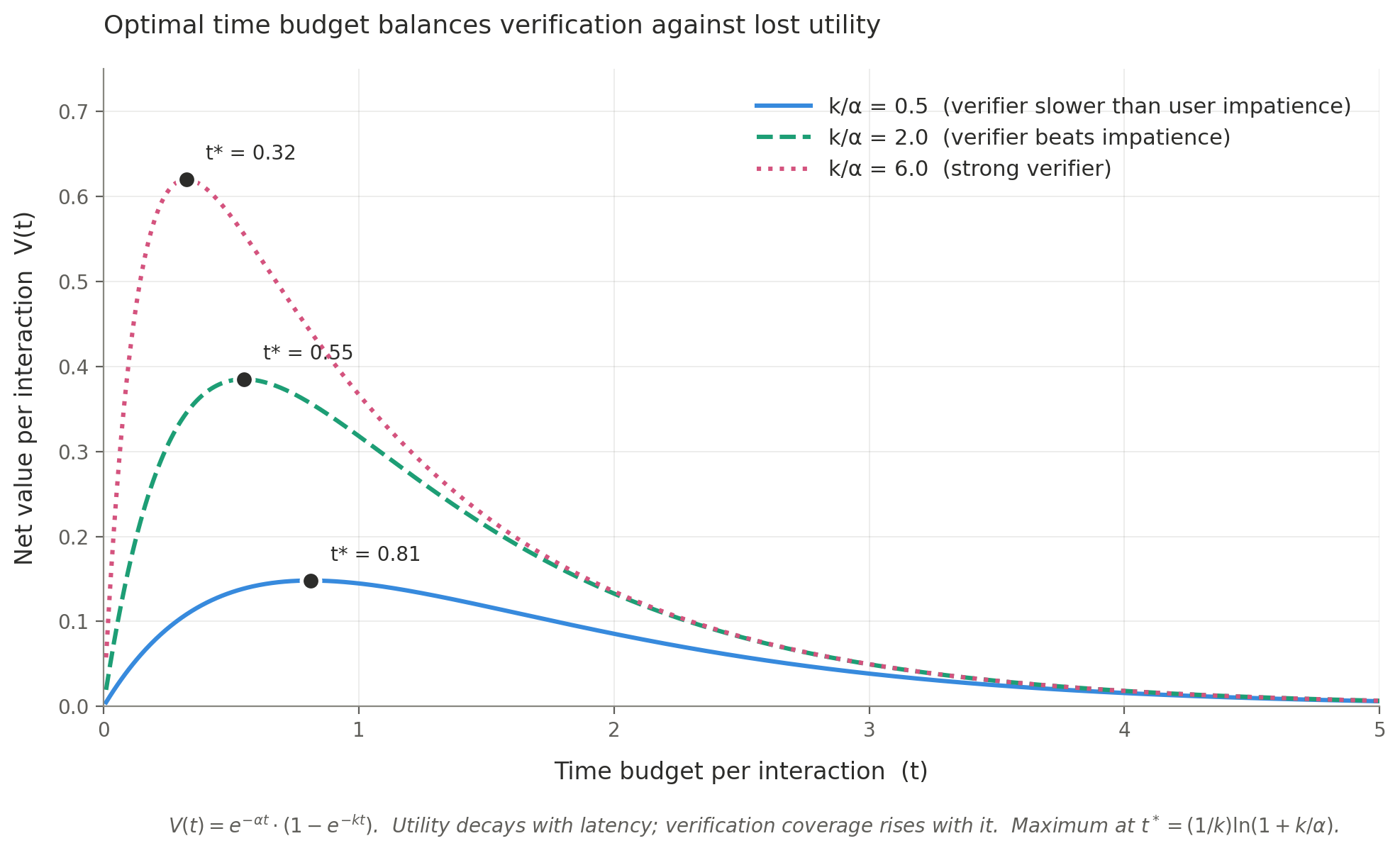
The ratio k/α is what determines whether slowing down is worth it. When k ≪ α, verifiers are too slow to matter, and the system should just optimize for speed. When k ≫ α, verifiers can do real work in the time budget, and the optimum shifts toward more verification. Humans cannot exploit this tradeoff because we do not have concurrent processes running checks on our own cognition at millisecond latency. LLMs can. While one process drafts an output, another simulates consequences, validates against policy, or cross-checks with a second model. Better verifiers, meaning higher k relative to α, raise the peak and shift it earlier: safety and throughput improve together. The old interventions assumed a serial agent with no spare cycles. LLMs are not that kind of agent.

This math means the systems-safety playbook applies, and it needs to be extended. We still want safety-rated guardrails at system boundaries, the way we do for factory robots and aircraft. We also need a new category of intervention that exploits the latency budget LLM speed creates, and that treats verification coverage as a first-class engineering target rather than an afterthought.

For LLMs, we need to develop these interventions while also understanding that no intervention can make an LLM, on its own, safe enough for an airplane cockpit. In my introduction to robotics course, I ask my students to read an FAA crash report about the 2009 Hudson River mid-air collision between a helicopter and a small airplane. One contributing factor to the crash was that the FAA controller was engaged in a “non-pertinent phone call,” and failed to correct the pilot’s incorrect readback of the Newark control tower’s radio frequency. But this sort of accident is rare exactly because we have many checkpoints, because we recognize that humans themselves are untrustworthy and need layers of verification.

We know how to build safe systems around untrustworthy components. We’ve been doing it for decades in aviation, medicine, and manufacturing. The lessons apply to AI, but they are not sufficient for AI. The untrustworthy components we have now run faster than the interventions we built for the untrustworthy components we had before. It’s time to apply the old lessons and to build the new ones.