


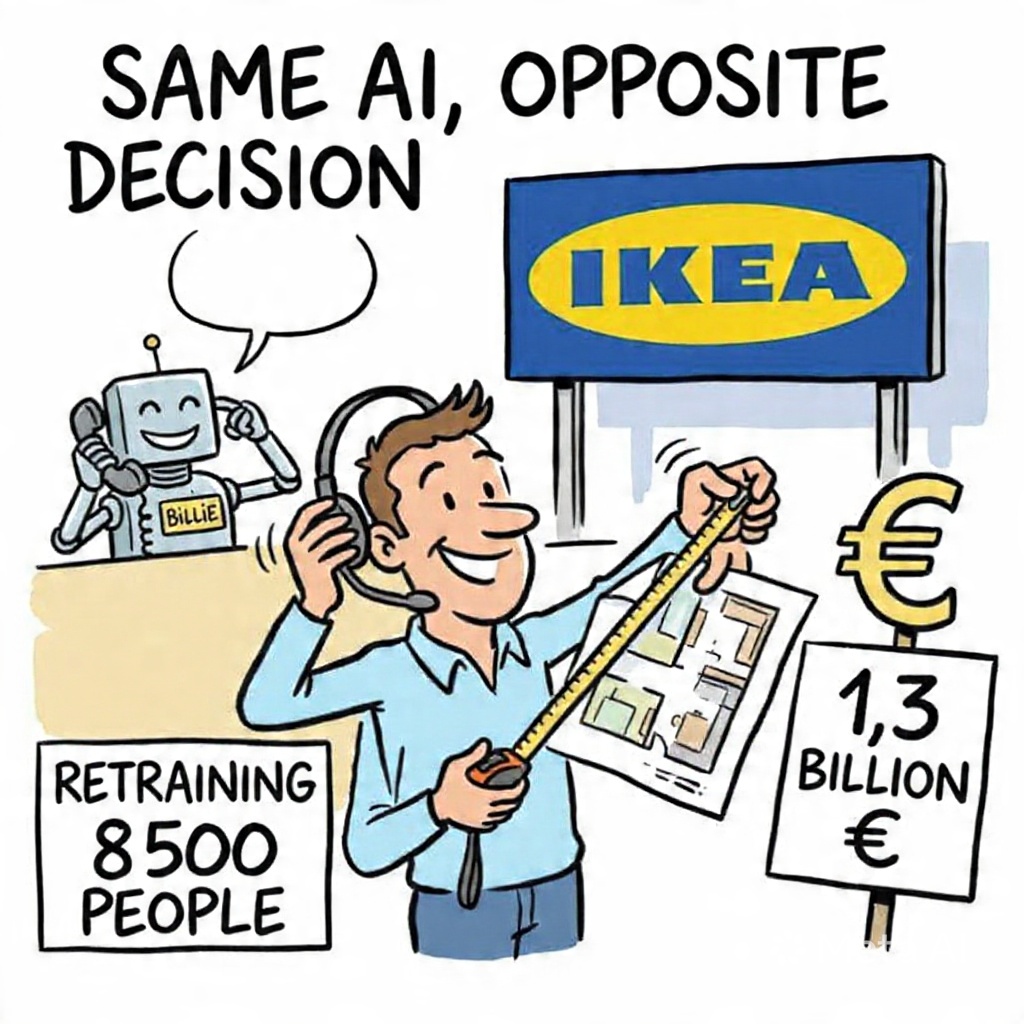
 Every major company in 2026 is deploying the same AI tools. Customer service chatbots. Document automation. Code assistants. Email summarization. The technology is genuinely good, the savings are real, and the press release writes itself.
Then comes the decision point.
Most CEOs use the savings to cut headcount. One company used the savings to build a €1.3 billion revenue line. Same technology. Same starting point. Opposite outcome. The difference was a single strategic decision made at the top, and it explains almost everything about why "AI-driven layoffs" mostly fail to create lasting value.
That company is IKEA. The case study is now public, verified, and well-documented across CIO, Reuters, PYMNTS, the World Economic Forum, and Ingka Group's own disclosures. Here is what actually happened, with the real numbers.
In 2021, Ingka Group, the largest of IKEA's 12 franchise operators (running the majority of 460+ stores worldwide), deployed an AI chatbot named Billie. The name was a nod to the famous Billy bookcase. Billie was built to handle the predictable queries that swamp every retail call center: order status, delivery tracking, store hours, return procedures, product availability.
By 2023, the results were exactly what the consulting deck would have predicted.
This is the part where, in 99% of companies, the CFO walks into a meeting with a workforce reduction proposal. 8,500 call center workers suddenly had roughly half their previous workload absorbed by software. The conventional playbook is to reduce headcount proportionally, announce the cost savings, watch the stock pop, and move on.
IKEA did not do that.
Instead of running the layoff math, Ingka Group did something almost no other company has bothered to do at this scale. They looked at the 53% of queries Billie could not solve.
The pattern in the unresolved queries was not random. Customers were not just asking harder versions of the same routine questions. They were asking consultative ones. How would this sofa fit in my living room? What should I pair with this kitchen? Can you help me plan a small bedroom from scratch? These were not transactional support tickets. They were design conversations that no chatbot could handle and no call center agent had time to handle properly.
That was the signal. Customers wanted interior design advice, they were willing to pay for it, and the latent demand had been invisible for years because the call center workforce was buried in routine queries that Billie was now handling automatically.
What IKEA built next is the part of the case study that competitors keep skipping over.
Ingka Group did not retrain a small pilot group. They retrained all 8,500 affected call center workers as remote interior design advisors. New competencies included remote design consultation, digital retail sales, room planning, relationship building, and the kind of judgment-heavy problem solving a chatbot cannot replicate.
The advisors operate by phone and video. In the UK, the service launched in April 2023 with tiered pricing: £25 for a 45 to 60 minute video consultation with product recommendations, and £125 for three workspace consultations including a floor plan and 3D visuals. By 2025, the service was helping over 73,000 customers annually with remote furniture and kitchen planning.
The workforce strategy made business sense for a specific reason. These 8,500 people already had two things that took years to build: deep IKEA product knowledge and customer empathy from years of handling queries. They were not retrained from scratch. They were leveled up from "answer the same question 50 times a day" into a higher-value role that built on what they already knew.
The numbers on the new revenue line are where this case study gets impossible to ignore.
Look at the gap between the two paths.
The difference is 100x. One hundred times more value created by retraining the workforce than by firing it. To the point where, as CIO reported, IKEA barely even mentions the original €13 million savings anymore. The cost story got absorbed by a revenue story that is two orders of magnitude bigger.
If the IKEA outcome is so obviously superior, why is the rest of the market running the opposite playbook?
A layoff announcement creates an immediate, measurable, board-friendly number. €13 million saved this year. It flows directly to operating margin. The CEO can take credit at the next earnings call. The CFO can model it cleanly. The market rewards the predictable narrative.
A reskilling program creates a messy, multi-year story. It costs money upfront. It requires building a new service no one has tested yet. The revenue line takes 18 to 36 months to materialize. The CEO who launches it might not be in the seat to take credit when the numbers land. The incentives at most public companies are pointed in the wrong direction.
Retraining 8,500 people is not a memo. It is a budget line, a curriculum, an instructional design team, a quality assurance program, and 12 to 18 months of dedicated investment. A 2026 PYMNTS Intelligence report of CFOs at large US firms found only 12% feel "very prepared" to manage workforce transitions triggered by AI deployment. 47% expect AI to significantly reduce headcount. Only half expect AI to create new roles requiring new skills.
The gap between the IKEA approach and the average corporate approach is not a gap in available technology. It is a gap in organizational capability and strategic patience.
The layoff narrative comes pre-packaged with willing storytellers. Press release templates. Investor briefings. AI-transformation slide decks. Layoff washing, the practice of branding cost cuts as AI-driven strategic transformation, is so common in 2026 that the term has its own Wikipedia entry and academic papers.
The reskilling path has none of that. It requires the company to actually build something, deliver it to customers, and prove it works in revenue. Much harder. Much riskier. Much more interesting if it works.
The Three Workforce Lessons For Executives
Strip the IKEA case study down to its operational essentials and three principles emerge.
1. AI Creates Freed Capacity, Not A Strategy
When a chatbot absorbs 47% of customer queries, that does not tell you what to do with the workforce that was handling those queries. The technology hands you free capacity. What you do with that capacity is a separate decision, made by humans, with a different set of incentives. Most companies default to subtraction (cut the freed capacity from the cost base). A few choose addition (redirect the freed capacity into a new revenue line). The technology is identical. The outcomes are not.
2. The Workforce Already Has The Hardest Skills
The hardest skills to teach are domain knowledge and customer empathy. IKEA's 8,500 retrained workers already had both. Adding interior design training on top of an existing customer-service foundation is far cheaper than hiring 8,500 new interior design advisors from scratch and teaching them the product catalog. Reskilling existing employees is usually the cheapest path to a new capability, even when the upfront cost looks high on paper.
3. The High-Value Work Is What The AI Cannot Do
The 53% of queries Billie could not handle were not a failure case. They were a market signal. The unsolvable queries clustered around taste, judgment, relationship building, and contextual recommendation work. That is exactly the work humans do better than machines, and exactly the work customers pay premium prices for. Mapping the AI failure modes is one of the highest-leverage analytical exercises a company can run, because those failure modes mark the territory where a redirected workforce becomes irreplaceable.
What This Means For Salary And Career Strategy In 2026
For workers reading this, the IKEA case is one of the most important salary data points of the decade. It establishes that the value of a customer-facing employee can grow dramatically when AI handles the routine portion of the job. The £25 per 45-minute design consultation generates roughly £33 per hour of agent time, against a base call center salary of perhaps £12 to £15 per hour. More than double the hourly value, on the same headcount, with the same people.
This is the wage growth path nobody talks about. Not "switch jobs every 18 months." Not "negotiate harder." Become the version of yourself that the AI cannot replicate, inside the same company, before the company decides to cut your role rather than redirect it. That is a salary strategy, not just a workforce strategy.
The workers who actively map their own AI-resistant skills (judgment, taste, relationship depth, complex problem solving, anything that requires presence) are the ones who end up in the redirected roles when the chatbot lands. The workers who do not, end up in the severance package. Same technology. Same company. Different outcomes, decided by which conversation each individual employee has with their manager 12 months before the chatbot goes live.
The IKEA case study is not a feel-good story about good corporate values. It is a strategic playbook with a verified 100x ROI delta against the conventional layoff path. €1.3 billion in new revenue versus €13 million in cost savings, from the same starting situation.
The technology made the choice possible. The leadership decision made the difference. Most companies will keep choosing the layoff path because the incentives at most public companies reward visible short-term savings over invisible long-term value creation. A handful will copy IKEA, build new revenue lines on the back of redirected workforces, and quietly eat the lunch of the competitors who chose subtraction.
Three years from now, when the case studies on the 2024 to 2027 AI transition wave get written, IKEA will be in the chapter on what should have happened. Most of the rest of the market will be in the chapter on what actually did.
此内容由惯性聚合(RSS阅读器)自动聚合整理,仅供阅读参考。 原文来自 — 版权归原作者所有。