
惯性聚合 高效追踪和阅读你感兴趣的博客、新闻、科技资讯
阅读原文 在惯性聚合中打开

推荐订阅源

T
Threat Research - Cisco Blogs
OSCHINA 社区最新新闻
OSCHINA 社区最新新闻
The Register - Security
A
About on SuperTechFans
Cyber Security Advisories - MS-ISAC
L
LangChain Blog
N
Netflix TechBlog - Medium
量子位
博客园 - 三生石上(FineUI控件)
宝玉的分享
宝玉的分享
H
Help Net Security
D
Docker
D
DataBreaches.Net
T
Tailwind CSS Blog
阮一峰的网络日志
阮一峰的网络日志
B
Blog
博客园 - 聂微东
Apple Machine Learning Research
Google DeepMind News
The Cloudflare Blog
F
Full Disclosure
GbyAI
GbyAI
F
Fortinet All Blogs
Last Week in AI
Last Week in AI
Y
Y Combinator Blog
人人都是产品经理
人人都是产品经理
Recent Announcements
博客园 - Franky
MongoDB | Blog
MongoDB | Blog
有赞技术团队
有赞技术团队
博客园 - 叶小钗
小众软件
小众软件
V
Visual Studio Blog
月光博客
月光博客
Stack Overflow Blog
Stack Overflow Blog
The GitHub Blog
The GitHub Blog
Recorded Future
Recorded Future
J
Java Code Geeks
雷峰网
雷峰网
P
Privacy & Cybersecurity Law Blog
C
Cisco Blogs
C
Cyber Attacks, Cyber Crime and Cyber Security
AWS News Blog
AWS News Blog
Webroot Blog
Webroot Blog
美团技术团队
N
News | PayPal Newsroom
G
Google Developers Blog
Security Archives - TechRepublic
博客园_首页
V
Vulnerabilities – Threatpost

Hacker News - Newest: "AI"

AI can't read an investor deck AI as an attorney? Student uses ChatGPT, Gemini to sue UW over alleged racial discrimination Hacking MCP Servers in AI Systems – The Rug Pull: Tool Changes After Approval GitHub - MeepCastana/KubeezCut: Free Web based video editor GitHub - GenAI-Gurus/awesome-eu-ai-act: Curated tools, official sources, OSS, templates, and guides for EU AI Act compliance. Can AI judge journalism? A Thiel-backed startup says yes, even if it risks chilling whistleblowers Coming soon: 10 Things That Matter in AI Right Now DARPA built an AI to fact-check enemy weapons claims What explains heterogeneity in AI adoption? When AI Meets Muscle: Context-Aware Electrical Stimulation Promises a New Way to Guide Human Movements - Department of Computer Science AI Changed How We Build. It Did Not Change What Matters. Linux rules on using AI-generated code - Copilot is OK, but humans must take 'full responsibility for the… Meta spins up AI version of Mark Zuckerberg to engage with employees Code Mode: Let Your AI Write Programs, Not Just Call Tools | TanStack Blog GitHub - Delavalom/graft: Go framework for building AI agents. Type-safe tools, multi-provider (OpenAI, Anthropic, Gemini, Bedrock), zero vendor SDKs. India's TCS tops estimates, says new AI models did not dent services demand Gen Z's fading AI hype Strong feeling: we are in a folded AI reality GitHub - machinarii/total-recall-catalog: A reference catalog of latest knowledge retrieval, memory & RAG systems GitHub - mensfeld/code-on-incus: Give each AI agent its own isolated machine with root, Docker, and systemd. Active defense detects and stops threats automatically.. Quantization, LoRA, and the 8% Problem: Benchmarking Local LLMs for Production AI Iran war: We spoke to the man making Lego-style AI videos that experts say are powerful propaganda Powell, Bessent discussed Anthropic's Mythos AI cyber threat with major U.S. banks GitHub - immartian/bellamem: Persistent belief-graph memory for AI agents. Retrieves decisive context by importance — not recency, not RAG, not /compact. recursive-mode: The Repo-Native Operating System for AI Engineering After the attack on Sam Altman's home, will AI CEO's go on the offensive? The biggest advance in AI since the LLM Opus 4.6 vs GPT 5.4 One Prompt Unity World Generation Test “AI polls” are fake polls Client Challenge Can AI be a 'child of God'? Inside Anthropic's meeting with Christian leaders How to Switch AI Chatbots and Why You Might Want To GitHub - MattMessinger1/agentic_refund_guardrail: Safe refund policy layer for AI agents — Python + TypeScript. Same behavior, shared tests. Adam/papers/emergent_values_whitepaper.md at master · strangeadvancedmarketing/Adam Ask HN: How do you stop playing 20 questions with your AI coding tools How far can automation and AI support psychotherapy? - @theU GitHub - stagas/rtdiff: realtime git diff gui and AI-assisted commits A Mac Studio for Local AI — 6 Months Later A History of the Early Years of AI at the University of Edinburgh Why AI Coding Tools Still Feel Stuck on Localhost MSN AI Datacenters Are Becoming Strategic Targets twitter.com Penn Researchers Use AI to Surface Unreported GLP-1 Side Effects in Reddit Posts Show HN: MoodSense AI (ML and FastAPI and Gradio, Deployed on Hugging Face) Moodsense Ai - a Hugging Face Space by aman179102 AI models are terrible at betting on soccer—especially xAI Grok GitHub - xialeistudio/echoic GitHub - HimashaHerath/github-dev-wrapped: AI-powered weekly GitHub activity reports deployed to GitHub Pages GitHub - alejandrobalderas/claude-code-from-source: Architecture, patterns & internals of Anthropic's AI coding agent — reverse-engineered from source maps AI and Tech brief: Ireland ascendant GitHub - Titovilal/context0: Context0 - Never Surrender Training for a Marathon with an AI Coach: What Worked and What Didn't Cyber Pulse: Agentic Intel - Apps on Google Play I Built an AI PR Reviewer That Catches Bugs by Not Looking for Bugs Gen Z workers are so fearful AI will take their job they’re intentionally sabotaging their company’s AI rollout | Fortune How AI Is Reimagining the Game of Golf–For Both Players and Courses GitHub - nattergabriel/reseed: A CLI tool for managing and distributing agent skills across projects Is SVG the final frontier? My AI workflow evolved from prompts to a near-autonomous workflow MLSharp Help - 3DGS Viewer & Generator I put my cognitive field based AI's runtime on GitHub Is Numble the first AI-proof game? A3: Kubernetes for autonomous AI agent fleets | Emergent Principles Deepali Vyas ("The Elite Recruiter") GitHub - msmarkgu/RelayFreeLLM: A restful API designed to route user prompts to various AI model providers. Unionized ProPublica staff are on strike over AI, layoffs, and wages Unleashing the Advantage of Quantum AI We're heading for an AI-fueled 'dementia crisis,' brain scientist warns The AI-Assisted Breach of Mexico's Government Infrastructure [pdf] GitHub - stef41/lmscan: 🔍 Detect AI-generated text and fingerprint which LLM wrote it. Open-source GPTZero alternative. Zero dependencies, works offline. MSN GitHub - visionscaper/collabmem: Enabling long-term collaboration with Agentic AI - building up episodic and world model memory over time with in-context awareness We gave an AI a 3 year retail lease in SF and asked it to make a profit | Andon Labs AI Code is Hollowing Out Open Source, and Maintainers are Looking the Other Way What leaked "SteamGPT" files could mean for the PC gaming platform's use of AI AI is the boss at this retail store. What could go wrong? GitHub - Wuzu11517/agentic-proxy: Local proxy meant to help reduce With Drones, Geophysics and ArtificiaI Intelligence, Researchers Prepare to Do Battle Against Land Mines A Single Operator, Two AI Platforms, Nine Government Agencies: The Full Technical Report 在 Steam 上购买 FriedrichAI: Offline AI 立省 10% GitHub - inevolin/resume-cli: Hit Claude usage limits? Resume any AI coding session elsewhere. Switch tools at zero friction. GitHub - atripati/ark: AI Runtime Kernel — a context operating system for AI agents. Eliminates tool bloat, loads only what’s needed, and gives LLMs their reasoning space back. How to Build a Secure AI PR Reviewer with Claude, GitHub Actions, and JavaScript This Startup Wants You to Pay Up to Talk With AI Versions of Human Experts Intel Arc Pro B70 Brings 32GB VRAM to Local AI for $949 WordPress 7.0: The Good, the AI, and the Still Missing AI on the couch: Anthropic gives Claude 20 hours of psychiatry IatroBench: Pre-Registered Evidence of Iatrogenic Harm from AI Safety Measures AI Agents Know About Supabase. They Don't Always Use It Right. The history and future of AI at Google, with Sundar Pichai Inside an AI‑enabled device code phishing campaign How Meta Used AI to Map Tribal Knowledge in Large-Scale Data Pipelines AI for Systems: Using LLMs to Optimize Database Query Execution Forecasting the Economic Effects of AI Introducing Tinker: Play with AI, bring your ideas to life AI sheds light on an ancient gaming mystery People really hate AI but not as much as Iran—or Democrats | Fortune What is an AI Product Engineer? Phoebe Gates wants her $185 million AI startup to succeed with 'no ties to my privilege or my last name': 'I have a chip on my shoulder' | Fortune
We are living in the dial-up era of AI · xydac
Deepak Seth · 2026-06-16 · via Hacker News - Newest: "AI"

Do you remember the sound?

The shriek and hiss of a modem talking its way onto the network. I used to dial in late at night, after everyone was asleep, so I wouldn’t tie up the phone. I’d sit there in the dark and listen to that handshake like it was two machines whispering a password to each other, and I’d hold my breath through the part where it could still fail. Then it would catch. You were online. To anyone walking past it was just noise. To me it was a door opening.

If you lived through it, you already feel where this is going. If you didn’t, stay with me, because I think you’re feeling a version of it right now and you just haven’t noticed yet.

When slow felt like magic

Dial-up was painfully slow. A photo loaded one strip at a time, top to bottom, and you’d sit there building the picture in your head, guessing what it was before it finished. A single song took most of a TV episode to come down. You waited for things the way you wait for a kettle.

And it was fragile in a way that’s hard to explain to anyone who came later. The internet and the phone shared one line, so being online meant the phone was busy, and anyone who picked up a receiver in another room walked straight into your connection. You’d be ninety percent through a download and hear a click, then that ugly burst of static screeching out of the earpiece, and you knew before they did: the line was gone, the file was dead, start over from zero. Half the arguments in my house were about somebody needing to “make a quick call.” I learned to shout I’m online! down the hallway like it was a thing worth defending. Sometimes it worked. Sometimes the modem dropped mid-handshake anyway and I just sat there, staring at the broken progress bar, starting again.

And here’s the part I can’t get across to people who weren’t there: it still didn’t feel slow. It felt impossible. We were pulling things out of the air, out of machines on the other side of the planet, and the fact that any of it arrived at all was the whole miracle. The waiting wasn’t a flaw in the experience. The waiting was the part where you leaned in close and paid attention with your whole body. You watched it come.

None of us had any idea we were standing at the very beginning of something.

Watch what you do now

Type a question into an AI. Hit enter. The answer streams back, word by word, left to right, painting itself down the screen. You lean in. You watch it land. Sometimes you can feel where the sentence is going a half-second before it gets there, and something in you leans forward to meet it.

Same posture. Same held breath. Same quiet, slightly disbelieving sense that a machine on the other side of the glass is doing something it has no business being able to do.

Here’s what I keep turning over at night: this is dial-up. Not like dial-up. Actually dial-up. The 56k modem of intelligence. We are watching the image paint itself one strip at a time and calling it fast, because we have nothing faster to hold it up against yet.

I have proof of how slippery the word “fast” really is. I went digging and found a screenshot I took in 2012: a Windows ISO coming down at 3.8 megabytes a second, the whole 2.4 gigabytes due in about fourteen minutes. I remember the feeling exactly: pure, uncomplicated pride. After all those years of dial-up, watching a multi-gigabyte file land faster than I could make a sandwich felt like the future had finally walked through the door and sat down next to me.
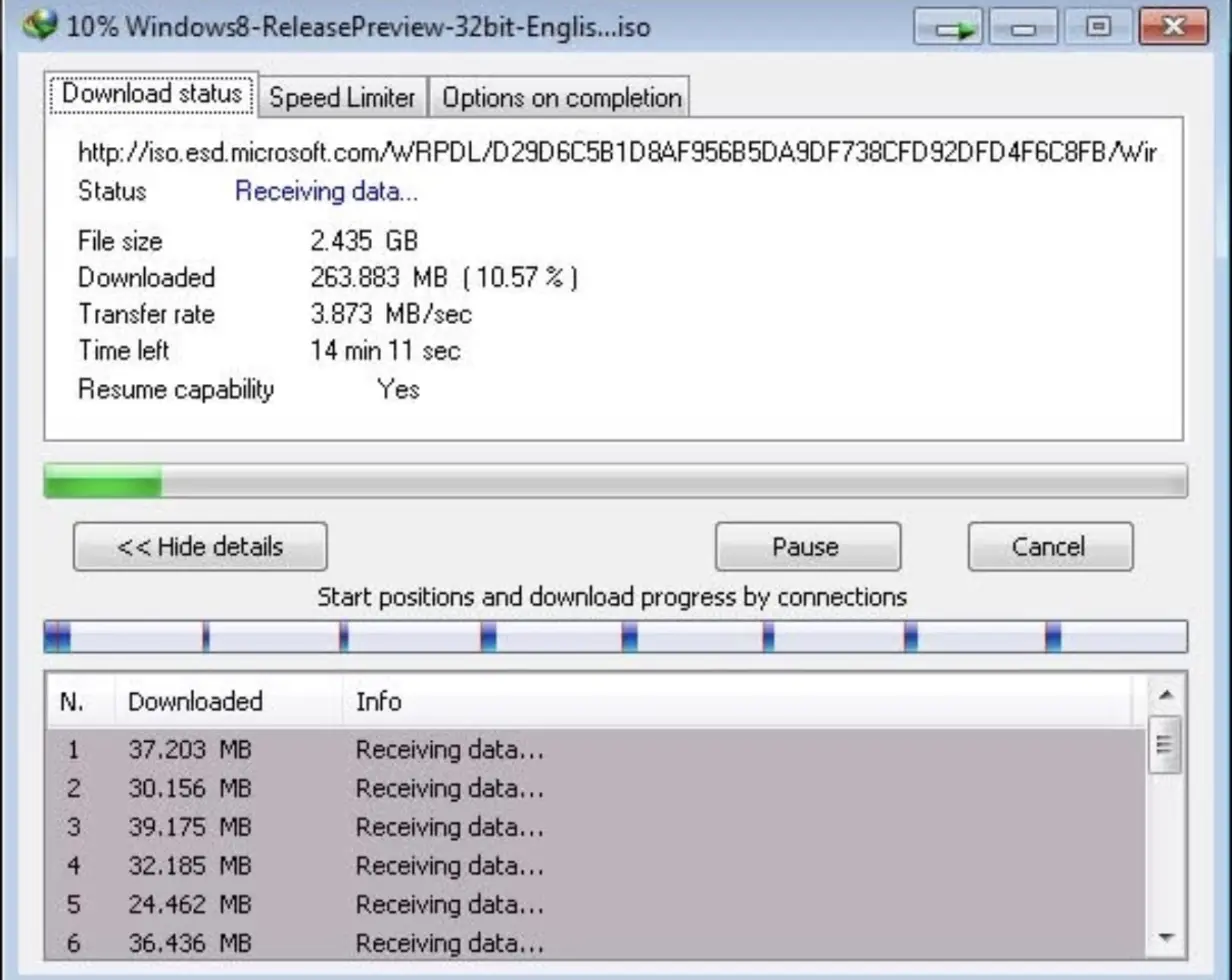
A 2012 Internet Download Manager window: a 2.4 GB Windows 8 ISO downloading at 3.873 MB/sec with 14 minutes remaining

2012. I was so proud of this I saved the screenshot. 3.8 MB/s felt like flying. Today it would feel broken.

Look at me. I was thrilled. And I had no idea I was still, in every sense that matters, waiting. That’s the trap, and it’s worth saying out loud: every speed feels like the finish line while you’re standing on it. We never think we’re on dial-up. We always think we just got off it.

We’ve already walked this road

The internet didn’t stay on dial-up, and the thing that changed wasn’t really speed. Each step quietly deleted the waiting, and every single time the waiting vanished, we didn’t just do the old thing faster. We did things that had been unthinkable the day before.

Cable made you “always on.” No more dialing in, no more kicking your sister off the phone. The page arrived whole instead of strip by strip, and the internet stopped being an event you scheduled and became a utility you forgot about. The version of that for AI is the moment short answers simply appear, too fast to track token by token. You stop asking-and-waiting. You ask, and it’s already there.

Broadband pushed it further. Video, calls, the cloud. The connection slid into the background and you stopped thinking about it at all. You quit saying “let me get online.” You just were. The AI version is when the model stops being a place you go. It’s ambient, sitting quietly inside everything you touch, half-answering before you’ve finished forming the question.

Then fiber made the pipe basically invisible. Nobody watches a webpage load anymore; the loading simply isn’t there. And once the connection stops being the bottleneck, the only thing left in your way is your own imagination about what to do with it. That’s the last rung for AI too: the moment speed stops being the constraint, and the only limit left is what you can dream up to ask of something nearly instant and nearly endless.

I genuinely don’t know what gets invented at that stage. Neither did anyone listening to a modem in 1997. Try explaining a video call to them, or a stranger streaming their whole life to millions, and watch their face. That’s the whole point. The interesting part was never the faster version of what we already had. It was the things that only became possible once nobody was waiting.

The magic is on loan

Notice what we’ve started calling these things. The most powerful models we’ve built carry names like Mythos and Fable. Not version numbers. Myth. Fable. The words a culture saves for the stories it tells to hold what it can’t otherwise explain. We reached for the language of legend without quite meaning to, because somewhere underneath we already know what this feels like: something out of folklore, sitting calmly on the other side of the screen, doing the impossible like it’s nothing.

But here’s what the dial-up house taught me, and what I keep having to relearn: the magic is always more fragile than it lets on. Back then the whole connection died the instant someone in another room lifted a receiver. This past week I watched a much heavier hand reach for the phone. Spooked about who overseas might get the most capable versions, the U.S. government ordered them restricted, and the order landed so bluntly that Mythos and the just-released Fable went dark for everyone, everywhere, not only the people it was aimed at. The most astonishing thing most of us had ever touched, switched off overnight as collateral. A click on the line. The download gone.

I sat with that longer than I expected to. Not because of the politics. Because of how it felt. It was the same small, stupid heartbreak as the broken progress bar at 90%. A reminder that none of this is owed to us. The door we keep walking through can be closed, sometimes by accident, sometimes by people who don’t even know whose line they’re cutting. Which is exactly why I can’t bring myself to take a single day of it for granted.

So lean in while you can still feel it

There’s a strange gift in being early. The people who remember dial-up got something the kids raised on fiber never will: we felt the magic, because we could feel the friction. We knew what it was like back when the connection itself was the wonder, before it got buried under everything we built on top of it.

We’re those people again, right now, with this. We still lean toward the screen. We still watch the words arrive one at a time and feel a little catch in the chest, the sense of being present at the start of something we don’t have a name for yet.

So pay attention to it. Maybe I’m wrong about the timeline (I’ve been wrong before), but I’d bet almost anything that this slowness, this clunky, miraculous, dial-up slowness, is the most awake any of us will ever be to this technology. Soon it’s cable. Then broadband. Then fiber. Then nothing you’d even think to mention.

One day you’ll try to describe what it was like to watch the tokens arrive, one at a time, holding your breath a little, and someone younger will give you the exact look kids give you now when you imitate the sound of a modem.

That sound meant a door was opening.

So does this one. Stand in it while it’s still open.