







Everything here, I've used myself. If you buy through these links, I earn a small commission — but that's not why I wrote this.
TL;DR: AI agents sort into three tiers in 2026: enterprise SaaS (Salesforce, Microsoft, Google, AWS), open-source ready-to-run (OpenClaw and its variants, Hermes Agent), and frameworks (LangChain, CrewAI, AutoGen). For most lean teams, the answer is one open-source agent in the middle tier.
Key Takeaways
- Gartner forecasts 40% of enterprise apps will feature task-specific AI agents by end of 2026, up from less than 5% in 2025 (Gartner, 2025)
- Over 40% of agentic AI projects will be cancelled by end of 2027, driven by cost overruns, unclear value, and weak risk controls (Gartner, 2025)
- The market sorts cleanly into three tiers, each with a different buyer, cost shape, and time commitment
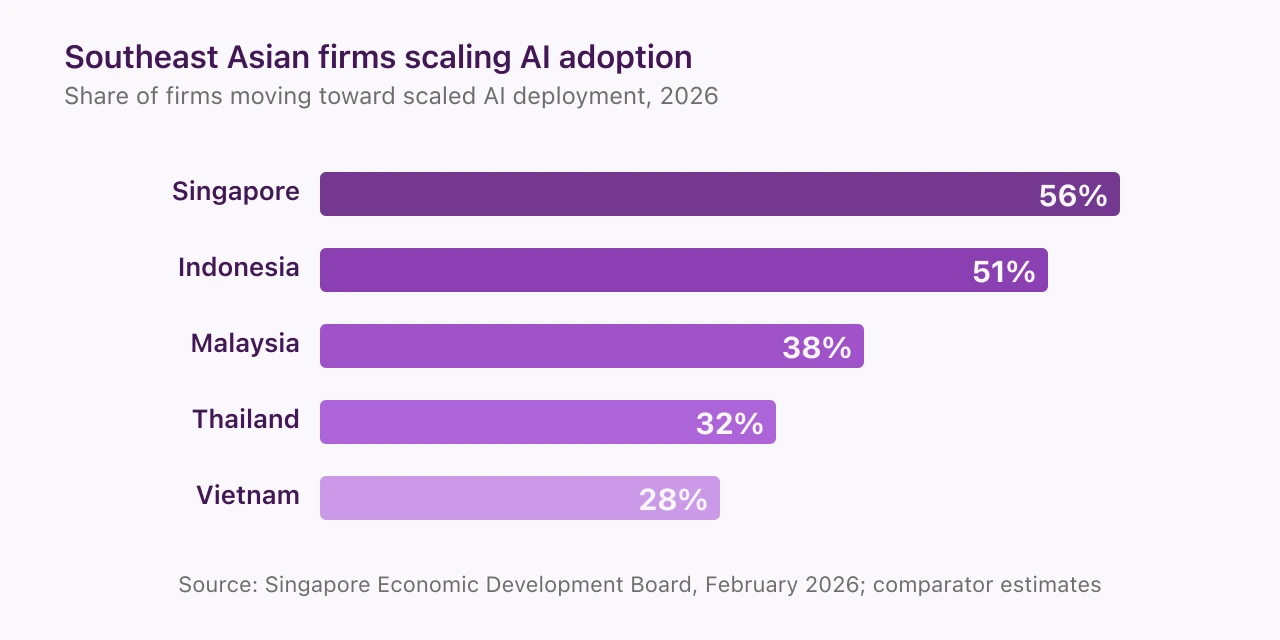
- In Southeast Asia, 56% of Singapore firms and 51% of Indonesian firms are already scaling AI, and nine in ten organisations across the region are ready to experiment with agentic AI (Singapore EDB, 2026)
- For most lean teams, the answer is one open-source agent and an honest list of what you need it to do, not a stack
An AI agent is a piece of software that holds context across conversations, decides what to do next, and acts on its own schedule. It is different from a chatbot in three concrete ways. A chatbot resets when you close the tab. An agent remembers. A chatbot answers one question at a time. An agent works on a task across many steps. A chatbot waits for you. An agent runs on a heartbeat or a cron and reaches out first.
The category took its current shape over about eighteen months. In late 2024, the first wave was custom GPTs and early frameworks. Through 2025, builders worked out which patterns held up in production. By early 2026, three things had happened in quick succession. NVIDIA announced NemoClaw at GTC on March 16, 2026, putting its weight behind the open-source OpenClaw project (NVIDIA Newsroom, 2026). Salesforce, Microsoft, Google and AWS all locked down their pricing for enterprise agents. And the gap between “AI demo” and “AI production” started to show up in real budgets.
The growth curve is steep enough that the laggards are about to notice.
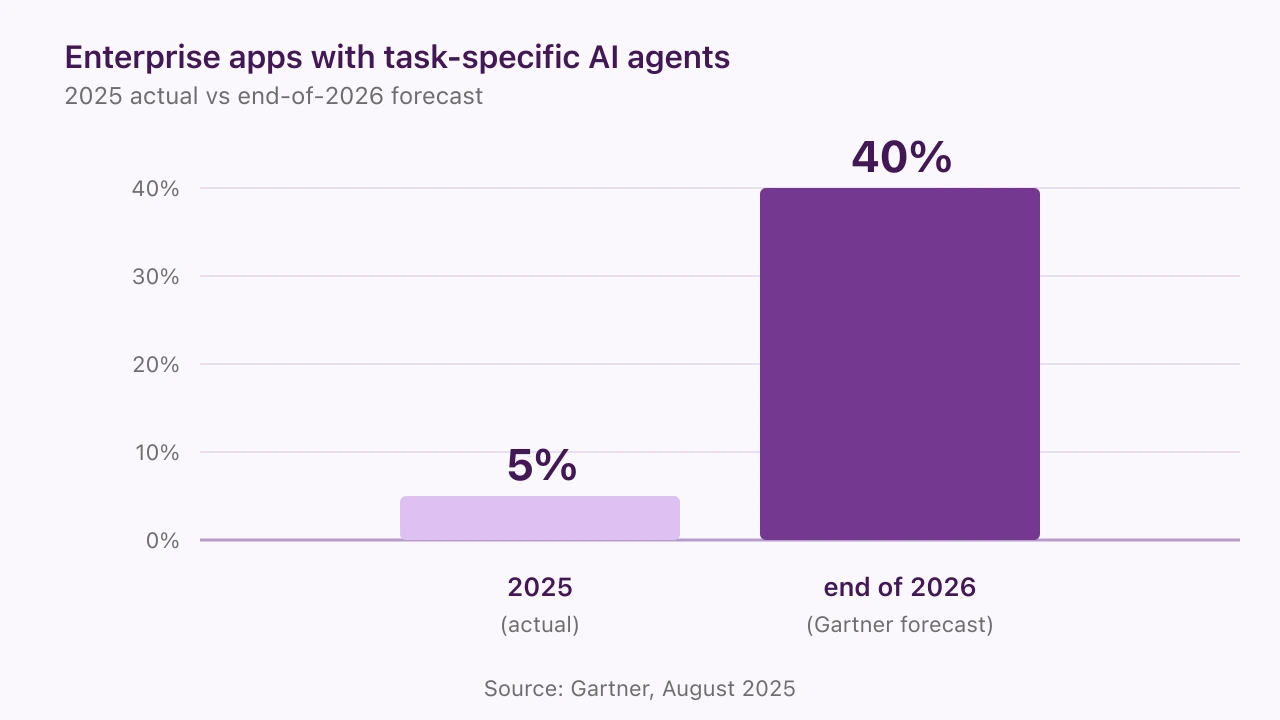
The honest framing matters. A 40% adoption forecast is not 40% of companies running agents successfully. Gartner expects over 40% of agentic AI projects to be cancelled by end of 2027, citing cost overruns, unclear value, and inadequate risk controls (Gartner, 2025). The category is growing fast. So are the dead-end projects inside it. The question for any business is not whether to look at agents, it is which tier matches the budget and the appetite for risk.
There are roughly three groups of AI agent products on the market in May 2026, and they answer three different buyers. Tier 1 is enterprise SaaS. You pay a subscription, the vendor runs it, the agent does customer-facing work inside their product. Tier 2 is open-source ready-to-run. You self-host a working agent and configure it through markdown files. Tier 3 is frameworks. Engineers build the agent themselves on top of a toolkit.
The infographic below shows the full map in one image. The rest of this section walks the three tiers in turn.
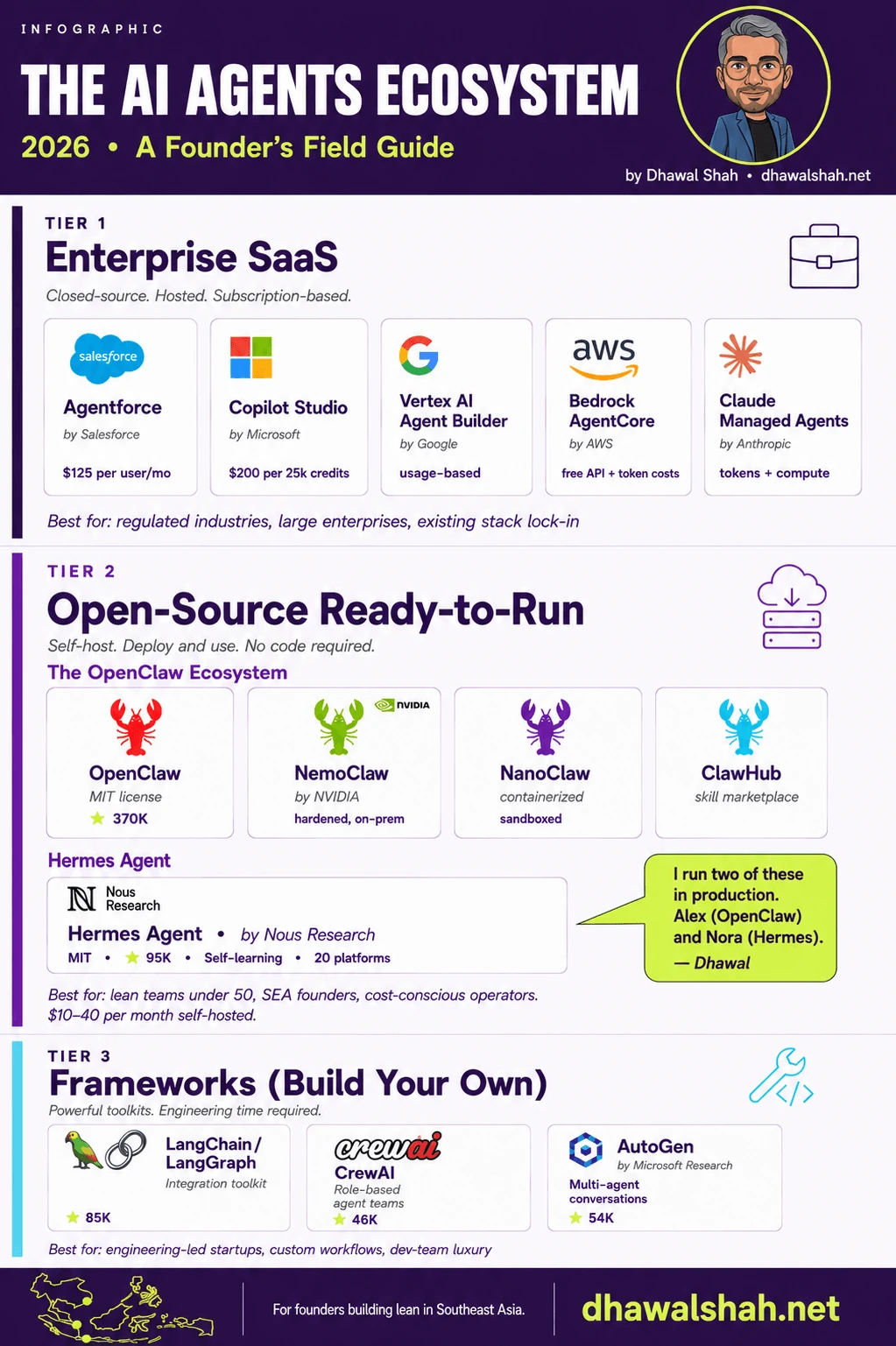
Use the infographic above on your own site.
These are full products built by large vendors and sold on a per-seat or per-usage subscription. The buyer is a regulated enterprise or a company already locked into the vendor’s stack. The agent runs inside the vendor’s cloud, the data flows through the vendor’s pipes, and pricing is predictable but not cheap.
The four serious options in May 2026:
Salesforce Agentforce uses three coexisting pricing models. A flat $2 per conversation for customer-facing agents. Flex Credits starting at $500 per 100,000 credits (roughly $0.10 per standard action at 20 credits each). And a $125 per user per month add-on license for internal use (Salesforce Agentforce pricing, 2026). Agentforce sits inside Salesforce, talks to Salesforce data, and answers Salesforce-shaped questions.
Microsoft Copilot Studio charges $200 per month for a pack of 25,000 Copilot Credits, with an alternative pay-as-you-go option that bills consumption at the end of each billing period (Microsoft Copilot Studio pricing, 2026). Copilot Credits replaced the older per-message billing as Microsoft moved the agent line onto consumption-based pricing (Microsoft Learn, 2026). For shops already on Microsoft 365 Copilot, internal agents are bundled in.
Google Vertex AI Agent Builder (rebranded as Gemini Enterprise Agent Platform at Cloud Next 2026) uses pure usage-based pricing across multiple dimensions: agent runtime compute, session memory events, Vertex Search queries, and model tokens, all billed separately (Google Cloud Pricing, 2026). Predictable for technical builders. Hard to estimate up front for a non-technical buyer.
AWS Bedrock AgentCore is the most fragmented of the four. Charges break across separate services: Runtime, Browser, and Code Interpreter at $0.0895 per vCPU-hour plus $0.00945 per GB-hour; Gateway API invocations at $0.005 per 1,000 calls; short-term memory at $0.25 per 1,000 events; with model tokens billed on top (AWS Bedrock AgentCore pricing, 2026). Predictable per line item, but the total is hard to estimate without an engineering team that will track each meter.
Anthropic Claude Managed Agents launched on April 8, 2026 as the runtime for developers building Claude-powered features into their own products (SiliconANGLE, 2026). Pricing is $0.08 per session-hour on top of standard Claude API token costs (Anthropic, 2026). It sits next to Bedrock AgentCore conceptually: a vendor-managed agent loop with no built-in chat interface. You build the user interface yourself. Best for engineering teams who want Claude specifically as their model and want Anthropic to manage state, container provisioning, and event streaming. I wrote a deeper comparison in Claude Managed Agents vs OpenClaw.
Tier 1 is the right answer if you are in a regulated industry (banking, healthcare, government), if your data already lives inside one of these vendors’ stacks, or if buying through procurement is faster than building. It is the wrong answer for a lean team that wants ownership and flat costs.
This tier is where most of the recent action sits, and where I run both of my agents. These are open-source projects you self-host on a small server, configure through a markdown file or a UI, and connect to the messaging apps and tools you already use. No code required.
The OpenClaw ecosystem is the centre of gravity. OpenClaw itself is MIT-licensed, the most-starred software project on GitHub, and as of May 2026 it has crossed 370,000 stars after passing React on March 3 (OpenClaw GitHub, 2026). Around the core project, three variants have grown:
NemoClaw is NVIDIA’s reference design for running OpenClaw securely in regulated enterprises. It bundles the OpenShell sandbox runtime, a privacy router, network guardrails, and NVIDIA Nemotron open models, all installable through a single command (NVIDIA Newsroom, 2026). Jensen Huang’s framing at the launch was direct: “OpenClaw is the operating system for personal AI.” NemoClaw is what you reach for if you want OpenClaw’s flexibility with enterprise-grade isolation.
NanoClaw is a lighter, container-isolated alternative built on Anthropic’s Agents SDK. It connects to WhatsApp, Telegram, Slack, Discord, and Gmail, supports memory and scheduled jobs, and runs in a tighter resource footprint (NanoClaw GitHub, 2026). Useful when you want sandbox isolation but do not need NemoClaw’s enterprise tooling.
ClawHub is the marketplace and registry for OpenClaw skills, plugins, and agent configurations. A library of pre-built capabilities you install with a single command. The flip side: when researchers ran a security audit in early 2026, they found 341 malicious skills among 2,857 audited (The Hacker News, 2026). Reviewing before installing matters.
Outside the OpenClaw ecosystem, the main alternative is Hermes Agent by Nous Research. Hermes is MIT-licensed, currently at version 0.13.0 (released May 7, 2026), and ships with 20 native platform integrations including Telegram, WhatsApp, Discord, Slack, Signal, Twilio SMS, Matrix, IMAP/SMTP email, Home Assistant, Microsoft Teams and Google Chat (Hermes Agent v0.13.0 release notes, 2026). Its differentiator is a self-learning loop: Hermes creates its own skills as it notices recurring patterns, and persists them across sessions through a curator system.
Tier 2 is the right answer for lean teams under 50 people, for founders who value flat predictable costs, and for anyone in Southeast Asia who wants to run an agent through Telegram or WhatsApp without paying enterprise per-seat pricing. The monthly bill for a self-hosted agent runs roughly $10 to $40, plus model API costs that depend on usage.
The third tier is for engineering-led teams who want to build a custom agent from primitives. These are powerful toolkits, but they assume you have a developer who will write the agent loop, manage state, and ship it to production.
LangChain and LangGraph sit at the centre of this tier. LangChain is broad: an integration toolkit for connecting models, tools, retrieval, and memory. LangGraph adds a state-machine layer on top, with audit and rollback semantics that hold up in production. LangChain has roughly 85,000 stars on GitHub, and LangGraph passed CrewAI in stars in early 2026.
CrewAI models agents as a “crew” with named roles and tasks. The framing makes prototyping quick. Around 46,000 stars on GitHub. Best for teams who think in role assignments and want a clean abstraction.
AutoGen is Microsoft Research’s conversational multi-agent framework. Around 54,000 stars on GitHub. Strong on group decision and debate patterns where agents argue toward a solution. AutoGen Studio offers a no-code UI for non-developers, but the underlying mental model still rewards engineering taste.
Tier 3 is the right answer for engineering-led startups building a custom agent into a product, or for teams who genuinely need workflows that none of the Tier 2 ready-to-run agents support. It is the wrong answer for a founder who wants to ship something useful this week.
The choice is less about size and more about three constraints: regulation, engineering bandwidth, and how fast you want to ship.
If you are in a regulated industry, the answer is Tier 1, full stop. Singapore PDPA, Indonesia PDP, healthcare, banking, and government work all push toward vendors with auditable cloud infrastructure and signed compliance attestations. Within Tier 1, pick by where your data already lives. Salesforce shop, Agentforce. Microsoft shop, Copilot Studio. GCP-native, Vertex. AWS-native, Bedrock. The on-premises variant for regulated cases is NemoClaw, which gives you OpenClaw’s flexibility behind NVIDIA’s security stack.
If you have engineers who would rather build than configure, and the use case is custom enough that no off-the-shelf agent fits, Tier 3 is yours. The trade-off is honest: faster ceiling, slower start, and a dev team committed to the agent indefinitely.
For most lean teams, the answer is Tier 2. This is where the time-to-useful is fastest, the monthly cost is lowest, and the flexibility is highest. The Singapore Economic Development Board’s February 2026 report found that 56% of Singaporean firms and 51% of Indonesian firms are scaling AI adoption, and nine in ten organisations across the region are ready to experiment with agentic AI (Singapore EDB, 2026). Most of those experiments will land in Tier 2, because lean teams cannot justify $125 per user for a thirty-person team and do not have a dev team to spare on agent infrastructure. The common SEA SME workflows I see deployed, like WhatsApp support, lead triage, and social scheduling, all sit in this tier.
Want my Tier 2 setup guide? I publish a fortnightly newsletter for founders running lean teams in Southeast Asia. Setup guides, real numbers, and what I am learning week to week. Subscribe here.
The rest of this article zooms into Tier 2, because that is the choice the most readers face and the one I have direct production experience with.
OpenClaw is a self-hosted personal AI agent platform that runs on a small server you control. You configure its behaviour through a set of files in your workspace: openclaw.json for the main config, AGENTS.md for agent setup, SOUL.md for personality and voice, TOOLS.md for tool definitions, and a skills directory for any reusable capabilities you install. None of this requires programming, but it is more files to learn than a single config. The primary interface is a messaging app, usually Telegram or WhatsApp, with twelve channel plugins available. It supports multiple AI models including Claude, Gemini, and others via OpenRouter, so you are not tied to a single provider.
The platform reached over 370,000 GitHub stars by May 2026, surpassing React in March to become the most-starred open-source software project in GitHub history (OpenClaw GitHub, 2026). Its creator, Peter Steinberger, joined OpenAI in early 2026 (TechCrunch, 2026).
What OpenClaw is best at:
SOUL.md and AGENTS.mdMy instance is called Alex. I have been running him in production since March 2026, and his role has shifted over the last two months. He started as my daily assistant. He is now running closer to an autonomous AI cofounder, building his own projects and publishing his own work for Southeast Asia. More on that below. I have written a full setup walkthrough in the OpenClaw install guide and a deeper look at the original daily-assistant use cases in the private AI assistant business guide. The full breakdown of how he and Nora divide the work today is in How I Actually Use Both.
Hermes Agent is also self-hosted, also MIT-licensed, and also runs on a small server. Where it differs from OpenClaw is in its core design philosophy. Hermes is built around a self-learning loop. As you use it, the agent creates its own reusable skills based on patterns it notices, and persists them across sessions through a curator system. The skill set is not retraining the model. It is the agent learning your work patterns and saving procedures it can use again.
The current version is 0.13.0, released May 7, 2026, with 864 commits and 20 native platform integrations including Telegram, WhatsApp, Slack, Discord, Signal, Twilio SMS, Microsoft Teams, Google Chat, Matrix, Feishu, WeCom, Weixin, BlueBubbles for iMessage, and IMAP/SMTP email (Hermes Agent v0.13.0 release notes, 2026). The model backend is swappable, which means I pick the cheapest model that fits each task and keep my total API spend under $10 a month.
What Hermes is best at:
My instance is called Nora. She runs my morning briefing, labels my inbox before I sit down to work, flags decisions I am running out of time on, drafts replies and speeches in my voice, and sends an evening recap of what she handled during the day. Setup ran on a $6 per month DigitalOcean droplet, one virtual CPU, one gigabyte of RAM, and 24 gigabytes of disk. Cheaper than Alex’s setup, easier to install, and so far more self-sufficient. The full breakdown of how she and Alex divide the work is in the next section. I wrote the full setup walkthrough in the Hermes Agent setup guide, and the self-learning loop deep-dive lives on the Hermes Agent hub as more content goes up.
A single sentence captures the difference. Alex follows instructions. Nora learns patterns. Everything else is detail.
| OpenClaw (Alex) | Hermes Agent (Nora) | |
|---|---|---|
| License | MIT, fully open source | MIT, fully open source |
| Best for | Structured automation, workflow execution | Ambient intelligence, Chief of Staff |
| Model strategy | Multi-model routing (Claude, Gemini, OpenRouter) | Swappable per task, OpenAI-compatible |
| Memory | Configured workspace files, conversation history | Auto-curated skills and persistent memory |
| Scheduling | Heartbeat system | Built-in cron with delivery to any platform |
| Interface count | 12+ channel plugins | 20 native platforms |
| Server footprint | 2 vCPU, 4 GB RAM (Singapore region) | 1 vCPU, 1 GB RAM (any region) |
| Monthly server cost | $24 (DigitalOcean) | $6 (DigitalOcean) |
| Monthly model API cost | $20+, depending on workload | Under $10, depending on routing |
| Setup time | One afternoon for the comfortable, one weekend otherwise | About half a day, easier than Alex |
| Configuration files | openclaw.json + AGENTS.md + SOUL.md + TOOLS.md + skill files | Config file + SOUL.md |
| Marketplace | ClawHub (3,000+ skills, audit before install) | Skills created in-session, no external marketplace |
The numbers above are mine, from my own DigitalOcean bills and Anthropic and Google AI console statements. Your costs will vary with usage. For a deeper look at the costs and what each agent does week to week, the side-by-side keeps holding up: Alex is the executor, Nora is the strategist.
A few practical notes the table does not capture. Hermes’s swappable model backend matters more than it sounds. Most SaaS AI tools charge a flat rate regardless of which model is doing the work. With Hermes, I route the cheap tasks to Gemini Flash Lite and the harder reasoning to Claude Haiku or Sonnet, and the monthly bill stays predictable. OpenClaw can do this too through OpenRouter, but Hermes makes it the default.
The flip side: OpenClaw’s ClawHub gives Alex a library of pre-built skills I can install in a minute. Calendar summary, email triage, client report generation. Nora builds these herself over time. Faster start with Alex. Better long-term fit with Nora.
I want to be careful here. The internet has more “here is my AI agent stack” essays than the situation warrants, most of them written within a week of setup. I have been running Alex since March 2026 and Nora for about ten weeks at the time of writing. I still find new uses every week. The list below is where I am right now, not a finished system.
A real Tuesday in early May 2026.
8am. Nora posts the morning briefing to my Telegram. This used to be Alex’s job. He still has the same heartbeat scheduled. Nora has been running her own version for about three weeks, and it is better, so I have left it that way. The briefing covers top of inbox, calendar conflicts for the day, urgent items from the to-do list, and headlines from the feeds I follow. The new part: by the time I open my email, Nora has already labelled every message. When I sit down to actually work, my inbox is sorted into action items, follow-ups, and noise. I asked her to do the briefing. I did not ask her to label the inbox. She picked that up by watching me triage manually each morning.
9:30am. Nora flags decisions she thinks I am running out of time on. Her logic pulls from my calendar and my to-do list. She tells me which urgent items are at risk of slipping, where they could fit in the day, and what would have to give to fit them in. She also reads sentiment across recent client communications and flags anything that feels off. And she pings my project management system to surface any project running over budget. This was not set up explicitly. It compounded from the patterns she noticed.
2pm. A specific example. I had an opening address to give at an event. I sent her the brief in one Telegram message: date, audience, length, three points I wanted to make. She drafted the speech. At the same time, she drafted an email to the event organiser in my Gmail drafts, ready for me to vet and send. I did not ask for the email. She inferred I would want one.
6pm. Evening summary. Nora sends a recap of everything she did during the day. What emails got labelled. What decisions she flagged. What got drafted. What was left undone. This is the audit trail. Once a week I open her memory file and check what got compacted, what got dropped, and whether I agree with her edits. So far, no objections.
Throughout the day. Self-learning is the part that compounds. Nora removes insights that have gone stale, adds fresh ones from the day’s work, and keeps her memory roughly the same size over time. A specific example from last week: she hit an internal 2,200 character ceiling on one memory file, compacted it, and flagged the compaction in her evening summary so I could verify what she kept and what she dropped. The flag is the part I care about. It is the closest thing I have seen to an agent doing its own housekeeping in a way I can audit.
What is Alex doing now? Something I did not plan when I added Nora. As Nora took over the daily ops work, I started experimenting in the other direction with Alex. OpenClaw’s bigger repository of skills and its more open configuration make it easier to give an agent room to act on its own. So I have been treating Alex less like an assistant and more like an AI cofounder.
He generates his own ideas each day. He owns and runs his own site at alexsterling.ai, writes his own blog posts, and posts on X under his own name. He has already had a full first cycle as a cofounder: he ran an email outreach campaign to hundreds of people for an earlier idea, the idea fell flat, the spend was real, and he has been writing publicly about what he learned from it. He is now building in public on a second project focused on Southeast Asia, designed to be useful to both humans and other AI agents. I read what he produces, decide what is worth keeping, and let the rest sit. I do not yet know whether this experiment compounds into anything real. It is the most genuinely original thing I am running right now. The honest finding from ten weeks with both agents is that the two-agent stack did not stay “executor and strategist.” It became “Chief of Staff and cofounder,” which is a more interesting split than I had planned for.
Now the harder part. What I have not figured out yet.
I have not moved Nora or Alex to WhatsApp. Both integrations work. The blocker is partly policy and partly logistics. I am still exploring WhatsApp’s banning policy boundaries, because the platform is more aggressive about flagging non-personal numbers than Telegram, and I am debating whether to get a second phone number dedicated to my agents. I have use cases that would justify it. I do not yet have the time to set them up properly. This is a question of when, not whether.
I have not settled the model routing for Nora. Some weeks I run her on Gemini Flash Lite for almost everything. Other weeks I push the harder work to Claude Haiku. I have not built the routing decision into a stable rule. I keep meaning to.
I have not tuned the cron schedules. Nora’s briefing is at 8am because that is when I asked for it. Most of her other scheduled checks I set up in week one and have not revisited. There are probably three or four that could run earlier or later and serve me better.
Nora’s subagent delegation is something I almost never use. Hermes supports running multiple agents in parallel for a task, and I default to running everything sequentially in the same conversation. That is laziness, not a considered decision.
I have not figured out how to measure Alex’s autonomous work. He runs free, he ships output, and I have a strong instinct that some of it is interesting and some of it is noise. I have not built a way to tell the difference at scale, so right now I read everything he produces and make the call manually. That does not scale and it is the next thing I need to solve.
New use cases keep appearing. Last weekend I gave Nora my inbox. She cleared over 30,000 emails, designed a new label structure I had been meaning to design for months, and synthesised the newsletters I subscribe to and uploaded that content into my existing second-brain. The second-brain is a separate project I already run. Populating it from the firehose of incoming newsletters was the part I had been avoiding for months. Nora did it in a weekend.
Nora’s centre of gravity now is everything Dhawal-the-person needs: inbox, briefing, drafting, decision flagging, second-brain synthesis. Alex’s centre of gravity is the opposite. The goal is to have him executing broader ideas, not just responding to me. Bouncing concepts back, researching ideas, forming hypotheses, testing them, and shipping the results to whoever cares. The longer-term goal is for Alex to become the blueprint for something I can package and offer to solopreneurs, early-stage founders, and small business owners: a rent-a-cofounder. Most of those people would benefit from an autonomous agent more than they would from another SaaS subscription. Alex is the prototype for what that looks like.
This is month three for Alex and week ten for Nora. It is not a finished playbook. The reason I am writing this article is partly that I think the field is moving fast enough that any “here is the optimal setup” piece is wrong within a month of publication, and partly that I want a record of where I am now so I can come back in six months and see what I learned.

Want the real-time version of this? I write a fortnightly newsletter about what I am actually learning, including the things I get wrong. Subscribe here.
The honest answer for most readers is one. Some should start with zero. Very few should start with two. Here is the decision logic in plain form.

Reality check: Gartner forecasts that over 40% of agentic AI projects will be cancelled by end of 2027. The most common reasons: cost overruns, unclear value, and weak risk controls. Most failures come from people running too many agents too fast, not too few.
Start with zero if you do not yet have a recurring task that takes more than an hour a week, that follows a predictable shape, and that you would happily delegate. Agents are most useful for work you already do and want to stop doing. If you cannot name the task, you do not yet have the use case.
Start with one if you can name the task. Pick from Tier 2 if you are a lean team without an engineering bench. Pick OpenClaw if the work is structured and you want to define it precisely. Pick Hermes if the work is fuzzier and you want the agent to learn what you mean.
Move to two only after you have run one for at least three months and have hit a real limitation. For me, that limitation was that Alex executed everything I told him perfectly but could not surface what I had not asked. Nora filled that gap. If you cannot articulate a specific limit you have hit, you do not need a second agent yet.
For getting started, see the OpenClaw install guide or the Hermes Agent setup guide. The two-agent setup is not a starting point. It is a destination you arrive at after the first one has earned its keep.
An AI agent for business is software that holds context across conversations, decides what to do next, and acts on a schedule. It differs from a chatbot in three ways: it remembers, it works across multiple steps, and it reaches out first rather than waiting for a prompt. Common business uses include morning briefings, email triage, customer support automation, and scheduled report generation.
Pricing splits cleanly by tier. Enterprise SaaS agents like Salesforce Agentforce charge $125 per user per month or $2 per customer conversation. Microsoft Copilot Studio runs $200 per pack of 25,000 credits. Open-source self-hosted agents like OpenClaw and Hermes cost between $10 and $40 per month for the server, plus $5 to $20 in model API costs depending on usage. Frameworks like LangChain are free, but require engineering time.
OpenClaw is a self-hosted agent optimised for structured automation. You configure it through a workspace of markdown files (AGENTS.md, SOUL.md, TOOLS.md) plus a JSON config, and it runs predictable multi-step workflows. Hermes Agent is also self-hosted and also uses a SOUL.md file for personality, but the rest of its setup is consolidated into a single config file. In my experience, Hermes was simpler to stand up. Both run on the same shape of hardware. The shorthand: OpenClaw follows instructions, Hermes learns patterns.
NemoClaw is NVIDIA's reference design for running OpenClaw securely in enterprise environments. It wraps OpenClaw with the NVIDIA OpenShell sandbox runtime, a privacy router, network guardrails, and NVIDIA Nemotron open models. It is not a replacement for OpenClaw. It is a hardened deployment path for organisations that need policy-based isolation and on-premises deployment.
Open-source AI agents like OpenClaw and Hermes are safe when you control the deployment. Self-hosting keeps your conversation data on a server you own. The risks are real but addressable: review any third-party skills before installing them (a 2026 ClawHub audit by Koi Security found 341 malicious skills among 2,857 audited, reported by The Hacker News), keep your server patched, and audit what the agent is learning if you run a self-learning agent like Hermes. For regulated industries, NemoClaw or Tier 1 enterprise SaaS is the safer path.
Yes. Both OpenClaw and Hermes Agent support WhatsApp natively. Hermes supports 20 platforms total including WhatsApp, Telegram, Discord, Slack, Signal, and Microsoft Teams. OpenClaw supports WhatsApp through a community plugin alongside 12 other channels. You will need a dedicated phone number for the WhatsApp Business API integration in either case.
For most small businesses under 50 people, a Tier 2 open-source ready-to-run agent is the best fit. The monthly cost stays under $50, the setup takes a weekend, and the agent runs on a server you control. Pick OpenClaw if your use case is structured automation (briefings, triage, scheduled reports). Pick Hermes if your use case is ambient intelligence or Chief of Staff work. Tier 1 enterprise SaaS makes more sense for businesses already deeply embedded in Salesforce, Microsoft, Google, or AWS infrastructure.
A Tier 2 self-hosted agent like Hermes takes about half a day for someone comfortable with SSH. OpenClaw takes about one afternoon to one weekend depending on how much configuration you want done up front. Tier 1 enterprise SaaS agents are usually live in under an hour but require ongoing subscription cost. Tier 3 frameworks like LangChain require an engineering team and typically take weeks to ship to production.
Want the infographic from this article for your own slides or blog? Embed code:
<a href="https://dhawalshah.net/article/ai-agents-for-business-2026/">
  <img src="https://dhawalshah.net/images/blog/ai-agents-2026-ecosystem-infographic.png"
       alt="The AI Agents Ecosystem 2026: field guide to enterprise SaaS, open-source agents, and frameworks" />
</a>
<p>Infographic by <a href="https://dhawalshah.net">Dhawal Shah</a></p>
此内容由惯性聚合(RSS阅读器)自动聚合整理,仅供阅读参考。 原文来自 — 版权归原作者所有。