



惯性聚合 高效追踪和阅读你感兴趣的博客、新闻、科技资讯
阅读原文 在惯性聚合中打开

推荐订阅源

K
KPMG report finds enterprise disconnect between AI and its ROI | CIO
S
SegmentFault 最新的问题
Last Week in AI
Last Week in AI
阮一峰的网络日志
阮一峰的网络日志
Cloudbric
Cloudbric
www.infosecurity-magazine.com
S
Security @ Cisco Blogs
月光博客
月光博客
T
Troy Hunt's Blog
H
Help Net Security
Forbes - Security
Forbes - Security
博客园 - 叶小钗
Apple Machine Learning Research
IT之家
IT之家
L
LINUX DO - 最新话题
Hacker News - Newest:
Hacker News - Newest: "LLM"
GbyAI
GbyAI
S
Schneier on Security
Spread Privacy
Spread Privacy
Attack and Defense Labs
Blog — PlanetScale
Blog — PlanetScale
N
News | PayPal Newsroom
F
Fortinet All Blogs
Latest news
Latest news
人人都是产品经理
人人都是产品经理
Recent Announcements
博客园_首页
Martin Fowler
Martin Fowler
Stack Overflow Blog
Stack Overflow Blog
雷峰网
雷峰网
O
OpenAI News
I
Intezer
S
Security Affairs
罗磊的独立博客
T
Tailwind CSS Blog
小众软件
小众软件
P
Palo Alto Networks Blog
Help Net Security
Help Net Security
V
Vulnerabilities – Threatpost
博客园 - 【当耐特】
F
Full Disclosure
cs.AI updates on arXiv.org
J
Java Code Geeks
H
Hackread – Cybersecurity News, Data Breaches, AI and More
博客园 - 聂微东
博客园 - 司徒正美
T
The Exploit Database - CXSecurity.com
L
Lohrmann on Cybersecurity
C
Cisco Blogs
Security Latest
Security Latest

Hacker News - Newest: "AI"

AI can't read an investor deck AI as an attorney? Student uses ChatGPT, Gemini to sue UW over alleged racial discrimination Hacking MCP Servers in AI Systems – The Rug Pull: Tool Changes After Approval GitHub - MeepCastana/KubeezCut: Free Web based video editor GitHub - GenAI-Gurus/awesome-eu-ai-act: Curated tools, official sources, OSS, templates, and guides for EU AI Act compliance. Can AI judge journalism? A Thiel-backed startup says yes, even if it risks chilling whistleblowers Coming soon: 10 Things That Matter in AI Right Now DARPA built an AI to fact-check enemy weapons claims What explains heterogeneity in AI adoption? When AI Meets Muscle: Context-Aware Electrical Stimulation Promises a New Way to Guide Human Movements - Department of Computer Science AI Changed How We Build. It Did Not Change What Matters. Linux rules on using AI-generated code - Copilot is OK, but humans must take 'full responsibility for the… Meta spins up AI version of Mark Zuckerberg to engage with employees Code Mode: Let Your AI Write Programs, Not Just Call Tools | TanStack Blog GitHub - Delavalom/graft: Go framework for building AI agents. Type-safe tools, multi-provider (OpenAI, Anthropic, Gemini, Bedrock), zero vendor SDKs. India's TCS tops estimates, says new AI models did not dent services demand Gen Z's fading AI hype Strong feeling: we are in a folded AI reality GitHub - machinarii/total-recall-catalog: A reference catalog of latest knowledge retrieval, memory & RAG systems GitHub - mensfeld/code-on-incus: Give each AI agent its own isolated machine with root, Docker, and systemd. Active defense detects and stops threats automatically.. Quantization, LoRA, and the 8% Problem: Benchmarking Local LLMs for Production AI Iran war: We spoke to the man making Lego-style AI videos that experts say are powerful propaganda Powell, Bessent discussed Anthropic's Mythos AI cyber threat with major U.S. banks GitHub - immartian/bellamem: Persistent belief-graph memory for AI agents. Retrieves decisive context by importance — not recency, not RAG, not /compact. recursive-mode: The Repo-Native Operating System for AI Engineering After the attack on Sam Altman's home, will AI CEO's go on the offensive? The biggest advance in AI since the LLM Opus 4.6 vs GPT 5.4 One Prompt Unity World Generation Test “AI polls” are fake polls Client Challenge Can AI be a 'child of God'? Inside Anthropic's meeting with Christian leaders How to Switch AI Chatbots and Why You Might Want To GitHub - MattMessinger1/agentic_refund_guardrail: Safe refund policy layer for AI agents — Python + TypeScript. Same behavior, shared tests. Adam/papers/emergent_values_whitepaper.md at master · strangeadvancedmarketing/Adam Ask HN: How do you stop playing 20 questions with your AI coding tools How far can automation and AI support psychotherapy? - @theU GitHub - stagas/rtdiff: realtime git diff gui and AI-assisted commits A Mac Studio for Local AI — 6 Months Later A History of the Early Years of AI at the University of Edinburgh Why AI Coding Tools Still Feel Stuck on Localhost MSN AI Datacenters Are Becoming Strategic Targets twitter.com Penn Researchers Use AI to Surface Unreported GLP-1 Side Effects in Reddit Posts Show HN: MoodSense AI (ML and FastAPI and Gradio, Deployed on Hugging Face) Moodsense Ai - a Hugging Face Space by aman179102 AI models are terrible at betting on soccer—especially xAI Grok GitHub - xialeistudio/echoic GitHub - HimashaHerath/github-dev-wrapped: AI-powered weekly GitHub activity reports deployed to GitHub Pages GitHub - alejandrobalderas/claude-code-from-source: Architecture, patterns & internals of Anthropic's AI coding agent — reverse-engineered from source maps AI and Tech brief: Ireland ascendant GitHub - Titovilal/context0: Context0 - Never Surrender Training for a Marathon with an AI Coach: What Worked and What Didn't Cyber Pulse: Agentic Intel - Apps on Google Play I Built an AI PR Reviewer That Catches Bugs by Not Looking for Bugs Gen Z workers are so fearful AI will take their job they’re intentionally sabotaging their company’s AI rollout | Fortune How AI Is Reimagining the Game of Golf–For Both Players and Courses GitHub - nattergabriel/reseed: A CLI tool for managing and distributing agent skills across projects Is SVG the final frontier? My AI workflow evolved from prompts to a near-autonomous workflow MLSharp Help - 3DGS Viewer & Generator I put my cognitive field based AI's runtime on GitHub Is Numble the first AI-proof game? A3: Kubernetes for autonomous AI agent fleets | Emergent Principles Deepali Vyas ("The Elite Recruiter") GitHub - msmarkgu/RelayFreeLLM: A restful API designed to route user prompts to various AI model providers. Unionized ProPublica staff are on strike over AI, layoffs, and wages Unleashing the Advantage of Quantum AI We're heading for an AI-fueled 'dementia crisis,' brain scientist warns The AI-Assisted Breach of Mexico's Government Infrastructure [pdf] GitHub - stef41/lmscan: 🔍 Detect AI-generated text and fingerprint which LLM wrote it. Open-source GPTZero alternative. Zero dependencies, works offline. MSN GitHub - visionscaper/collabmem: Enabling long-term collaboration with Agentic AI - building up episodic and world model memory over time with in-context awareness We gave an AI a 3 year retail lease in SF and asked it to make a profit | Andon Labs AI Code is Hollowing Out Open Source, and Maintainers are Looking the Other Way What leaked "SteamGPT" files could mean for the PC gaming platform's use of AI AI is the boss at this retail store. What could go wrong? GitHub - Wuzu11517/agentic-proxy: Local proxy meant to help reduce With Drones, Geophysics and ArtificiaI Intelligence, Researchers Prepare to Do Battle Against Land Mines A Single Operator, Two AI Platforms, Nine Government Agencies: The Full Technical Report 在 Steam 上购买 FriedrichAI: Offline AI 立省 10% GitHub - inevolin/resume-cli: Hit Claude usage limits? Resume any AI coding session elsewhere. Switch tools at zero friction. GitHub - atripati/ark: AI Runtime Kernel — a context operating system for AI agents. Eliminates tool bloat, loads only what’s needed, and gives LLMs their reasoning space back. How to Build a Secure AI PR Reviewer with Claude, GitHub Actions, and JavaScript This Startup Wants You to Pay Up to Talk With AI Versions of Human Experts Intel Arc Pro B70 Brings 32GB VRAM to Local AI for $949 WordPress 7.0: The Good, the AI, and the Still Missing AI on the couch: Anthropic gives Claude 20 hours of psychiatry IatroBench: Pre-Registered Evidence of Iatrogenic Harm from AI Safety Measures AI Agents Know About Supabase. They Don't Always Use It Right. The history and future of AI at Google, with Sundar Pichai Inside an AI‑enabled device code phishing campaign How Meta Used AI to Map Tribal Knowledge in Large-Scale Data Pipelines AI for Systems: Using LLMs to Optimize Database Query Execution Forecasting the Economic Effects of AI Introducing Tinker: Play with AI, bring your ideas to life AI sheds light on an ancient gaming mystery People really hate AI but not as much as Iran—or Democrats | Fortune What is an AI Product Engineer? Phoebe Gates wants her $185 million AI startup to succeed with 'no ties to my privilege or my last name': 'I have a chip on my shoulder' | Fortune
Misplaced panic over AI progress
agluszak · 2026-05-11 · via Hacker News - Newest: "AI"
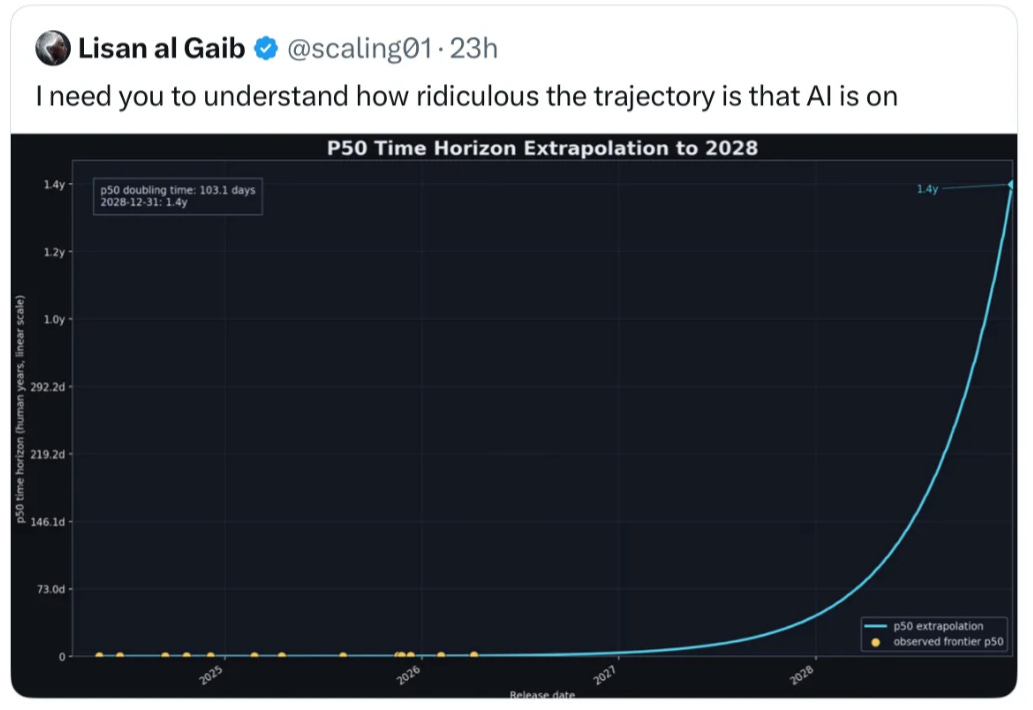
1. Take the mostly horizontal part (yellow dots, actually attested); 2. Infer vertical.

A couple days ago METR, a think tank that evaluates AI, dropped its latest graph, and the Twitterverse quickly became overwhelmed with panic, including a pile of tweets like these (and the one above):
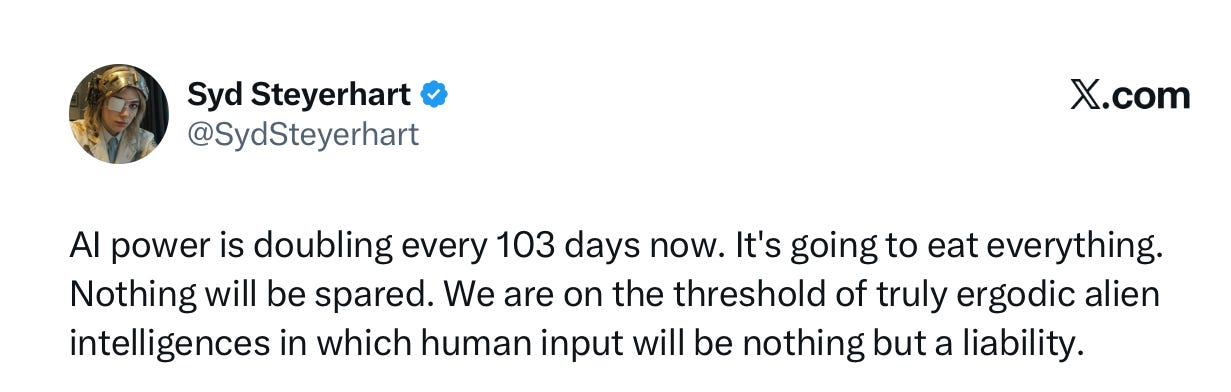
and
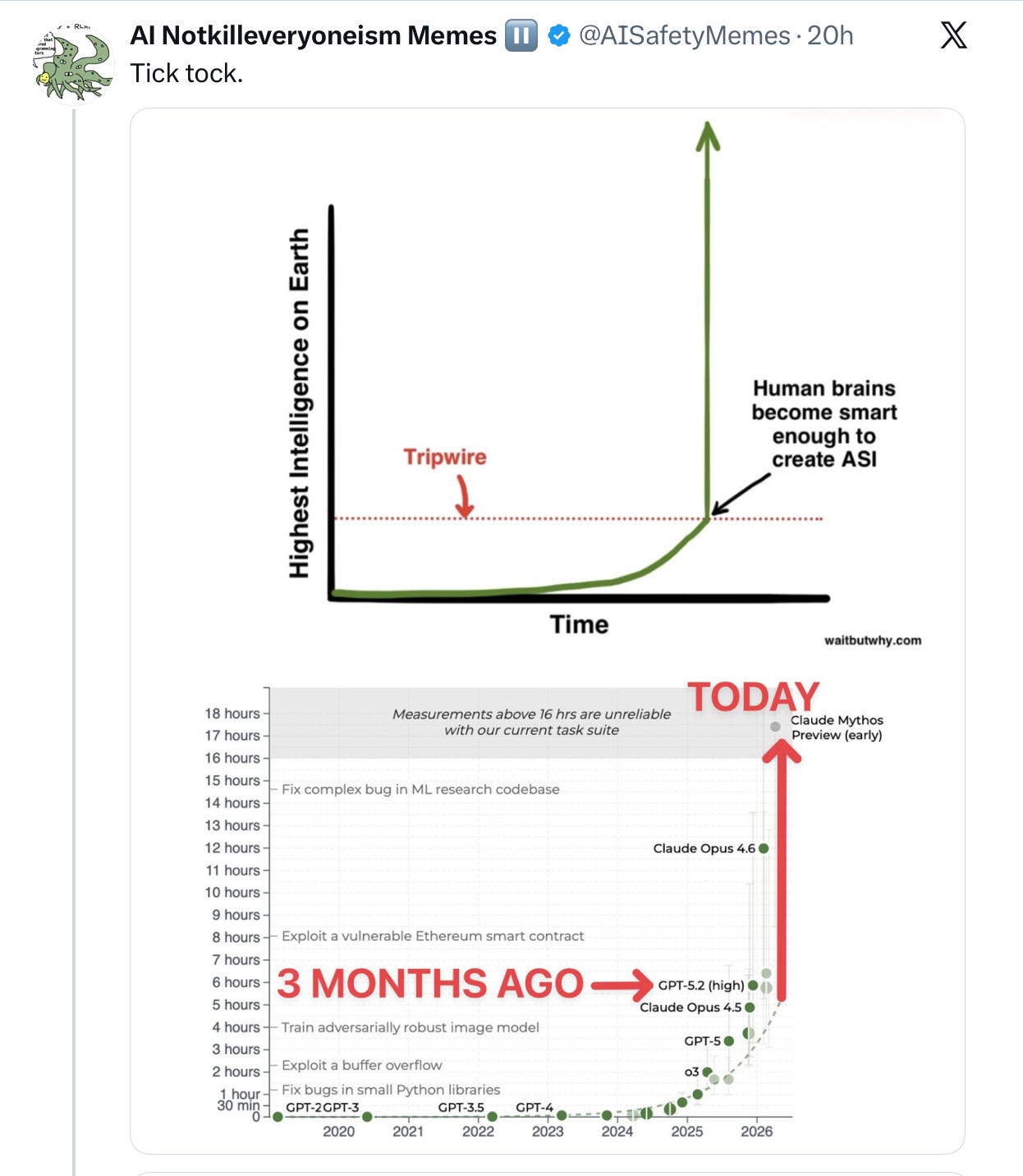
All were triggered by METR’s latest edition of their famous “time horizon” graph:

X avatar for @METR_Evals

METR@METR_Evals

We evaluated an early version of Claude Mythos Preview for risk assessment during a limited window in March 2026. We estimated a 50%-time-horizon of at least 16hrs (95% CI 8.5hrs to 55hrs) on our task suite, at the upper end of what we can measure without new tasks.

11:41 PM · May 8, 2026 · 849K Views

65 Replies · 234 Reposts · 2K Likes

Even the usually sober forecaster Peter Wildeford worried that Mythos had “broken” the graph, meaning that we could no longer measure the limits of AI capabilities:
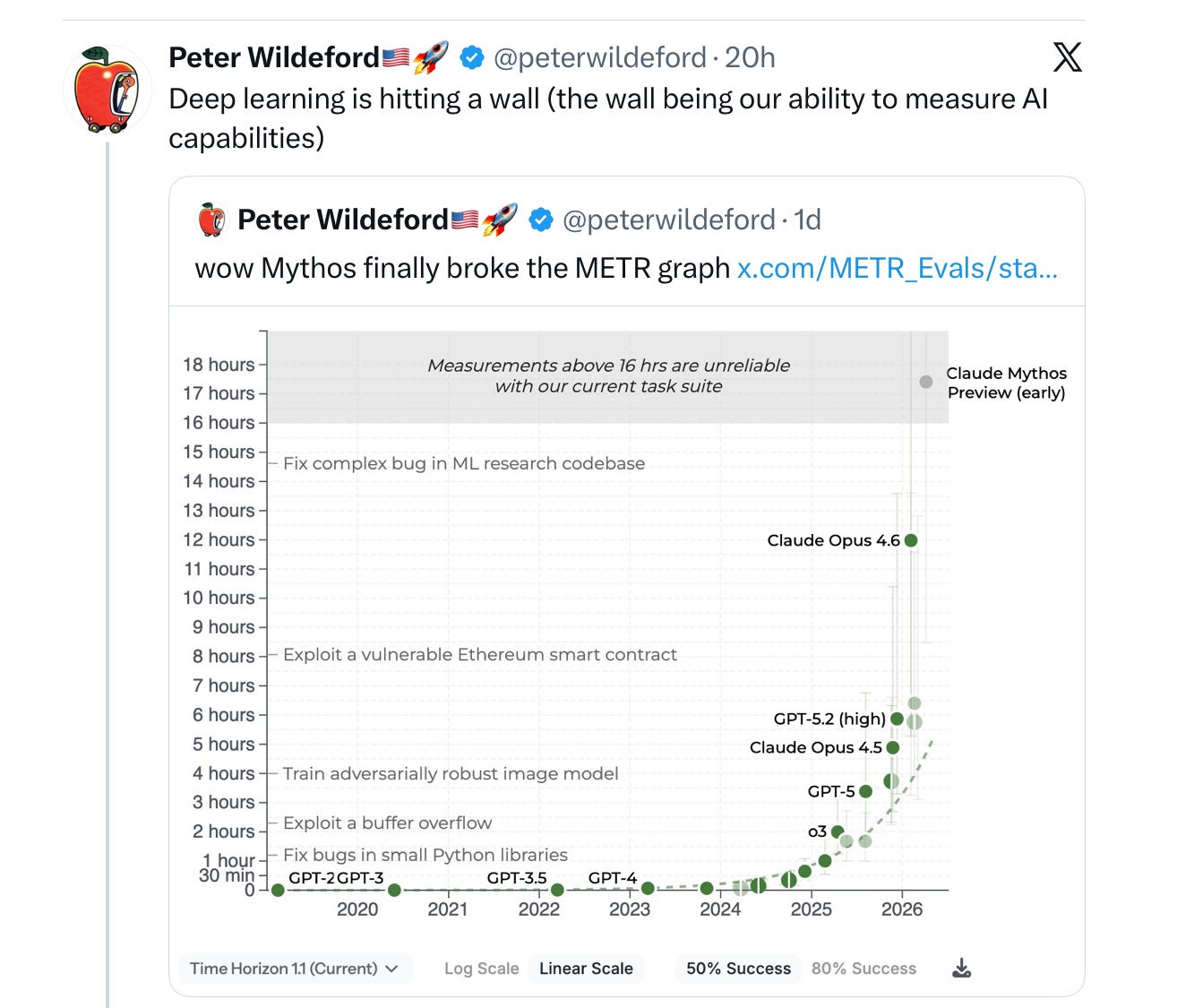
Hold on. Let’s take a deep breath.

(And let’s ignore the fact that “Deep learning is hitting a wall” was an essay about the limits of pure scaling, rather than what Wildeford is discussing.)

What the METR “time horizon” graph is measuring – with two important asterisks that I will get to — is the length (measured in time) of software development tasks that frontier models can complete, normed against human software engineers.

It used to be that the best “frontier models” could “succeed” at tasks that would occupy humans for a minute, then they could “succeed” at two minute task, then four, then eight etc; it’s up to sixteen hours now (but wait for the asterisks).

The implication is that systems are steadily getting better and better, at tasks that are more and more complex.

As Ernest Davis and I discussed a year ago, there are a bunch of problems with how the task is conceived and implemented, but for now let’s just stipulate for the sake of argument that the graph has been carefully made.

Here’s some context:

  • Claude Code is a real advance; Mythos probably builds on some of what is learned there. But…

  • If you read METR’s tweet about their graph carefully, it is about achieving *50%* success. Not 100 or 99 or even 90. (There is an 80% version, and it looks less ominous; it is the same general shape, but much lower overall performance.)

  • For exactly that reason, Wildeford’s concern about Mythos “breaking the graph” is a red herring. He’s saying that Mythos basically solves all the tasks that METR had prepared for the benchmark. And I don’t doubt that that’s true. But it’s only true at the arbitrary 50% success level. There is plenty of headroom left on the current METR set of tasks if you simply demand 80% success, even more headroom if you demand 95% success. (It’s also stacking the deck to only look at jobs that take a day or two, when the real job of a software engineer may involve overseeing projects that take months or years.)

  • More broadly, the key problem with GenAI has been reliability; a graph that demands only 50% success does not address reliable performance. At all.

  • The graph pertains only to software-development tasks. Not general intelligence.

  • It certainly doesn’t tell you that Mythos can do *most* things that humans can do in 16 hours, let alone do them reliably. (Example, watch a two-hour Hollywood movie that nobody has seen before and sensibly discuss key plot points.)

  • Importantly, the graph doesn’t show you *how* the improvements have been made. As noted in my newsletter, a lot of the advance in recent months is likely from the incorporation of symbolic tools (like code interpreters, verification, and harnesses) rather than from model scaling per se. (Incidentally, this is yet another vindication of neurosymbolic AI – not proof that LLMs themselves can be perpetually scaled. Nor a proof that another trillion dollars will indefinitely continue the trends shown in the graph.)

  • Per a graph that Ramez Naam showed a month ago, Mythos is not actually far off trend on the ECI benchmark, which is a broader measure.

    X avatar for @ramez

    Ramez Naam@ramez

    Anthropic's Mythos does not appear to show any acceleration of ECI. After normalizing Anthropic's internal ECI with @EpochAIResearch 's public ECI, it's clear that the two metrics are extremely close, and that Mythos is pretty much on trend, just slightly above GPT 5.4. /1

    6:30 PM · Apr 8, 2026 · 409K Views

    40 Replies · 101 Reposts · 917 Likes

Bottom line: Mythos is awfully good at coding relative to its predecessors, but 50% is a low bar, and (a) we don’t have data at 95% or 99% success, we don’t know that the curves will keep going, and (b) we don’t have evidence that Mythos is actually an important step towards broad superintelligence.

Instead, its techniques likely work best with things like coding and math, where formal verification (good old symbolic AI for the win!) can straightforwardly apply.

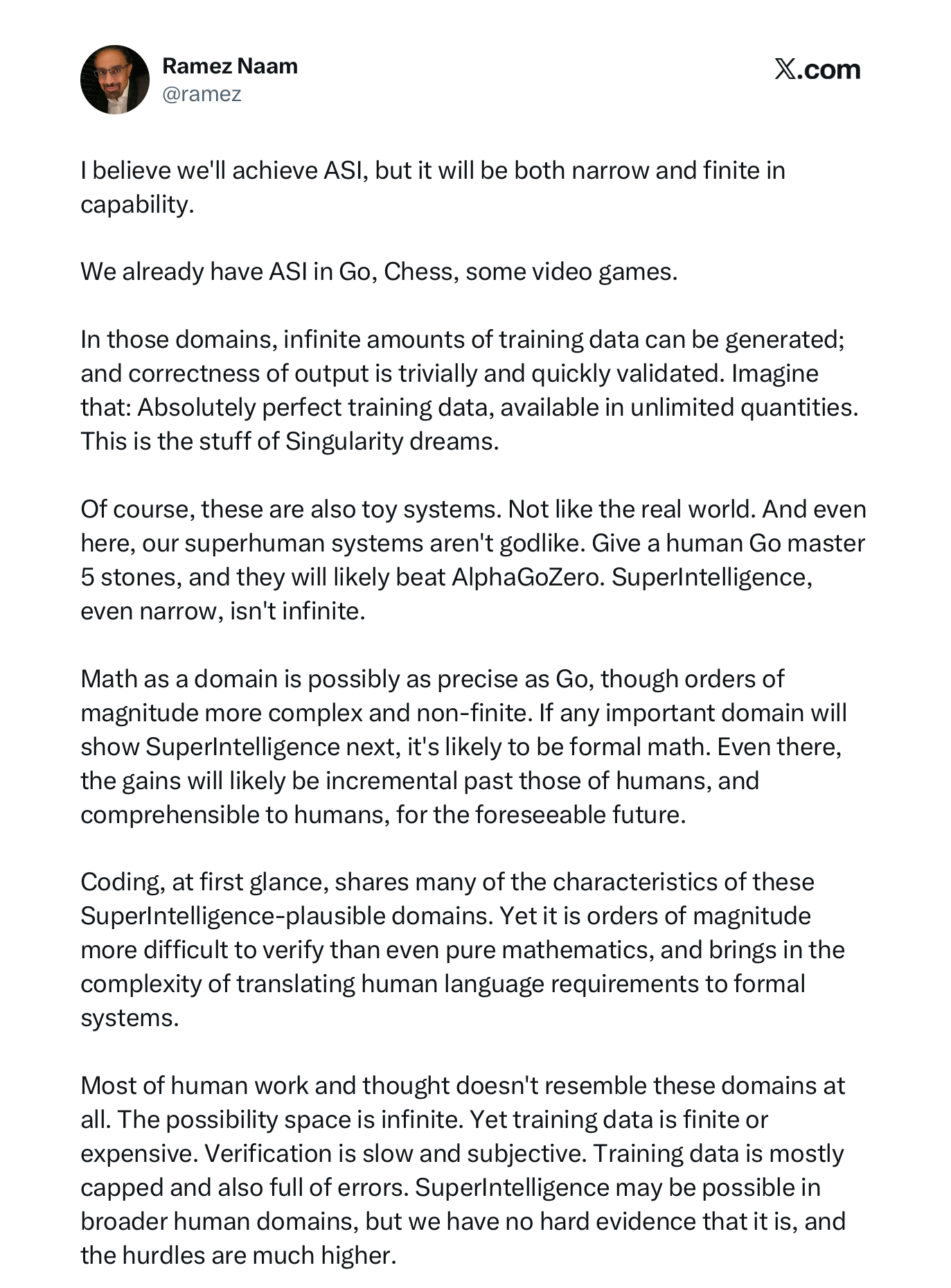
Ramez Naam was sharp on this point, too, yesterday:
§

Here’s an even wilder extrapolation from a few days ago, about money rather than task performance:
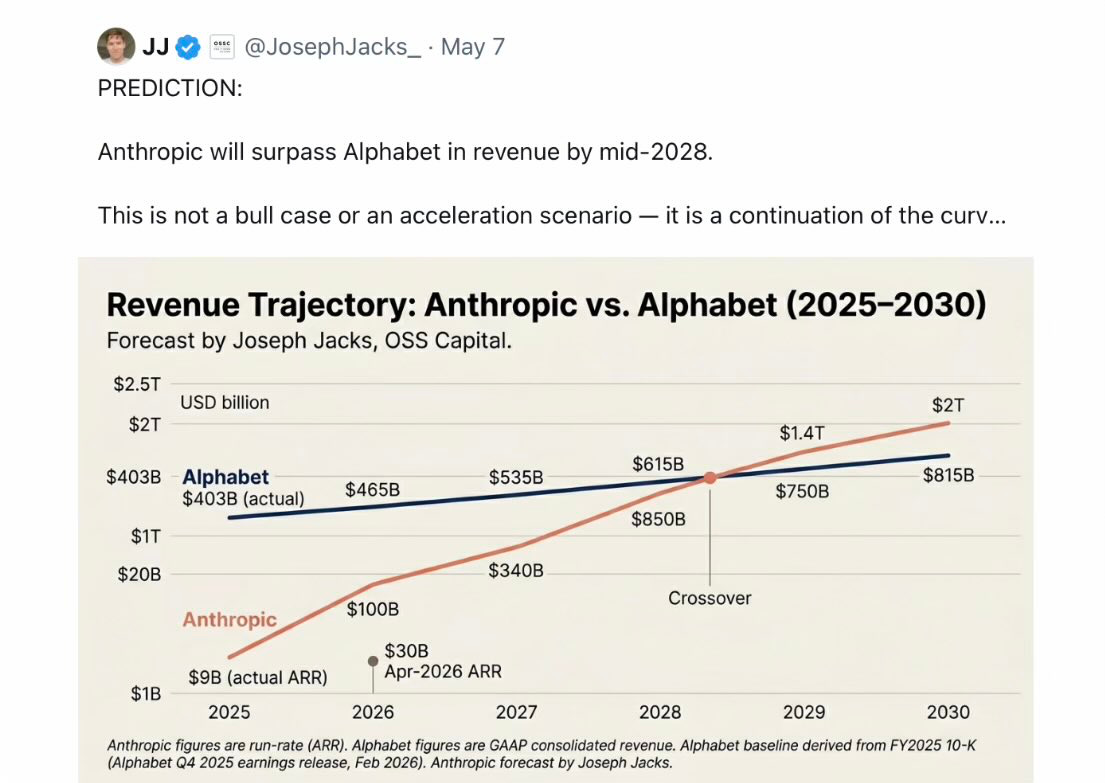
To anticipate that Anthropic will have $2T revenue in 2030 is a perfect example of what I have often called the trillion pound baby fallacy: Just because a baby doubles in weight in its first four months doesn’t mean it will continue to doubling every few months til he goes away to college.

§

Over and over I saw variants on the trillion pound baby fallacy yesterday with the METR graph, with people assuming that processes that initially doubled would continue unimpaired, indefinitely. Very few exponential processes do.

Babies don’t keep doubling forever, and nor will AI progress. We might hit resource constraints (energy, chips etc); “benchmarkmaxxing” (teaching to the test, which hears means building tools that focus around software design) may have limits; formal verification techinques may hit limits in less formal problems; some types of challanges (e.g., reasoning accurately with respect to world models, reducing hallucinations etc) may simply not be amenable to current approaches; and so on.

We can be absolutely sure that the task length “time horizon” for AI is not going to keep doubling until “time horizons will be 580 times the age of the universe” as Lisan al-Ghaib joked.

And most importantly, solving (some aspects of) software design is not open-ended intelligence. AI is definitely getting better at some things, but there is no reason to think that it is close to fully general yet.

My strong intuition is that Mythos will be under 20% and perhaps under 10% on the Remote Labor Index (a benchmark of percent of online tasks a bot can do), and with no meaningful improvement on doing physical jobs — which means the number of actual full human jobs that can be entirely replaced will remain small, at least for now.

In short, there is no need (yet?) to panic.

Thanks for reading Marcus on AI! If you enjoyed this post, considering sharing it!

Share

No posts