


惯性聚合 高效追踪和阅读你感兴趣的博客、新闻、科技资讯
阅读原文 在惯性聚合中打开

推荐订阅源

D
DataBreaches.Net
F
Fortinet All Blogs
D
Docker
让小产品的独立变现更简单 - ezindie.com
WordPress大学
WordPress大学
罗磊的独立博客
Y
Y Combinator Blog
Cyber Security Advisories - MS-ISAC
J
Java Code Geeks
T
The Blog of Author Tim Ferriss
U
Unit 42
N
Netflix TechBlog - Medium
OSCHINA 社区最新新闻
OSCHINA 社区最新新闻
V
V2EX
云风的 BLOG
云风的 BLOG
钛媒体:引领未来商业与生活新知
钛媒体:引领未来商业与生活新知
T
Tailwind CSS Blog
Hugging Face - Blog
Hugging Face - Blog
Stack Overflow Blog
Stack Overflow Blog
爱范儿
爱范儿
酷 壳 – CoolShell
酷 壳 – CoolShell
P
Proofpoint News Feed
G
Google Developers Blog
H
Help Net Security

Hacker News - Newest: "AI"

AI can't read an investor deck AI as an attorney? Student uses ChatGPT, Gemini to sue UW over alleged racial discrimination Hacking MCP Servers in AI Systems – The Rug Pull: Tool Changes After Approval GitHub - MeepCastana/KubeezCut: Free Web based video editor GitHub - GenAI-Gurus/awesome-eu-ai-act: Curated tools, official sources, OSS, templates, and guides for EU AI Act compliance. Can AI judge journalism? A Thiel-backed startup says yes, even if it risks chilling whistleblowers Coming soon: 10 Things That Matter in AI Right Now DARPA built an AI to fact-check enemy weapons claims What explains heterogeneity in AI adoption? When AI Meets Muscle: Context-Aware Electrical Stimulation Promises a New Way to Guide Human Movements - Department of Computer Science AI Changed How We Build. It Did Not Change What Matters. Linux rules on using AI-generated code - Copilot is OK, but humans must take 'full responsibility for the… Meta spins up AI version of Mark Zuckerberg to engage with employees Code Mode: Let Your AI Write Programs, Not Just Call Tools | TanStack Blog GitHub - Delavalom/graft: Go framework for building AI agents. Type-safe tools, multi-provider (OpenAI, Anthropic, Gemini, Bedrock), zero vendor SDKs. India's TCS tops estimates, says new AI models did not dent services demand Gen Z's fading AI hype Strong feeling: we are in a folded AI reality GitHub - machinarii/total-recall-catalog: A reference catalog of latest knowledge retrieval, memory & RAG systems GitHub - mensfeld/code-on-incus: Give each AI agent its own isolated machine with root, Docker, and systemd. Active defense detects and stops threats automatically.. Quantization, LoRA, and the 8% Problem: Benchmarking Local LLMs for Production AI Iran war: We spoke to the man making Lego-style AI videos that experts say are powerful propaganda Powell, Bessent discussed Anthropic's Mythos AI cyber threat with major U.S. banks GitHub - immartian/bellamem: Persistent belief-graph memory for AI agents. Retrieves decisive context by importance — not recency, not RAG, not /compact. recursive-mode: The Repo-Native Operating System for AI Engineering After the attack on Sam Altman's home, will AI CEO's go on the offensive? The biggest advance in AI since the LLM Opus 4.6 vs GPT 5.4 One Prompt Unity World Generation Test “AI polls” are fake polls Client Challenge
We're heading for an AI-fueled 'dementia crisis,' brain s...
2026-04-11 · via Hacker News - Newest: "AI"

We’ve been told that many things increase our risk of dementia, such as genetics, too much alcohol, not enough exercise, improper nutrition, high blood pressure — the risks go on and on.

Neuroscientist Vivienne Ming wants to add one more item to the list: artificial intelligence.

Scientists have already sounded the alarm that US dementia cases could nearly double by 2060, thanks to our aging population and rising rates of obesity, diabetes and hypertension.

Now, Ming is warning that AI could contribute to a “dementia crisis” because it weakens the brain systems responsible for curiosity, attention, high-order reasoning and executive function, among other duties.
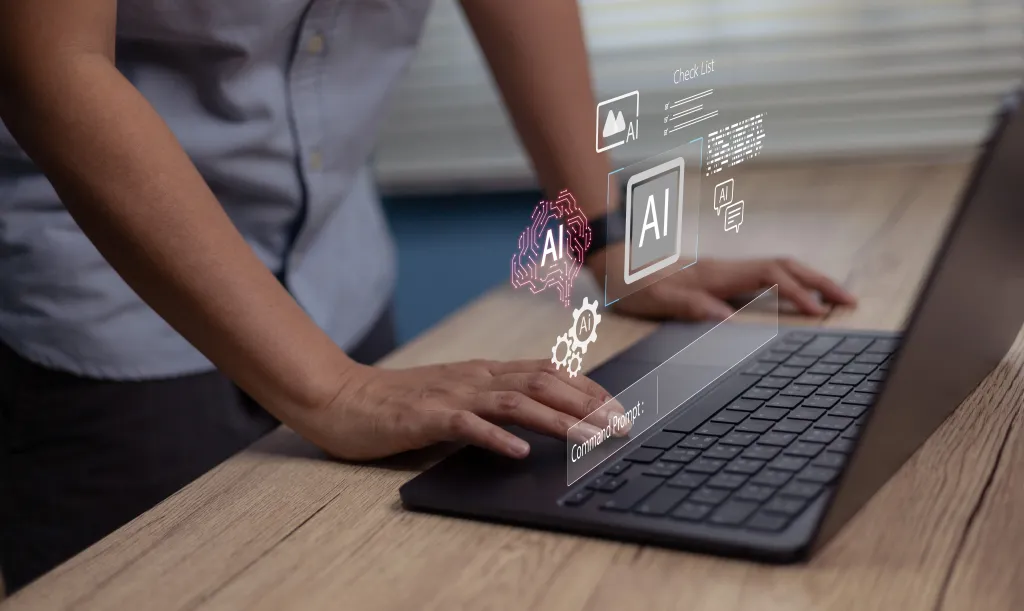
Person using a laptop with virtual AI interface elements including a brain icon and a command prompt.

AI is becoming increasingly popular, which may pose a problem for our cognitive function. Kanokwan – stock.adobe.com

“My own data shows that students using AI in the most common way — asking it questions and accepting the answers — show more than a 40% reduction in the gamma-band brain activity that indicates active cognitive engagement,” Ming, author of the new book “Robot-Proof: When Machines Have all the Answers, Build Better People,” told The Post.

“Their brains are measurably less active than when they work without AI.”

Ming describes what an AI-powered dementia crisis could look like — and shares four early warning signs that suggest overreliance on AI.

How can AI affect cognition?

A survey last year revealed that 56% of US adults use AI tools, with 28% using them at least once a week.

Seeking information or quick answers is one of the top functions. For people who use AI this way, Ming said that changes to cognition are not immediately noticeable but build over time.

“When the answer is always one tap away, we stop developing the habit of wondering,” she explained.

“Without errors to drive learning, our brain’s reward circuits stop responding to mystery. We short-circuit the parts where wondering becomes exploration.”

Person typing "how to get to" into an AI chat app on a smartphone, with a blurred notebook and laptop in the background.

Relying too much on AI for answers means you’re spending less effort on critical analysis. YarikL – stock.adobe.com

Metacognition is also affected. That’s the awareness and regulation of your own thinking, also known as “thinking about thinking.”

Ming describes it as “testing your own understanding against reality, experiencing the gap and updating.”

When AI does that work for you, you get the illusion of understanding rather than true skill acquisition.

“We need ‘productive friction,’ the challenges that make life a little harder and thereby make us better,” Ming said.

How certain are we that a crisis is on the horizon?

Many innovations over the years have changed the way we think — calculators and smartphones are just a couple — but nobody blamed calculators for a dementia crisis.

GPS navigation is the closest analogy to AI, Ming said.

Habitual GPS use has been shown to diminish spatial reasoning by reducing activity in the brain region responsible for forming mental maps: the hippocampus.

“While GPS offloads one cognitive function, AI is designed to offload any cognitive function you’re willing to give it: writing, reasoning, planning, synthesis, judgment,” Ming noted.

“The substitution is nearly total, and it’s self-reinforcing because AI that’s better than you at something creates a temptation to stop practicing that thing, which makes you worse at it, which makes you more dependent on the AI.”

A concentrated senior man in glasses is putting together a wooden puzzle.

Older adults need to keep their minds active to potentially delay dementia. Overdependence on AI risks cognitive atrophy. Studio Romantic – stock.adobe.com

Experts have long recommended seniors engage in stimulating work, read and learn new skills to strengthen their cognitive reserve, potentially staving off dementia.

If there is an AI-fueled dementia crisis, Ming said it “would look like a gradual, population-level compression of cognitive reserve, the brain’s accumulated resilience against age-related decline.”

She acknowledged AI tools haven’t been around long enough to measure long-term impact “but the mechanistic evidence is there, the short-term behavioral evidence is there, and anyone claiming we need more proof before taking this seriously is applying a standard of certainty they don’t apply to anything else they care about.”

Can the brain positively adapt to AI use?

You want to use AI, but you also want to preserve your cognitive reserve.

The best way would be to have the AI act as an “adversarial collaborator” that does not blindly agree with your inputs, Ming suggested.

The AI would challenge your reasoning, identify weak evidence and force you to refine your arguments.

It doesn’t work if you “use AI the way most people currently use it — as a magic genie that provides answers,” Ming said.

Early warning signs that can suggest AI dependence

  • You struggle to start a document without AI generating a draft first.
  • You can follow a complex argument as you read it, but can’t reconstruct it an hour later.
  • You can’t keep up with a long book without frequent summaries.
  • You express confidence about skills you can’t demonstrate if tested.

“These are the signs of a monitoring loop that has stopped running,” Ming said.