








Pika Labs recently announced a new product that lets you “meet” with your AI agent in the form of an animated avatar:

Pika@pika_labs
Conversations tend to go better with a face and a voice. That’s why we’re thrilled to release the beta version of the first video chat skill for ANY agent, powered by our new real-time model, PikaStream1.0. The skill preserves memory and personality, and enables real-time
8:38 PM · Apr 2, 2026 · 2.32M Views
365 Replies · 719 Reposts · 5.3K Likes
My initial gut reaction was - why? From a practical standpoint, I don’t see how this is a better way to communicate with your agent (“this could have been an email”). While we’re all grappling with the tidal wave of displacement AI is forcing upon us, I don’t think anyone will be sad to see work meetings die (if this doesn’t apply to you - why do you hate joy?).
But as I put my vitriol towards excessive meetings aside, I realized there’s a more interesting tension hiding in this announcement - are AI agents our coworkers or are they our tools (or both)? I’m noticing a clear divide between those who rush to anthropomorphize their agents and those who want them to be cold soulless tools. From a purely intellectual design perspective, I have argued that they are more akin coworkers:
The best framework that bridges the past and the future here is Jobs-To-Be-Done: customers don’t buy your tools - they hire them to get a job done. Each SaaS app was effectively a toolbox. Our job as designers was to understand the job at hand, surface the right tools in a given context, and make those tools easy to use so you can accomplish the job. With LLM agents, a SaaS app is now more akin to a coworker that goes out and does the job. And how do you talk to a coworker? You chat with them.
This insight has one important implication - personality is now a core design dimension for AI products. In other words, it’s the flavor of the AI interface. And it’s clearly core to product adoption and engagement. There’s a reason most people who spend significant time interacting with these agents prefer Claude over ChatGPT. Capability is certainly one reason. But personality is arguably as important. The more likable, authentic, and human-like the AI personality is, the easier it is to develop a sense of connection. Connection drives engagement. Engagement drives stickiness. Stickiness drives profit. You see where I’m going with this.
It’s also arguably the most ineffable design dimension, which makes it both extremely challenging to get right and nigh impossible to replicate. Even people who build, design, and train these models don’t fully understand how this personality emerges, and steering it is as much an art as it is science. Hence, the ineffability of AI personality is a competitive advantage.
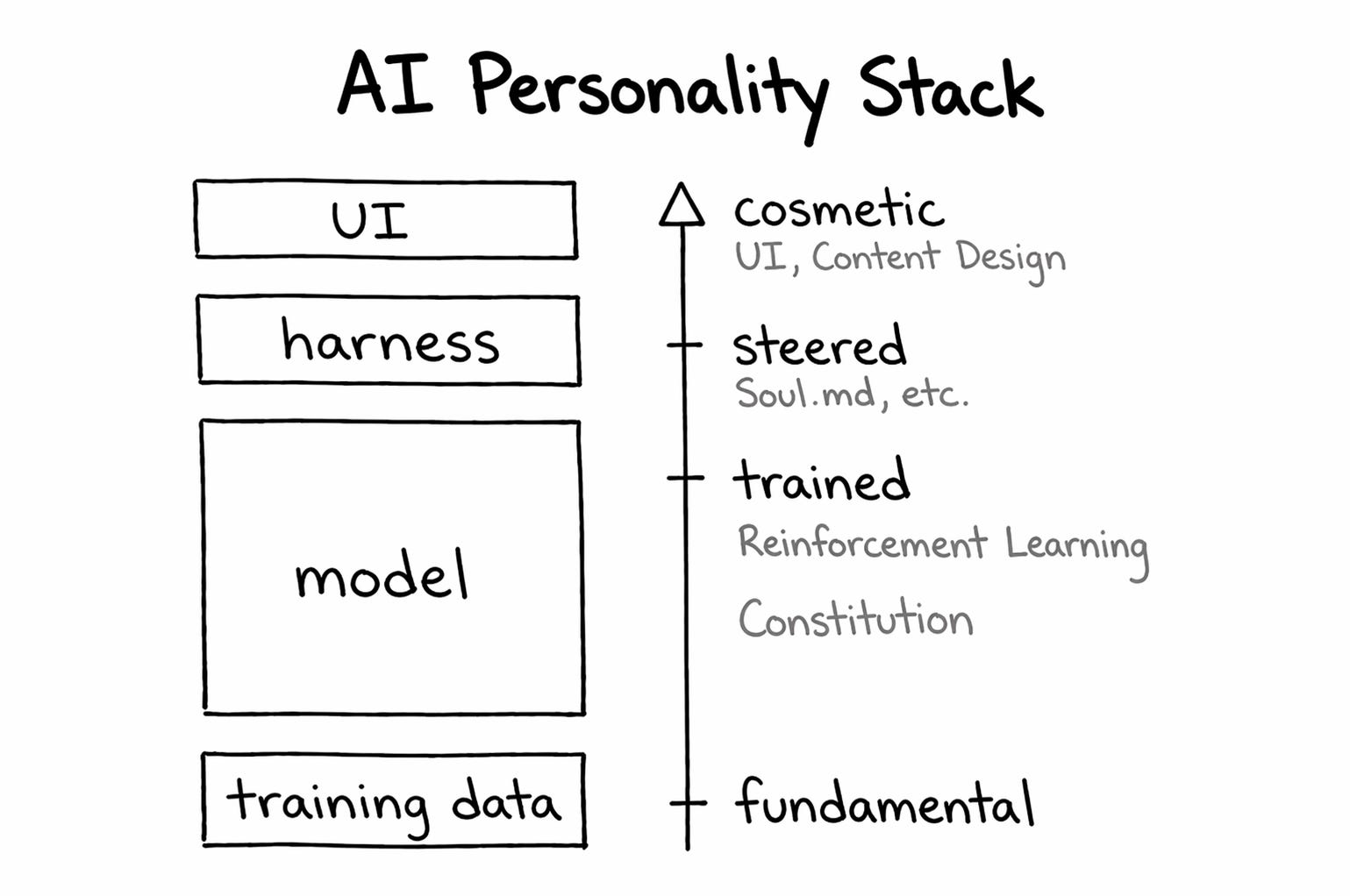
So what does this mean for designers today? Well, for one, there’s work to do. It’s not a far-fetched idea that “personality designer” will be an important job going forward. And the further down the AI personality stack you can operate, both in understanding and applied skills, the more influence you have over the experience.
Are today’s content designers tomorrow’s personality designers? Quite possibly. And the role of personality designers goes way beyond comprehension, value messaging, emotional tone, or even brand alignment. Those things still matter. A confusing AI product is still a bad product. A useful agent with the personality of a smug consultant is still annoying. But personality design sits a layer deeper than copy or visual layout. It shapes how the system behaves, when it asks questions, how much confidence it projects, how it handles uncertainty, when it pushes back, when it gets out of your way, and how it makes you feel while working with it.
1. Open-source specification for Design.md

Stitch by Google@stitchbygoogle
Today, we’re open-sourcing the draft specification for DESIGN.md, so it can be used across any tool or platform. We’re also adding new capabilities. DESIGN.md lets you easily export and import your design rules from project to project. Instead of guessing intent, agents know
4:18 PM · Apr 21, 2026 · 5.46M Views
173 Replies · 1.69K Reposts · 15.7K Likes
Google’s Stitch team (the team behind their AI design product of the same name) just open-sourced their specification for a DESIGN.md file and created a CLI that helps you validate & manipulate them. I highly recommend watching a short video in that tweet to generally understand what a design.md is (TL:DR - it’s a design system inside a markdown file, with a few nuances).
One great thing about AI so far has been a revival in open-source standards (like MCP) that will allow more of these systems to inter-operate and share the same primitives. Interestingly, this is not really good for business for most companies - open standards prevent walled gardens. But for large companies like Google, it’s in their interest to set the agenda as their profit center will never be something like Stitch but more people using their AI models, agents, and infrastructure.
A standardized Design.md is a boon to design - assuming newer models and agents learn to expect a certain format and will get better at adhering to it, it’ll only lead to better outputs and easier ways to create, maintain, and evolve design systems as the source of truth and design process keeps moving closer to code.
A great article from the head of design @ Anthropic:

Joel Lewenstein@joellewenstein
https://t.co/Hi44svp9nv
4:14 PM · Apr 21, 2026 · 120K Views
19 Replies · 36 Reposts · 475 Likes
With everyone in design jumping to conclusions, it’s refreshing to see a humble admission by the very same makers of those tools that we just don’t know and the truth is likely more nuanced than we imagine. It’s also an interesting peek behind the curtain at Anthropic’s own tool stack - they’re not designing and shipping end-to-end with Claude. They’re using everything under the sun, and they don’t expect Claude Design to become an everything tool.
A good reminder to everyone (including me) who’s trying to make predictions in this space that’s moving at breakneck speed.

hilary gridley@yourgirlhils
today’s amazing new AI-designed artifacts will look like slop in a month, once everyone learns to recognize the patterns the model falls back on. like AI-generated writing, the output isn’t objectively “bad,” (in fact it is often technically quite good), but once it becomes

Claude @claudeai
Introducing Claude Design by Anthropic Labs: make prototypes, slides, and one-pagers by talking to Claude. Powered by Claude Opus 4.7, our most capable vision model. Available in research preview on the Pro, Max, Team, and Enterprise plans, rolling out throughout the day.
1:50 PM · Apr 18, 2026 · 58.6K Views
40 Replies · 35 Reposts · 574 Likes
I found this to be a compelling argument for why AI alone will never make designers completely obsolete. Every model, however amazing, will regress towards the same patterns that we will recognize as slop. To stay authentic, you’ll always need an opinionated judge to steer a model towards something unique and one-of-a-kind.
Today’s issue is a bit late because yesterday I attended an all-day event coincidentally called Design.md organized by Shopify Design (one of the most talented bunch of designers in the industry). I’m usually not a fan of design conferences in general as I find them boring. This was an exception. The excitement, tinkering, and fun was palpable. I came out of it full of ideas, questions, and inspiration, which I’m sure I’ll be unfolding over the next many issues.
I want to ask you for a favor - if you’ve been enjoying the newsletter, please consider sharing it with your team / colleagues / friends. It really helps, especially in these early stages as I’m posting into the social media void and looking for like-minded people. To those that already shared - thank you, it means a lot. Have a good weekend and see you on Tuesday.