

惯性聚合 高效追踪和阅读你感兴趣的博客、新闻、科技资讯
阅读原文 在惯性聚合中打开

推荐订阅源

T
Threatpost
CTFtime.org: upcoming CTF events
T
The Blog of Author Tim Ferriss
S
SegmentFault 最新的问题
OSCHINA 社区最新新闻
OSCHINA 社区最新新闻
博客园 - 司徒正美
T
Tailwind CSS Blog
The Cloudflare Blog
The Last Watchdog
The Last Watchdog
PCI Perspectives
PCI Perspectives
博客园 - 聂微东
Stack Overflow Blog
Stack Overflow Blog
TaoSecurity Blog
TaoSecurity Blog
云风的 BLOG
云风的 BLOG
C
Cybersecurity and Infrastructure Security Agency CISA
O
OpenAI News
Recorded Future
Recorded Future
GbyAI
GbyAI
www.infosecurity-magazine.com
Y
Y Combinator Blog
D
Darknet – Hacking Tools, Hacker News & Cyber Security
量子位
博客园 - 叶小钗
V
Vulnerabilities – Threatpost
F
Full Disclosure
Recent Announcements
Vercel News
Vercel News
S
Schneier on Security
H
Heimdal Security Blog
Cisco Talos Blog
Cisco Talos Blog
V2EX - 技术
V2EX - 技术
cs.AI updates on arXiv.org
B
Blog RSS Feed
宝玉的分享
宝玉的分享
Exploit-DB.com RSS Feed
P
Privacy & Cybersecurity Law Blog
T
Threat Research - Cisco Blogs
G
Google Developers Blog
C
Cyber Attacks, Cyber Crime and Cyber Security
爱范儿
爱范儿
IT之家
IT之家
大猫的无限游戏
大猫的无限游戏
C
Check Point Blog
N
Netflix TechBlog - Medium
S
Security @ Cisco Blogs
cs.CV updates on arXiv.org
Microsoft Azure Blog
H
Hackread – Cybersecurity News, Data Breaches, AI and More
Threat Intelligence Blog | Flashpoint
Cyberwarzone
Cyberwarzone

Hacker News - Newest: "AI"

AI can't read an investor deck AI as an attorney? Student uses ChatGPT, Gemini to sue UW over alleged racial discrimination Hacking MCP Servers in AI Systems – The Rug Pull: Tool Changes After Approval GitHub - MeepCastana/KubeezCut: Free Web based video editor GitHub - GenAI-Gurus/awesome-eu-ai-act: Curated tools, official sources, OSS, templates, and guides for EU AI Act compliance. Can AI judge journalism? A Thiel-backed startup says yes, even if it risks chilling whistleblowers Coming soon: 10 Things That Matter in AI Right Now DARPA built an AI to fact-check enemy weapons claims What explains heterogeneity in AI adoption? When AI Meets Muscle: Context-Aware Electrical Stimulation Promises a New Way to Guide Human Movements - Department of Computer Science AI Changed How We Build. It Did Not Change What Matters. Linux rules on using AI-generated code - Copilot is OK, but humans must take 'full responsibility for the… Meta spins up AI version of Mark Zuckerberg to engage with employees Code Mode: Let Your AI Write Programs, Not Just Call Tools | TanStack Blog GitHub - Delavalom/graft: Go framework for building AI agents. Type-safe tools, multi-provider (OpenAI, Anthropic, Gemini, Bedrock), zero vendor SDKs. India's TCS tops estimates, says new AI models did not dent services demand Gen Z's fading AI hype Strong feeling: we are in a folded AI reality GitHub - machinarii/total-recall-catalog: A reference catalog of latest knowledge retrieval, memory & RAG systems GitHub - mensfeld/code-on-incus: Give each AI agent its own isolated machine with root, Docker, and systemd. Active defense detects and stops threats automatically.. Quantization, LoRA, and the 8% Problem: Benchmarking Local LLMs for Production AI Iran war: We spoke to the man making Lego-style AI videos that experts say are powerful propaganda Powell, Bessent discussed Anthropic's Mythos AI cyber threat with major U.S. banks GitHub - immartian/bellamem: Persistent belief-graph memory for AI agents. Retrieves decisive context by importance — not recency, not RAG, not /compact. recursive-mode: The Repo-Native Operating System for AI Engineering After the attack on Sam Altman's home, will AI CEO's go on the offensive? The biggest advance in AI since the LLM Opus 4.6 vs GPT 5.4 One Prompt Unity World Generation Test “AI polls” are fake polls Client Challenge Can AI be a 'child of God'? Inside Anthropic's meeting with Christian leaders How to Switch AI Chatbots and Why You Might Want To GitHub - MattMessinger1/agentic_refund_guardrail: Safe refund policy layer for AI agents — Python + TypeScript. Same behavior, shared tests. Adam/papers/emergent_values_whitepaper.md at master · strangeadvancedmarketing/Adam Ask HN: How do you stop playing 20 questions with your AI coding tools How far can automation and AI support psychotherapy? - @theU GitHub - stagas/rtdiff: realtime git diff gui and AI-assisted commits A Mac Studio for Local AI — 6 Months Later A History of the Early Years of AI at the University of Edinburgh Why AI Coding Tools Still Feel Stuck on Localhost MSN AI Datacenters Are Becoming Strategic Targets twitter.com Penn Researchers Use AI to Surface Unreported GLP-1 Side Effects in Reddit Posts Show HN: MoodSense AI (ML and FastAPI and Gradio, Deployed on Hugging Face) Moodsense Ai - a Hugging Face Space by aman179102 AI models are terrible at betting on soccer—especially xAI Grok GitHub - xialeistudio/echoic GitHub - HimashaHerath/github-dev-wrapped: AI-powered weekly GitHub activity reports deployed to GitHub Pages GitHub - alejandrobalderas/claude-code-from-source: Architecture, patterns & internals of Anthropic's AI coding agent — reverse-engineered from source maps AI and Tech brief: Ireland ascendant GitHub - Titovilal/context0: Context0 - Never Surrender Training for a Marathon with an AI Coach: What Worked and What Didn't Cyber Pulse: Agentic Intel - Apps on Google Play I Built an AI PR Reviewer That Catches Bugs by Not Looking for Bugs Gen Z workers are so fearful AI will take their job they’re intentionally sabotaging their company’s AI rollout | Fortune How AI Is Reimagining the Game of Golf–For Both Players and Courses GitHub - nattergabriel/reseed: A CLI tool for managing and distributing agent skills across projects Is SVG the final frontier? My AI workflow evolved from prompts to a near-autonomous workflow MLSharp Help - 3DGS Viewer & Generator I put my cognitive field based AI's runtime on GitHub Is Numble the first AI-proof game? A3: Kubernetes for autonomous AI agent fleets | Emergent Principles Deepali Vyas ("The Elite Recruiter") GitHub - msmarkgu/RelayFreeLLM: A restful API designed to route user prompts to various AI model providers. Unionized ProPublica staff are on strike over AI, layoffs, and wages Unleashing the Advantage of Quantum AI We're heading for an AI-fueled 'dementia crisis,' brain scientist warns The AI-Assisted Breach of Mexico's Government Infrastructure [pdf] GitHub - stef41/lmscan: 🔍 Detect AI-generated text and fingerprint which LLM wrote it. Open-source GPTZero alternative. Zero dependencies, works offline. MSN GitHub - visionscaper/collabmem: Enabling long-term collaboration with Agentic AI - building up episodic and world model memory over time with in-context awareness We gave an AI a 3 year retail lease in SF and asked it to make a profit | Andon Labs AI Code is Hollowing Out Open Source, and Maintainers are Looking the Other Way What leaked "SteamGPT" files could mean for the PC gaming platform's use of AI AI is the boss at this retail store. What could go wrong? GitHub - Wuzu11517/agentic-proxy: Local proxy meant to help reduce With Drones, Geophysics and ArtificiaI Intelligence, Researchers Prepare to Do Battle Against Land Mines A Single Operator, Two AI Platforms, Nine Government Agencies: The Full Technical Report 在 Steam 上购买 FriedrichAI: Offline AI 立省 10% GitHub - inevolin/resume-cli: Hit Claude usage limits? Resume any AI coding session elsewhere. Switch tools at zero friction. GitHub - atripati/ark: AI Runtime Kernel — a context operating system for AI agents. Eliminates tool bloat, loads only what’s needed, and gives LLMs their reasoning space back. How to Build a Secure AI PR Reviewer with Claude, GitHub Actions, and JavaScript This Startup Wants You to Pay Up to Talk With AI Versions of Human Experts Intel Arc Pro B70 Brings 32GB VRAM to Local AI for $949 WordPress 7.0: The Good, the AI, and the Still Missing AI on the couch: Anthropic gives Claude 20 hours of psychiatry IatroBench: Pre-Registered Evidence of Iatrogenic Harm from AI Safety Measures AI Agents Know About Supabase. They Don't Always Use It Right. The history and future of AI at Google, with Sundar Pichai Inside an AI‑enabled device code phishing campaign How Meta Used AI to Map Tribal Knowledge in Large-Scale Data Pipelines AI for Systems: Using LLMs to Optimize Database Query Execution Forecasting the Economic Effects of AI Introducing Tinker: Play with AI, bring your ideas to life AI sheds light on an ancient gaming mystery People really hate AI but not as much as Iran—or Democrats | Fortune What is an AI Product Engineer? Phoebe Gates wants her $185 million AI startup to succeed with 'no ties to my privilege or my last name': 'I have a chip on my shoulder' | Fortune
AWS Credential Isolation for Local AI Agents
alexsmolen · 2026-04-28 · via Hacker News - Newest: "AI"

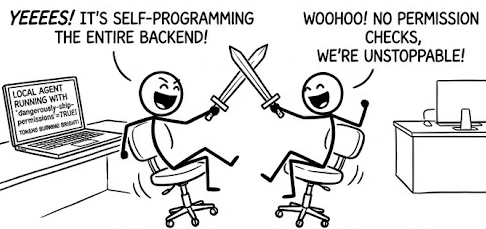
If you run local agents, you need to make tough choices between autonomy and safety. Setting dangerously-skip-permissions while sword fighting on desk chairs and letting the tokens burn bright is an out-of-reach dream when you’re forced to babysit file access and “can I use the internet for this?” requests. But the impact of an agent doing something stupid needs to be pretty low for humans to check out of the loop.
Agent credential isolation diagram

I’ve been interacting with AWS from my local coding agents and ran into a source of flummoxation. If you’ve got even a moderately complicated AWS IAM setup, profile management gets gnarly. The problem has three parts:

  • The agent should only have access to a specific AWS identity, not whatever creds happens to be in your shell
  • That identity should use short-lived credentials that refresh automatically, not static keys you rotate manually
  • And (ideally) the permissions on that identity are scoped to what the agent actually needs for the task at hand

Personal opinion, but trailtool is an awesome way to handle the third point - see my blog post for how TrailTool can generate least privilege IAM roles from observed CloudTrail activity. For the first two, I ran into a tool called elhaz that solves the credentials part nicely. By tying them together, you can get a sandboxed agent scoped to a specific AWS identity, with automatically refreshing short-lived credentials, locked down to least privilege.

elhaz

Elhaz is a local credential broker daemon that manages in-memory AWS STS credentials and serves them over a Unix socket at ~/.elhaz/sock/daemon.sock. A core concept is a config - a saved set of parameters for assuming an AWS role (the role ARN, session configuration, etc). When you run elhaz daemon add -n my-config you’re telling the daemon to actually assume that role using your active AWS cred chain and start managing the session. From that point the daemon holds live, automatically refreshing credentials for that config in memory.

# Create a config for the role you want the agent to assume
elhaz config add

# Start the daemon and initialize the session
elhaz daemon start
elhaz daemon add -n my-agent-role

# Verify it's working
elhaz whoami -n my-agent-role

A very cool aspect of elhaz is that it exposes the assumed role credentials via Unix socket IPC rather than through the standard env var or filesystem approaches that underlie the AWS credential chain. That’s what makes the sandboxing story clean.

Sandboxing AWS credentials in a container

Agent sandboxing is moving fast and anything I say about specific tools will get stale quickly. There’s a whole ecosystem here: sandbox-exec, Bubblewrap, fence, Codex and Claude sandboxes, and more landing constantly. The point is that these mechanisms restrict agent access to resources using OS-level primitives. The credential delivery mechanism needs to fit the affordances, and it doesn’t seem env vars, files, and ports fit the bill. In my research, I’ve been using Docker for agent isolation, and what follows is what I found, listed in increasing order of how well each approach actually holds up.

Note: this assumes you’re using ephemeral, role-based credentials throughout. IAM user access keys are static, long-lived, and the top entry point for attackers when they leak..

Environment variables

When we need isolated creds, you might consider reaching for aws-vault exec or aws configure export-credentials (elhaz also support export), capture the output, and inject it into the container. It works for a one-off, but those are snapshot credentials. STS session tokens typically expire in an hour, at which point your long-running agent session breaks and you’re back to manually refreshing and re-injecting. You may be able to wire something like this up where the container stays updated over time, but it’s not a hands-off approach.

Credential files

Mounting ~/.aws/ into the container is a step up since the SDK can re-read profiles and SSO tokens directly. But it gives the agent access to every profile in that directory, not just the one you intended. And SSO tokens cached on the host are not refreshable from inside the container without a browser. In a multi-agent setup the access boundary is too coarse: you can’t easily say “Agent A gets dev access and Agent B gets prod access” without a lot of manual wiring.

One note: Claude Code has a native sandbox worth understanding here, because it does not solve the credential isolation problem. The sandbox restricts writes to an allowlist of paths and filters outbound HTTP through a proxy. Reads are unrestricted by default. That means Claude can read your entire home directory out of the box, including ~/.aws/credentials etc. You can add ~/.aws to a deny list, but it doesn’t hold: the deny list applies to Claude’s built-in file read tool, not bash subprocesses. Running cat ~/.aws/credentials via Bash succeeds regardless.

Metadata emulation

The more sophisticated approach is emulating the AWS instance metadata service locally. This is how ECS delivers credentials to tasks in production: the SDK makes HTTP requests to a well-known local endpoint and gets fresh credentials back on demand. Tools like aws-vault replicate this locally via --server mode, pointing AWS_CONTAINER_CREDENTIALS_FULL_URI at a local HTTP server that vends credentials.

The problem is that this doesn’t work on macOS, and the workarounds are dead ends. Docker Desktop runs the engine inside a Linux VM, so --network host reaches the VM’s loopback, not the Mac’s (Docker host networking doesn’t work on macOS). And even if you could route it, the AWS SDK has a hardcoded allowlist for HTTP credential endpoints: only localhost, 127.0.0.1, and the ECS/EKS metadata IPs are permitted. Adding host.docker.internal was requested and closed as “not planned.” The aws-vault issue tracker has an open thread on this that has been sitting unresolved for years.

Unix sockets

Unix sockets represent a convenient way to use filesystem access to express AWS dynamic credential access. If you don’t explicitly mount a socket into a container, that socket doesn’t exist in that container’s universe. Run two elhaz configs, get two socket files, and the volume mount itself becomes the authorization decision. Agent B cannot reach Agent A’s credentials as the storage locations are partitioned.

Here’s what it looks like in practice:

# On the host: start the daemon and assume the role
elhaz daemon start
elhaz daemon add -n my-agent-role

# Run a container with only that socket mounted
docker run --rm \
  -v ~/.elhaz/sock/daemon.sock:/tmp/elhaz.sock \
  -e AWS_DEFAULT_REGION=us-east-1 \
  -e AWS_PROFILE=elhaz \
  python:3.12-slim \
  bash -c '
pip install elhaz awscli -q &&
mkdir -p ~/.aws &&
cat > ~/.aws/config <<EOF
[profile elhaz]
credential_process = elhaz --socket-path /tmp/elhaz.sock export --format credential-process -n my-agent-role
region = us-east-1
EOF
aws sts get-caller-identity
'

The container never touches your ~/.aws directory or environment variables. Credentials are scoped to a single named config, automatically refreshed by the daemon, and never written to disk inside the container. The same pattern likely works with non-Docker sandboxing approaches since Unix socket access is controlled by filesystem permissions, a primitive that most sandboxing tools expose in some form (swapping Docker for Bubblewrap, testing on different Linux platforms, etc. is left as an exercise to the reader).

If you’re figuring out the right IAM architecture for your org, how to structure agent roles, define permission boundaries, and build the feedback loop between observed behavior and policy updates, that’s something I work through with teams. Get in touch.