








Americans speaking out against artificial intelligence data centers on social media are falling under police surveillance, a confidential law enforcement bulletin obtained by The Intercept reveals.
A fusion center in Philadelphia combed through spicy internet comments from AI critics and concluded there is a growing risk of physical violence against data centers from “domestic violent extremists,” ranging from white supremacists to anarchists.
“Domestic violent extremists (DVEs) are likely interested in targeting artificial intelligence (AI) data centers, posing a physical and cyber threat to infrastructure in the Philadelphia regional area,” the Delaware Valley Intelligence Center wrote in a December alert.
The fusion center distributed its warning, marked “for official use only,” through the national fusion center network of state, local, and federal police agencies.
Like many of the reports produced by fusion centers, the bulletin points to news reports and social media posts, but cites little in the way of tangible threats. It acknowledges “a lack of specific information on plans to target AI data centers in the Philadelphia area,” but warns law enforcement that three planned data center facilities in the region could become targets of future protests.
Some of the anti-AI posts included in the document reflect hyperbolic anti-AI rhetoric that is widespread across social media, including an unnamed internet user who “indicated a desire to ‘burn down’ data centers.” Other examples of potentially terroristic posts included references to a fictional anti-robot movement in the science fiction novel “Dune” and a Facebook meme.
The fusion center, housed inside the Philadelphia Police Department, warned that “disruptive First Amendment activity” is an “indicator” of risk from “Domestic Violent Extremists,” an expansive term favored by the FBI and other law enforcement agencies.
Fusion centers, which sprouted up across the country after the September 11, 2001, attacks, have long been criticized for doing little to thwart actual terror plots and too much to subject lawful protesters to suspicion and surveillance. They have previously warned local cops about the supposed threat from Black Lives Matter protesters and Keystone XL to Line 3 pipeline opponents.
Pennsylvania has its own history of counterterror agencies targeting advocacy groups. In 2010, then-Gov. Ed Rendell apologized for the state Department of Homeland Security contracting with a private firm to produce fearmongering reports on groups including anti-fracking activists.
When it came to the recent data center activist report, longtime Philadelphia civil rights lawyer Paul Hetznecker said he was troubled by the fusion center’s association of AI skeptics with terrorists.
“Those are legitimate, popular political concerns that are raised by local communities.”
“Those are legitimate, popular political concerns that are raised by local communities,” Hetznecker said. “This particular report from [the Delaware Valley Intelligence Center] reflects a very dangerous attempt to characterize that protected First Amendment activity — activity which is fundamental to our democracy — as something other, something more dangerous, a breeding ground for something more sinister.”
In response to questions emailed to the Philadelphia Police Department and the Delaware Valley Intelligence Center, a spokesperson responded with a statement asserting that the center “recognizes and respects the rights of individuals to lawfully express opinions, engage in peaceful advocacy, and participate in protected First Amendment activities.”
“Fusion centers exist to help stakeholders understand emerging threats and hazards that could impact public safety, critical infrastructure, major events, government facilities, businesses, and the communities we serve,” said Sgt. Eric Gripp, a spokesperson for the Philadelphia Police Department. “These assessments cover a wide range of topics and are designed to provide situational awareness, not to characterize lawful activity or constitutionally protected speech as criminal conduct.”
The Intercept obtained the Philadelphia report as part of a larger cache of such documents from local fusion centers. It adds to growing evidence that counterterror officials are putting data center skeptics under a microscope. Last week, Wired magazine reported on other notices from local intelligence agencies warning about “anti-tech extremism.” Journalists Ken Klippenstein and Dan Boguslaw also reported on a document from the U.S. Capitol Police Intelligence Services Bureau warning of the potential for anti-data center violence.
The reports are tied to a genuine upswell in popular pushback against data centers. The opposition extends well beyond the mishmash of far-right and far-left groups identified in the Philadelphia fusion center’s report. Seven out of 10 Americans oppose having data centers as neighbors, a recent Gallup poll found.
The fusion center report frames the outcry as a potential first step toward violence, telling local police with jurisdiction over the roughly 16 data centers near Philadelphia that they should be aware of angry online posts.
The report warns about posts on an “anti-capitalist blog that remains popular amongst local anarchist extremist collectives.”
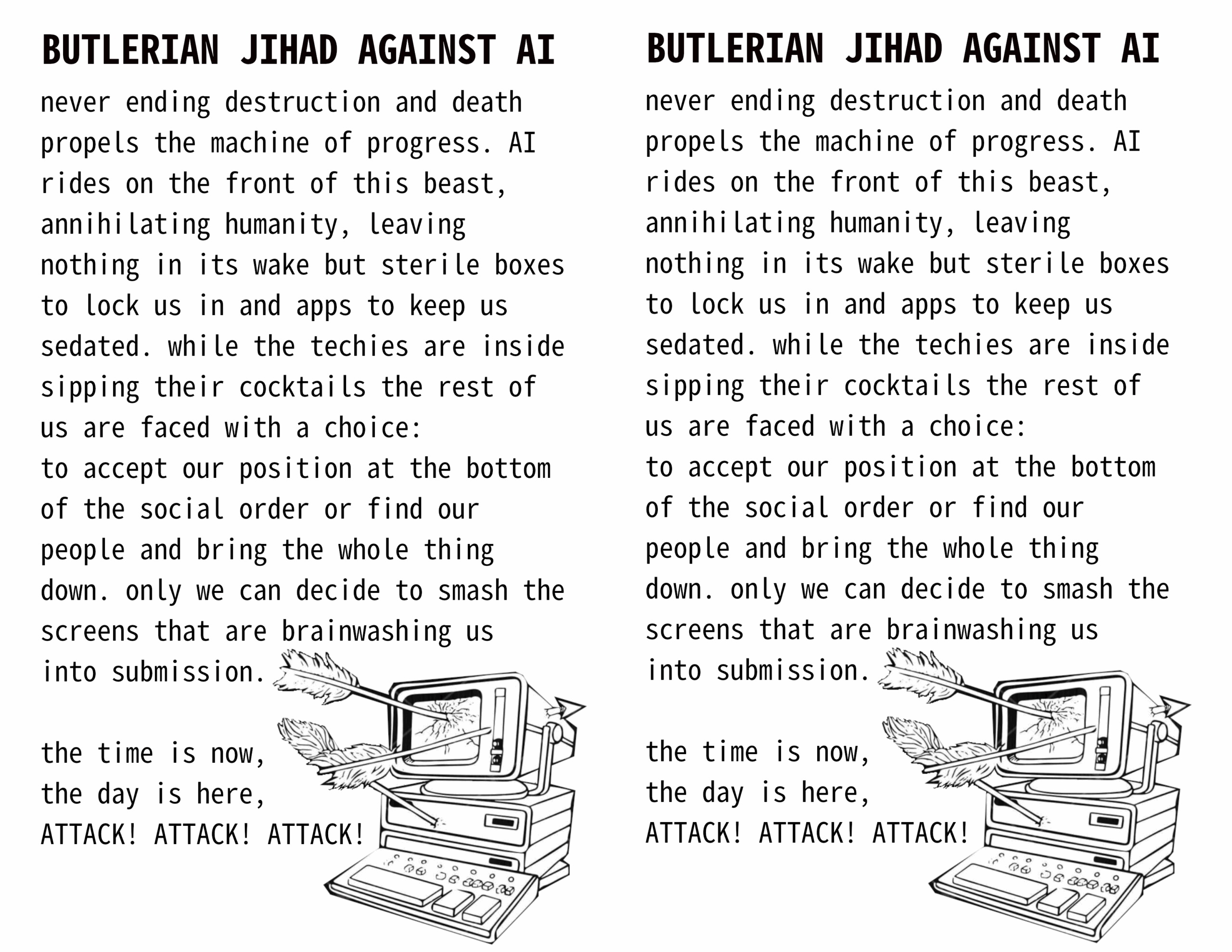
Under a title urging “Butlerian Jihad Against AI” — a reference to a book in the Dune science-fantasy series about humans revolting against their intelligent computer overlords — a post on the Philly Anti-Capitalist blog said “only we can decide to smash the screens that are brainwashing us into submission. The time is now, the day is here, ATTACK! ATTACK! ATTACK!”
The post was unattributed, did not include targets for attack, and included a cartoonish sketch of an old-fashioned computer struck by arrows. Nevertheless, local intelligence analysts appeared to take the threat seriously.
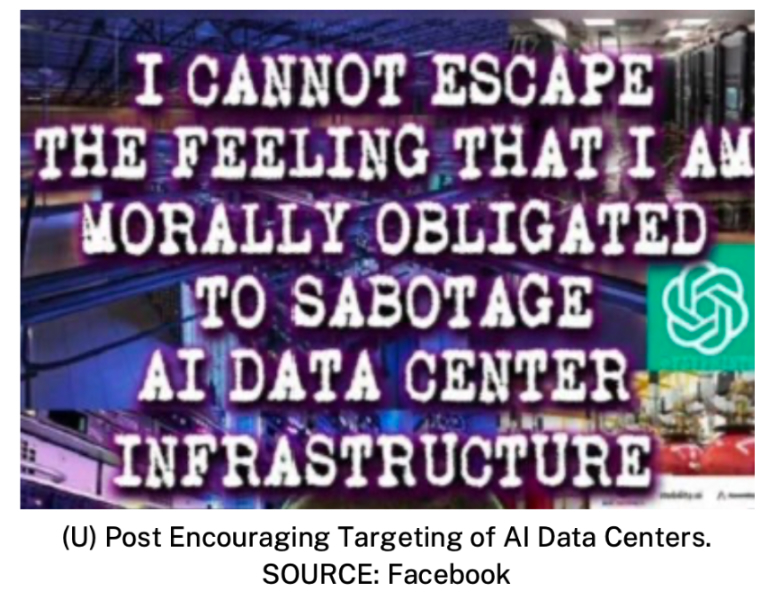
The bulletin also ticked off other signs of anti-data center furor. There was a meme post on shared on a local Facebook account with text reading: “I cannot escape the feeling that I am morally obligated to sabotage AI data center infrastructure.” Commenters on the post had discussed a proposed Amazon data center near Berwick, Pennsylvania, as a “potential target,” according to the report. The Intercept was able to find other versions of this meme posted to Facebook and Instagram unrelated to the targeting of specific, physical data centers.
The fusion center bulletin also said that white supremacists and members of the dark online subculture dubbed “nihilistic violent extremism” by the FBI had agitated online against data centers.
The document also mentioned a DHS report highlighting a thread on an online image board where users discussed using magnets, explosives, or even — in an idea that reflected a sci-fi movie trope — an electromagnetic pulse weapon to take out data centers.
The fusion center analysts appeared to take seriously other rhetoric proposing dramatic attacks. “In addition to general anti-AI data center rhetoric, online users have recently discussed tactics, techniques, and procedures (TTPs) for carrying out attacks varying from simple swatting and hoax threats to property damage, arson, and even the use of chemical, biological, radiological, and nuclear (CBRN) material,” the report said.
“That appears to be an effort by law enforcement to hype up the threat where there may be no threat at all.”
Hetznecker, the civil rights lawyer, said the idea of a nuclear threat raised concerns for him about the quality of the fusion center’s sources and its conclusions.
“That appears to be an effort by law enforcement to hype up the threat where there may be no threat at all,” he said. “To increase scrutiny on First Amendment activities by lumping in those activities with the most extreme, possible scenarios one could imagine that have no factual basis.”
The Philadelphia fusion center report specifically warned authorities of the likelihood that new local data centers could be the target of protest.
“There is potential for significant pushback to the three newly proposed AI data centers in the Philadelphia area. Indicators of an increased threat in the short term may consist of more disruptive First Amendment activity in opposition to AI data centers, small acts of vandalism, online calls for action to boycott and or protest local AI data centers in the Philadelphia area, and extensive criticism of higher utility bills resulting from AI data centers,” the report said.
The mention of boycotts, criticism, and other activities protected by the First Amendment raised red flags for Hetznecker.
“I wouldn’t be surprised if we see heightened law enforcement scrutiny on legitimate expressions of AI data center concerns, and I hope that would not chill the appropriate dialogue that needs to occur on the impact of data centers on local communities,” he said.
Update: June 1, 2026, 11:01 a.m. ET
The article was updated with a statement from the Philadelphia Police Department received after publication.
此内容由惯性聚合(RSS阅读器)自动聚合整理,仅供阅读参考。 原文来自 — 版权归原作者所有。