
惯性聚合 高效追踪和阅读你感兴趣的博客、新闻、科技资讯
阅读原文 在惯性聚合中打开

推荐订阅源

月光博客
月光博客
Cyberwarzone
Cyberwarzone
L
LINUX DO - 最新话题
N
News and Events Feed by Topic
T
Troy Hunt's Blog
Help Net Security
Help Net Security
S
Security @ Cisco Blogs
Google DeepMind News
Security Archives - TechRepublic
M
MIT News - Artificial intelligence
G
Google Developers Blog
Cyber Security Advisories - MS-ISAC
V2EX - 技术
V2EX - 技术
Y
Y Combinator Blog
D
Darknet – Hacking Tools, Hacker News & Cyber Security
大猫的无限游戏
大猫的无限游戏
OSCHINA 社区最新新闻
OSCHINA 社区最新新闻
Microsoft Security Blog
Cisco Talos Blog
Cisco Talos Blog
T
Threatpost
Recent Commits to openclaw:main
S
SegmentFault 最新的问题
I
InfoQ
H
Hacker News: Front Page
D
Docker
Scott Helme
Scott Helme
Threat Intelligence Blog | Flashpoint
Blog — PlanetScale
Blog — PlanetScale
人人都是产品经理
人人都是产品经理
博客园 - 叶小钗
freeCodeCamp Programming Tutorials: Python, JavaScript, Git & More
N
Netflix TechBlog - Medium
AWS News Blog
AWS News Blog
Know Your Adversary
Know Your Adversary
博客园 - 【当耐特】
T
Tor Project blog
U
Unit 42
H
Heimdal Security Blog
Microsoft Azure Blog
K
KPMG report finds enterprise disconnect between AI and its ROI | CIO
P
Privacy & Cybersecurity Law Blog
PCI Perspectives
PCI Perspectives
美团技术团队
O
OpenAI News
T
Tailwind CSS Blog
H
Hackread – Cybersecurity News, Data Breaches, AI and More
B
Blog
GbyAI
GbyAI
cs.CL updates on arXiv.org
MyScale Blog
MyScale Blog

Hacker News - Newest: "AI"

AI can't read an investor deck AI as an attorney? Student uses ChatGPT, Gemini to sue UW over alleged racial discrimination Hacking MCP Servers in AI Systems – The Rug Pull: Tool Changes After Approval GitHub - MeepCastana/KubeezCut: Free Web based video editor GitHub - GenAI-Gurus/awesome-eu-ai-act: Curated tools, official sources, OSS, templates, and guides for EU AI Act compliance. Can AI judge journalism? A Thiel-backed startup says yes, even if it risks chilling whistleblowers Coming soon: 10 Things That Matter in AI Right Now DARPA built an AI to fact-check enemy weapons claims What explains heterogeneity in AI adoption? When AI Meets Muscle: Context-Aware Electrical Stimulation Promises a New Way to Guide Human Movements - Department of Computer Science AI Changed How We Build. It Did Not Change What Matters. Linux rules on using AI-generated code - Copilot is OK, but humans must take 'full responsibility for the… Meta spins up AI version of Mark Zuckerberg to engage with employees Code Mode: Let Your AI Write Programs, Not Just Call Tools | TanStack Blog GitHub - Delavalom/graft: Go framework for building AI agents. Type-safe tools, multi-provider (OpenAI, Anthropic, Gemini, Bedrock), zero vendor SDKs. India's TCS tops estimates, says new AI models did not dent services demand Gen Z's fading AI hype Strong feeling: we are in a folded AI reality GitHub - machinarii/total-recall-catalog: A reference catalog of latest knowledge retrieval, memory & RAG systems GitHub - mensfeld/code-on-incus: Give each AI agent its own isolated machine with root, Docker, and systemd. Active defense detects and stops threats automatically.. Quantization, LoRA, and the 8% Problem: Benchmarking Local LLMs for Production AI Iran war: We spoke to the man making Lego-style AI videos that experts say are powerful propaganda Powell, Bessent discussed Anthropic's Mythos AI cyber threat with major U.S. banks GitHub - immartian/bellamem: Persistent belief-graph memory for AI agents. Retrieves decisive context by importance — not recency, not RAG, not /compact. recursive-mode: The Repo-Native Operating System for AI Engineering After the attack on Sam Altman's home, will AI CEO's go on the offensive? The biggest advance in AI since the LLM Opus 4.6 vs GPT 5.4 One Prompt Unity World Generation Test “AI polls” are fake polls Client Challenge Can AI be a 'child of God'? Inside Anthropic's meeting with Christian leaders How to Switch AI Chatbots and Why You Might Want To GitHub - MattMessinger1/agentic_refund_guardrail: Safe refund policy layer for AI agents — Python + TypeScript. Same behavior, shared tests. Adam/papers/emergent_values_whitepaper.md at master · strangeadvancedmarketing/Adam Ask HN: How do you stop playing 20 questions with your AI coding tools How far can automation and AI support psychotherapy? - @theU GitHub - stagas/rtdiff: realtime git diff gui and AI-assisted commits A Mac Studio for Local AI — 6 Months Later A History of the Early Years of AI at the University of Edinburgh Why AI Coding Tools Still Feel Stuck on Localhost MSN AI Datacenters Are Becoming Strategic Targets twitter.com Penn Researchers Use AI to Surface Unreported GLP-1 Side Effects in Reddit Posts Show HN: MoodSense AI (ML and FastAPI and Gradio, Deployed on Hugging Face) Moodsense Ai - a Hugging Face Space by aman179102 AI models are terrible at betting on soccer—especially xAI Grok GitHub - xialeistudio/echoic GitHub - HimashaHerath/github-dev-wrapped: AI-powered weekly GitHub activity reports deployed to GitHub Pages GitHub - alejandrobalderas/claude-code-from-source: Architecture, patterns & internals of Anthropic's AI coding agent — reverse-engineered from source maps AI and Tech brief: Ireland ascendant GitHub - Titovilal/context0: Context0 - Never Surrender Training for a Marathon with an AI Coach: What Worked and What Didn't Cyber Pulse: Agentic Intel - Apps on Google Play I Built an AI PR Reviewer That Catches Bugs by Not Looking for Bugs Gen Z workers are so fearful AI will take their job they’re intentionally sabotaging their company’s AI rollout | Fortune How AI Is Reimagining the Game of Golf–For Both Players and Courses GitHub - nattergabriel/reseed: A CLI tool for managing and distributing agent skills across projects Is SVG the final frontier? My AI workflow evolved from prompts to a near-autonomous workflow MLSharp Help - 3DGS Viewer & Generator I put my cognitive field based AI's runtime on GitHub Is Numble the first AI-proof game? A3: Kubernetes for autonomous AI agent fleets | Emergent Principles Deepali Vyas ("The Elite Recruiter") GitHub - msmarkgu/RelayFreeLLM: A restful API designed to route user prompts to various AI model providers. Unionized ProPublica staff are on strike over AI, layoffs, and wages Unleashing the Advantage of Quantum AI We're heading for an AI-fueled 'dementia crisis,' brain scientist warns The AI-Assisted Breach of Mexico's Government Infrastructure [pdf] GitHub - stef41/lmscan: 🔍 Detect AI-generated text and fingerprint which LLM wrote it. Open-source GPTZero alternative. Zero dependencies, works offline. MSN GitHub - visionscaper/collabmem: Enabling long-term collaboration with Agentic AI - building up episodic and world model memory over time with in-context awareness We gave an AI a 3 year retail lease in SF and asked it to make a profit | Andon Labs AI Code is Hollowing Out Open Source, and Maintainers are Looking the Other Way What leaked "SteamGPT" files could mean for the PC gaming platform's use of AI AI is the boss at this retail store. What could go wrong? GitHub - Wuzu11517/agentic-proxy: Local proxy meant to help reduce With Drones, Geophysics and ArtificiaI Intelligence, Researchers Prepare to Do Battle Against Land Mines A Single Operator, Two AI Platforms, Nine Government Agencies: The Full Technical Report 在 Steam 上购买 FriedrichAI: Offline AI 立省 10% GitHub - inevolin/resume-cli: Hit Claude usage limits? Resume any AI coding session elsewhere. Switch tools at zero friction. GitHub - atripati/ark: AI Runtime Kernel — a context operating system for AI agents. Eliminates tool bloat, loads only what’s needed, and gives LLMs their reasoning space back. How to Build a Secure AI PR Reviewer with Claude, GitHub Actions, and JavaScript This Startup Wants You to Pay Up to Talk With AI Versions of Human Experts Intel Arc Pro B70 Brings 32GB VRAM to Local AI for $949 WordPress 7.0: The Good, the AI, and the Still Missing AI on the couch: Anthropic gives Claude 20 hours of psychiatry IatroBench: Pre-Registered Evidence of Iatrogenic Harm from AI Safety Measures AI Agents Know About Supabase. They Don't Always Use It Right. The history and future of AI at Google, with Sundar Pichai Inside an AI‑enabled device code phishing campaign How Meta Used AI to Map Tribal Knowledge in Large-Scale Data Pipelines AI for Systems: Using LLMs to Optimize Database Query Execution Forecasting the Economic Effects of AI Introducing Tinker: Play with AI, bring your ideas to life AI sheds light on an ancient gaming mystery People really hate AI but not as much as Iran—or Democrats | Fortune What is an AI Product Engineer? Phoebe Gates wants her $185 million AI startup to succeed with 'no ties to my privilege or my last name': 'I have a chip on my shoulder' | Fortune
Six Numbers from Running 1,500 AI Agents Simultaneously
Amit Limaye · 2026-06-18 · via Hacker News - Newest: "AI"

This is post 4 of a series.

The first three posts in this series built the foundation: Post 1 showed how we rewrite every syscall in a binary at load time so the guest can never bypass the runtime. Post 2 explained why we run with no guest kernel — just a 36KB shim that handles the ~30 syscalls an agent actually needs. Post 3 covered the pool daemon: how VMs are pre-warmed, how connections are pre-established, how the runtime sits in every agent’s path.

Post 4 is later than I’d like. The gap wasn’t writer’s block — it was the work itself. Getting 1,500 VMs to actually run stably, getting the pool daemon to hold TLS sessions under real load, chasing down the snapshot portability bugs that only show up when you move from a dev box to a different CPU family on AWS. This post exists because the system is now stable enough to measure reliably.

This post is what you can do with all of that — what it actually looks like running at scale.

Every number here comes from running 1,500 fully KVM-isolated virtual machines simultaneously on a single AWS c6i.metal. Not containers. Not shared-kernel processes. Each agent in its own VM, with its own hardware isolation boundary.

The question I wanted to answer: what does that actually cost? Memory, latency, throughput — does the isolation model make any of this unmeasurable, or do you pay for it everywhere?

Here’s what the operations dashboard showed.
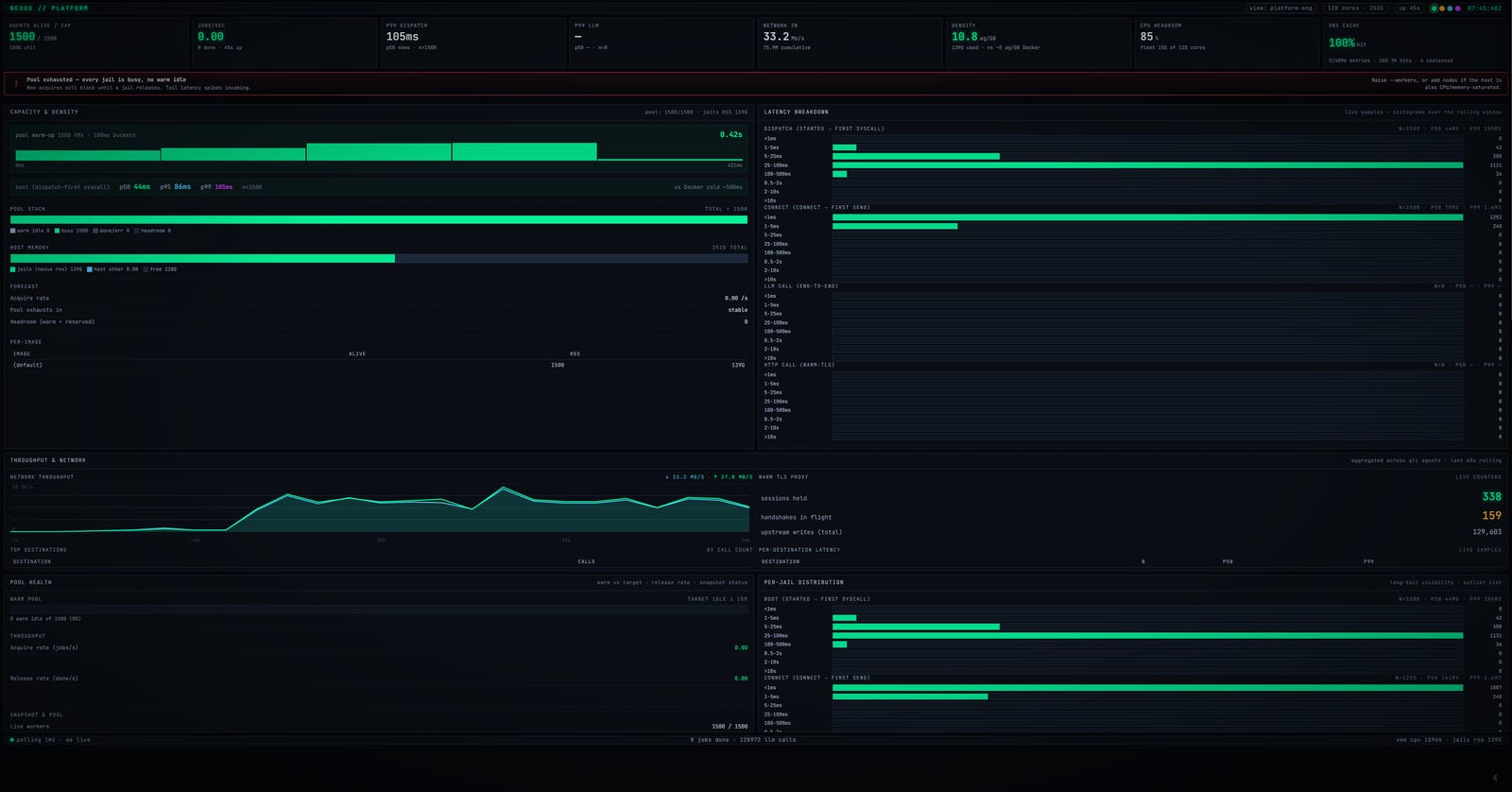
The pool has to be ready before anything else matters.

Warming 1,500 KVM VMs the naive way — fork, exec, boot, import — would take about 200ms per agent run sequentially. Five minutes before the first job runs.

What we do instead: run Python through its full import sequence once, freeze the VM at that point, and save the result as a snapshot. 99MB of non-zero pages — interpreter state, loaded modules, pre-resolved imports. At pool startup, all 1,500 VMs restore from that snapshot in parallel. Physical pages are shared across VMs until an agent writes to one. Each agent pays no import cost.

One thing worth being clear about: this snapshot only includes the Python standard library. User-level imports — anthropic, openai, requests, whatever your agent uses — still happen at agent startup. We could snapshot later in the boot sequence, after those imports, and squeeze the dispatch time down further. The tradeoff is that you’d end up with a different snapshot per agent type rather than one universal Python image shared across the entire fleet. We chose the universal image — 0.42s is fast enough, and one image is operationally simpler.

The bar chart shows how the 1,500 VMs distributed across 100ms time buckets. Most landed in the first two. Total wall time: 0.42 seconds.

We have no guest kernel. The shim is ~36KB. Nothing else.

This is the number I get asked about most.

1,500 KVM-isolated VMs — each making active TLS calls to an LLM API — fit in 139GB of physical RAM. That’s 10.8 agents per GB, not idle, not at rest, but under real load. The figure includes everything an agent accumulates at runtime: Python heap, open TLS sessions, in-flight request buffers, stack frames, syscall state.

The ps RSS reads higher — ~290GB summed across all VMM processes. That number is misleading: the 99MB Python snapshot is shared across all 1,500 workers and RSS accounting counts it once per process, not once per physical page. The 139GB on the dashboard is physical RAM, measured directly from the host.
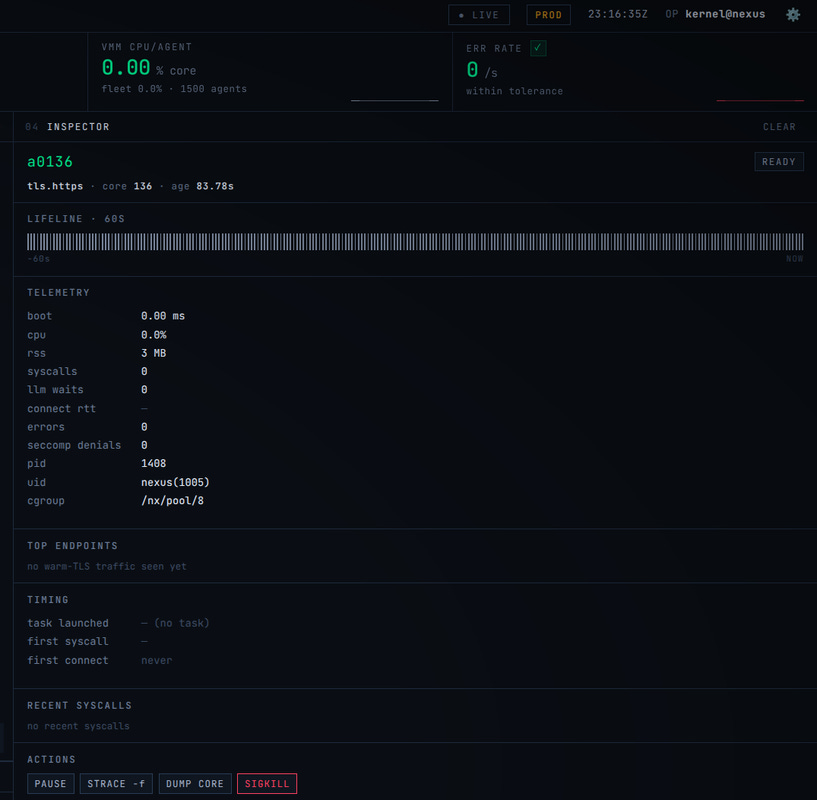
The 10.8 agents/GB is measured under real load. A warm idle VM costs 3MB (above). Your number will fall somewhere between those two depending on what your agents do and how much heap they accumulate at runtime.

A native Linux process gets OS-level DNS caching. Move that process into a VM with its own kernel and you typically lose it — the guest runs its own resolver, makes its own upstream queries, pays its own latency.

Our guests have no kernel. DNS queries exit through the pool daemon, which sits in the path before any UDP packet leaves the host. The pool maintains a shared cache across all 1,500 agents — so each guest gets exactly what a native process gets, and more: a single upstream query serves the entire fleet.

If 50 agents cold-miss the same name simultaneously, one query goes out and all 50 get the answer. The upstream resolver sees one query per name per TTL window, regardless of fleet size.

If you’ve been following the series, this will sound familiar: for anything the pool can’t parse or handle — exotic record types, DNSSEC, anything non-standard — the query falls through to the native Linux stack. The same principle as the syscall design. Fast path for the common case, the real thing as the backstop.

100% hit rate, 260,700 cache hits. In this run all 1,500 agents were hitting the same two endpoints — api.anthropic.com and a local Postman mock — so the cache saturates quickly. In a more diverse fleet the hit rate will be lower, but the coalescing benefit scales with agent count regardless. Isolation didn’t cost the agents their DNS cache — they got a better one.

Agent code is deterministic. The same task hits the network at the same point every time. So the time from dispatch to first network call is almost entirely infrastructure — time the agent spent waiting to be ready, not working.

Dispatch to first syscall:

p50:  44ms
p95:  86ms
p99:  105ms
n:    1,500

Connect to first send (warm TLS):

p50:  70ms
p99:  1.6s
n:    1,500
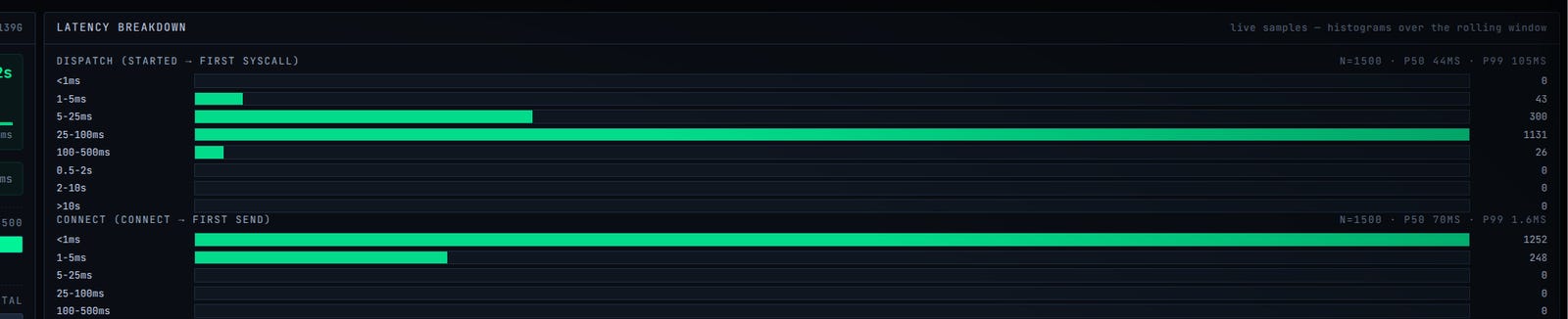
The dispatch number is pure infrastructure overhead — VM resume to first syscall. The connect number is how long until the first byte hits the wire over a pre-established TLS session. The p99 tail on connect reflects agents that hit Anthropic rate limiting before their first send.

At one job the 44ms is noise. At 1,500 agents running continuously, it’s the difference between the infrastructure being measurable or not.

Every HTTPS call normally starts with a TCP handshake (10–50ms) and a TLS handshake (50–150ms). At 1,500 agents all hitting the same endpoint, that’s a lot of latency you pay on every cold connection.

The pool daemon sits in the network path between every agent and every upstream destination — which means it can own the TLS layer too.

At pool startup, the daemon establishes persistent TLS sessions to configured upstream endpoints. When an agent makes an HTTPS request, it writes plaintext into a ring buffer. The daemon handles TLS on its behalf, into an already-established session. No handshake. No round trip.

338 sessions held across the fleet. 1,500 agents sharing 338 upstream connections. The API sees 338 connections. The agents see zero handshake latency.

One thing worth being direct about: the pool daemon reads the plaintext of every agent request. This is intentional — the same seam is what makes policy enforcement, credential injection, and response inspection possible. Whether that’s what you want depends on your threat model. It’s a design choice, not a side effect.

138,972 LLM calls completed at the time of this snapshot — cumulative since pool start, with 1,500 agents each making roughly one call per second.

33.2 MB/s in, 37.0 MB/s out. These numbers move with the fleet — this is a point-in-time snapshot from a live run, not a ceiling. At 1,500 agents the runtime isn’t anywhere near the network limit of a c6i.metal. The constraint here is the LLM API — in our case, Anthropic rate limiting. Agents spend most of their time waiting, not moving bytes.

Put them together and you get the lifecycle of a job on a running KVM fleet:

  1. Pool warms up: 1,500 VMs in 0.42s, fitting in 10.8 agents/GB

  2. Job arrives: 44ms to first network call

  3. Agent resolves endpoint: <1µs DNS cache hit, 0ms TCP (pre-established)

  4. Agent makes HTTPS call: 0ms TLS — 338 sessions held, agent writes plaintext

  5. Response flows back: 33.2 MB/s sustained across the fleet

Each layer works the same way: the runtime is already in the path, so it caches the DNS response, holds the TLS session, shares the snapshot pages. Nothing required a separate system. The same mechanism that enforces isolation is the one doing the optimization.

KVM isolation doesn’t have to mean heavy. These numbers are the evidence.

At 1,500 agents the savings are measurable. At 10,000 they become structural — the difference between needing more machines and not.

The next post covers what becomes possible when the runtime sees every syscall, every DNS query, every TLS session, every model call, across every agent on the host simultaneously.

If you’re running agents in production and any of this is a live problem — reach out on LinkedIn.

Discussion about this post

Ready for more?